Page 1
1.
What are two questions to consider when you address an informational report to people
from other cultures? (Select both answers.)
A)
How will your readers react to your choice of application?
B)
How many years of English classes have your readers had?
C)
How will your readers react to your writing style?
D)
All responses are correct.
E)
None of the responses are correct.
2.
What is the difference between a progress report and a status report?
A)
There is no difference.
B)
A progress report communicates the current status of an ongoing project, whereas a
status report is an update on the entire range of operations of a department or
division of an organization.
C)
A status report communicates the current status of an ongoing project, whereas a
progress report is an update on the entire range of operations of a department or
division of an organization.
D)
A progress report is written for readers outside of the originating organization,
whereas a status report is written for readers within the organization.
3.
Chapter 17 notes that in writing meeting minutes, you should be comprehensive and
clear. According to the chapter, what else should you do? (Select all that apply.)
A)
Be objective.
B)
Record emotional exchanges between participants.
C)
Be diplomatic.
D)
Create a planning document for use in preparing for the group’s next meeting.
4.
What are common formats for written informational reports? Select all that apply.
A)
memos
B)
reports
C)
web pages
D)
emails
E)
All responses are correct.
5.
According to Chapter 17, which two of the following organizational patterns are
frequently used in progress reports? (Select both answers.)
A)
spatial pattern
B)
time pattern
C)
cause-and-effect pattern
D)
task pattern
E)
progression pattern
Page 2
6.
According to Chapter 17, which of the following statements is true?
A)
A status report describes work on a project, whereas a progress report describes
work that is not specific to a particular project
B)
A progress report describes work on a project, whereas a status report describes
work that is not specific to a particular project.
C)
A progress report is for internal audiences, whereas a status report is for external
audiences.
D)
None of the responses are correct.
7.
Which of these is NOT a typical field report as described by Chapter 17?
A)
a report on a visit to a potential building site for an office for a client
B)
a report on maintenance performed on a broken piece of machinery in a shop
C)
a report on an inspection conducted at a customer’s site
D)
a report on an experiment conducted in your company’s laboratory
8.
Why is it important to be honest in an informational report when you have to share bad
news?
A)
Failure to be honest in the short term could lead to more problems in the long term.
B)
Being honest is the ethical thing to do.
C)
Sponsors or supervisors of a project have a right to know what is going on.
D)
All responses are correct.
9.
Which of the following statements best describes a progress report?
A)
A progress report is an initial document that helps establish a project.
B)
A progress report is an intermediate document produced while a project is ongoing.
C)
A progress report is a summative document produced at the conclusion of a project.
D)
None of the responses are correct.
10.
A writer in the research division of Radworth Pharmaceutical, Inc. is preparing a
monthly progress report on the development of a new drug. What is the best way to
organize the body of the report?
A)
by time
B)
from most-important to least-important accomplishments
C)
by task
D)
based on the budget allocated for the project
Page 3
11.
You have been sent by your employer, Madison Construction Company, to a regional
conference dealing with ways to improve communication between management and
workers in the field. Which of the following would NOT be an acceptable way to submit
an informational report on your trip?
A)
discussing the trip in your next status report
B)
issuing a directive
C)
writing a one-page trip-report memo
D)
filling out the company’s standardized trip form
12.
Which of the following statements is NOT true?
A)
Progress reports are similar to, but not identical to, status reports.
B)
Correctly written meeting minutes record everything that occurs at the meeting.
C)
Field reports may conclude with suggestions for future action.
D)
Incident reports are appropriate for describing accidents that occur in the
workplace.
13.
According to Chapter 17, field reports “explain problems, methods, results, and
conclusions, but they deemphasize methods and can include recommendations.” What
does it mean to deemphasize methods?
A)
Spend less effort describing how you did the research and more effort on what you
learned from it.
B)
Write fewer words describing how you did the research and more words on what
you learned from it.
C)
Always make sure that your methods section is not the first section.
D)
None of the responses are correct.
14.
You are an independent contractor. The due date for your current project falls fairly
close to your vacation, which means you are going to miss a deadline to deliver some
work to your client. Which of the following statements in a progress report sent before
your deadline is most ethical?
A)
I anticipate meeting the deadline.
B)
Against my protestations, the project manager pressured me to accept an overly
aggressive schedule.
C)
I did not realize how much my vacation would affect my work hours. I might need
1–2 extra days to complete everything.
D)
I have never missed a deadline with a client.
Page 4
15.
According to Chapter 17, which of the following is NOT a typical informational report?
A)
an incident report about the response of your company’s security team to an
unauthorized visitor on your property
B)
a proposal to study why a piece of your company’s machinery failed at a customer’s
site
C)
a directive about where employees should park while a construction crew will be
blocking some parking spaces
D)
meeting minutes recording decisions reached during a committee meeting
16.
According to Chapter 17, you should be “clear, comprehensive, objective, and
diplomatic” when writing meeting minutes. Which two of these ideal goals have the
greatest potential to conflict with each other?
A)
clarity and comprehensiveness
B)
comprehensiveness and objectivity
C)
objectivity and diplomacy
D)
comprehensiveness and diplomacy
17.
In general, why would someone need to write an incident report?
A)
Readers have followed the guidelines established in a recent directive.
B)
Something unexpected happened, and the results are good news.
C)
Work on a project has been completed.
D)
Something unexpected happened, and the results are bad news.
18.
According to Chapter 17, which of the options below is NOT an advantage of using a
commercial template to record meeting minutes?
A)
The note taker can enter the notes directly into his or her computer rather than
typing up written notes afterward.
B)
The form prompts the note taker to enter information he or she might have
otherwise overlooked.
C)
The template automatically distributes the minutes to all meeting attendees.
D)
Because the template is a table, readers quickly become accustomed to reading it
and locating the information they need.
19.
Which of these is NOT an important question to answer when writing an incident
report?
A)
What happened?
B)
Whose camera recorded the incident?
C)
Why did the incident happen?
D)
What should be done in response to this incident?
Page 5
20.
Which of the following people would be most likely to organize a progress or status
report according to task? (Select all answers that apply.)
A)
a salesperson responsible for selling medical devices in a two-state area
B)
a project manager overseeing the implementation of new software throughout your
company
C)
an engineer developing a new industrial ceramic compound for a client
D)
All responses are correct.
21.
A field report explains a problem, methods, results, and conclusions, but it
deemphasizes the methods and can include recommendations.
A)
True
B)
False
22.
A directive should include the reasoning behind a new policy or procedure so that
readers will be persuaded that the new policy or procedure is desirable or at least
necessary.
A)
True
B)
False
23.
A status report is usually organized according to task.
A)
True
B)
False
24.
A directive is an informational document, not a persuasive one.
A)
True
B)
False
25.
Whether you have good news or bad news to share, it is important to keep a
professional, measured tone in an informational report.
A)
True
B)
False
26.
It is appropriate to use a defensive tone in an informational report if something has not
happened according to plan.
A)
True
B)
False
Page 6
27.
It is not appropriate to add appendixes to informational reports.
A)
True
B)
False
28.
In writing a set of meeting minutes, you should interpret the events of the meeting for
your readers.
A)
True
B)
False
29.
When you are recording meeting minutes and an argument arises, you should record
both the argument and its outcome in order to ensure comprehensiveness.
A)
True
B)
False
30.
The primary purpose of a directive is to direct the reader to additional sources of
information.
A)
True
B)
False
31.
According to Chapter 17, what is the common goal of all informational reports?
32.
What are the five basic formats for informational reports discussed in Chapter 17?
33.
According to Chapter 17, what is the primary purpose of a directive?
34.
According to Chapter 17, what does an incident report describe?
35.
According to Chapter 17, what is the primary purpose of a field report?
36.
Identify three of the issues you should be sure to address in a field report?
37.
According to Chapter 17, what are the two organizational patterns frequently used in
progress reports?
Page 7
38.
How can you ensure that readers can easily find any appendixes you create for a report?
39.
What course of action should you take if you find that you will not be able to meet your
original deadline for delivery of a report?
40.
What is another name for a status report?
Page 8
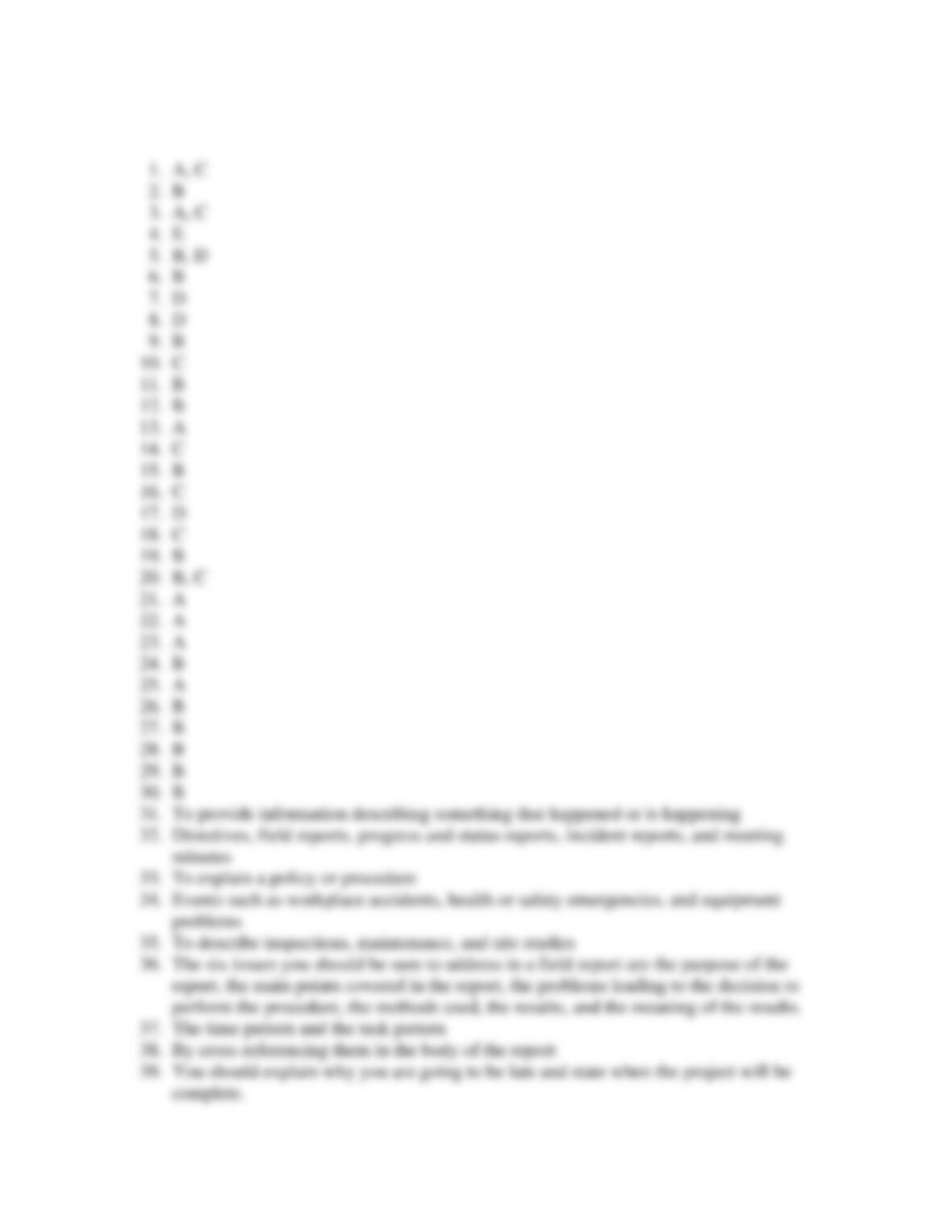
Answer Key

Page 9