45) The letter of transmittal says what you would say if you were handing the report directly to
someone.
46) The letter of transmittal should always use the indirect approach, especially if the report is an
analytical one.
47) If a report does not have a synopsis, the letter of transmittal can be used to summarize the
major findings, conclusions, and recommendations.
48) The table of contents should always include all levels of headings for the report.
49) A synopsis of a 15-page report should usually be at least four pages long.
50) For reports organized in the indirect approach, you should use an informative synopsis
instead of a descriptive one.
51) A synopsis is generally more comprehensive than an executive summary.
52) Unlike a synopsis, an executive summary may contain headings and visual elements.
53) Many reports, especially short ones, require neither a synopsis nor an executive summary.
54) The introduction to a formal business report should always exist as a separate section.
55) The introduction is a good place to tell readers why they should be concerned with your
topic.
56) Reports do not need an introduction if they have a synopsis and a letter of transmittal.
57) The close of a report may be called the “Summary” or “Conclusions and Recommendations.”
58) In reports that are intended to lead to action, the recommendations section may be fairly
extensive because it spells out exactly what should happen next.
59) The most common supplementary parts to include in a formal report are the appendix, the
bibliography, and the index.
60) Acknowledging sources in the body of a report is appropriate for academic work, but never
in business.
61) An index is necessary only if your report is going to be published.
62) Proposals addressed to external audiences, including potential customers and investors, are
nearly always formal.
63) The components of a formal proposal are entirely different from those of other formal
reports.
64) Most proposals have few supplementary parts.
65) A synopsis or executive summary is usually less useful in a formal proposal than in other
types of formal reports.
66) If a proposal is unsolicited, the letter of transmittal should follow the format for persuasive
messages.
67) The close of a formal proposal emphasizes the benefits that readers will realize from your
solution.
68) When you proofread the text part of a report, you should essentially look for the same types
of mistakes as you would look for in any business message.
69) By the time you are ready to check visual elements in the completing step for formal reports,
you can normally assume that all the data are correct.
70) After sending your report, you should wait at least six weeks before contacting the audience
if you don’t receive a response.
71) The three categories of report components are ________ parts, ________ parts, and the
supplementary parts.
72) The cover, title page, and table of contents are among the ________ parts of a formal report.
73) The ________ ________ is a single sheet of paper with only the title of the report on it.
74) A letter of ________ is a written acknowledgment of the letter of authorization.
75) The letter of ________ conveys the essence of the report to the readers in a manner that can
be less formal than the rest of the report.
76) A(n) ________ synopsis presents the main points of a report in the order in which they
appear in the text.
77) A(n) ________ synopsis simply tells what the report is about.
78) A(n) ________ ________ is a fully developed “mini” version of the report itself.
79) The writer’s analysis, logic, and interpretation of the information are usually included in the
________ of the report.
80) A bibliography and an index are the ________ parts of a formal report.
81) A(n) ________ contains materials that are too lengthy or too bulky to include in the main
body of a report.
82) A(n) ________ is a list of secondary sources consulted when preparing a report.
83) Instead of a letter of authorization, solicited proposals refer to the ________ issued by the
client.
84) In an unsolicited proposal, the letter of transmittal follows the pattern for ________
messages.
85) The ________ section is your last opportunity to urge readers to act on your proposal.
86) List at least three factors that can help you decide what parts to include in a business report.
87) What is one advantage of starting each section of your report on a separate page?
88) Describe the primary function of the letter of transmittal.
89) When should you include a separate list of illustrations with your report?
90) Briefly explain the difference between a synopsis and an executive summary.
91) Briefly explain the difference between an informative synopsis and a descriptive synopsis.
92) What three main parts make up the text of a report?
93) List at least three types of materials commonly included in appendixes.
94) Briefly explain how the components of a formal proposal often differ from those of other
formal reports.
95) List at least three elements normally included in the body of a formal proposal.
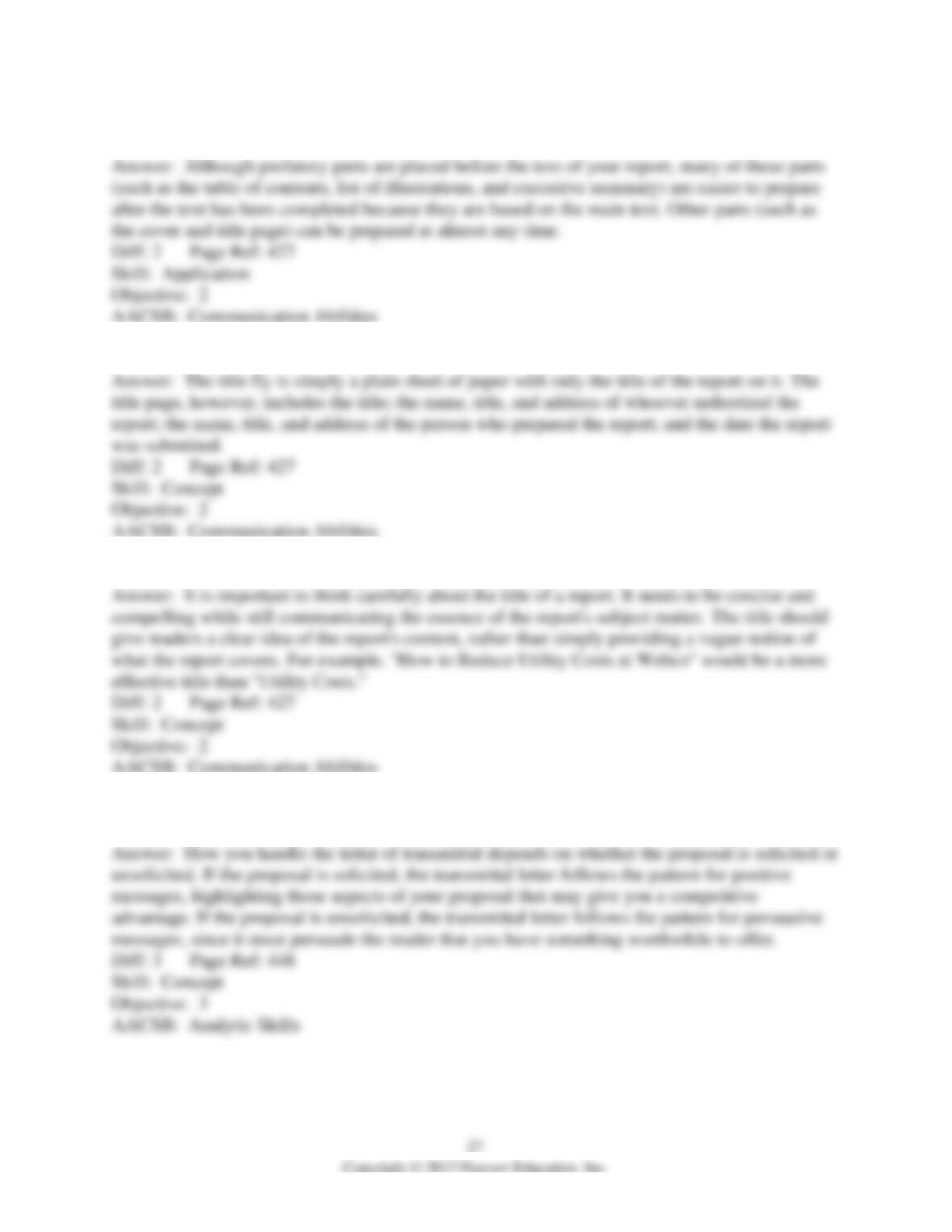
96) Explain why it is generally best to prepare the prefatory parts of your report after you’ve
written the text.
97) Explain the difference between a title fly and a title page.
98) What considerations should guide you when selecting an effective title for your report?
99) In a formal proposal, how do you determine the organizational approach to use in the letter
of transmittal?
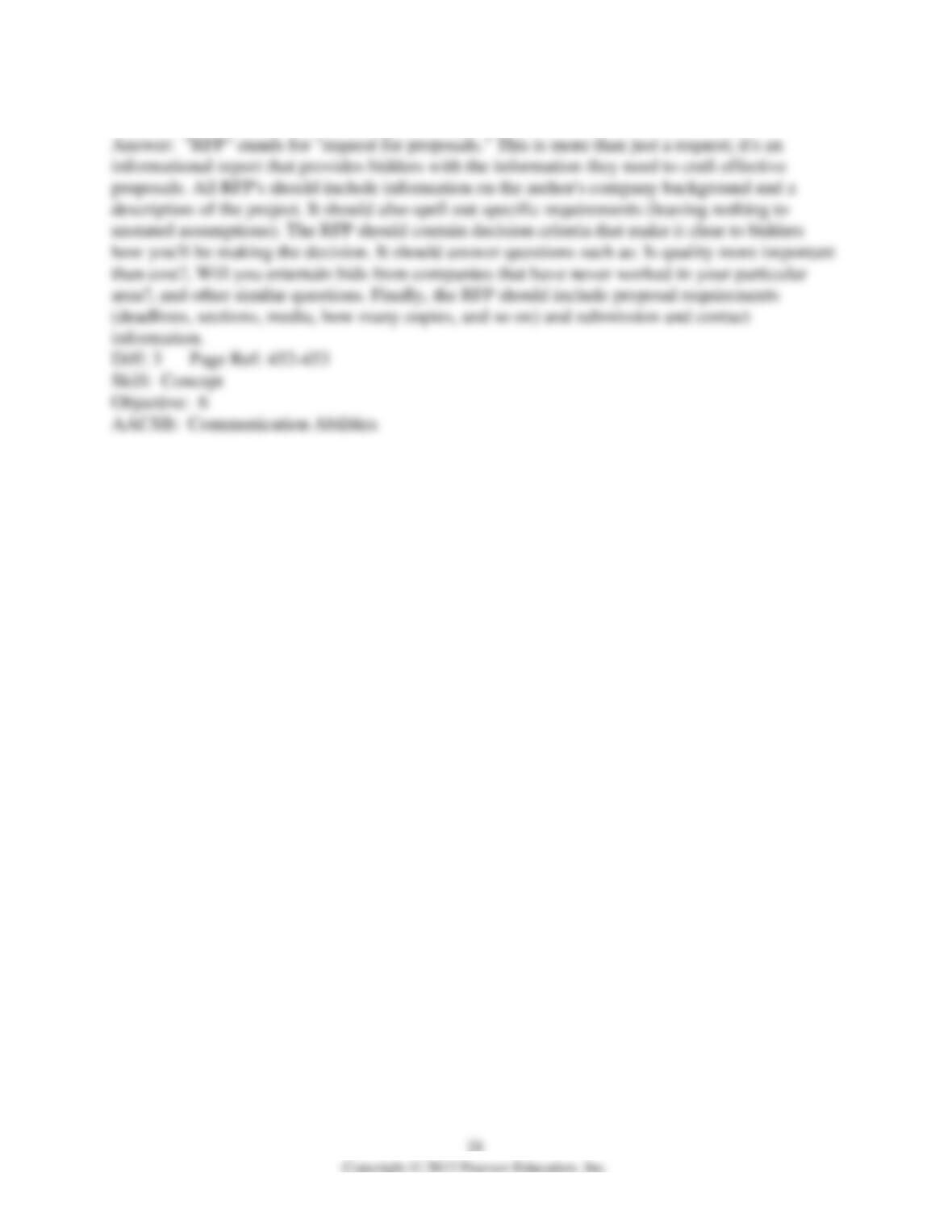
100) Define “RFP” and discuss its typical components.