Page 1
1.
When it appears in a letter, memo, or email, what does the symbol “c” stand for?
A)
confidential
B)
contract
C)
copy
D)
correspondence
2.
Chapter 14 describes two common letter formats. One is modified block. What is the
other format?
A)
full block style
B)
modified block with enhanced formatting
C)
simplified block
D)
full-justified block
3.
According to Chapter 14, three elements are always found at the top of the second and
subsequent pages of a memo. One is the page number. What are the other two? (Select
both answers.)
A)
the writer’s contact information
B)
the date of the memo
C)
the attention line
D)
the name of the recipient
4.
Which of the following best defines writing that projects the “you attitude”?
A)
writing that clearly sets the responsibility for a problem on the reader
B)
writing with the kind of tone and style that you would prefer in a letter you receive
C)
writing that conveys defensiveness and self-protection
D)
writing that addresses the reader as “you”
5.
According to Chapter 14, which of the following is NOT a guideline for effective
on-the-job microblogging?
A)
Sound like a person.
B)
Apologize when you make a mistake.
C)
Regard your followers as a market for your company’s products and services.
D)
Learn the technology.
6.
Which of the following is NOT a means of adhering to netiquette guidelines?
A)
Avoid dispensing harsh criticism.
B)
Take a friendly, casual tone.
C)
Keep messages brief.
D)
Avoid forwarding a message to online forums without obtaining the writer’s
permission.
Page 2
7.
Which of the following statements is true?
A)
Memos are commonly written to people outside your own organization.
B)
Memos are commonly written to people within your own organization.
C)
Memos are a highly formal type of workplace correspondence.
D)
Memos should not contain content with section headings.
8.
A writer working for the state department of agriculture wishes to educate farmers
statewide about upcoming changes in irrigation policies. Which of the following types
of communication would be most effective?
A)
memo
B)
email
C)
letter
D)
fax
9.
A small manufacturer of computer games discovers an error in the instructions shipped
with the latest product. A writer at the company has been asked to write a letter to recent
purchasers of the product explaining the correct information and apologizing for the
mistake. Which of the following elements would NOT appropriately be included in this
letter?
A)
blind-copy notation
B)
a heading
C)
a subject line
D)
a discount offer on another product

Page 3
10.
A writing team regularly uses email to coordinate projects and to maintain a friendly,
collaborative work environment. Which of the flaws listed below does the following
email exhibit? (Select all that apply.)
To: Documentation Department
Subject: Status of Trace Instrument’s Consulting Project
<snip>
> It would be nice to know the status of the Trace project so I can
> plan my summer hours with some accuracy.
<snip>
I understand that the uncertainty with the Trace Instrument’s project is causing some
scheduling nightmares. I want to briefly update you.
The project smaller than we first thought. Initially it seemed like a cast of thousands
would be involved. However, the company will pay for only three of us. Steve, Ming,
and Stacy will work on the project. While you may be disappointed, I’m sure some “cost
overruns” by the team will teach Trace Instruments a lesson
I have your name and will contract you if the project grows.
Wilma Vogel
A)
The writer failed to proofread the message before sending.
B)
The writer failed to understand the permanent nature of email messages.
C)
The writer wasted bandwidth by quoting an earlier message.
D)
The writer flamed the writer of an earlier message.
11.
According to Chapter 14, which of the correspondence types below is generally
considered the least formal?
A)
letters
B)
email
C)
memos
D)
microblogs
12.
You are writing a research paper on the hydrological impacts of hydraulic fracturing, or
fracking, on groundwater in your state. In your research, you have found that a professor
at a university in another state, Dr. Thomas Henry Wright, has conducted similar
research. You decide to write an inquiry letter to ask him some questions. Which
salutation is most appropriate for your letter?
A)
Dear Tom:
B)
Dear Thomas Henry Wright:
C)
Dear Dr. Wright:
D)
Dear Professor:
Page 4
13.
How might a business letter to someone from a very different culture differ from a
business letter to someone from your own culture?
A)
in the salutation
B)
in the tone
C)
in the level of specificity of the information
D)
All responses are correct.
14.
You are one of four people on a search committee interviewing candidates for a
marketing manager position in your department. The Human Resources (HR)
department has asked each person on the committee to provide feedback after every
interview. The candidate you interviewed this afternoon, Mr. Zoolander, did not seem at
ease, and you were disappointed in several of his responses to questions. Which passage
would be best to include in your email to the HR department?
A)
I was disappointed with several of Mr. Zoolander’s responses to our questions. He
did not show that he had thought deeply about the issues our department is facing.
B)
Zoolander is a no-go. Kind of a bug-eyed weirdo if you ask me.
C)
Zoolander almost blew a gasket when I asked him for a specific example of his
leadership. And he went to that college on the other side of the state? That’s all you
need to know right there.
D)
Mr. Zoolander presents a curious case for this committee. I think his nervousness
belies his enthusiasm for the position, but one cannot be too sure. I find myself in a
position of ambivalence.
15.
Your company intends to open a new office on the other side of the country. The goal is
to expand the company’s operations and move into some newer, more exclusive
markets. This is a major step for the company, and you want your shareholders to be
impressed. Which type of correspondence should you use to communicate with your
shareholders?
A)
memo
B)
letter
C)
email
D)
microblog post
16.
Which of the following statements is true?
A)
Clichés make your writing shorter and more efficient.
B)
Clichés are a good way to write with the “you attitude.”
C)
Clichés give your writing a stilted tone.
D)
Clichés give your writing a contemporary touch.
Page 5
17.
What does it mean to “link generously” when posting to a microblog at work?
A)
Post links to websites and articles that are relevant to a subject you are discussing
online.
B)
Post links to as many online articles about your company as possible.
C)
Post links for opportunities to give to charities.
D)
Post links to a competitor’s website after each link to your own company’s
information.
18.
In what situation should you use an attention line in a letter?
A)
You hope your letter will attract the reader’s attention.
B)
You want to convey a sense of urgency.
C)
You do not know the name of a specific person at the company you are writing to,
so you do not know who will read the letter.
D)
You want to identify the subject of your letter.
19.
Which of the following can be an unintended consequence of posting an informal
social-media message?
A)
trading multiple public insults after starting an online “flame war”
B)
embarrassing the company
C)
making a hasty, bold statement about your company that later turns out to be untrue
D)
All responses are correct.
20.
Why is it important to communicate honestly, no matter what type of document you
create?
A)
To be ethical you must be honest and avoid misleading people.
B)
Dishonest communication can lead customers to take their business elsewhere.
C)
Honesty projects a “you attitude” toward your reader.
D)
All responses are correct.
21.
Email is usually archived digitally (backed up in some way).
A)
True
B)
False
22.
A salutation is a greeting at the beginning of a letter, traditionally consisting of the word
“Dear,” the reader’s courtesy title and last name, and a colon.
A)
True
B)
False
Page 6
23.
The number following an enclosure notation at the bottom of a letter indicates the
number of sheets of paper enclosed with the letter.
A)
True
B)
False
24.
Twitter tweets and Facebook posts are forms of business correspondence.
A)
True
B)
False
25.
The terms letter and memo are interchangeable.
A)
True
B)
False
26.
One disadvantage of correspondence clichés is that they can be hard to understand.
A)
True
B)
False
27.
Generally speaking, the netiquette guidelines that apply to microblog posts do not apply
to email.
A)
True
B)
False
28.
In some cultures, a person is more likely to walk down the hall to deliver a brief
message than to send an email, because doing so shows more respect.
A)
True
B)
False
29.
In a bad-news adjustment letter, there is no sense trying to salvage goodwill; the reader
is so angry that he or she will never do business with you again.
A)
True
B)
False
30.
According to Chapter 14, it is inappropriate to use headings in informal documents such
as memos or email.
A)
True
B)
False
Page 7
31.
Provide an example of a letter cliché.
32.
Provide an example of a salutation.
33.
What does the notation “cc” stand for in a letter, memo, or email?
34.
Chapter 14 describes two common letter formats. One is modified block. What is the
other format described in the chapter?
35.
Chapter 14 offers several guidelines for writing inquiry letters. One is to explain who
you are and why you are writing. What is another guideline?
36.
According to Chapter 14, three elements are nearly always found at the top of the
second and subsequent pages of a memo. One is the page number. What are the other
two elements?
37.
What is flaming?
38.
What do you call a letter in which you respond to a claim and tell the author how you
plan to handle the situation described in the letter?
39.
What types of incidents and developments related to your organization should be the
subject of posts on a company-sponsored microblog?
40.
Chapter 14 states two reasons language errors in correspondence are unprofessional.
One is that they suggest a lack of respect for your reader and for yourself. What is the
other reason?
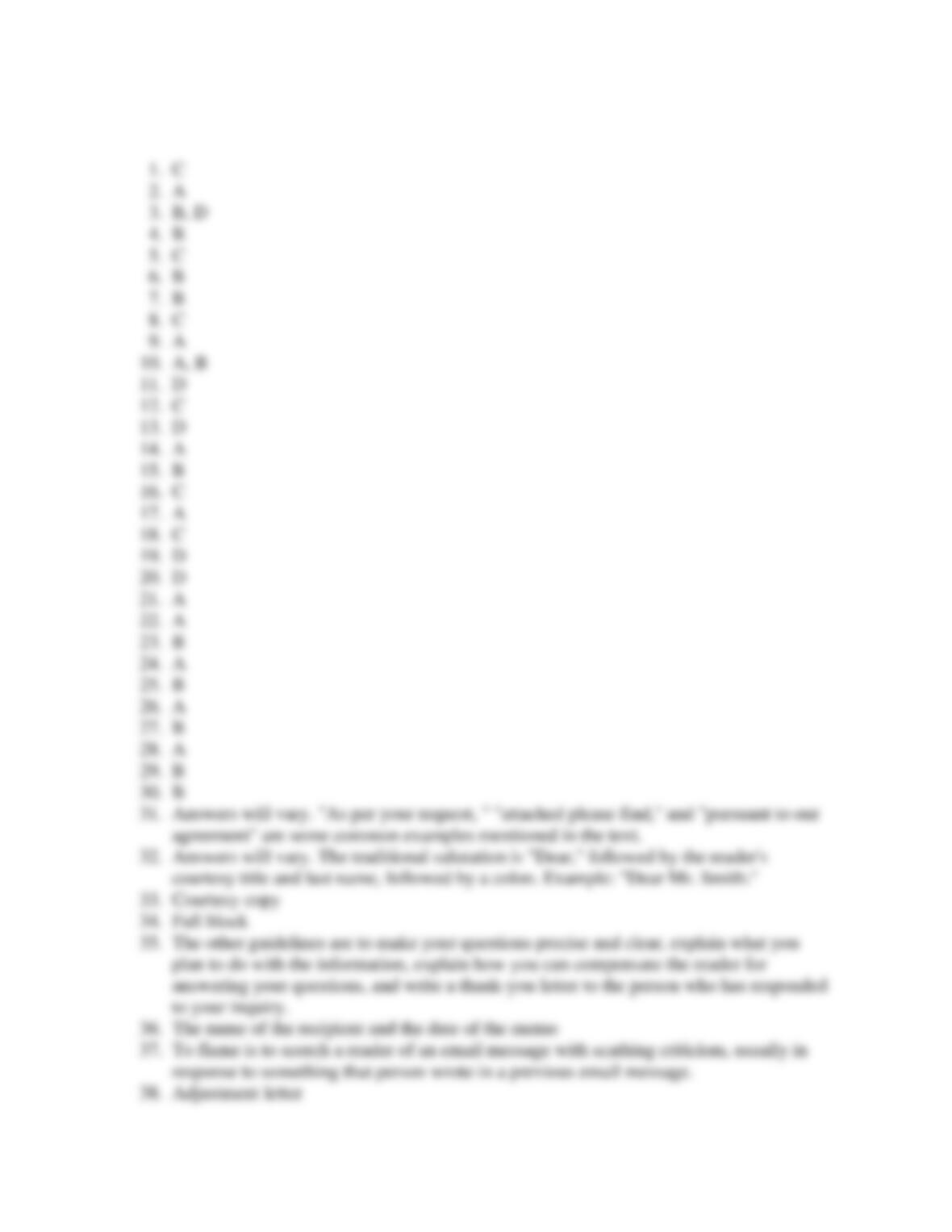
Page 8
Answer Key

Page 9