
In a competitive market, the market demand is Qd = 60 – 6P and the market supply is Q
= 4P. A price ceiling of $3 will result in a
A. shortage of 30 units.
B. shortage of 15 units.
C. surplus of 30 units.
D. surplus of 12 units.
Which of the following is the incorrect statement?
A. The marginal benefits curve is the slope of the total benefits curve.
B. dB(Q)/dQ = MB.
C. The slope of the net benefit curve is vertical where MB = MC.
D. The vertical difference between the total benefit curve and the total cost curve is
maximized at the optimal level of Q.
Suppose that consumers preferences are well behaved in that properties 4-1 to 4-4 are
satisfied. Furthermore, assume that X is a normal good, Y is an inferior good, and the
price of good Y increases. Then, which of the following effects is known with certainty?
A. The income and substitution effects reinforce one another, leading to an overall
decrease in the consumption of good X.
B. The income and substitution effects will reinforce one another, leading to an overall

increase in the consumption of good Y.
C. The income and substitution effects will reinforce one another, leading to an overall
increase in the consumption of good X.
D. The income and substitution effects will have competing effects, leading to an
indeterminate impact on the consumption of good Y.
Producer surplus is measured as the area
A. below the demand curve and above the market price.
B. above the demand curve and below the market price.
C. above the supply curve and below the market price.
D. below the supply curve and above the market price.
Suppose the supply curve for a product is given by and
, .
a. How much X is produced?
b. What is the inverse supply curve for X given the above information?
c. Graph this supply curve.
d. Show what happens to this supply curve if the price of Z goes up by $10.
A risk-neutral monopoly must set output before it knows the market price. There is a 50
percent chance the firms demand curve will be P = 20 – Q and a 50 percent chance it
will be P = 40 – Q. The marginal cost of the firm is MC = Q. What is the expression for
the expected marginal revenue function?
A. E(MR) = 20 – 2Q
B. E(MR) = 30 – 2Q
C. E(MR) = 40 – 2Q

D. E(MR) = 50 – 2Q
Which of the following is true?
A. A Nash equilibrium is always perfect.
B. A perfect equilibrium is always Nash.
C. A Nash equilibrium is always perfect in a multistage game.
D. Perfect equilibrium and Nash equilibrium are the same concept but with different
names.
Refer to the game.
Which of the following pairs of strategies constitute a Nash equilibrium of the game?
A. S1, t1
B. S1, t2
C. S2, t1
D. S1, t2 and S2, t1

Suppose the production function is given by Q = 2K + 5L. What is the marginal product
of labor when 15 units of capital and 10 units of labor are employed?
A. 2
B. 5
C. 25
D. 50
The HHI of a local market is usually _____________ that of national markets.
A. lower than
B. the same as
C. higher than
D. twice
Generally when calculating profits as total revenue minus total costs, accounting profits

are larger than economic profits because economists take into account:
A. only explicit costs.
B. only implicit costs.
C. both explicit and implicit costs.
D. Both types of profits are always equal because they account for the same costs.
A Lerner index of 0 suggests:
A. monopoly.
B. monopolistic competition.
C. oligopoly.
D. perfect competition.
Which of the following are quantity-setting oligopoly models?
A. Stackelberg.
B. Cournot.
C. Bertrand.
D. Stackelberg and Cournot.

Suppose the market demand for good X is given by QX
d = 20 – 2PX. If the equilibrium
price of X is $5 per unit then consumers expenditure on X is
A. $5.
B. $25.
C. $50.
D. cannot be determined from the information contained in the question.
Suppose that there are two industries, A and B. There are five firms in industry A with
sales at $5 million, $2 million, $1 million, $1 million, and $1 million, respectively.
There are four firms in industry B with equal sales of $2.5 million for each firm. The
four-firm concentration ratio for industry A is:
A. 0.9
B. 1.0
C. 0.8
D. 0.7
You are an aide for the Senate Banking Committee Chairman. He comes to you with a
bill that proposes setting limits on what ATM owners can charge nonaccount holders,
over and above what banks charge their own customers. Currently, large banks charge
noncustomers an average fee of $1.35 per transaction in addition to the fees the
customers own bank imposes. The Senator asks you to look at a proposal that would
place a $0.50 cap on the fees ATM owners can charge noncustomer for accessing their
money. If this legislation is enacted, what would be the likely effects?
Star Computer and a small telecommunications company are considering a merger. A
socially minded member of Star Computers board of directors is against the merger,
however, because she is concerned that the merger might not benefit society as a whole.
Provide the board member with an argument for why it may be socially beneficial for
the merger to take place.
Borris Industries operates in an industry that has a Rothschild index of 0.75. The firm
gained access to a government report that revealed the own-price elasticity of market
demand within the industry to be -3. Use this information to obtain an estimate of the
own-price elasticity of demand for the product produced by Borris Industries.
You are the manager of a new computer company that manufactures PCs to order.
Devise a plan that will convince potential customers your quality is the best in the
business.
The widget industry is comprised of six firms of varying sizes. Firm 1 has 35 percent of
the market. Firm 2 has 25 percent, and the remaining firms have 10 percent each. What
is the Herfindahl-Hirschman index for the widget industry? Based on the U.S.
Department of Justice merger guidelines described in the text, do you think the Justice
Department would be likely to block a merger between firms 5 and 6?
In the 1990s Japan reduced its exports of automobiles to the United States by 28
percent. If you were the manager of a Buick dealership, how would this affect your
pricing strategy? Explain.
“Guaranteed issue” is a controversial topic in the insurance market. It requires firms
offering health coverage for one employee to offer the same coverage to all employees,
regardless of their health risks. Why is this so controversial?
Airlines give away millions of tickets each year through their frequent flyer programs,
with the typical airline awarding a free ticket for each 25,000 miles flown on the airline.
The average airline ticket costs $500 and is for a 2,500-mile round trip. Given this
information, evaluate the following statement: Airlines could have the same effect on
demand by eliminating their frequent flyer programs and simply lowering the average
ticket price by 10 percent.
During the recession in the early 1990s, retailers observed that consumers were
spending a lot more time searching for good bargains than ever before, which led the
retailers to lower prices. Why?
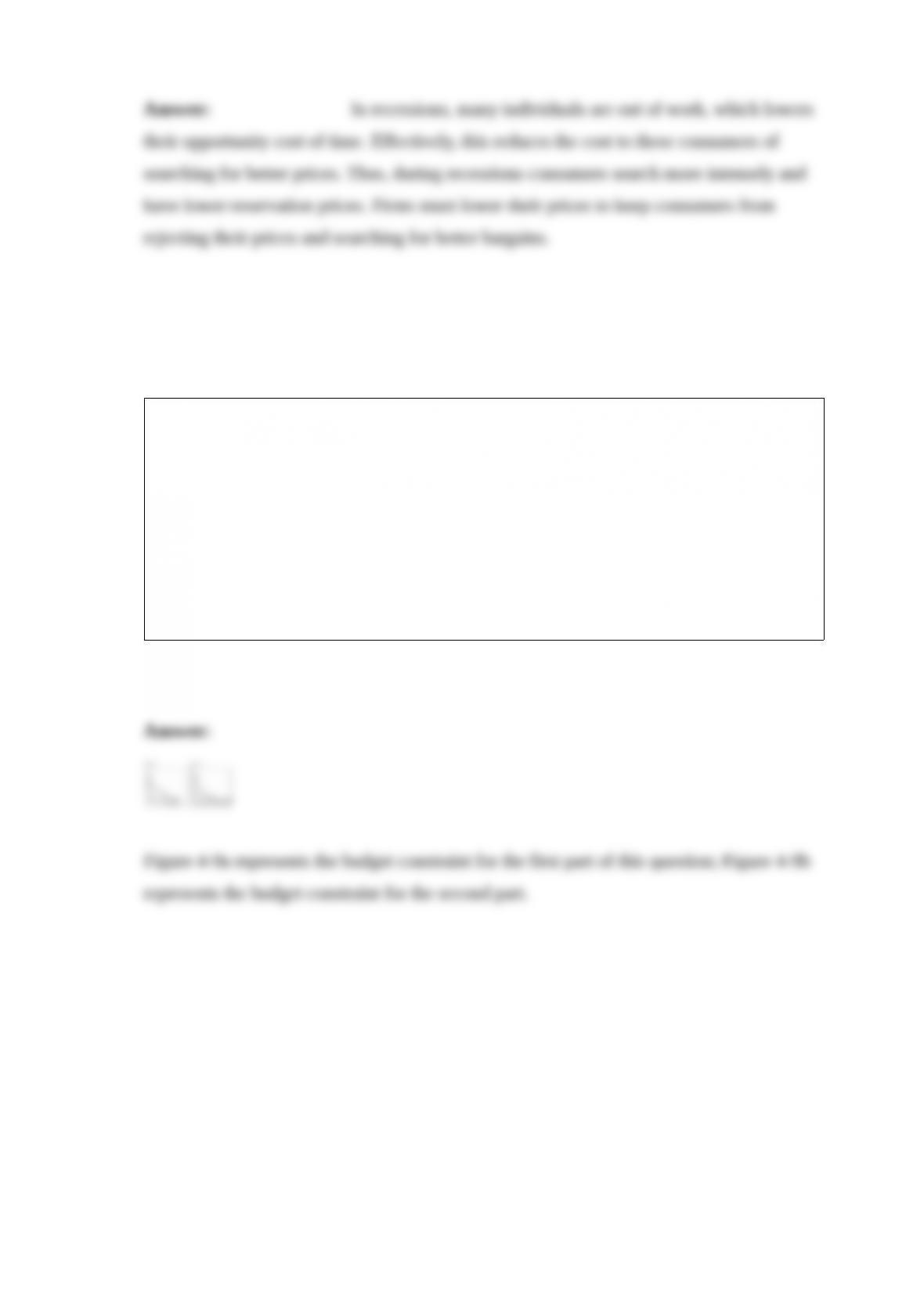
In order to encourage energy conservation, many public utility companies charge
consumers a higher rate on units of electricity consumed in excess of some threshold
amount. In contrast, a common marketing ploy by other firms is to offer “quantity
discounts” to consumers who purchase large quantities of a good. To illustrate how
these pricing schemes alter the typical consumers opportunity set, suppose income =
$100, Px = $2 if the consumer buys less than 40 units of X, Px = $3 if the consumer
buys more than 40 units of X, and Py = $5. Draw the budget constraint. How would the
budget constraint change if the price decreased to $1 after 40 units of X were
consumed?