
Alliances are strategies in and of themselves.
A potential problem in any alliance is that one partner may take advantage of another.
Typically, the hardest part of drawing up a good alliance contract is negotiating
termination rights.
Firms participating in effective alliances can gain competitive advantage.

The greenfield investment typically involves the greatest risk and time.
High entry barriers lead to higher prices and higher levels of average profitability.
To gain a competitive advantage, a firm must have the organizational ability to exploit
their resources.
Something that a firm can do that its competitors can’t do is called a distinctive
capability.

Corporate jets are an example of a resource that can either be valuable or can provide
little economic value.
The internal perspective assumes that firms can create a competitive advantage by
having resources that are rare or costly to imitate.
The success of an alliance depends on the willingness of the partners to enhance their
self-interests.
The separation of ownership from managerial control of a firm is known as the agency
problem.

Business leaders tend to ignore collective future outcomes by focusing on today’s
problems.
Entry mechanisms are referred to as ________.
A)entry actions
B)vehicles of entry
C)vehicles of strategy
D)competitive entry
As spokespersons, CEOs perform such communication tasks as lobbying, public
relations, and ________.
A)formal reporting
B)recruiting
C)financial analysis
D)forecasting

Before strategy implementation is attempted, firms should assess their existing
attributes including all except which of the following?
A) resources
B) implementation levers
C) management-action plans
D) history
If/when implementing strategic change, managers have the following combination of
change elements: communication of vision, skills, incentives, resources, and structure
change, which of the following forms of strategic change will most likely occur?
A) confusion
B) stress
C) gradual change
D) chaos

Which of the following is not a component of the solution to the agency problem?
A) Ensure that shareholders are involved in the day-to-day operations of the firm.
B) Ensure that corporate resources and profits are not squandered.
C) Ensure that executives will not make choices that benefit themselves at the
shareholders’ expense.
D) Ensure that shareholders will receive a positive return on their investments.
A dedicated alliance function may simply be one manager who is responsible for
________.
A)setting up the alliance
B)dissolving the alliance
C)tracking the alliance
D)all of the above
Acquisitions enable firms to ________.
A)enter new businesses slowly and methodically
B)increase the risks entailed by the process of starting new businesses internally

C)rapidly reach minimum efficient scale
D)increase the time associated with entering a new market
A conventional way to reconfigure the value chain is to compress it by ________.
A)eliminating a middle man
B)selling off unprofitable subsidiaries
C)making the firm’s workforce more lean
D)outsourcing
In a ________ acquisition, the acquiring company expands its product line by
purchasing another company.
A)horizontal
B)vertical
C)product-extension
D)market-extension

Horizontal alliances can create value in all of the following ways except ________.
A)they can reduce risk
B)they can help partners achieve greater efficiency
C)they can help reduce costs associated with defects and warranty work
D)they can help firms overcome political obstacles
Which of the following describes the most appropriate use of business-level strategies?
A.pursuing opportunities within a specific business
B.outsourcing production to overseas divisions
C.managing diversified businesses
D.competing in hypercompetitive markets
The creation of new businesses by established firms is known as ________.

A) corporate new venturing
B) new-venture creation
C) research and development
D) external entrepreneurship
Formal professional management entails all of the following except ________.
A) frequent measurement systems
B) centralization of authority
C) performance-based reward systems
D) formal ground rules
A company plans to maximize its profits by charging premium prices for superior
customer service. This plan represents an example of which of the following aspects of
strategy?
A.arenas
B.vehicles
C.economic logic
D.staging

Businesses are faced with varying social and cultural influences. Depending on the type
of business a firm operates, the critical factors to success could include all but which of
the following?
A)dominant religions
B)age and lifespan demographics
C)leisure time activities
D)unemployment rates
A firm’s choice of position depends on two important factors, which are ________.
A)low cost and differentiation
B)resources and industry structure
C)structure and strategy
D)differentiators and arenas
How does IKEA successfully pursue the integrated position?
What are some of the benefits of mutual trust?
What is the basic difference between mergers and acquisitions?
What are diseconomies of scale?
Explain the annual bonus plan, stock options, and long-term incentive forms of
executive incentives as corporate governance devices. Be sure to include all advantages
and disadvantages of each incentive type.
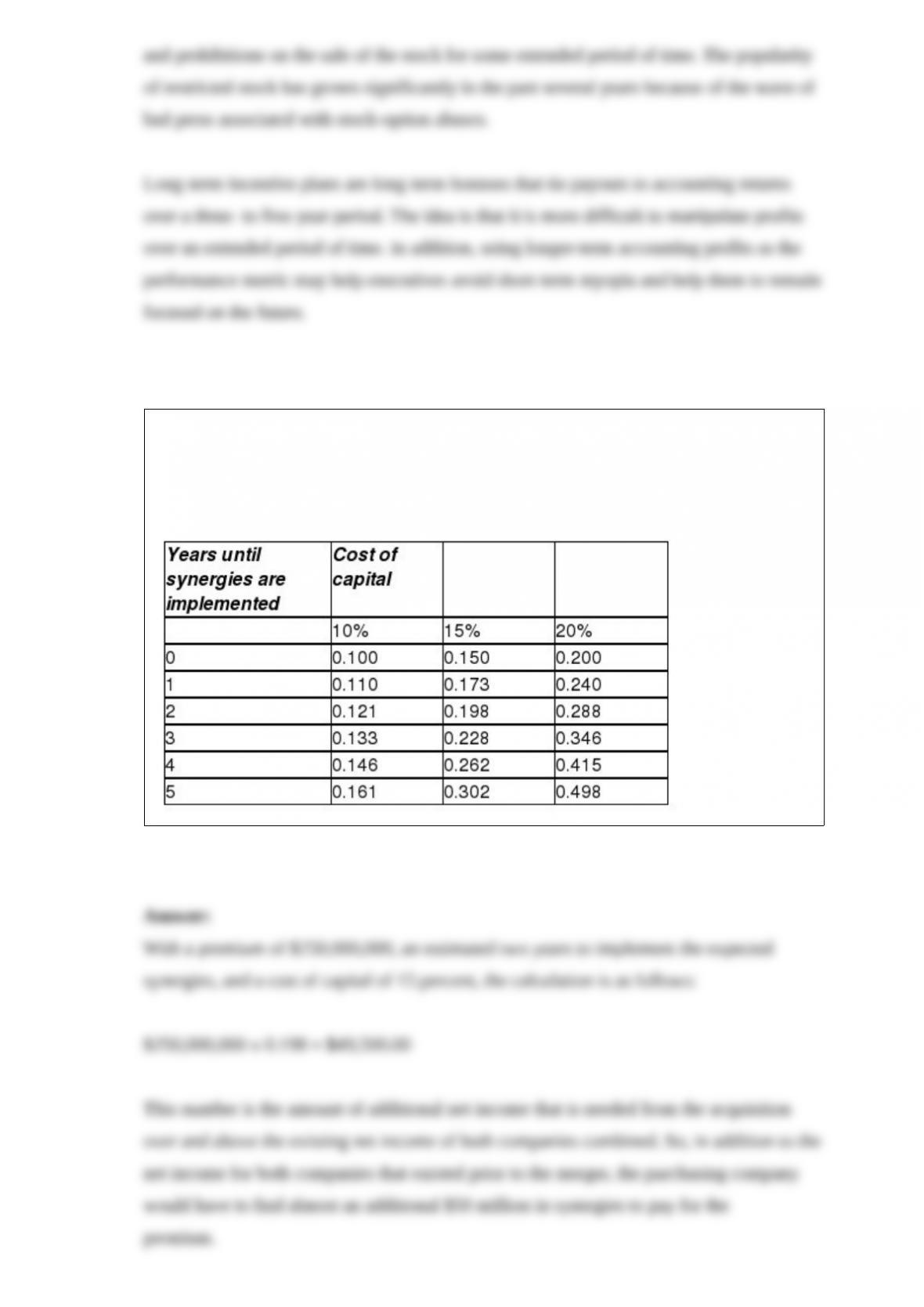
Use the table below to answer the following question. What would be the required
synergy given a premium of $250,000,000 if the company thinks that it will take two
years to implement the synergies, and if the cost of capital is 15 percent? What does this
number mean?