
Two local ready-mix cement manufacturers, Here and There, have combined demand
given by Q = 105 ” P. Their total costs are given by TCHere = 5QHere + 0.5Q2
Here and
TCThere = 5QThere + 0.5Q2
There. If they successfully collude, their total output will be:
a. 10 units.
b. 20 units.
c. 40 units.
d. 50 units.
e. 66.67 units.
In the model of perfect competition, firms produce a:
a. standardized product with considerable control over price.
b. differentiated product with considerable control over price.
c. standardized product with no control over price.
d. differentiated product with no control over price.
e. standardized or differentiated product with some control over price.

If a representative firm with long-run total cost given by TC = 50 + 2q + 2q2 operates in
a competitive industry where the market demand is given by QD = 1,410 ” 40P, the
long-run equilibrium output of the industry will be:
a. 490 units.
b. 530 units.
c. 570 units.
d. 610 units.
e. 650 units.
George’s shoe store buys and sells shoes in pairs. If George’s isoquants are drawn with
quantity of right shoes on the vertical axis and quantity of left shoes on the horizontal
axis, what do they look like? They are:
a. curves that get flatter as the number of left shoes increases.
b. curves that get steeper as the number of left shoes increases.
c. straight lines that have a negative slope.
d. L-shaped.
e. horizontal straight lines.

Suppose Al is currently consuming five movies and two concerts per month. If his
utility function is given by U = 15MC, where M represents the number of movies seen
and C represents the number of concerts attended, Al’s total utility is equal to:
a. 10
b. 15
c. 30
d. 75
e. 150
The Wilson Corporation produces output according to Q = 4(KL)1/2, where K is the
amount of capital used and L is the amount of labor employed. If capital costs $2 per
unit and labor costs $8 per unit, Wilson’s minimized long-run average total cost is:
a. $2.
b. $2Q.
c. $10.
d. $10Q.
e. $22.

If the demand curve is horizontal, the price elasticity used to calculate the
profit-maximizing price is:
a. “10.
b. “5.
c. “0.
d. “1.
e. infinity.
A manager is indifferent between rates of return satisfying i = 0.08 + 0.02s (s is the
standard deviation). The manager’s risk premium for s = 2 is:
a. 0%.
b. 2%.
c. 4%.
d. 8%.
e. 12%.
Multiple regression differs from simple regression in that:

a. there can be multiple dependent variables.
b. the time periods over which observations are taken are multiplied to increase
explanatory power.
c. a simple regression is done multiple times to increase explanatory power.
d. the computational requirements are less.
e. there are multiple independent variables.
When a firm requires a customer to buy additional products in order to buy one of its
products, this is known as a(n):
a. bundling contract.
b. price differentiation.
c. oligopolistic device.
d. two-part tariff.
e. maximizing device.
Which pair of strategies would cooperative cartel members A and B choose given this
payoff matrix?

a. W, Y.
b. W, Z.
c. X, Y.
d. X, Z.
e. Either X, Y or W, Z.
A cost of estimating demand functions particular to the use of market experiments is:
a. the possibility that customers may be lost and profits cut as a result of the
experiment.
b. the shipping costs to markets across the country.
c. the need to determine the profit-maximizing discount.
d. the cost of collecting data.
e. none of the above.

The use of consumer interviews to estimate demand functions has been criticized by
economists primarily because:
a. answering surveys takes too much time.
b. the answers collected cannot be easily quantified.
c. respondents don”t have strong incentives to answer accurately.
d. interviewers are often belligerent.
e. survey questions are difficult to word clearly.
A subjective definition of probability is:
a. a weighted average of different peoples’ degrees of certainty of an event’s occurring.
b. a theoretical probability distribution.
c. a person’s degree of certainty of an event’s occurring.
d. an expected value of a particular outcome.
e. the number of occurrences of an event in a large number of repetitions of an
experiment.
In a second-price, sealed-bid auction:

a. buyers bid against each other with a succession of increasingly higher prices until
only one remains.
b. a bid is announced, and if no buyer accepts the bid in a given period of time, a new,
slightly lower, bid is announced; this procedure continues until a bidder accepts the
announced price.
c. each bidder submits a price that is known only to that bidder; bids are opened and the
highest (lowest) bid is accepted.
d. each bidder submits a price that is known only to that bidder; bids are opened and the
highest (lowest) bidder wins, but the transaction occurs at the second highest (lowest)
price.
e. none of the above.
Sticky prices are an outcome of the kinked demand model because:
a. firms in an oligopoly will collude to hold prices fixed.
b. marginal costs are constant in oligopolistic industries.
c. marginal costs can vary to some extent, but firms will have no incentive to change
their prices in oligopolistic industries.
d. demand is perfectly elastic in oligopolistic industries.
e. firms will set price equal to marginal cost in oligopolistic industries.

The reservation prices, in dollars, for three classes of demanders (A, B, and C) for two
restaurants (1 and 2) are given in the following table. What is the maximum revenue
that can be generated by setting a separate price for each restaurant?
a. $49.
b. $45.
c. $36.
d. $34.
e. $30.
Hedge Fun is a landscaping firm that specializes in topiary. Last year, the firm had 60
employees and served 120 customers. This year, it had 70 employees and served 140
customers. The average product of labor is at a maximum when the number of
customers is:
a. less than 120.
b. equal to 120.
c. between 120 and 140.
d. equal to 140.
e. greater than 140.

The savings and loan crisis of the early 1990s was caused by a moral-hazard problem
because:
a. government insurance encouraged bank managers to take on more risk than they
would have without such insurance.
b. bank managers no longer attempted to maximize the profits of the firm.
c. insurance attracted depositors who would not have used banks otherwise.
d. depositors had more information about the banks than shareholders had.
e. government insurance encouraged bank managers to take on less risk than they
would have without such insurance.
Sally sells sandals. She can advertise on radio, A1, or on television, A2. Profits depend
on advertising according to p = 100 + 10A1 + 20A2 ” A2
1 ” A2
2 + 0.5A1A2. The
profit-maximizing levels of radio and television advertising are:
a. A1 = $8 and A2 = $12.
b. A1 = $12 and A2 = $12.
c. A1 = $8 and A2 = $8.
d. A1 = $12 and A2 = $8.
e. A1 = $10 and A2 = $10.

A reverse auction is one in which the:
a. price starts high and then is reduced until only one bidder remains.
b. price starts low and then the seller raises price until only one bidder remains.
c. price starts high and then is reduced until only one seller remains.
d. price starts low and then the buyer raises the price until only one seller remains.
e. bidders submit sealed bids for the right to participate in the auction.
If Y = a + bX + cXd, then dY/dX is:
a. a + bX + cXd.
b. b ” 1 + (c ” 1)Xd” 1.
c. b + (d ” 1)(c ” 1)Xd” 1.
d. b + cdXd” 1.
e. bX + cXd.

Bill’s Mechanical Devices Inc. produces robots for the automotive industry. If its
average variable costs are given by AVC = 25, its fixed costs are $2,500, and it charges
$75 a robot, what is Bill’s break-even level of output?
a. 25 robots.
b. 33.3 robots.
c. 50 robots.
d. 75 robots.
e. 100 robots.
Average fixed cost is equal to the:
a. difference between marginal cost and average variable cost.
b. difference between marginal cost and average total cost.
c. difference between average total cost and average variable cost.
d. total fixed cost divided by the minimum efficient scale.
e. total variable cost divided by the minimum efficient scale.
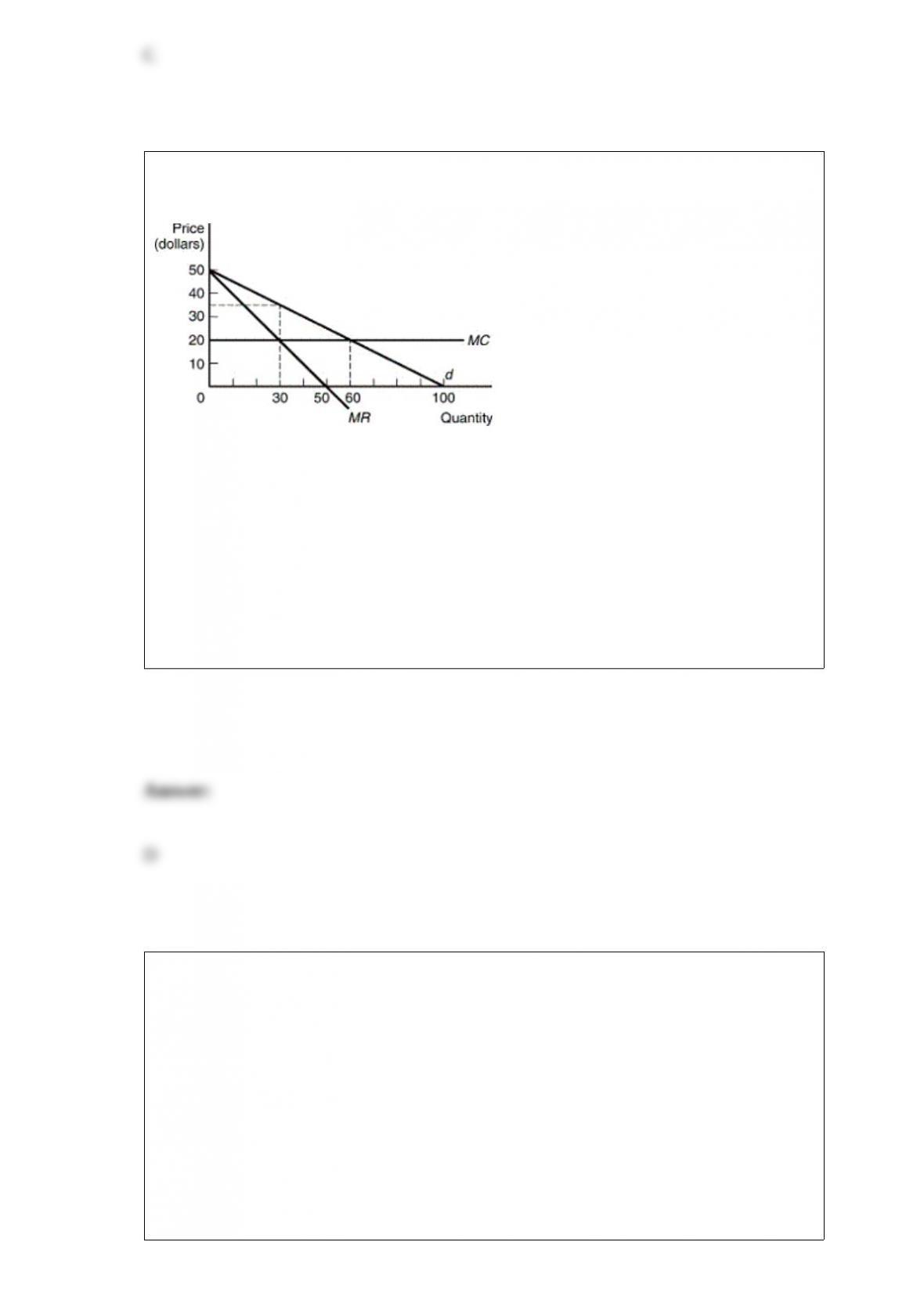
If the monopolist shown in the following figure could practice first-degree price
discrimination, the producer surplus would be:
a. $0.
b. $225.
c. $450.
d. $900.
e. $1,200.
El Niño wind patterns affected the weather across the United States during the winter of
1997″1998. Suppose the demand for home heating oil in Connecticut is given by Q =
20 ” 2Phho + 0.5Png ” TEMP, where Q is the quantity of home heating oil demanded,
Phho is the price of home heating oil per unit, Png is the price of natural gas per unit,
and TEMP is the absolute difference between the average winter temperature over the
past 10 years and the current average winter temperature. If the current price of home
heating oil is $1.20, the current price of natural gas is $2.00, and the average winter
temperature this year is 40 degrees compared to 28 degrees over the past 10 years, if the
sellers of home heating oil are profit maximizers, they should:
a. lower prices.

b. raise prices.
c. advertise more.
d. advertise less.
e. none of the above
Suppose that the demand curve for compact disks is given by P = 600 ” Q and that the
supply curve is given by P = 0.5Q, where Q is the quantity of compact disks and P is
their price. What is the price elasticity of demand at the equilibrium price and quantity?
a. “0.05.
b. “0.02.
c. “0.20.
d. “0.50.
e. “2.00.
Two local ready-mix cement manufacturers, Here and There, have combined demand
given by Q = 105 ” P. Their total costs are given by TCHere = 5QHere + 0.5Q2
Here and
TCThere = 5QThere + 0.5Q2
There. If they cannot successfully collude and instead produce

where the market price equals marginal cost, each firm’s profits will be:
a. $111.11.
b. $222.22.
c. $333.33.
d. $444.44.
e. $555.55.
If a firm is choosing cost-minimizing combinations of inputs, marginal cost can be
defined as the price of any:
a. input divided by its average product.
b. variable input divided by its average product.
c. fixed input divided by its average product.
d. variable input divided by its marginal product.
e. fixed input divided by its marginal product.
Suppose the Ajax Insurance Company provides insurance for skydivers whose wealth
before diving is $400. An accident will leave divers with a wealth of $100. The

company divides the divers into two classes, safe (probability of an accident = 0.2) and
unsafe (probability of an accident = 0.5). The utility of wealth for all divers is given by
the function: U(w) = w0.5. Given this information, the divers are:
a. risk-averse.
b. risk seeking.
c. risk-neutral.
d. indifferent to risk.
e. risk-averse, risk seeking, or risk-neutral; we cannot tell from this information.
Economies of scale are said to exist whenever:
a. the learning curve is upward-sloping.
b. increases in output bring about higher output.
c. increases in output bring about higher input prices.
d. the elasticity of total cost with respect to output is greater than 1.
e. the long-run average cost curve is downward-sloping.
The demand for textbooks is Q = 200 ” P + 25U ” 50Pbeer. Assume that the

unemployment rate U is 8 and the price of beer Pbeer is $2. When the average price of a
textbook is P = $100, the price elasticity of demand is:
a. “1.0.
b. “2.0.
c. “0.5.
d. “50.
e. “5.0.