If the real interest rate is 3% and the expected inflation rate is 6%, then the nominal
interest rate is
A) 0.5%.
B) 2%.
C) 3%.
D) 9%.
Which of the following is a way to measure of real GDP per capita?
A) (Labor productivity) x (Fraction of the population working)
B) (Nominal GDP) / (Real GDP)
C) (Total factor productivity) / (Capital stock)
D) (Real GDP) x (population)
The two basic ways for workers to acquire human capital are
A) formal education and “learning by doing.”
B) purchases in the capital market and trade.

C) increases in the capital stock and increases in total factor productivity.
D) training and intuition.
If the MPC is 0.5 and the tax rate is 10%, a $500 increase in autonomous government
purchases will increase equilibrium income by
A) $225.
B) $280.
C) $910.
D) $1,110.
A measure of how much debt an investor takes on in making an investment is referred
to as
A) asset management.
B) the debt-equity ratio.
C) securitization.
D) leverage.

Suppose y = Ak1/3, the capital-labor ratio is $30,000 per worker, the level of total factor
productivity is 400, 50% of the population works, and there are 50 million workers.
Real GDP per worker is
A) $9,861.69.
B) $12,424.66.
C) $15,530.82.
D) $18,067.92.
If d = the depreciation rate, n = the growth rate of the labor force, and k = the
capital-labor ratio, which of the following expressions best describes break-even
investment?
A) dnk
B) (d – n)/k
C) dk – nk
D) (d + n)k

Which expression best represents the break-even level of investment when
incorporating labor-augmenting technological change into the Solow growth model?
A) (d + n + g)k
B) (d + n)k
C) (d + n ) / (k + g)
D) (d + n + k) / (gk)
Emily lost her job as a typesetter for the local newspaper when the newspaper’s owner
finally decided to computerize all printing operations. Emily has been searching,
unsuccessfully, for another typesetting job in her small town. Emily would best be
categorized as
A) frictionally unemployed.
B) structurally unemployed.
C) cyclically unemployed.
D) seasonally unemployed.
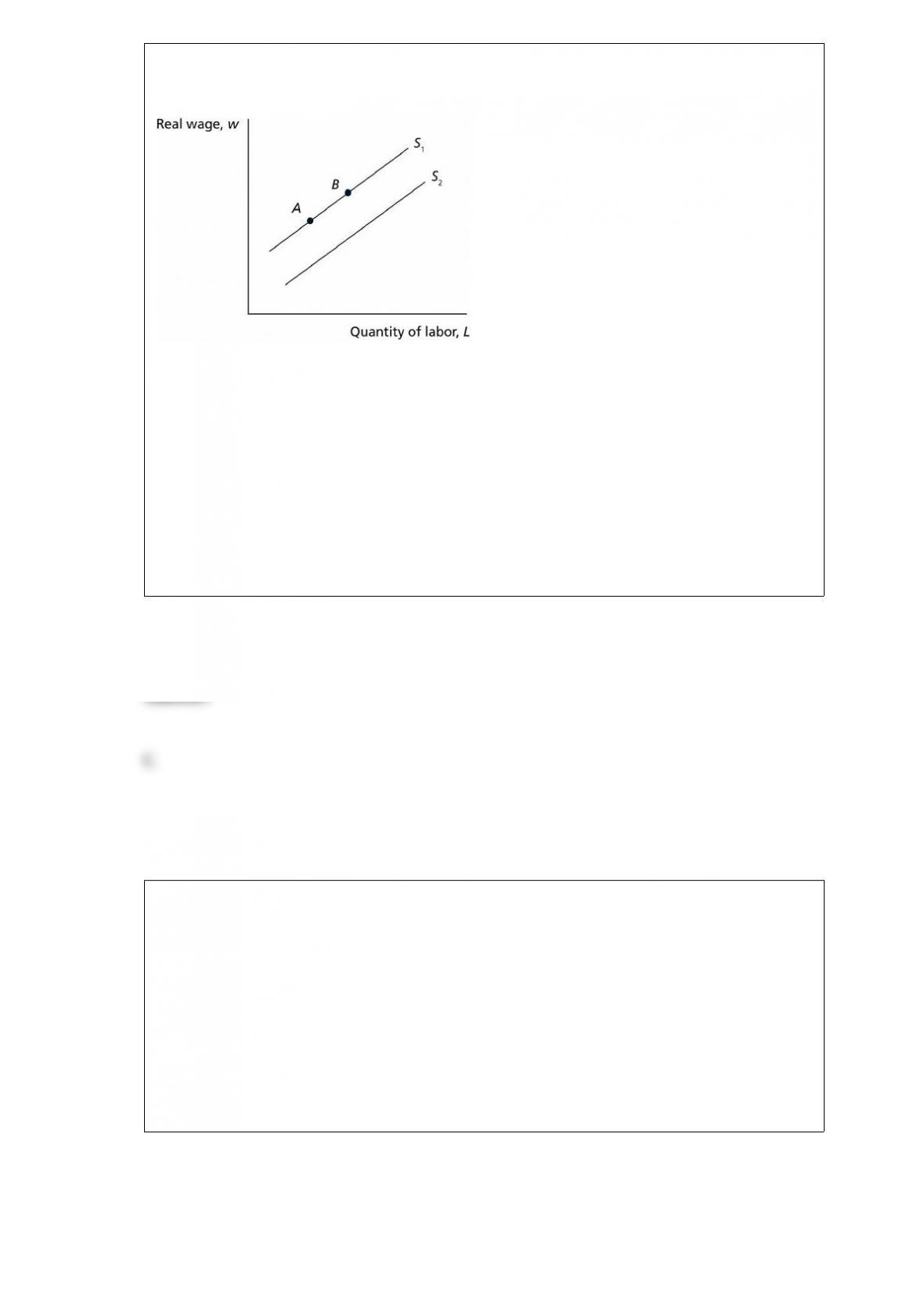
Figure 8.2
Refer to Figure 8.2. Holding other variables constant, a decrease in households’ wealth
will result in a
A) movement from point A to point B.
B) movement from point B to point A.
C) shift from curve S1 to curve S2.
D) shift from curve S2 to curve S1.
The marginal product of capital is always ________ and it ________ as the capital
stock increases.
A) positive; increases
B) positive; decreases
C) negative; increases
D) negative; decreases

Assume the economy is in a recession and the Federal government decides to cut
personal income tax rates. All else equal, the cut in tax rates should
A) increase consumption expenditures and cause real GDP to increase relative to
potential GDP.
B) increase the nominal interest rate and cause potential GDP to increase relative to real
GDP.
C) decrease the real interest rate and decrease expectations of inflation.
D) increase the target interest rate and cause real GDP to fall relative to potential GDP.
An example of fixed investment spending is
A) the purchase of a new apartment building by a property management company.
B) the purchase of corporate bonds by Microsoft Corporation.
C) the purchase of a new wood chipper by a landscape maintenance company.
D) $4 million in unsold furniture at a home furnishings manufacturer.

Which of the following functions of money would be least affected if the economy
experiences high rates of inflation?
A) unit of account
B) store of value
C) standard of deferred payment
D) medium of exchange
Which of the following is an example of a monetary policy?
A) The federal government decreases income tax rates on people earning less than
$40,000.
B) The U.S. Bureau of Engraving and Printing redesigns the $20 bill.
C) The Federal Reserve takes action to increase the money supply during an economic
recession.
D) Congress authorizes an increase in spending on health care.
Figure 10.9
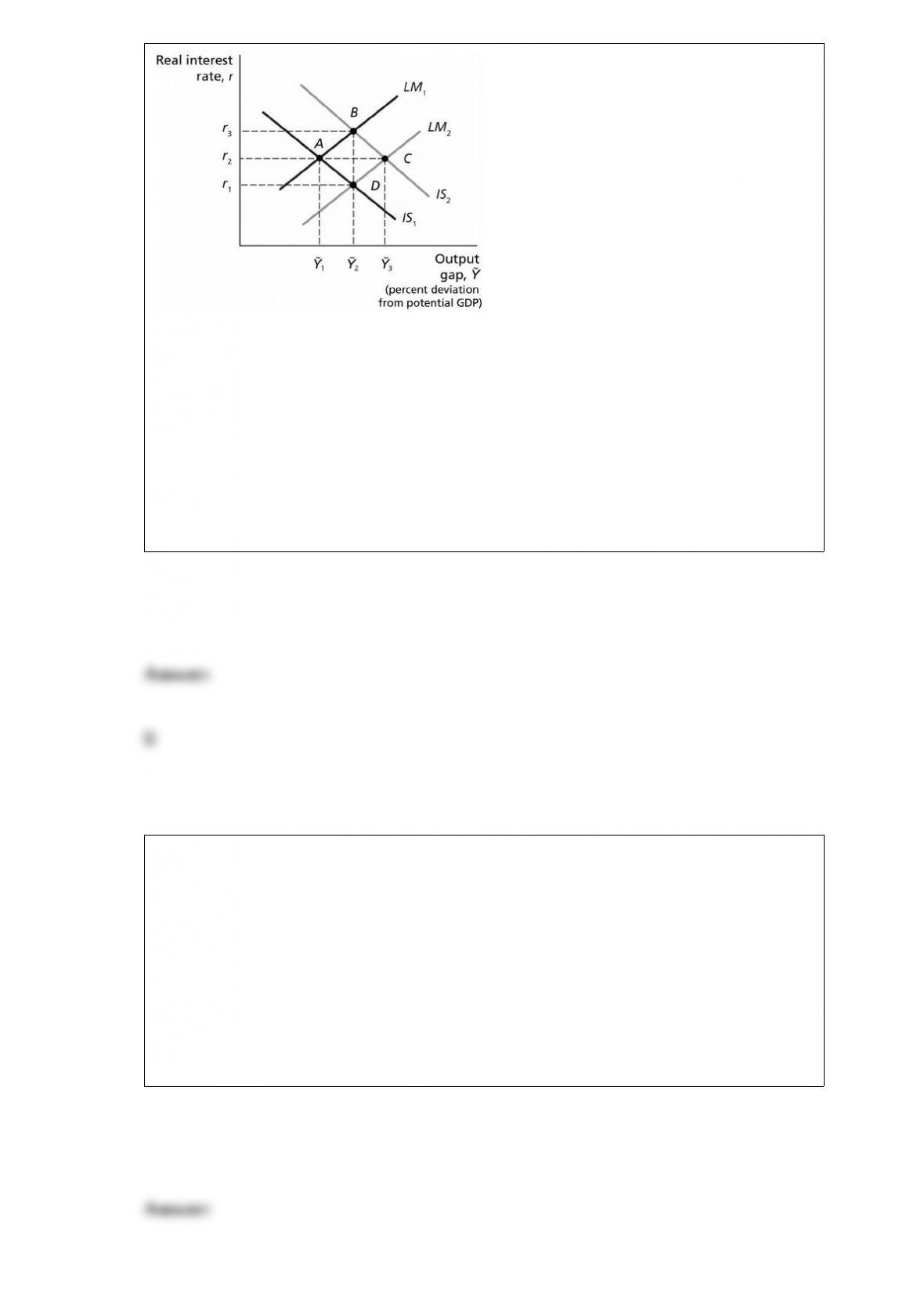
Refer to Figure 10.9. Other things equal, an increase in the nominal money supply by
the Fed is best represented as a change in equilibrium from
A) point A to point B.
B) point A to point D.
C) point C to point B.
D) point C to point D.
When the economy responds to a supply shock, there is ________ in the short run and
________ in the long run between inflation and unemployment
A) an inverse relationship; no trade-off
B) no trade-off; an inverse relationship
C) an inverse relationship; an inverse relationship
D) no trade-off; no trade-off

When a bank receives a $50 million discount loan from the Federal Reserve, the bank’s
reserves
A) remain the same.
B) increase by less than $50 million.
C) increase by $50 million.
D) increase by more than $50 million.
Since 1962, which of the following federal expenditures, measured as a percentage of
GDP, has increased the most?
A) Social Security
B) Medicare and Medicaid
C) net interest
D) defense

Consumer purchases which are consumed at the time and place of purchase are
categorized by the Bureau of Economic Analysis as
A) durable goods.
B) nondurable goods.
C) services.
D) investments.
Which of the following statements would make a reasonable hypothesis to test?
A) Deflation is worse than inflation in any economy.
B) An unemployment rate below 4% is bad for the economy.
C) As tax rates increase, eventually tax revenues will decline.
D) Higher real GDP per capita figures lead to happier citizens.
There is ________ to how much increases in labor inputs can increase real GDP per
capita, and there is ________ to how much increases in labor productivity can increase
real GDP per capita.
A) a limit; a limit

B) a limit; no limit
C) no limit; a limit
D) no limit; no limit
Suppose the government cuts taxes by $300 million dollars this year and must pay off
its debt next year by increasing taxes by $300 million. According to Ricardian
equivalence, private saving will ________ this year and ________ next year, all else
equal.
A) increase by $300 million; decrease by $300 million
B) increase by $150 million; decrease by $150 million
C) increase by $300 million; not change
D) not change; not change
Figure 10.3
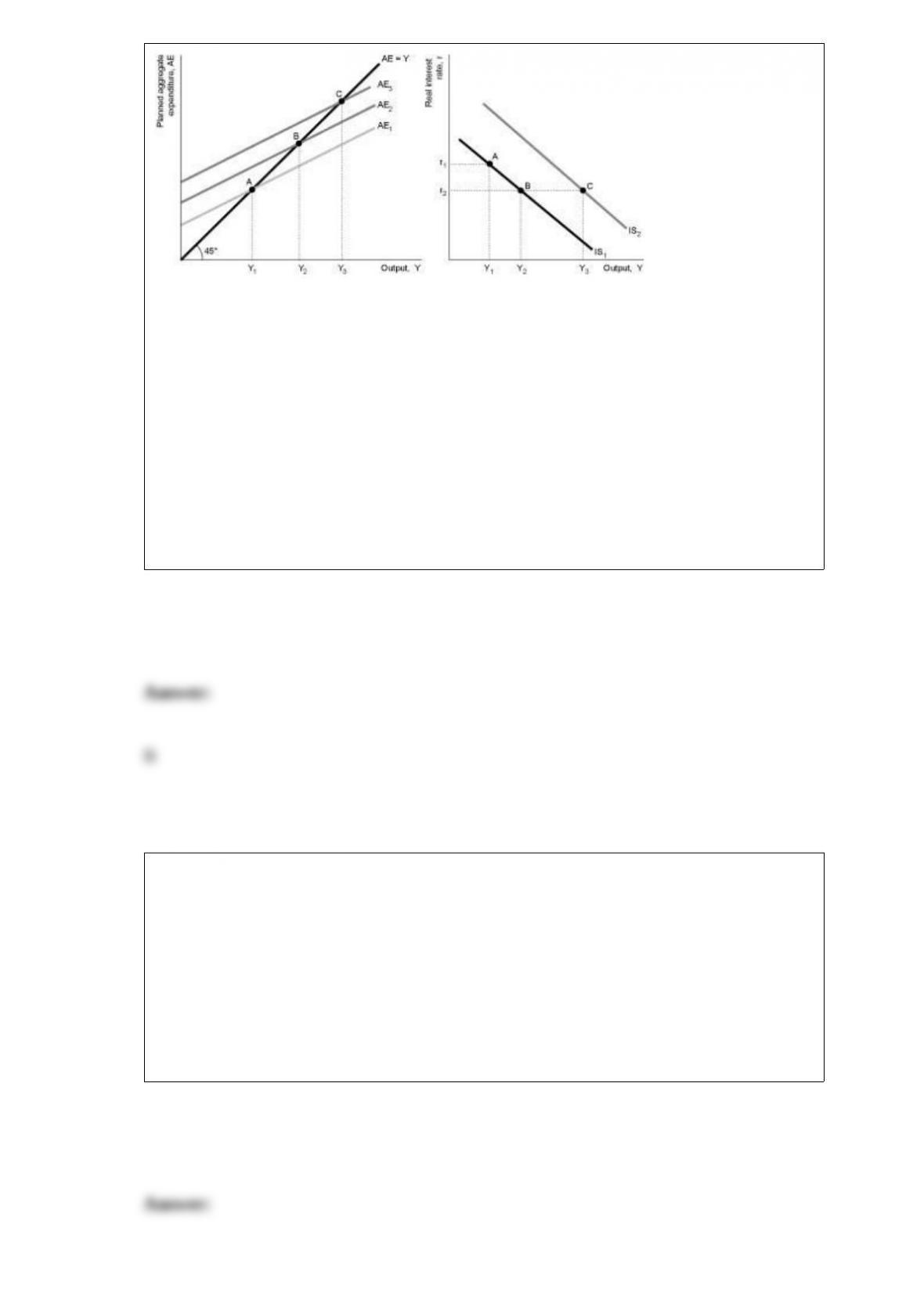
Panel (a) Panel (b)
Refer to Figure 10.3. A positive demand shock with no change in the real interest rate
is best represented by ________ in panel (a) and ________ in panel (b).
A) a shift from AE3 to AE2; a shift from IS2 to IS1
B) a shift from AE2 to AE3; a shift from IS1 to IS2
C) a shift from AE1 to AE2; a movement from point A to point B
D) a shift from AE1 to AE3; a movement from point A to point C
Diminishing marginal returns do not exist for increases in
A) capital stock.
B) labor.
C) total factor productivity.
D) Diminishing marginal returns exist for all of the above answers.

In the two-sector growth models, endogenous growth arises from
A) increased saving.
B) the research sector.
C) increased capital.
D) the manufacturing sector.
Under a fixed exchange rate system, at low domestic real interest rates net capital
outflows are ________, so the central bank ________ foreign-exchange reserves.
A) positive; acquires
B) positive; loses
C) negative; acquires
D) negative; loses
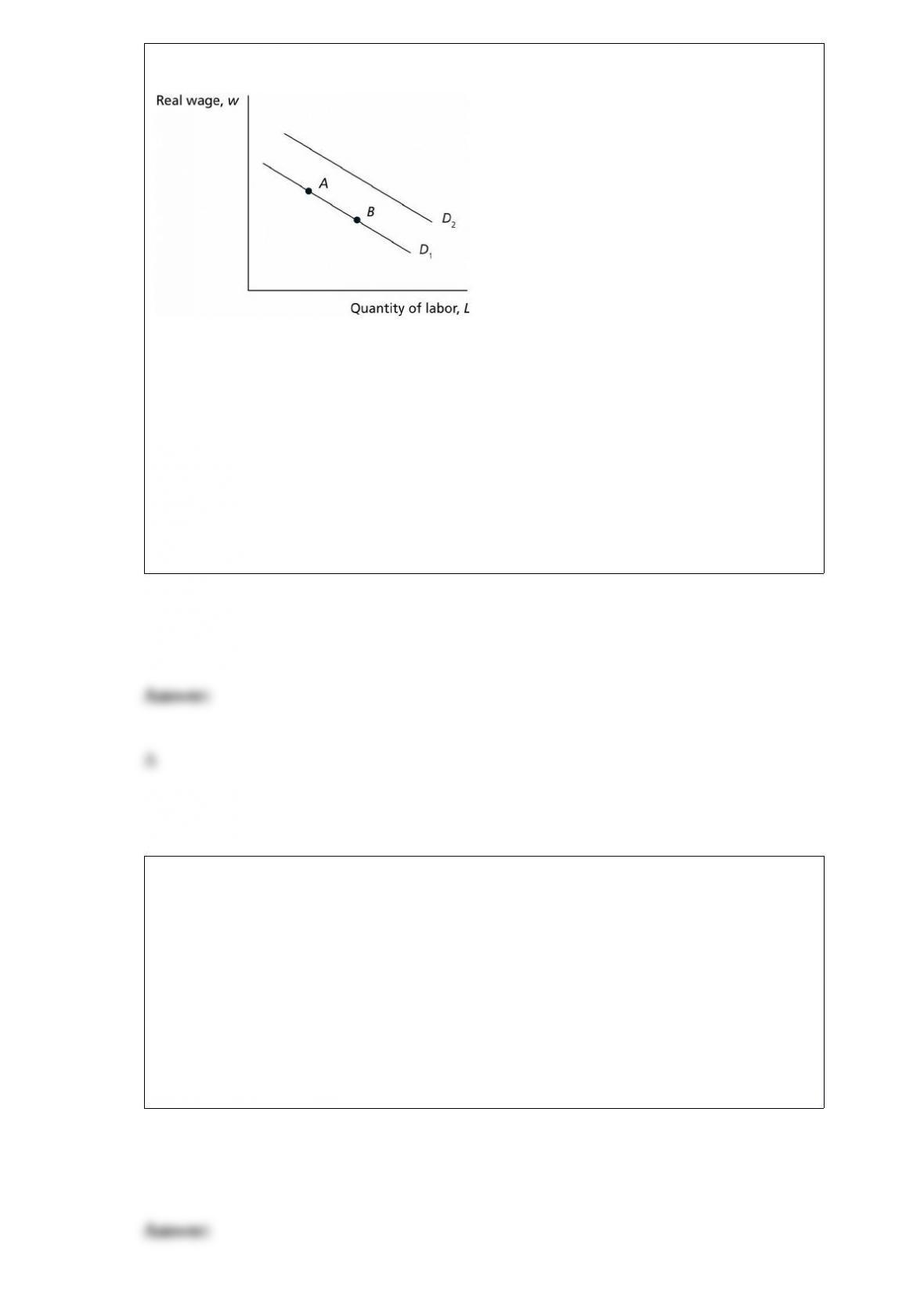
Figure 8.1
Refer to Figure 8.1. Holding other variables constant, an increase in the skill level of
workers will result in a
A) shift from curve D1 to curve D2.
B) shift from curve D2 to curve D1.
C) movement from point A to point B.
D) movement from point B to point A.
If Jennifer withdraws $750 from her savings account and deposits it in her checking
account, then M1 will ________ and M2 will ________.
A) increase; increase
B) increase; decrease
C) increase; not change
D) not change; decrease

Suppose the economy is in equilibrium with an output gap equal to zero and the actual
inflation rate equals the expected inflation rate. If the economy experiences a negative
demand shock, the output gap will ________ and the inflation rate will ________.
A) increase; increase
B) increase; decrease
C) decrease; increase
D) decrease; decrease
From 1950 to 2009, the average length of recessions in the United States has been
A) less than 1 year.
B) between 1 year and 2 years.
C) between 2 years and 3 years.
D) longer than 3 years.

If potential GDP for the third quarter of 2012 = $20.4 billion, and the deviation from
potential GDP for the third quarter of 2012 = -$1.6 billion, then the output gap was
A) -7.8%.
B) -12.8%.
C) -18.8%.
D) -32.6%.
Which of the following is not an example of inflation causing a redistribution of income
because the inflation was unexpected?
A) Firms have to hire extra workers to change prices because of inflation.
B) A firm signs a 4-year contract with a union based on a 3% expected rate of inflation
per year, and the actual inflation rate ends up being 5% per year.
C) An employee receives an increase in salary that is less than the rate of inflation
because management under-predicted inflation.
D) A bank collects a lower amount of interest from a loan because inflation was
predicted to be 2% but was actually 4%.
Zelda won the jackpot on a penny slot machine in Las Vegas and is given the following
three options to receive her jackpot:
Option 1: $100,000 to be received right away, with four additional payments of
$100,000 to be received each year for the next four years.
Option 2: $250,000 to be received right away with two additional payments of
$100,000 to be received each year for the next two years.
Option 3: $400,000 to be received right away.
Which option should Zelda choose if the interest rate is 8%? Would she choose the
same option if the interest rate was 10%? Why?
Suppose the velocity of money is not fixed, but stable at about 4% growth per year.
How could the quantity theory of money be modified to include a stable growth rate of
the velocity of money? In this modified version with velocity growing at about 4% per
year, what would the growth rate of the other variables need to be to cause inflation?
The unemployment rate in the United States increased from 5% in December 2007 to
9.9% in December 2009. Was this almost doubling of the unemployment rate due to
cyclical, frictional, or structural reasons, and did the increase in unemployment change
the natural rate of unemployment?
What are some of the explanations offered for why the U.S. economy experienced a
period of relative stability from 1950-2007?
What is precautionary saving? What might cause precautionary saving to increase or
decrease if households have a desired level of wealth?
Explain the XOAXOAerence between GDP and GNP.
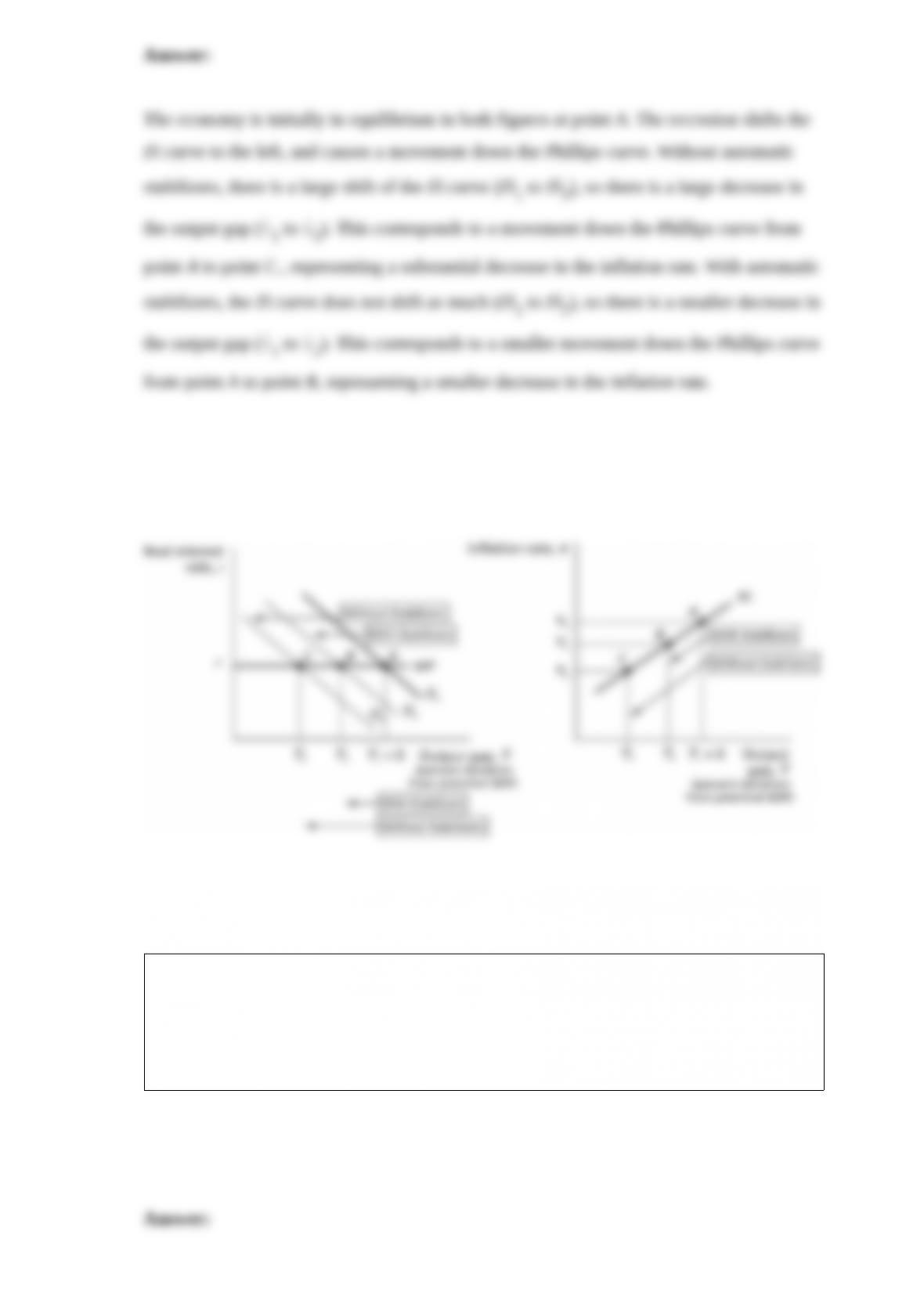
Suppose the economy is initially at full employment with real GDP equal to potential
GDP. Use the IS–MP model and the Phillips curve to explain what happens if the
economy experiences a recession both with and without automatic stabilizers.
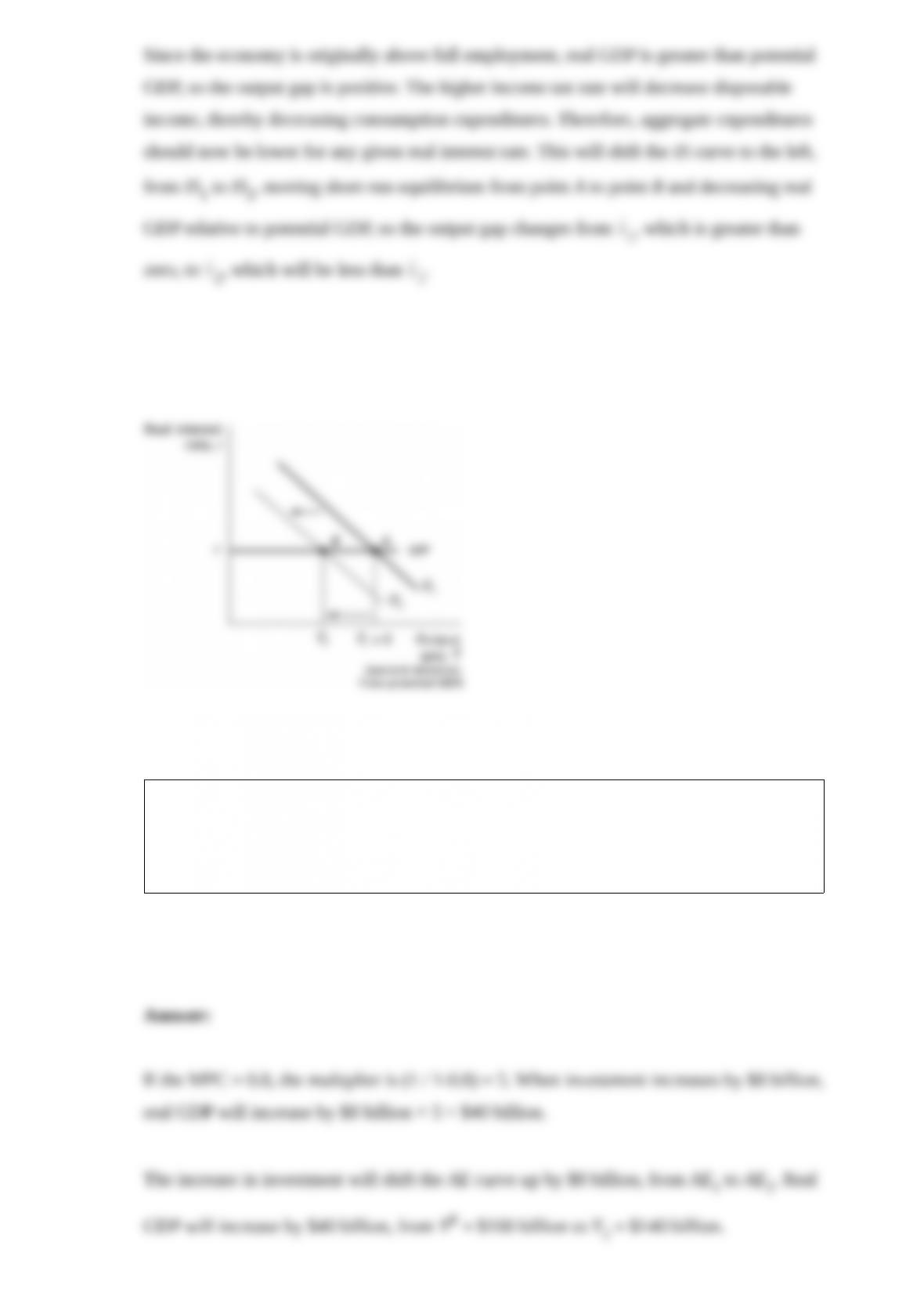
Suppose that the economy is experiencing inflation and is above full employment, and
the federal government implements an income tax increase as a corrective action. Use
the IS–MP model to analyze the effect the tax increase should have on real GDP and the
output gap. Show any shifts in the IS curve and the MP curve, and identify the old and
new equilibrium values of the output gap.
Suppose the economy is initially in equilibrium at potential GDP = $100 billion and
investment increases by $8 billion. If the MPC in this economy is 0.8, what will happen
to real GDP? Draw an aggregate expenditure graph showing this change in investment
and real GDP.
Explain how discretionary monetary policy may have brought about the end of the
Great Moderation and ushered in the Great Recession.
Explain how a mortgage lender may act differently if it intends to resell mortgages in
secondary markets instead of holding the mortgages itself.
What are the 5 steps generally used by economists to develop a model?
Explain the difference between nominal GDP and real GDP. Which is more important
when using GDP as a measure of production? Why?
Explain why many economists are skeptical about whether Ricardian equivalence
describes the behavior of households in the economy.
Using the expectations hypothesis on the term structure of interest rates, explain the
relationship between the interest rate on a one-year Treasury bond and the interest rate
on a two-year Treasury bond.
What is break-even investment, and what happens to the break-even level of investment
when the growth rate of the labor force either increases or decreases?
What is fiscal policy?
Why is the balance of payments always zero?
Explain how efficiency wages, labor unions, and minimum wage laws affect labor
markets.
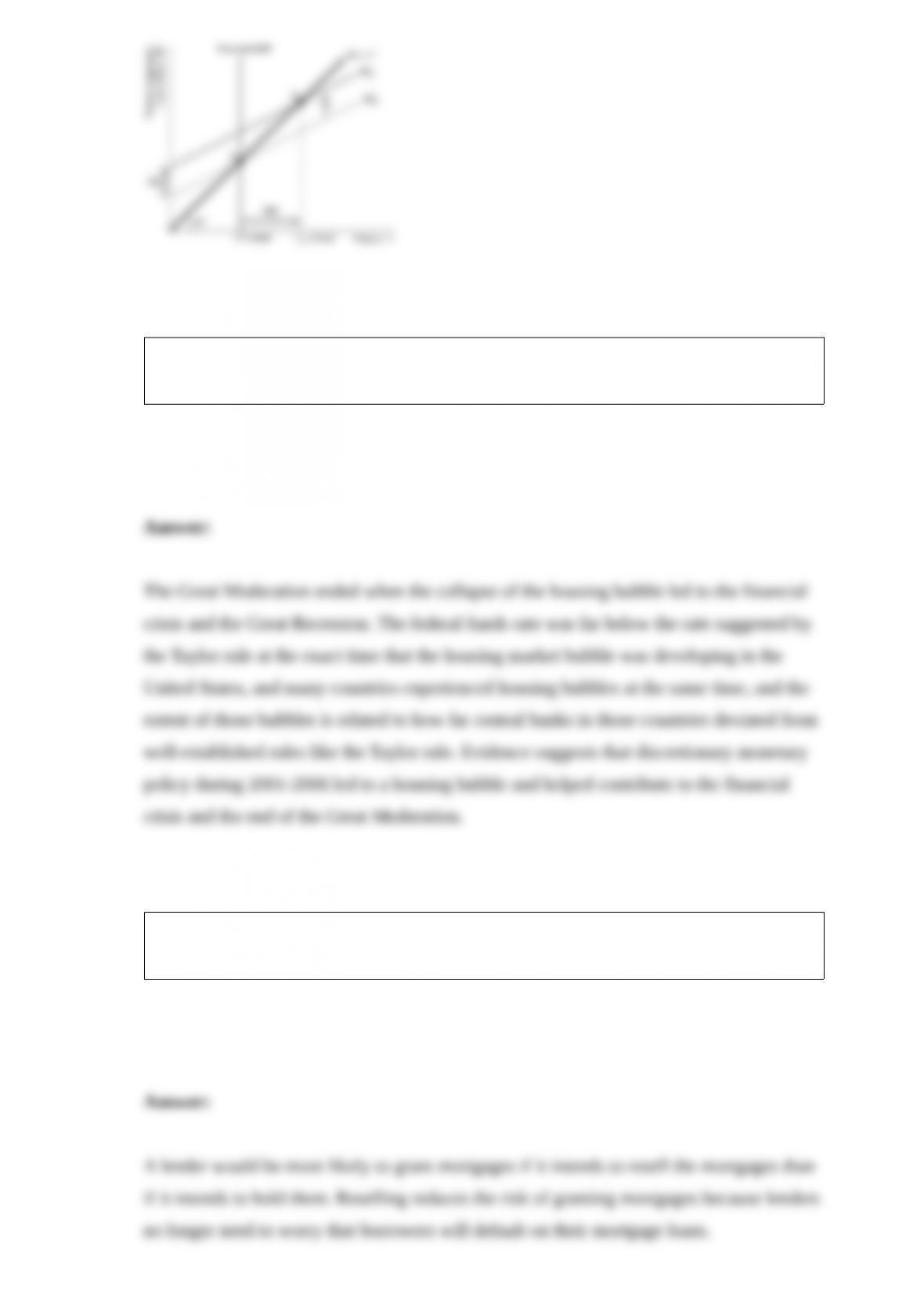
Use a graph to show the differences in the central bank reaction function if the Fed is
more tolerant or less tolerant of deviations from inflation in the short run.