
Of the three levels of government in the United States,
a. only the federal government provides public goods
b. only the federal government has the power to tax
c. local governments are primarily responsible for primary and secondary education
d. the federal government is primarily responsible for higher education
e. state governments are primarily responsible for economic stability
A major distinguishing feature between capitalist and socialist (or command)
economies is that
a. under capitalism the average citizen is always wealthier than in socialist economies
b. decision making is typically decentralized in socialist economies and is centralized in
capitalist economies
c. socialist countries all have red flags and capitalistic economies do not
d. resources are publicly owned in capitalist economies
e. decision making is typically decentralized under capitalism while it is centralized in
command economies

Which of the following does the United States import?
a. cotton
b. wheat
c. oil seeds
d. zinc
e. barley
Brian is the sole proprietor owner of Long Voyage Software, which generates maps for
wilderness trips. He started the business with an initial investment of $80,000. A faulty
map caused one customer to get hopelessly lost. After her rescue and recuperation, she
sued Long Voyage for $5,000,000. Which of the following is true?
a. The customer can be awarded only $80,000–what the firm has available to pay.
b. The customer can be awarded $5,000,000, but can get only $80,000.
c. The customer can be awarded $5,000,000, but Brian personally won’t have to pay
more than $80,000.
d. If $5,000,000 is awarded, Brian will have to pay none of it.
e. If $5,000,000 is awarded, Brian is personally responsible for paying all of it.

Consider two resource markets in which the demand curves slope downward. In market
A, the supply curve is horizontal, equilibrium price is $6, and 100 units of the resource
are hired. In market B, the supply curve is vertical, equilibrium price is $20, and 30
units of the resource are hired. Which of the following is true?
a. All of the resource earnings in market A are opportunity costs.
b. All of the resource earnings in both markets are opportunity costs.
c. All of the resource earnings in market B are opportunity costs.
d. None of the resource earnings in either market is an opportunity cost.
e. None of the resource earnings in either market is economic rent.
An example of a positive externality is
a. pollution because it affects people not directly involved with producing it
b. a homeowner’s maintenance of a beautiful lawn because this creates a benefit for
neighbors
c. creating a monopoly
d. driving a car that emits pollution
e. cigarette smoking because this imposes an indirect cost on people around the smoker

U.S. exports
a. represent approximately 50 percent of GDP
b. represent approximately 35 percent of GDP
c. represent approximately 11 percent of GDP
d. consist primarily of agricultural commodities
e. consist primarily of metals and other raw materials
To tell a compelling story, an economist relies on
a. case studies
b. anecdotes
c. irrelevant data
d. anecdotes and irrelevant data
e. case studies and anecdotes
Differences in tastes among nations
a. make gains from trade possible even in the absence of differences in resource

endowments
b. make gains from trade possible only when there are differences in resource
endowments
c. negate any potential gains from trade
d. are caused by differences in resource endowments
e. occur only among countries whose people are of different religions
Which of the following points in Exhibit 2-4 is unattainable, given the quantity of
resources and level of technology?
a. h
b. g
c. f
d. i
e. e
If the demand for tacos increases,
a. the supply of corn increases

b. the supply of corn decreases
c. the demand for corn increases
d. the demand for corn decreases
e. the price of corn falls
Suppose demand increases and supply increases. Which of the following will happen?
a. equilibrium price will increase
b. equilibrium price will decrease
c. equilibrium quantity will increase
d. equilibrium quantity will decrease
e. neither the equilibrium price nor the equilibrium quantity will change
An excise tax will generate more revenue to the government, the more price elastic the
demand for the product is.
a. True
b. False

The Clayton Act is an example of
a. social regulation
b. economic regulation
c. Herfindahl regulation
d. antitrust regulation
e. public utility regulation
Game theory is most useful in understanding the decision making behavior of firms in
which type of industry?
a. perfect competition
b. monopoly
c. monopolistic competition
d. natural monopoly
e. oligopoly

Food stamps and Medicaid are examples of
a. money transfers
b. resource earnings
c. in-kind transfers
d. tax expenditures
e. capital gains
One disadvantage of a sole proprietorship as a form of business organization is that
a. sole proprietorships cannot lower the transaction costs associated with contracting
with resource owners
b. sole proprietorships are less efficient than corporations, because they are less
specialized in production
c. owners of sole proprietorships can lose all their personal assets if the business is sued
or fails
d. owners of sole proprietorships generally find it difficult to negotiate separation
agreements with the other partners in the firm
e. owners of sole proprietorships generally have very little control over how they
operate their businesses
If a firm is producing at its minimum efficient scale, increasing its output slightly will
lead to diseconomies of scale.
a. True
b. False
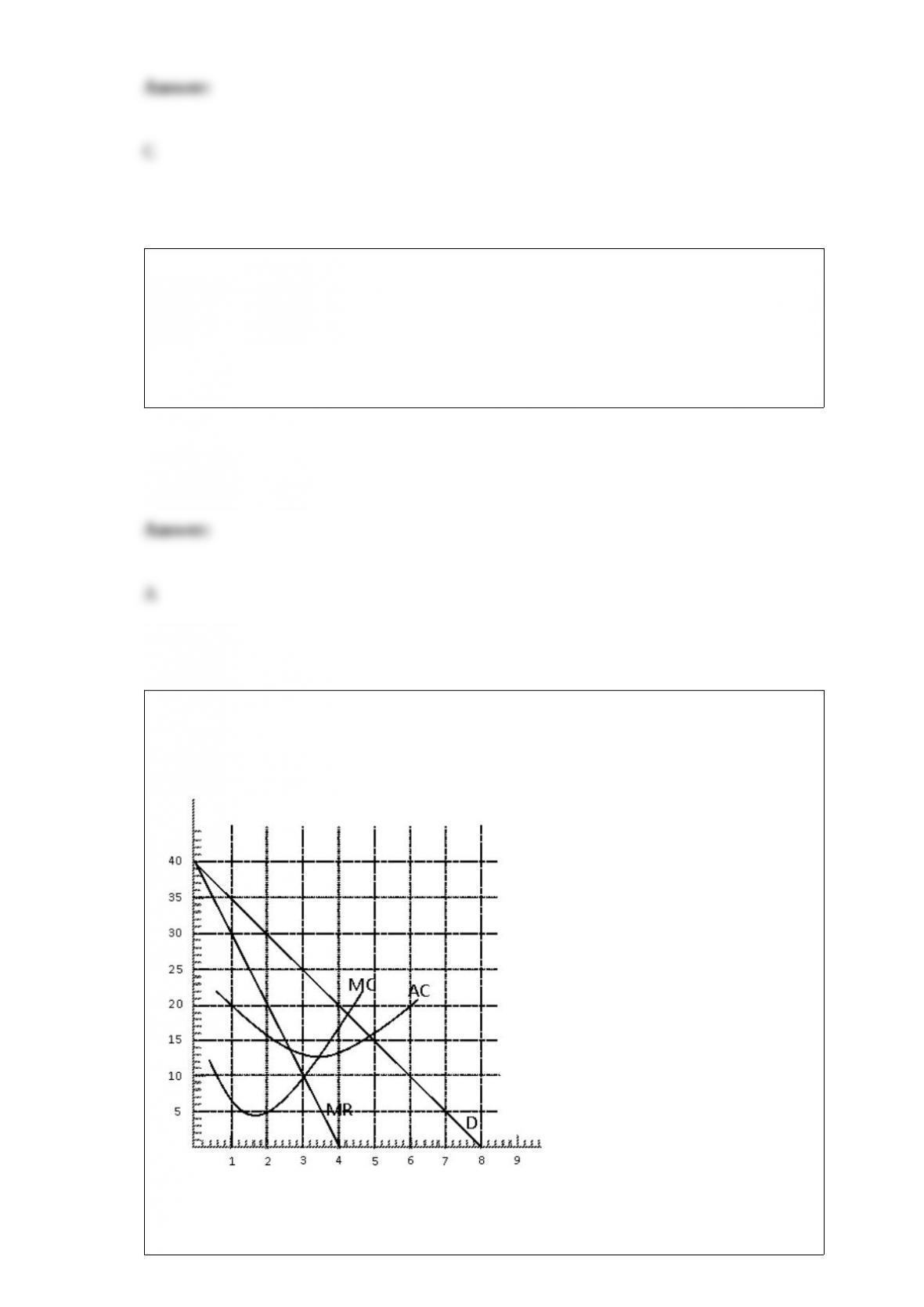
Exhibit 9-18
The firm in Exhibit 9-18, who charges the same price to all customers, will earn how
much revenue?
a. $25

b. $50
c. $75
d. $100
e. $125
Which of the following would be most likely to increase the demand for downtown
parking in a large city?
a. improved bus service to the downtown area
b. lower downtown parking fees
c. more downtown parking lots
d. more freeways leading to the downtown area
e. a major employer moves to the suburbs
The set of mechanisms and institutions that resolve the basic economic questions is
called the
a. economic system
b. production possibilities dilemma
c. business resolution device
d. absolute advantage determination
e. comparative advantage determination
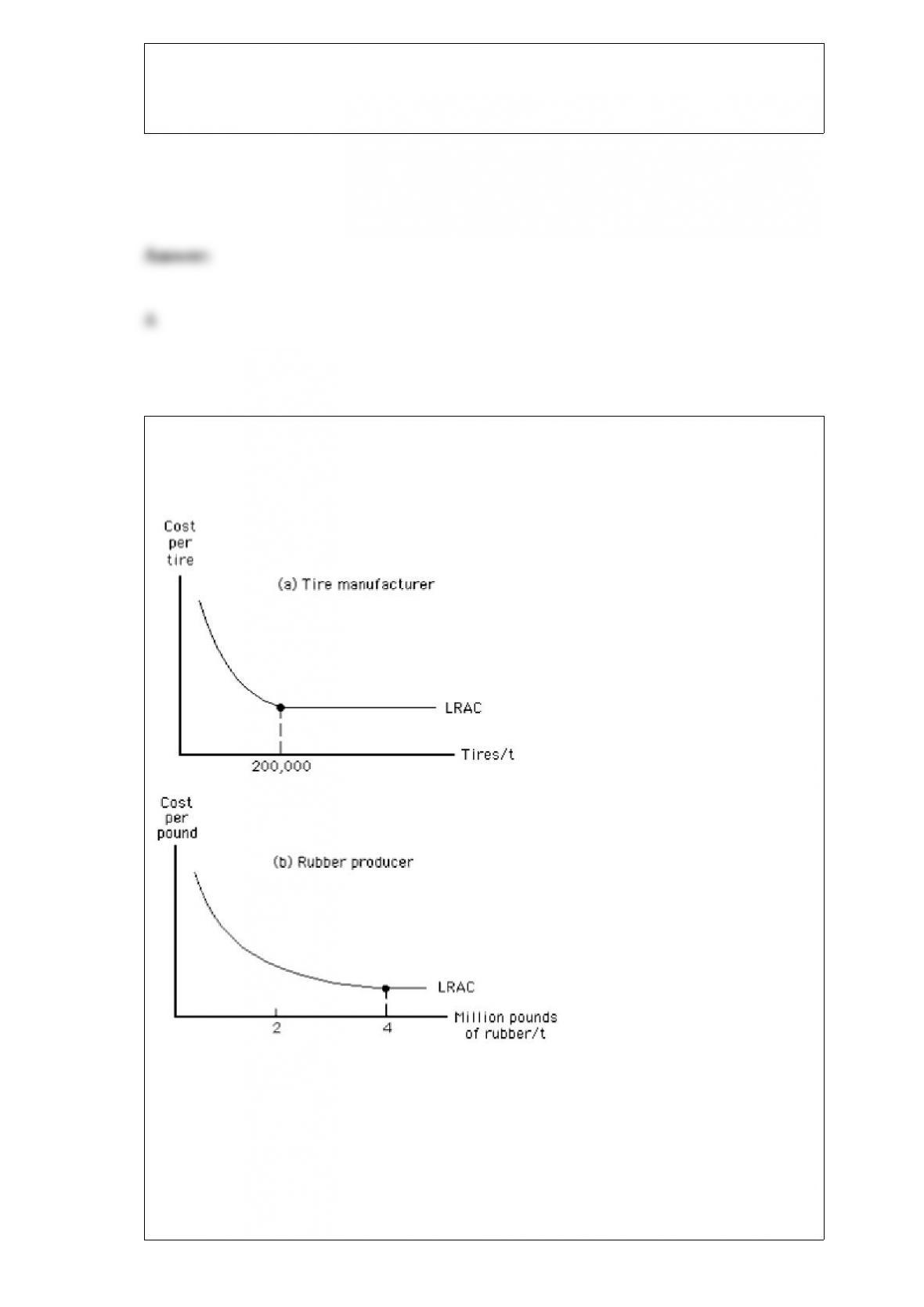
Exhibit 14-1
In Exhibit 14-1, suppose each tire produced requires ten pounds of rubber. Which of the
following is true?
a. The tire manufacturer should integrate backward into producing rubber.
b. The tire manufacturer should produce more than 200,000 tires.

c. The tire manufacturer should buy rubber rather than produce it.
d. The rubber producer must be a monopolist.
e. The minimum efficient scale of rubber production is 2 million pounds.
Based on 2005 data what country is the worlds leading recycler?
a. Germany
b. United States
c. Japan
d. Ireland
e. Canada
Which of the following would indicate that a tax is regressive?
a. High-income people pay $5,000; low-income people pay $2,000.
b. High-income and low-income people pay $200 each.
c. High-income people pay 20 percent of their income in taxes; low-income people pay
10 percent.

d. Both high-income and low-income people pay 10 percent of their income in taxes.
e. Low-income people are exempt from the tax.
Which category includes the largest number of firms?
a. sole proprietorship
b. partnership
c. corporation
d. S-corporation
e. limited partnerships
Suppose Arf n’ Barf restaurant has a monopoly on restaurant food in a certain small
town. Their rent, which is one of several fixed costs they pay whether they sell food or
not, has gone up. In the short run, the Arf n’ Barf should
a. pay the higher rent and increase menu prices
b. pay the higher rent and leave menu prices unchanged
c. pay the higher rent and lower prices
d. go out of business
e. shut down

Which of the following does a monopoly control, that a perfectly competitive firm does
not control?
a. how much to produce
b. technology
c. what price to charge
d. what inputs to use
e. plant size
As welfare rolls declined during the late 1990s and early 2000s,
a. states with aggressive work requirements found that their federal grants also declined
b. states with aggressive work requirements were rewarded with larger federal grants
c. few welfare recipients were able to find jobs
d. there was a significant increase in welfare spending per recipient
e. states cut back on their provision of services such as job placement and child care

Activities that go unreported to the government in order to avoid paying taxes or
because the activity is illegal are known collectively as the
a. non-profit sector
b. federal sector
c. illegal economy
d. special-interest category
e. underground economy
Which of the following does not explain why U.S. wage rates are higher than wage
rates in developing countries?
a. better education and training of workers in the United States
b. greater availability of capital in the United States
c. use of the latest technology in the United States
d. higher productivity in the United States
e. unstable business conditions in the United States
An increase in demand for chocolate chips would usually result in a(n)

a. higher equilibrium price and a lower equilibrium quantity
b. lower equilibrium price and a lower equilibrium quantity
c. lower equilibrium price and a higher equilibrium quantity
d. higher equilibrium price and a higher equilibrium quantity
e. increase in the supply of chocolate chips
Officials have estimated the size of the U.S. underground economy to be approximately
a. 6 to 8 percent of GDP
b. about $5 trillion
c. 50 percent of GDP
d. $60-80 billion
e. about $1 trillion
It is possible for a firm to enjoy a short-run producer surplus, while at the same time
suffering a short-run economic loss
a. True

b. False