If the actual federal budget shows a deficit but the structural budget deficit is falling,
economists would conclude that
a. the structural deficit is based on an incorrect estimate of potential output.
b. the actual budget deficit should be revised to equal the structural deficit.
c. government spending should be curtailed severely.
d. current fiscal policy is probably doing a fair job of stabilizing the economy.
e. the tax rate is too low.
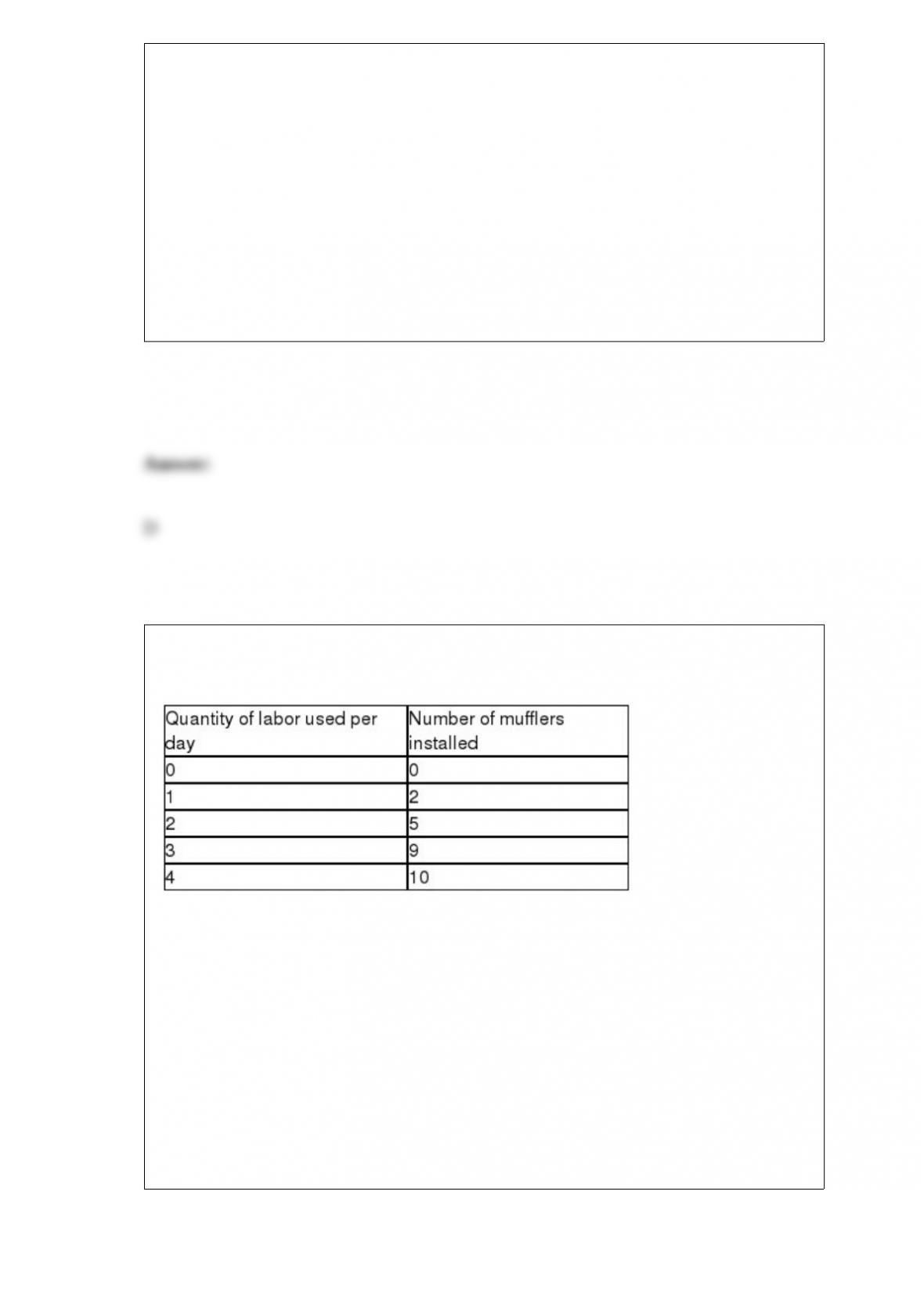
The following questions are based on the following information for an auto repair shop
specializing in muffler installation.
The marginal product of the fourth worker is
a. 1.
b. 2.
c. 4.
d. 9.
e. 10.
While much of the U.S. business world was struggling with the problems of the Great
Depression and clinging to the classical view that the country’s economic problems
would rectify themselves, John Maynard Keynes felt that the way out of the depression
was to
a. hold the lid on consumer demand while expanding production.
b. expand effective aggregate demand by using government’s power to spend and tax.
c. make larger numbers of people employable.
d. limit government power to tax.
e. nationalize all basic industries as the first step toward socialism.
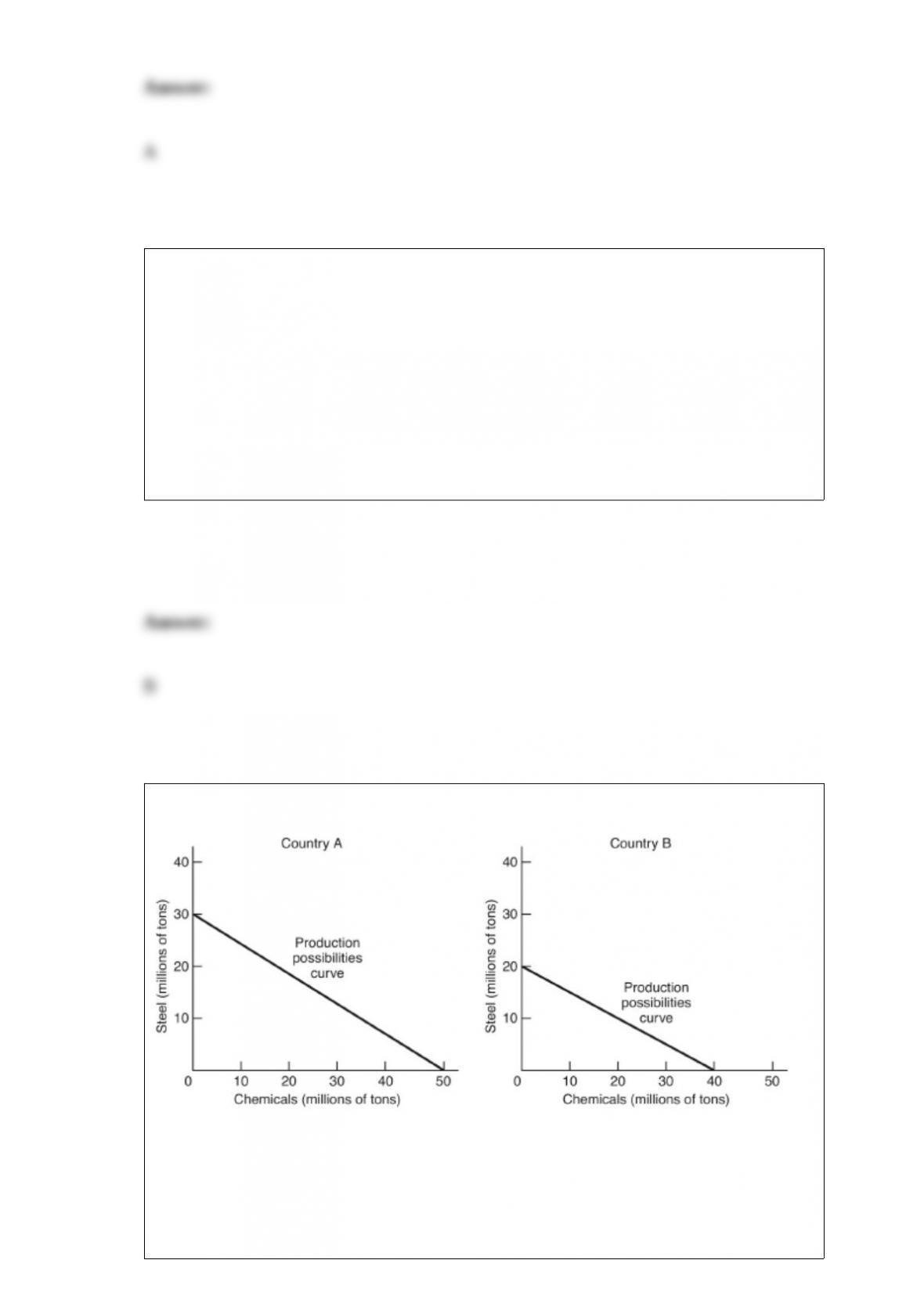
The following questions are based on the following diagrams:
Trade between these two countries would
a. probably result in complete specialization.
b. probably result in partial specialization because the costs of producing steel and

chemicals are rising.
c. be unlikely because country B is less productive than country A.
d. take place only if there are qualitative differences between each country’s goods.
e. tend to enrich country A at the expense of country B.
Which of the following best summarizes the short-term outcome of the restrictions on
Japanese imported cars during the 1980s?
a. Many jobs were saved, but consumers paid for them in higher foreign and domestic
auto prices.
b. Despite higher prices on both domestic and imported cars, few jobs could be saved.
c. Ultimately, additional jobs were lost, but prices were held constant for over a year.
d. The restrictions had little effect on the job market, but domestic car costs fell
substantially.
e. They were ineffective in both reducing the imports of Japanese cars and saving U.S.
jobs.
The basic requirement of money is that it be
a. backed by precious metals.

b. authorized as legal tender by the nation’s government.
c. generally accepted as a medium of exchange.
d. some form of debt or credit.
e. unlimited in quantity.
A primary function of investment bankers is to
a. help firms sell their securities to the public.
b. create money and promote economic growth.
c. pay interest and provide customers with economic security.
d. set interest rates and support the Federal Reserve.
e. collect taxes and hold government deposits.
A country’s standard of living is closely correlated with its
a. physical size.
b. population density.

c. mineral resources
d. cultural diversity.
e. labor force productivity.
In the long run, what adjustments take place when a perfectly competitive market in
long-run equilibrium experiences an increase in demand?
a. Price and profits fall, causing new firms to enter and existing firms to expand.
b. Price and output remain fixed.
c. Price rises but output remains unchanged.
d. Price rises and firms expand output by using existing capacity more intensively.
e. New firms enter and existing firms expand capacity, leading to an increase in supply
and a decline in price.
In national output determination theory, personal consumption expenditures depend
primarily on
a. the amount of net investment.
b. the expected rate of return.
c. disposable income.
d. the difference between the average and marginal propensities to consume.
e. the aggregate demand curve.
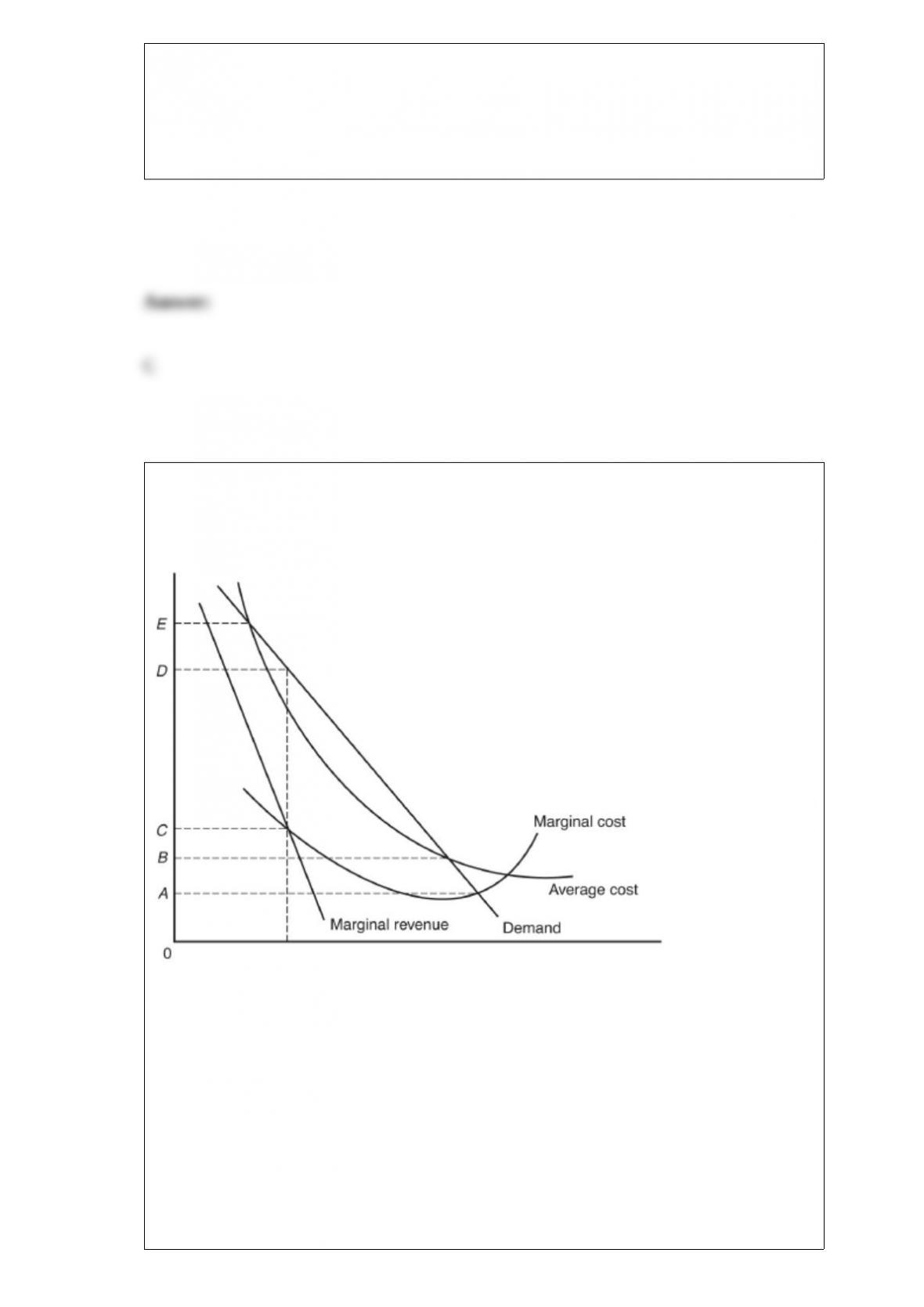
The following questions are based on the following graph showing the demand and cost
curves of a regulated monopolist. Assume the cost curves include provisions for “fair”
rates of return.
The regulatory agency typically establishes a price of
a. 0A.
b. 0B.
c. 0C.
d. 0D.
e. 0E.

Farm programs in many countries reflect the disproportionate amount of political power
that farmers possess. In part, this power drives from the fact that
a. in most countries, farmers constitute more than one-half of the population.
b. technological advances in agriculture have given farmers more time to serve as
elected representatives.
c. governments raise more income from taxes on agricultural production, processing,
and distribution than they do from other sectors of the economy.
d. agricultural programs are likely to be more cost-effective and efficient than free
market alternatives.
e. countries do not want to be dependent on foreign sources of food, or be ill-prepared
in the event of droughts.
Economists view the relationship between the degree of equality of income and wealth
and economic efficiency as a
a. technicality.
b. tradeoff.
c. tempest in a teapot.
d. truism.

e. travesty of justice.
The pure rate of interest is the
a. rate of interest charged for large, as compared to small, loans.
b. interest rate minus any administrative costs, such as bookkeeping and collection.
c. difference between the interest rate charged on a loan with no risk and one with a
measurable degree of risk.
d. prime rate of interest.
e. interest rate on a riskless loan.
An external economy occurs when
a. library facilities of a university are open to the general public without charge.
b. wealthy individuals are taxed more heavily to support programs to help poor people.
c. a consumer buys a hamburger and a milkshake.
d. someone attends a regular Academy of Music performance of the Philadelphia
Orchestra.
e. people smoke in public facilities.

A group of firms that produce similar goods is called a ________ group.
a. monopolistic
b. product
c. market
d. retail
e. homogeneous
Demand-side inflation is most likely to occur when the economy
a. has substantial excess capacity.
b. is approaching or operating at full employment.
c. has an aggregate demand curve shifting to the left.
d. has a horizontal aggregate supply curve.
e. has labor productivity rising faster than wages.
The firm or individual that first applies a new technology is called a(n)
a. consumer.
b. monopolist.
c. Keynesian.
d. innovator.
e. financier.
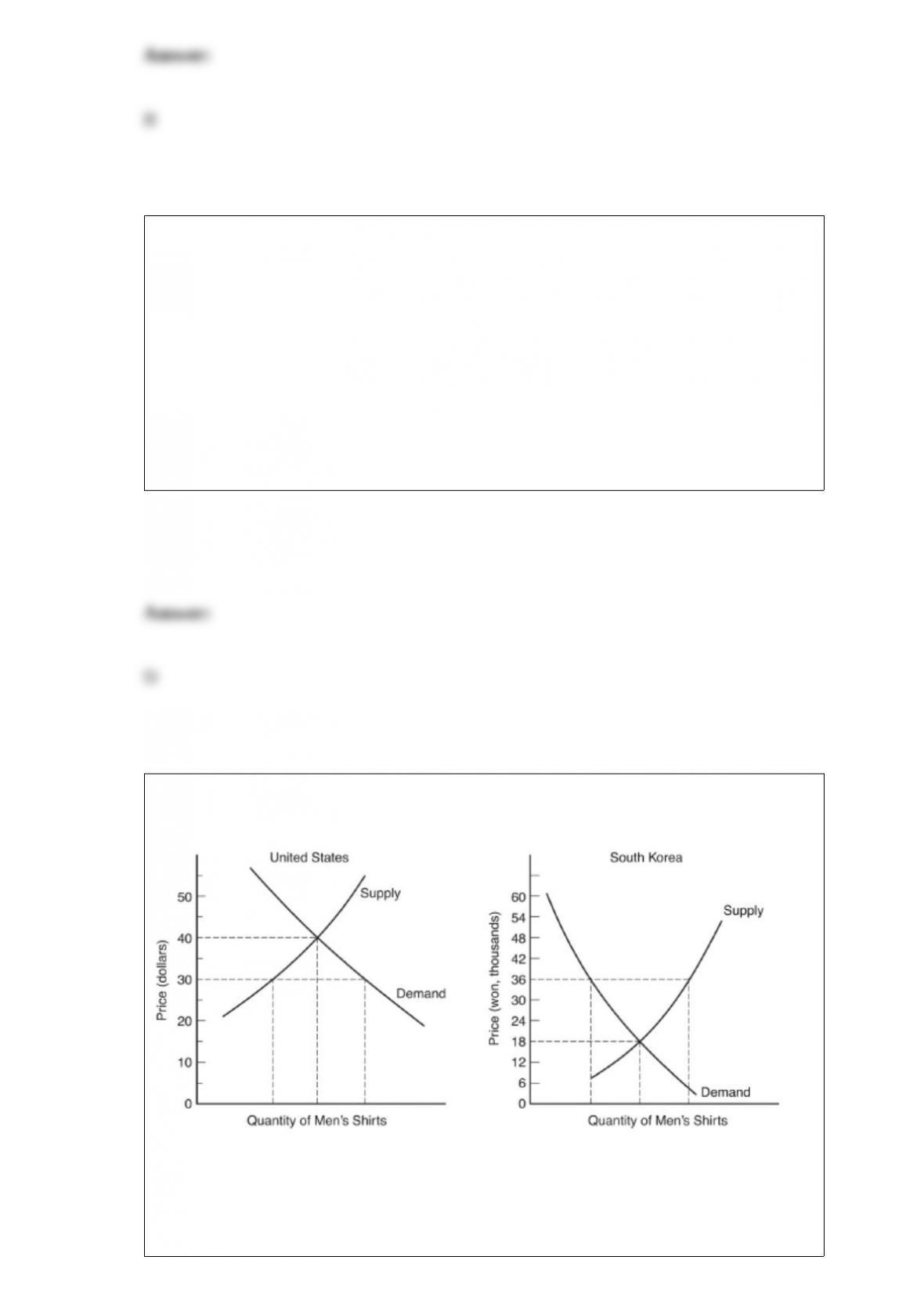
The following questions are based on the following graphs for men’s shirts in South
Korea and the United States. The exchange rate is 1,200 won equals $1.00.
Under the market conditions shown in the graphs
a. the United States tends to export men’s shirts to South Korea. The price falls in the
United States but rises in South Korea.
b. the United States imports all of its men’s shirts and curtails domestic production.
c. the demand curve for men’s shirts in the United States and the supply curve for men’s
shirts in South Korea both shift to the left and prices in the two markets equalize.
d. the South Koreans introduce a tariff on imported men’s shirts to keep out U.S. goods.
e. the United States tends to import men’s shirts from South Korea rather than export
men’s shirts to it.
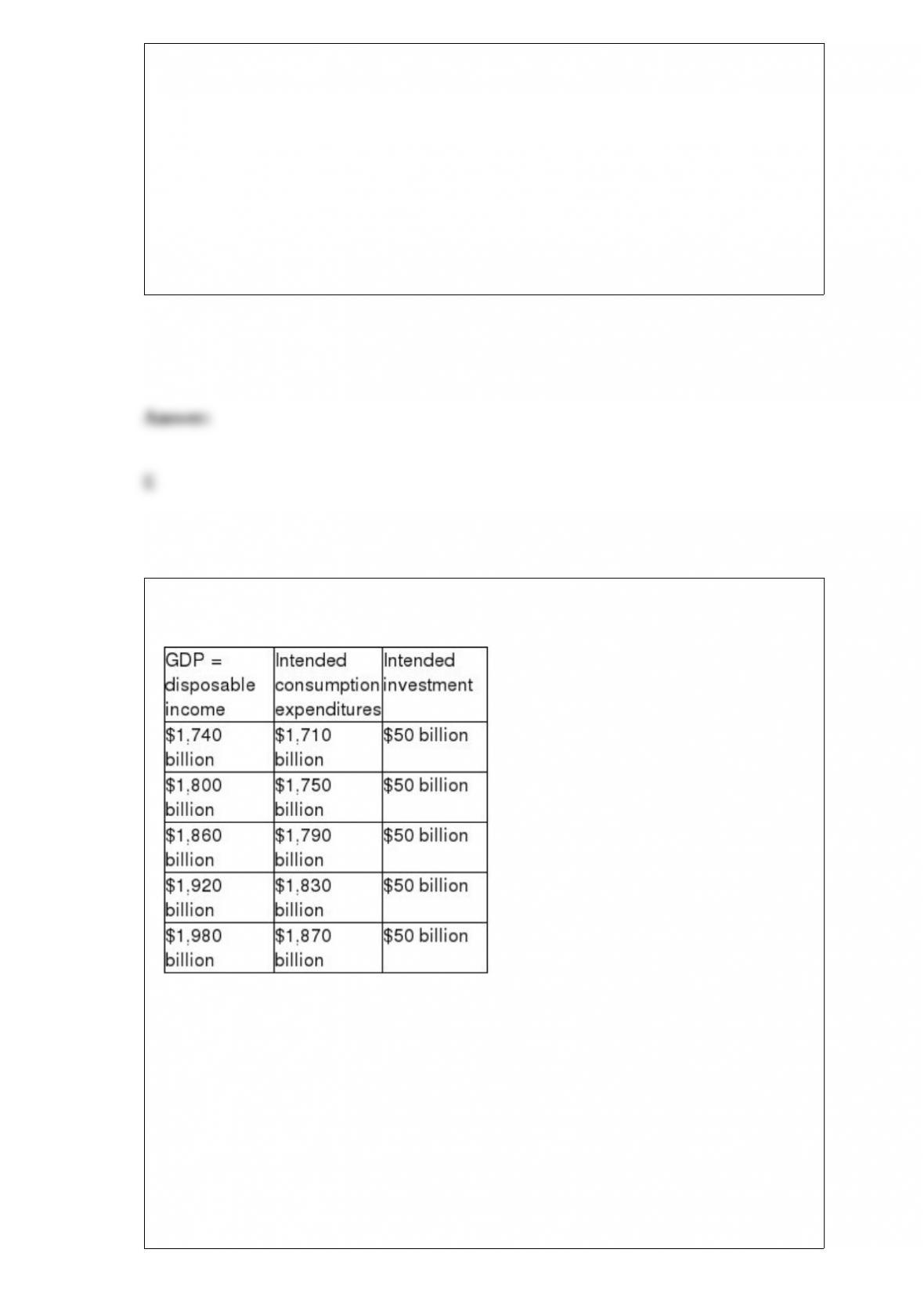
The following questions are based on the following information:
If actual GDP equals $1,980 billion
a. intended saving equals intended investment.
b. the economy is operating below its equilibrium level.
c. business inventories will increase by $60 billion.
d. producers will plan to increase production further still.

e. the C + I line lies above the 45-degree line.
The economic situation experienced by the country in the mid-1970s was different from
that in preceding times mainly because
a. inflation was higher than it had ever been.
b. total unemployment reached record levels.
c. it faced high unemployment coupled with high inflation.
d. the federal budget steadily decreased as a percentage of GDP.
e. this was the first time the Fed held to a tight monetary policy.
If total intended spending precisely equals GDP
a. inflation soars.
b. consumer spending begins to decline.
c. expected rates of return exceed interest rates.
d. unemployment rises.
e. GDP tends to remain unchanged.

The marginal propensity to consume is
a. 1.
b. 19/21.
c. 5/7.
d. 2/3.
e. impossible to tell from the graph.
Severe inflations often result when
a. the economy is in a serious depression.
b. governments excessively increase the money supply.
c. price levels are falling.
d. the value of money rises rapidly.
e. the public’s desire to hold money balances increases.

GDP is at the equilibrium level when
a. total intended household spending equals business spending.
b. it is at full-employment level.
c. the rate of inflation equals the rate of unemployment.
d. any further increases in intended spending increase the price level.
e. it equals the amount of intended spending.
Some opposed to using federal budget surpluses to cut taxes argue that
a. surpluses could disappear and deficits return in the future, so we should not take any
chances and instead pay down the national debt.
b. since the tax has already been collected, there is no need to return it.
c. cutting taxes would set off a recession, reducing government revenue.
d. the larger the budget surplus, the greater the money supply, which automatically
reduces taxes.
e. taxes are currently at historically low levels.

The fact that surgeons receive higher hourly wages than school teachers reflects the
a. higher hourly value of a surgeon’s marginal product.
b. shortage of school teachers.
c. surplus of surgeons.
d. longer hours worked by surgeons.
e. incompetence of school teachers.
The basic characteristic of an economic resource is that it
a. is made by machine.
b. is free.
c. is relatively scarce.
d. consists of buildings, equipment, and inventories.
e. comes from the earth.

The basic distinction between the short run and the long run in a perfectly competitive
industry is that in the long run, firms
a. earn economic profits.
b. are free to enter or exit.
c. face vertical demand curves.
d. have zero marginal costs.
e. produce the highest possible output rates.
An inflationary gap
a. exists when actual spending is less than intended spending.
b. measures the additional intended spending needed to ensure full employment.
c. indicates the additional spending needed to lower the rate of inflation.
d. measures the increase in GDP needed to achieve full employment.
e. can be eliminated by fiscal policies designed to shift the aggregate demand curve to
the left.