
If a government chooses to finance a budget deficit by borrowing and the expected
inflation rate does not change, this will cause the real interest rate to ________ and the
nominal interest rate to ________.
A) increase; increase
B) increase; decrease
C) decrease; increase
D) decrease; decrease
As a percentage of GDP, U.S. imports have been ________ and U.S. imports have been
________ since 1950.
A) growing; declining
B) declining; growing
C) growing; growing
D) declining; declining
When the nominal interest rate is constant, ________ in the growth rate of the money
supply ________ the inflation rate, and ________ the debt-to-GDP ratio.
A) an increase; increases; increases

B) an increase; decreases; increases
C) a decrease; decreases; decreases
D) a decrease; decreases; increases
The more leveraged an investment, the ________ the potential gain and the ________
the potential loss from that investment.
A) greater; greater
B) greater; smaller
C) smaller; smaller
D) smaller; greater
When determining interest rates, the loanable funds model is more useful when we are
concerned with the determinants of the ________, and the money market model is more
useful when we are concerned with the determinants of the ________.
A) long-term real interest rate; short-term nominal interest rate
B) short-term real interest rate; long-term nominal interest rate
C) short-term real interest rate; short-term nominal interest rate

D) long-term real interest rate; long-term nominal interest rate
If the world real interest rate were 6% and the domestic real interest rate in Estonia was
4%, borrowers in Estonia would borrow at the rate of ________ and lenders in Estonia
would lend at the rate of ________.
A) 6%; 6%
B) 6%; 4%
C) 4%; 6%
D) 4%; 4%
________ unemployment is short term, but ________ unemployment can last for longer
periods because workers need time to acquire new skills.
A) Cyclical; frictional
B) Structural; seasonal
C) Seasonal; frictional
D) Frictional; structural

If a minimum wage is set above the equilibrium market wage,
A) lower-skilled workers will have an easier time finding jobs.
B) the quantity of labor demanded will be below the quantity of labor supplied.
C) the quantity of labor supplied will be below the quantity of labor demanded.
D) highly-skilled workers will have a harder time finding jobs.
The combined effect of a real wage increase is that
A) the income effect always dominates, leading to fewer hours worked at a higher
wage.
B) the substitution effect always dominates, leading to more hours worked at a higher
wage.
C) if the substitution effect outweighs the income effect, the labor supply curve slopes
downward, but if the income effect outweighs the substitution effect, the labor supply
curve slopes upward.
D) if the substitution effect outweighs the income effect, the labor supply curve slopes
upward, but if the income effect outweighs the substitution effect, the labor supply
curve slopes downward.

If actual inflation is lower than expected inflation,
A) there is a redistribution of wealth from borrowers to lenders.
B) there is a redistribution of wealth from lenders to borrowers.
C) there is no redistribution of wealth, but the total wealth in the economy increases.
D) there is no redistribution of wealth, but the total wealth in the economy decreases.
If the rate of job finding equals 7%, and the rate of job separation equals 1%, then the
natural rate of unemployment is
A) 7%.
B) 8.75%.
C) 12.5%.
D) 14.3%.

When an economy is on the balanced growth path, the growth rate of real GDP per
capita is determined by the growth rate of
A) convergence.
B) capital accumulation.
C) total factor productivity.
D) the labor force.
Credit rationing and the financial accelerator are responsible, in part, for
A) the significant volatility of gross private investment.
B) the significant volatility of real personal consumption.
C) smoothing gross private investment during severe recessions.
D) smoothing real personal consumption during expansions.
Suppose the Fed has a target inflation rate of 3%, the Fed always hits its target, and the
inflation rate has been 3% for several years. Furthermore, assume Amazon sets the price
of its Kindle Fire at $140 in 2012 and wants to keep the real price of the Kindle
constant in order to maximize profits. Now suppose that the Fed announces on January
1, 2013 that it will decrease its target rate for inflation to 1%. If Amazon has rational
expectations, it will set its price for the Kindle in 2013 at

A) $137.20.
B) $140.00.
C) $141.40.
D) $144.20.
Of the three primary tax sources of revenue for the U.S. federal government, which of
the following has displayed no long-term trend as a percentage of GDP since 1962?
A) corporate income taxes
B) social insurance taxes
C) sales and excise taxes
D) individual income taxes
Expenditure and tax multipliers are likely to be large
A) if the economy is experiencing deflation.
B) when real interest rates rise rapidly.
C) during severe recessions.

D) if the economy has negative cyclical unemployment.
Janie convinces her uncle Seymour that she is on the Dean’s list each semester and asks
him to lend her $5,000 to help pay for her college tuition for the upcoming year,
assuring him that she will be able to pay him back as soon as she graduates and gets a
job. In reality, Janie has flunked out of college, has spent all her savings on food for her
40 ferrets, and wants to use the money to bail her boyfriend out of jail. Not being honest
with her uncle when asking for the loan is an example of ________, and spending the
borrowed money to pay her boyfriend’s bail is an example of ________.
A) moral hazard; asymmetric information
B) moral hazard; the principal-agent problem
C) adverse selection; moral hazard
D) the principal-agent problem; adverse selection
Three policy lags limit the effectiveness of monetary policy: recognition lags,
implementation lags, and impact lags. Of these three policy lags, fiscal policy is
impacted by
A) only implementation and impact lags.
B) only recognition and implementation lags.

C) only recognition and impact lags.
D) all three policy lags.
The government’s budget deficit is financed by some combination of all of the
following except
A) private saving.
B) transfer payments.
C) net exports.
D) reduced private investment.
When incorporating labor-augmenting technological change into the Solow growth
model, the focus is on
A) capital per worker and output per worker.
B) capital per effective worker and output per worker.
C) capital per worker and output per effective worker.
D) capital per effective worker and output per effective worker.
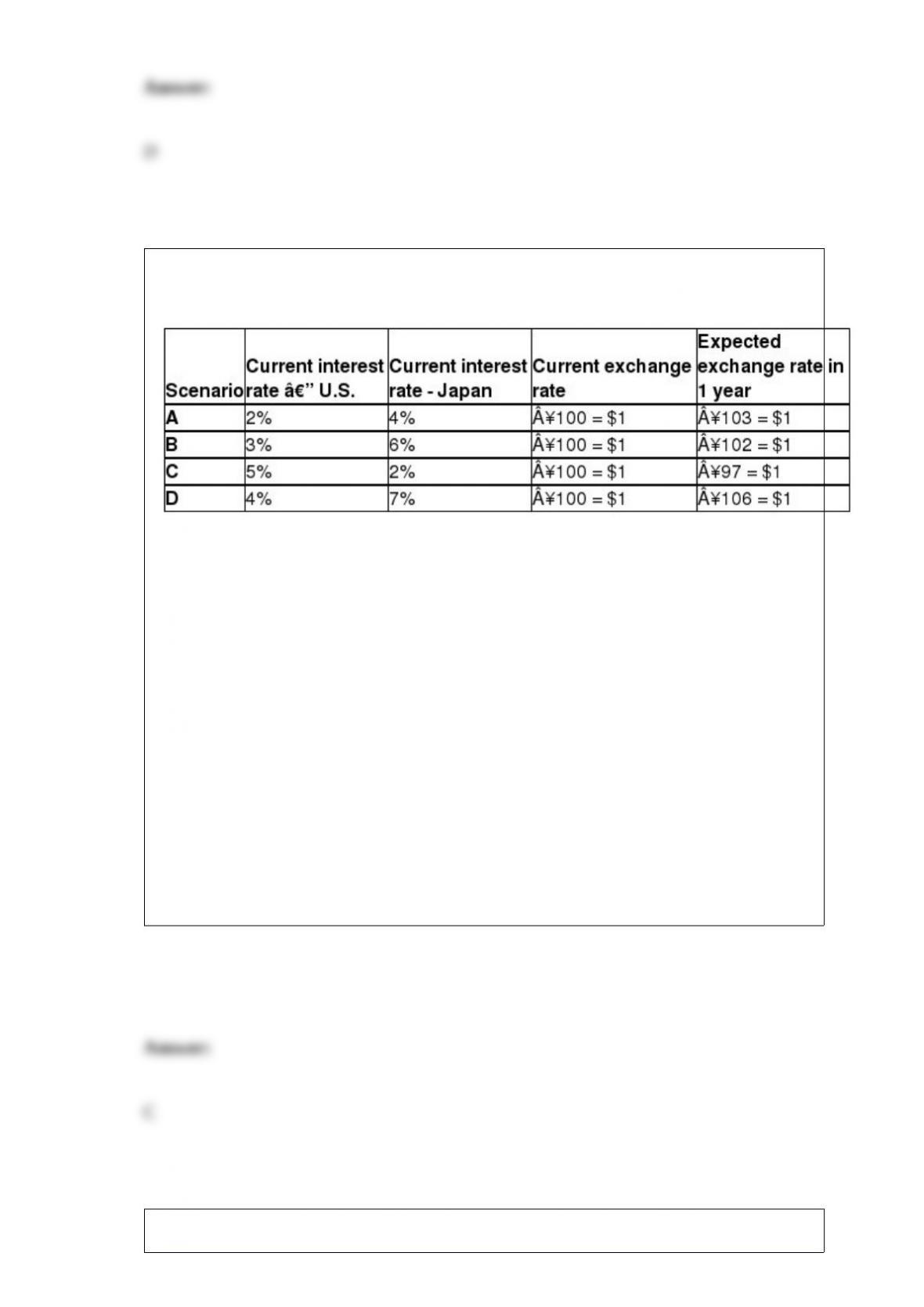
Table 4.2
Suppose that you intend to invest $10,000 in one-year government bonds. You are
looking for the highest return on your investment and do not care whether you
invest in the United States or Japan, but as U.S. resident, you want your
investment return to be in U.S. dollars. The Table lists 4 scenarios, each showing
the current interest rate for one-year government bonds in the United States and
Japan, the current exchange rate between the dollar and the yen, and the expected
exchange rate in one year. Other than the interest rates, you assume the bonds
from each country to be identical.
Refer to Table 4.2. In which scenario does the interest parity condition hold?
A) A
B) B
C) C
D) D
Suppose you purchase a two-year bond that has a $450 coupon and a face value of

$5,000, and immediately after you purchase the bond, new bonds are issued that are
otherwise identical, except they have coupons of $375. If you sell your bond, the price
of your bond will be
A) $4,868.07.
B) $5,000.00.
C) $5,069.76.
D) $5,134.67.
If the substitution effect is stronger than the income effect, an increase in real interest
rates will lead to ________ in aggregate consumption and will lead to ________ in
household saving.
A) an increase; a decrease
B) a decrease; a decrease
C) a decrease; an increase
D) an increase; an unclear change
John Maynard Keynes described periods of irrational pessimism and optimism that
affect the investment behavior of firms as animal spirits. When considering the
investment behavior of firms, animal spirits can be thought of as changes in the

A) actual marginal product of capital.
B) capital stock.
C) expected marginal product of capital.
D) user cost of capital.
An increase in uncertainty about the future will tend to ________ precautionary saving
and ________ the desired level of wealth for households.
A) increase; increase
B) increase; decrease
C) decrease; increase
D) decrease; decrease
One of the provisions of the second stimulus bill increased the amount of investment
spending that firms were allowed to depreciate for tax purposes from 50% to 100%. If
and when the government changes the depreciation allowance back to its original
amount, this should cause the
A) uc curve to shift down.
B) uc curve to shift up.
C) MPKecurve to shift to the right.
D) MPKecurve to shift to the left.
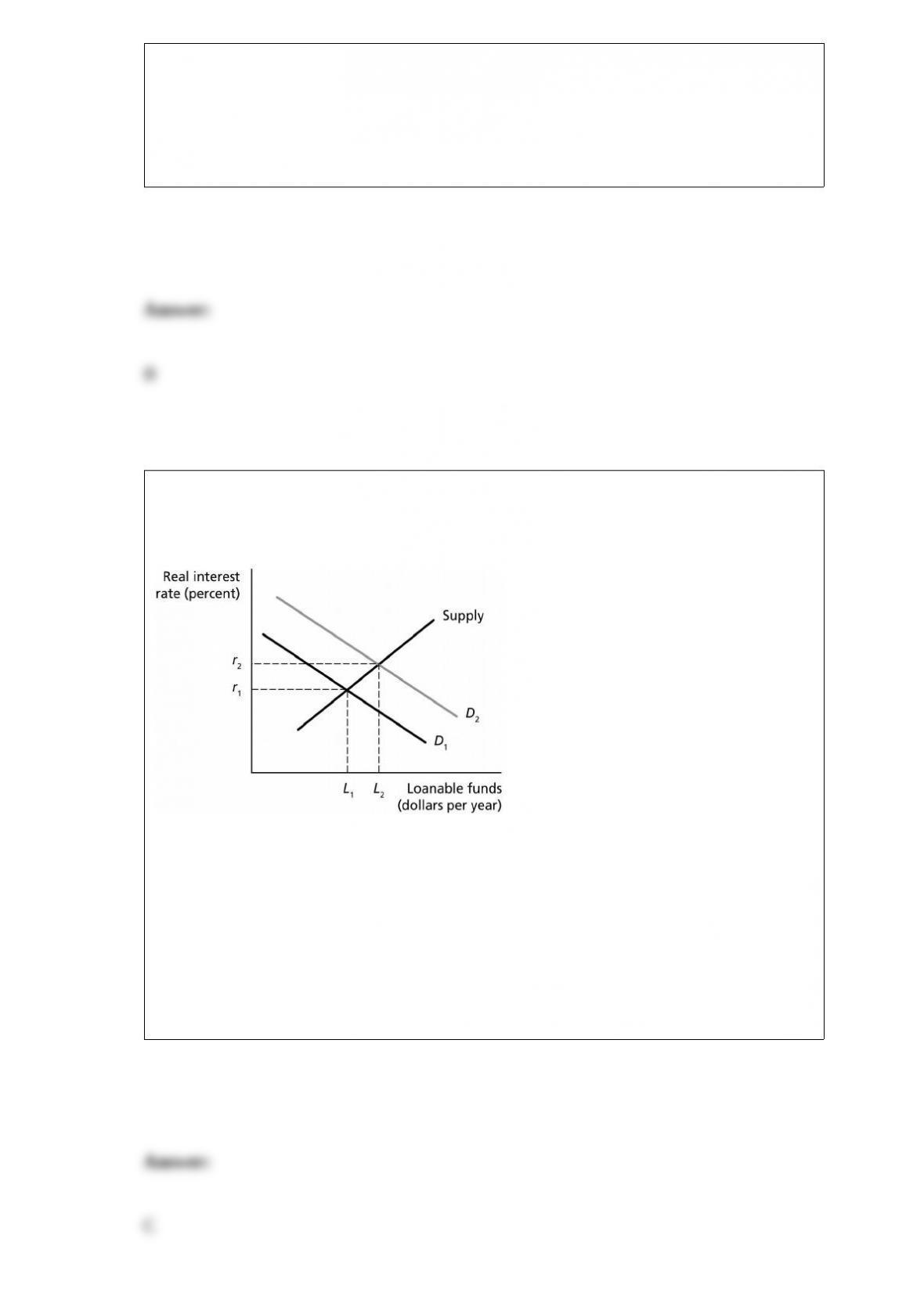
Figure 2
Refer to Figure 4.2. A shift from D2 to D1 will result from which of the following?
A) an increase in expected future profits
B) an increase in net exports
C) an increase in corporate taxes
D) a decrease in tax credits for savings
Assume that the Fed has a target inflation rate of 2% and that the values for how much
the nominal target federal funds rate responds to a deviation of inflation from its target,
g, and how much the nominal target federal funds rate responds to real GDP, h, are both
0.5. According to the Taylor rule, if inflation increases by 6%, the real interest rate will
increase by
A) 3%.
B) 4%.
C) 6%.
D) 9%.
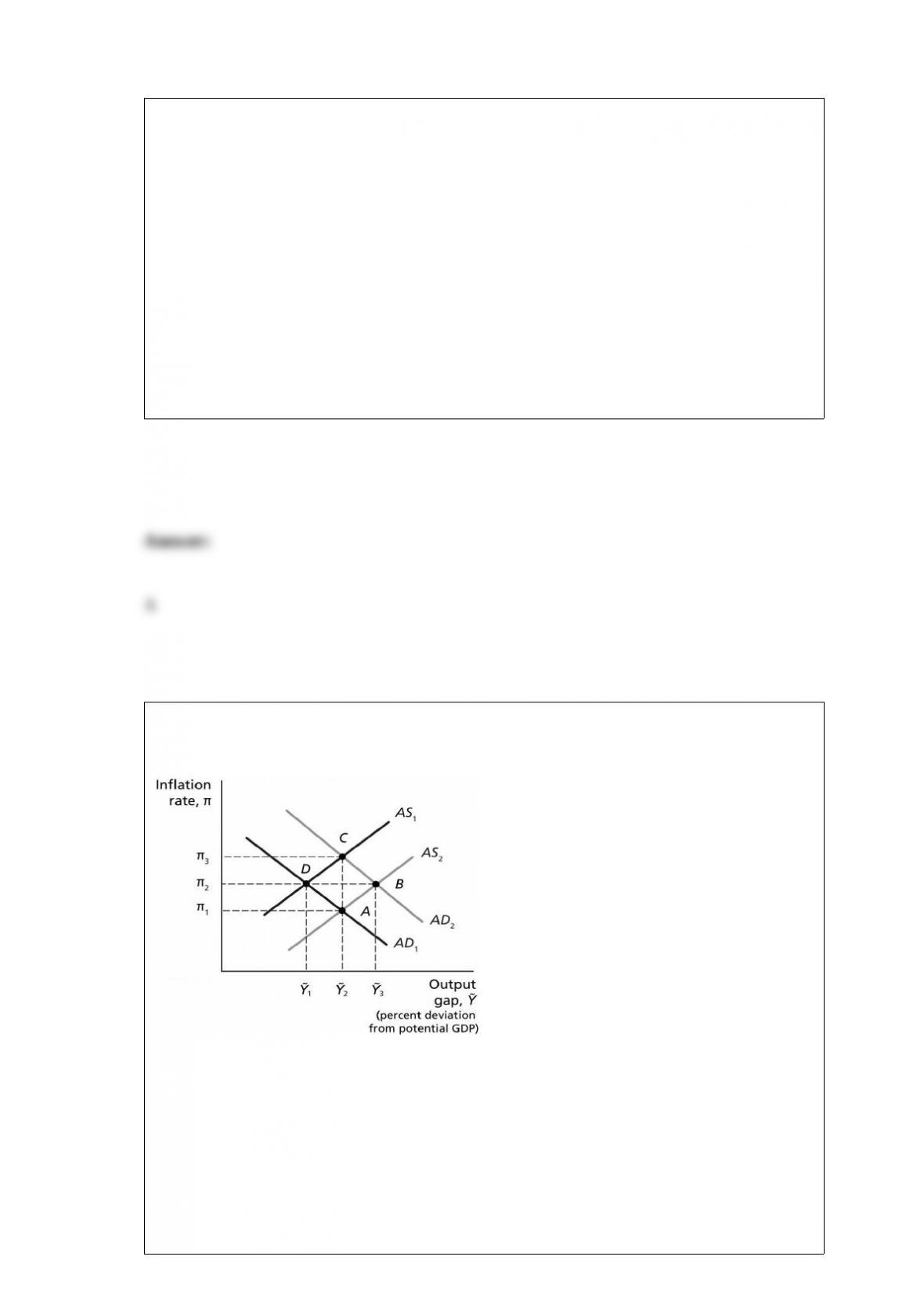
Figure 14.3
Refer to Figure 14.3. Suppose the economy is initially at long-run equilibrium and the
economy experiences a demand shock such as a stock market crash. The economy then
reaches a new, short-run equilibrium point. Assuming expectations are adaptive, this
will allow the central bank to decrease the real interest rate, moving the economy to a
another new equilibrium point. The stock market crash is temporary, so the next
movement on the path to the long-run equilibrium will be from
A) point A to point B.

B) point A to point C.
C) point A to point D.
D) point B to point C.
The oil shock of 2007-2008 saw the price of oil rising from less than $60 a barrel in
March 2007 to over $145 a barrel in July 2008, and decreasing again to just over $30 a
barrel in December 2008. Assuming the economy was at potential GDP prior to the oil
shock, the decrease in the price of oil, such as what occurred between July 2008 and
December 2008, acts as a positive supply shock, causing the inflation rate to ________
and the output gap to ________.
A) increase; grow
B) decrease; grow
C) increase; shrink
D) decrease; shrink
Which of the following has the highest present value?
A) $1,000 received in 3 years if the current interest rate is 4%
B) $1,500 received in 5 years if the current interest rate is 6%

C) $2,000 received in 6 years if the current interest rate is 11%
D) $3,000 received in 10 years if the current interest rate is 12%
Tobin’s q is the ratio of the
A) dividend payments of a firm to the current stock price of the firm.
B) market value of a firm to the replacement cost of its capital.
C) current stock price of a firm to the number of outstanding shares of stock in the firm.
D) current stock price of a firm to the total earnings of the firm.
The Bureau of Economic Analysis releases its estimate for GDP before it releases its
estimate for GDI
A) only for the first quarter of the year.
B) only for the first two quarters of the year.
C) only for the fist three quarters of the year.
D) for all four quarters of the year.
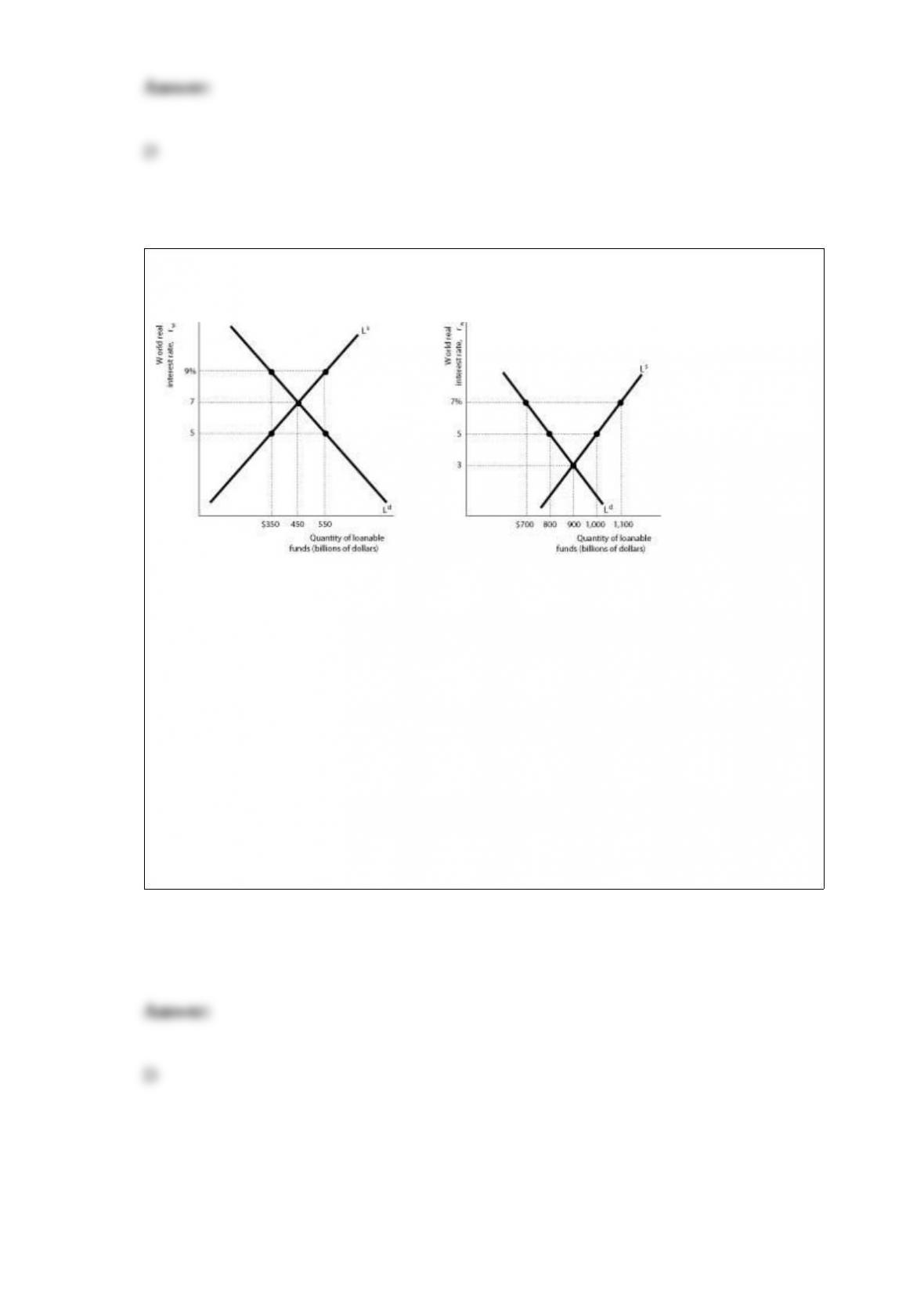
Figure 4.4
Suppose the world consists of two large open economies, the United States and the
rest of the world. The figures above represent loanable funds graphs for these two
economies.
Refer to Figure 4.4. The international capital market will be in equilibrium when the
real interest rate in the United States is ________ and the real interest rate in the rest of
the world is ________.
A) 7%; 3%
B) 5%; 7%
C) 9%; 3%
D) 5%; 5%