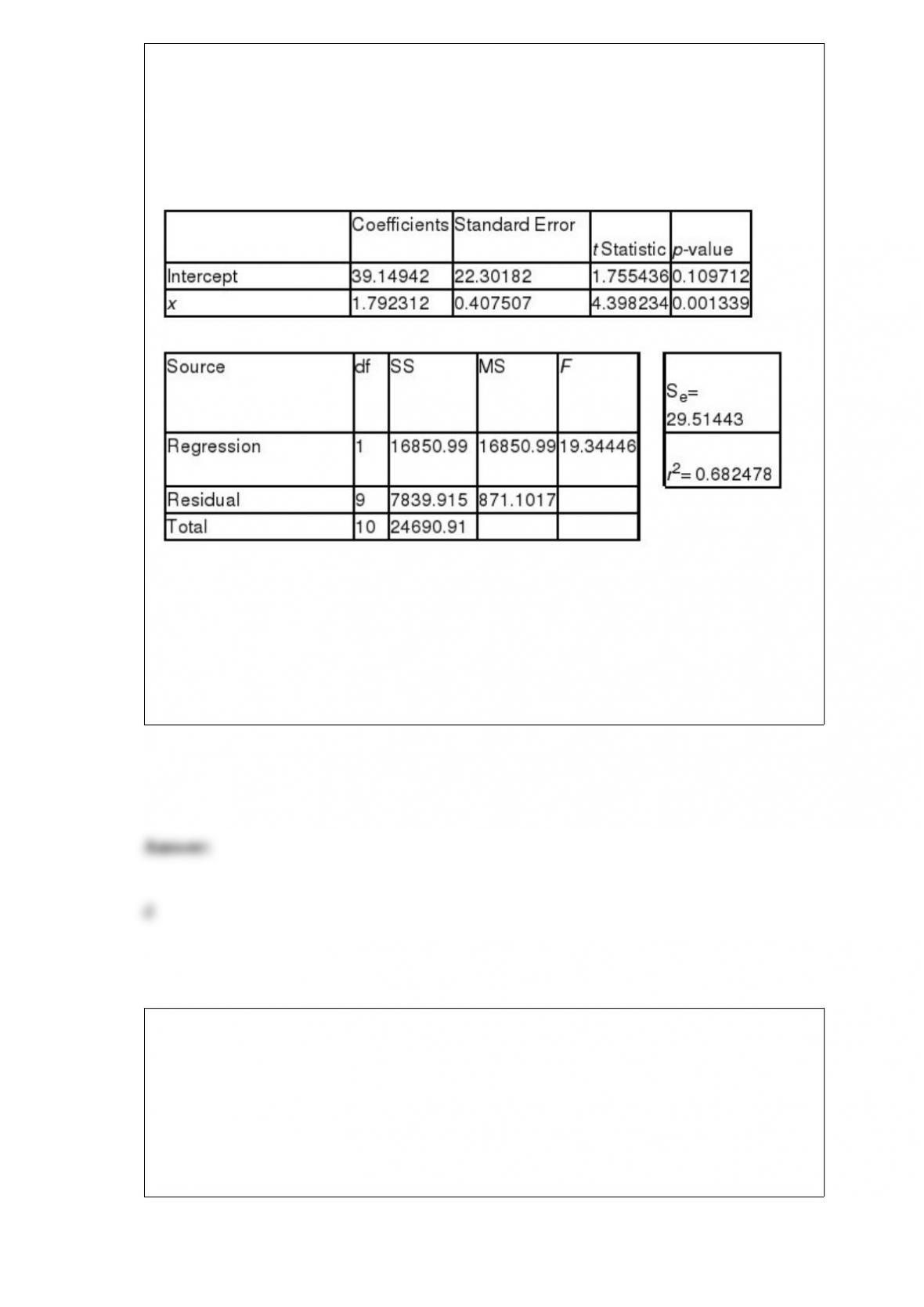
Abby Kratz, a market specialist at the market research firm of Saez, Sikes, and Spitz, is
analyzing household budget data collected by her firm. Abby’s dependent variable is
monthly household expenditures on groceries (in $’s), and her independent variable is
annual household income (in $1,000’s). Regression analysis of the data yielded the
following tables.
For a household with $50,000 annual income, Abby’s model predicts monthly grocery
expenditures of ________________.
a) $150.35
b) $50.35
c) $1,959.29
d) $128.65
e) $1286.50
The alternate hypothesis for a one-sample runs test is __________________.
a) “the observations in the sample are not cross-linked”
b) “the observations in the sample are correlated”
c) “the observations in the sample are not statistically independent”
d) “the observations in the sample are not randomly generated”
e) “the observations are not systematically generated”
Miguel Hernandez , Senior Vice President of Human Resources at Memorial Hospital is
exploring the usage of nursing overtime in the emergency department during the last
operating year. Staffing records and emergency department visits for all 360 days
between the period of January 1, 2012 and December 31, 2012 are selected for analysis.
Miguel’s dataset can best be classified as a
is ordering a ____________.
a) statistic b) census
c) sample
d) sorting
e) parameter
Suppose that .06 of each of two populations possess a given characteristic. Samples of
size 400 are randomly drawn from each population. The standard deviation for the
sampling distribution of differences between the first sample proportion and the second
sample proportion (used to calculate the z score) is _______.
a) 0.00300
b) 0.01679
c) 0.05640
d) 0.00014
e) 0.12000
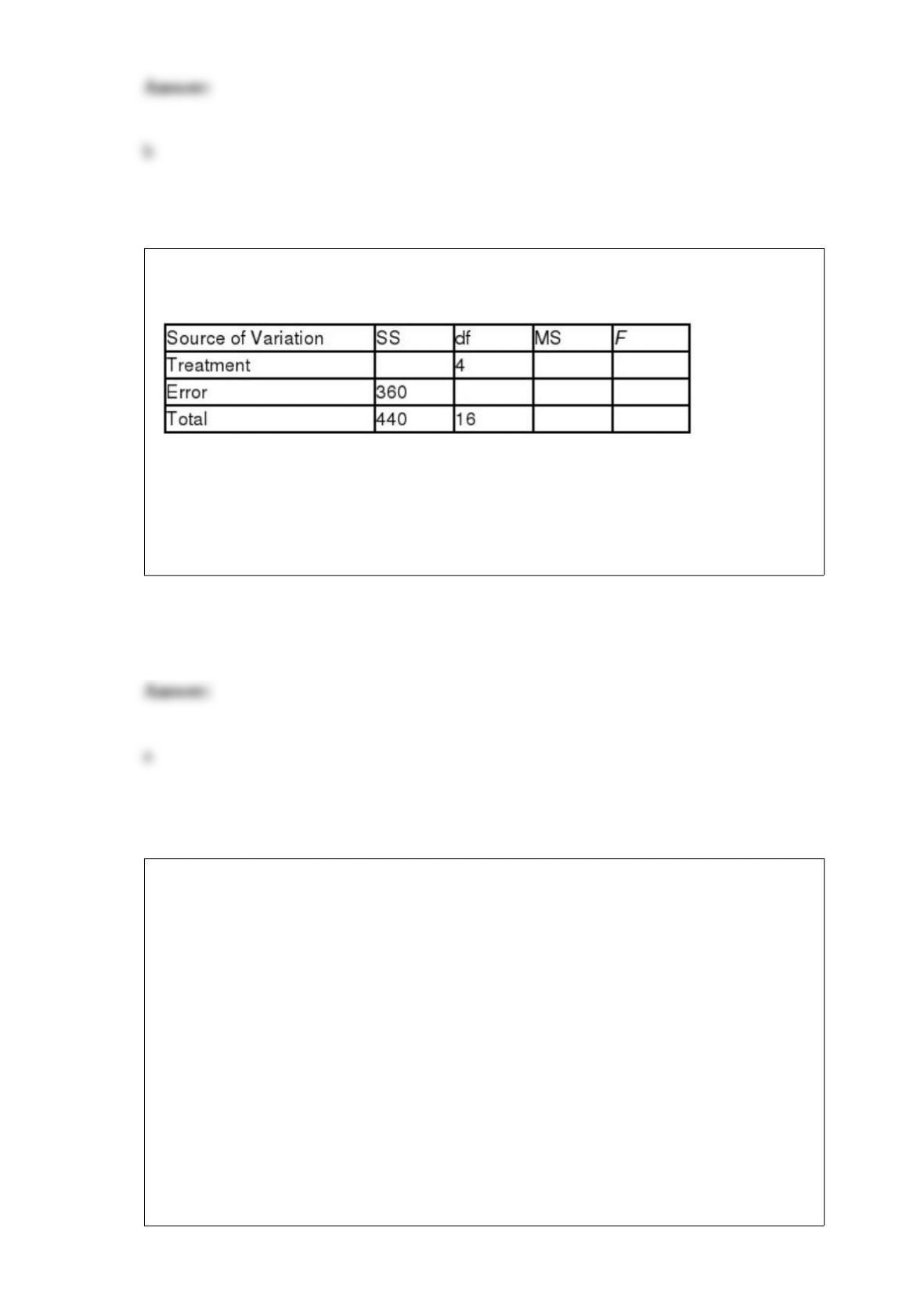
For the following ANOVA table, the MS Treatment value is ___________.
a) 20
b) 200
c) 76
d) 84
e) 360
Rebecca Sear, Marketing Director of a regional restaurant chain, is directing a study to
identify and assess the in-dining experience of the customers at one of the restaurants.
She directs her staff to design a web-based market survey for distribution to all of the
restaurant’s 100 customers who enjoyed a meal during the past 6 months. For this study,
the set of 100 customers is ________________.
a) a parameter
b) a sample
c) the population
d) a statistic
e) the frame
In American Roulette, there are two zeroes and 36 non-zero numbers (18 red and 18
black). If a player bets 1 unit on red, his chance of winning 1 unit is therefore 18/38 and
his chance of losing 1 unit (or winning -1) is 20/38. Let x be the player profit per game.
The mean (average) value of x is approximately_______________.
a) 0.0526
b) -0.0526
c) 1
d) -1
e) 0
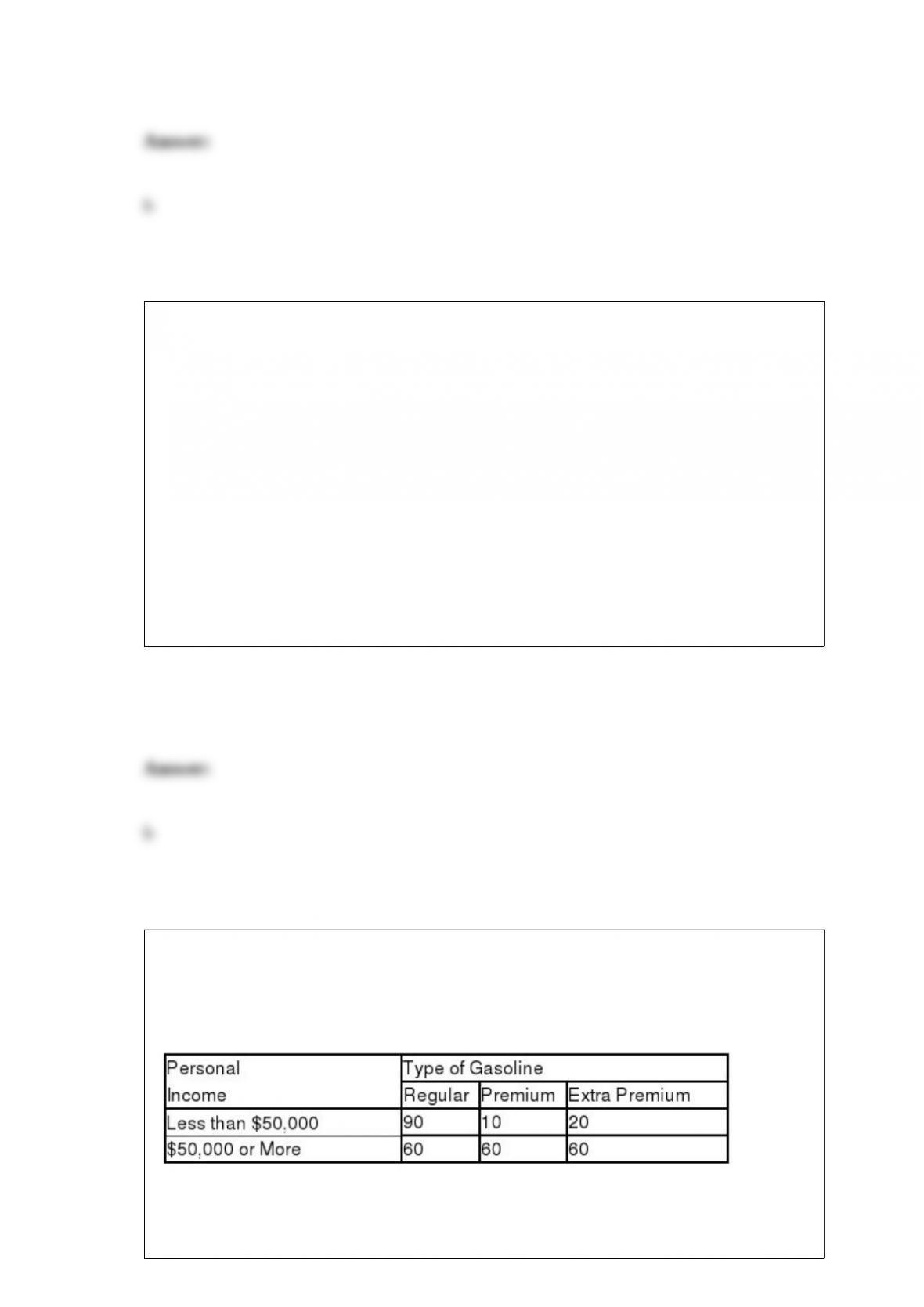
A gasoline distributor wonders whether an individual’s income level influences the
grade of gasoline purchased. The following is a contingency table from a random
sample of 300 individuals.
Using
= .01, critical chi-square value is ______________.
a) 15.09
b) 7.88
c) 9.21
d) 16.81
e) 17.89
Which of the following statements best describes Design for Six Sigma?
a) A process for designing a quality improvement team.
b) The measure and improve steps of a six sigma initiative.
c) A framework for implementing Deming’s 14 points.
d) A root cause analysis using 100% inspection.
e) A quality scheme that emphasizes designing the product or process to perform
defect-free.
A test of independence is to be performed. The contingency table has 4 rows and 5
columns. What would the degrees of freedom be?
a) 20
b) 9
c) 7
d) 12
e) 19
Elwin Osbourne, CIO at GFS, Inc., is studying employee use of GFS e-mail for
non-business communications. A random sample of 200 e-mail messages was selected.
Thirty of the messages were not business related. The 90% confidence interval for the
population proportion is _________.
a) 0.108 to 0.192
b) 0.153 to 0.247
c) 0.091 to 0.209
d) 0.145 to 0.255
e) 0.255 to 0.265
A company that uses benchmarking as a quality improvement practice will ________.
a) emulate the best practices and techniques used in their industry
b) institutionalize the not-invented-here philosophy
c) not analyze the competition’s product
d) rely exclusively on government research for product improvements
e) be in the furniture business
Correlation coefficients may be computed for parametric and nonparametric data. If the
data are nonparametric, which of the following should be used?
a) Pearson correlation coefficient
b) Spearman correlation coefficient
c) Gaussian correlation coefficient
d) De Moivre correlation coefficient
e) Gossett correlation coefficient
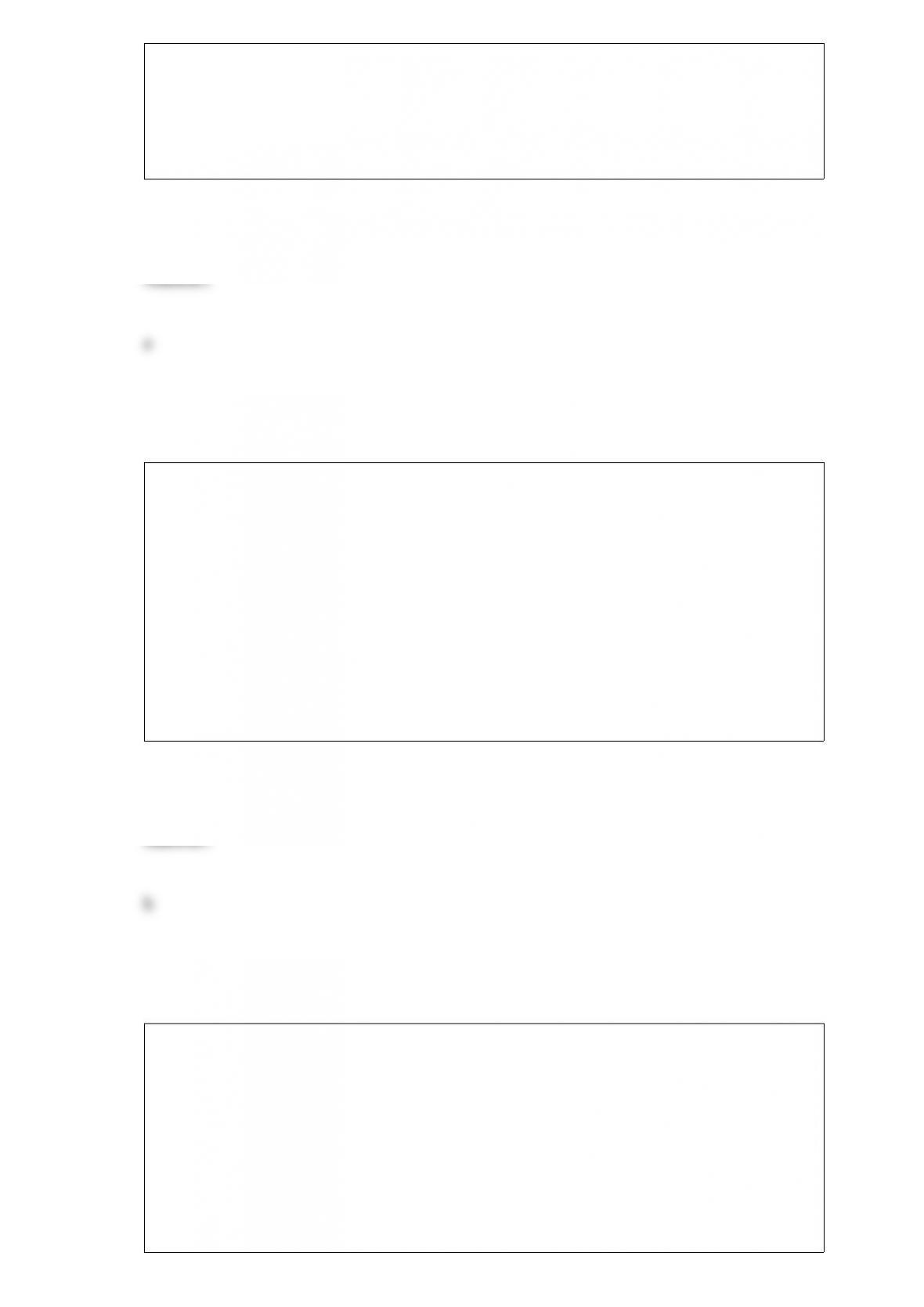
The staff of Mr. Wayne Wertz, VP of Operations at Portland Peoples Bank, prepared a
cumulative frequency ogive of waiting time for walk-in customers.
The percentage of walk-in customers waiting one minute or less was _________.
a) 22%
b) 11%
c) 67%
d) 10%
e) 5%
Assuming an equal chance of a new baby being a boy or a girl (that
is, p= 0.5), wewould like to nd the probability of 40 or more of the
next 100 births at a local hospital will be boys. Using the normal
approximation for binomial with acorrection for continuity, we should
use the z-score _______
a) 0.4
b) -2.1
c) 0.6
d) 2
e) -1.7
A researcher wants to conduct a before/after study on 11 subjects to determine if a new
cholesterol medication results in higher HDL cholesterol readings. The null hypothesis
is that the average difference is zero while the alternative hypothesis is that the average
difference is not zero. Scores are obtained on the subjects both before and after taking
the medication. After subtracting the after scores from the before scores, the average
difference is computed to be “2.40 with a sample standard deviation of 1.21. Assume
that the differences are normally distributed in the population. The observed tvalue for
this test is _______.
a) -21.82
b) -6.58
c) -2.4
d) 1.98
e) 2.33
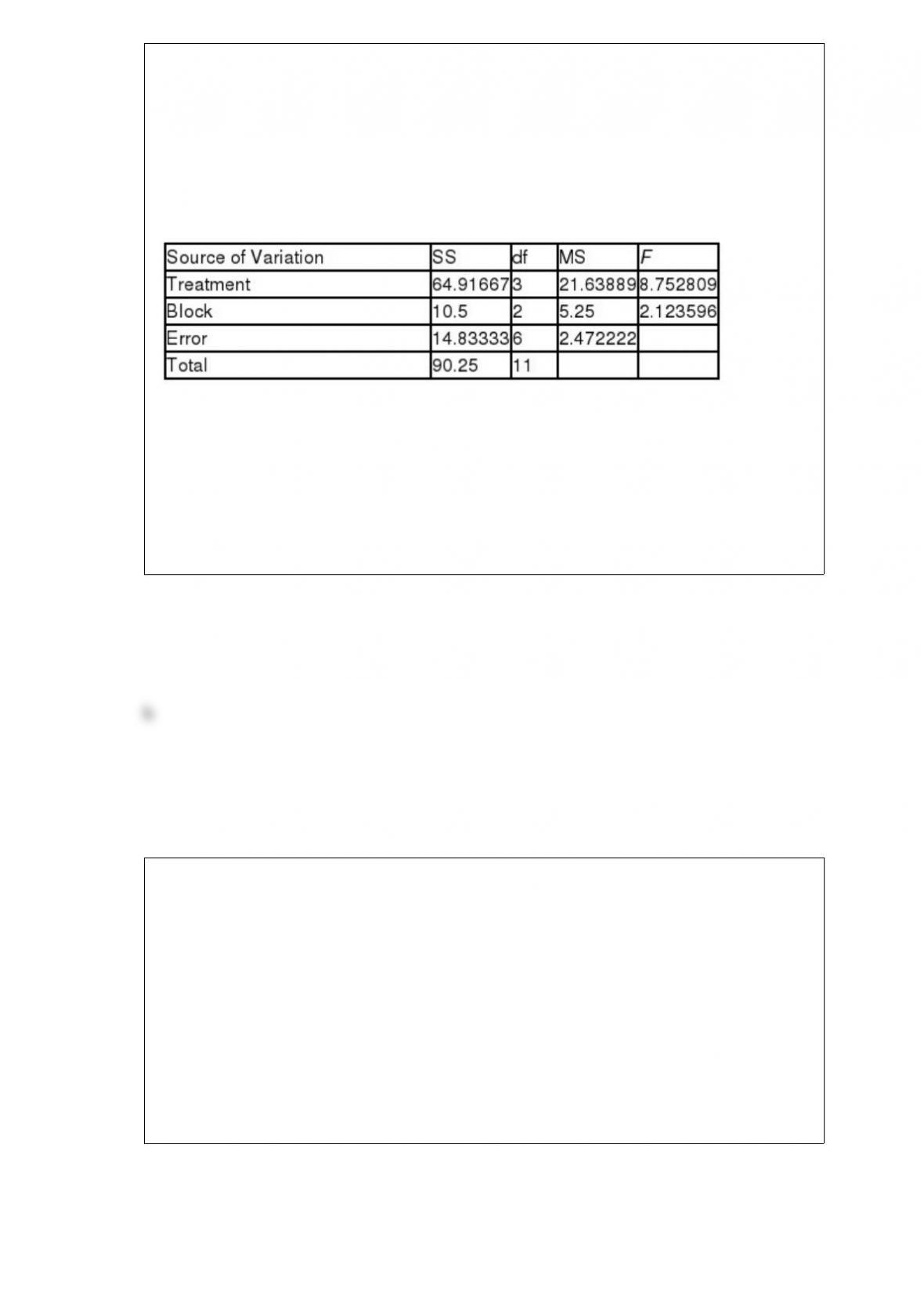
Use the following set of observed frequencies to test the independence of the two
variables. Variable one has values of ‘A’ and ‘B’; variable two has values of ‘C’, ‘D’, and
‘E’.
Using
= 0.05, the observed chi-square value is _______.
a) 0
b) 0.69
c) 1.54
d) 21.28
e) 8.29
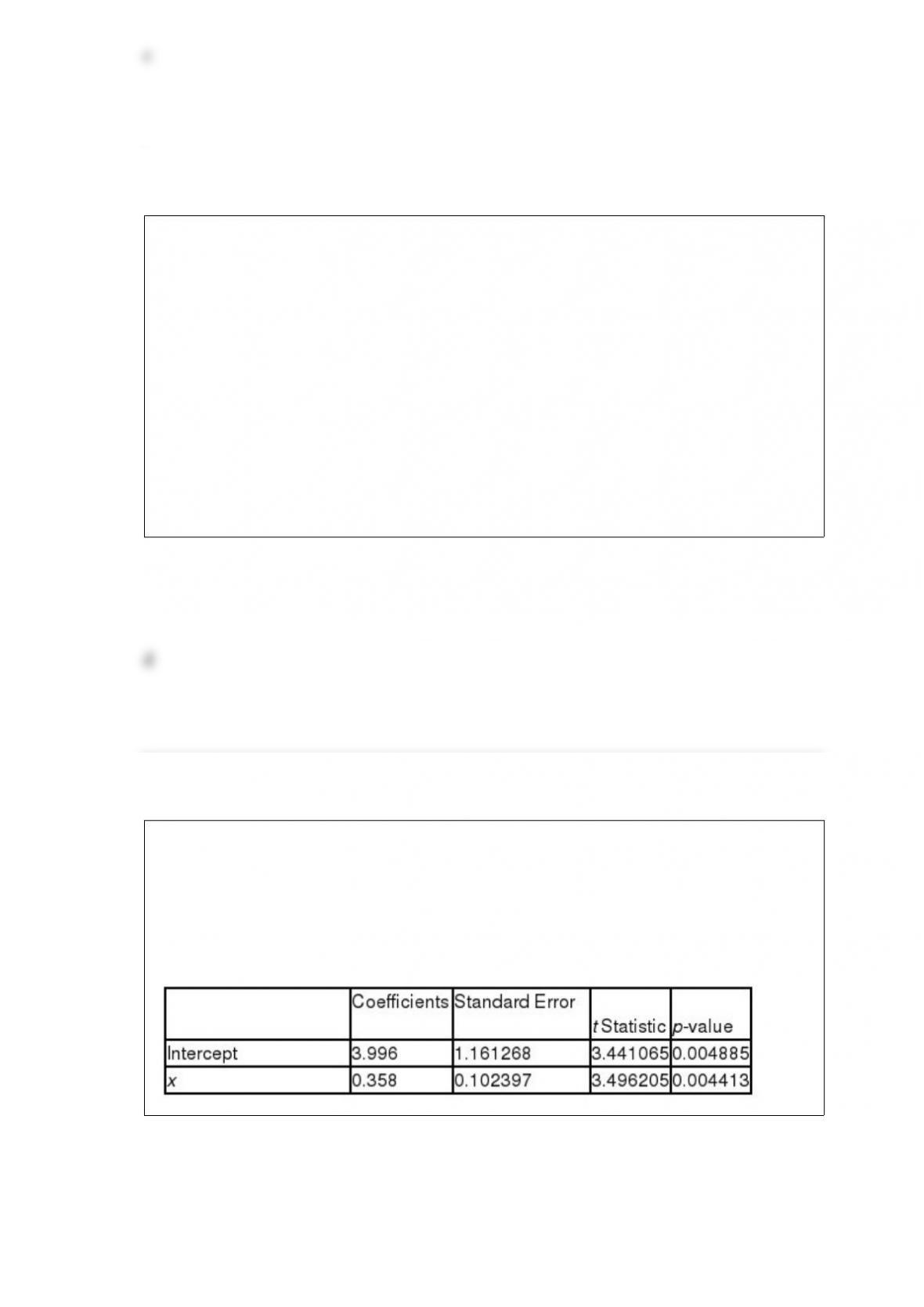
Cindy Ho, VP of Finance at Discrete Components, Inc. (DCI), theorizes that the
discount level offered to credit customers affects the average collection period on credit
sales. Accordingly, she has designed an experiment to test her theory using four sales
discount rates (0%, 2%, 4%, and 6%). First, she classified DCI’s credit customers into
three categories by total assets (small, medium, and large). Then, she randomly
assigned four customers from each category to a sales discount rate. An analysis of
Cindy’s data yielded the following ANOVA table.
Using
= 0.05, the appropriate decision for block effects is ________.
a) do not reject the null hypothesis
1
2
3
b) do not reject the null hypothesis
c) reject the null hypothesis
1
2
3
d) reject the null hypothesis
1
2
3
e) do nothing
BigShots, Inc. is a specialty e-tailer that operates 87 catalog Web sites on the Internet.
Kevin Conn, Sales Director, feels that the style (color scheme, graphics, fonts, etc.) of a
Web site may affect its sales. He chooses three levels of design style (neon, old world
and sophisticated) and randomly assigns six catalog Web sites to each design style.
Kevin’s experimental design is a ________.
a) factorial design
b) random block design
c) completely randomized design
d) normalized block design
e) partially randomized design
Suppose an interdisciplinary committee of 3 faculty members is to be selected from a
group consisting of 4 men and 5 women. The probability that one male faculty and two
female faculty are selected is approximately ______
a) 0.15
b) 0.06
c) 0.33
d) 0.48
e) 0.58
Louis Katz, a cost accountant at Papalote Plastics, Inc. (PPI), is analyzing the
manufacturing costs of a molded plastic telephone handset produced by PPI. Louis’s
independent variable is production lot size (in 1,000’s of units), and his dependent
variable is the total cost of the lot (in $100’s). Regression analysis of the data yielded
the following tables.
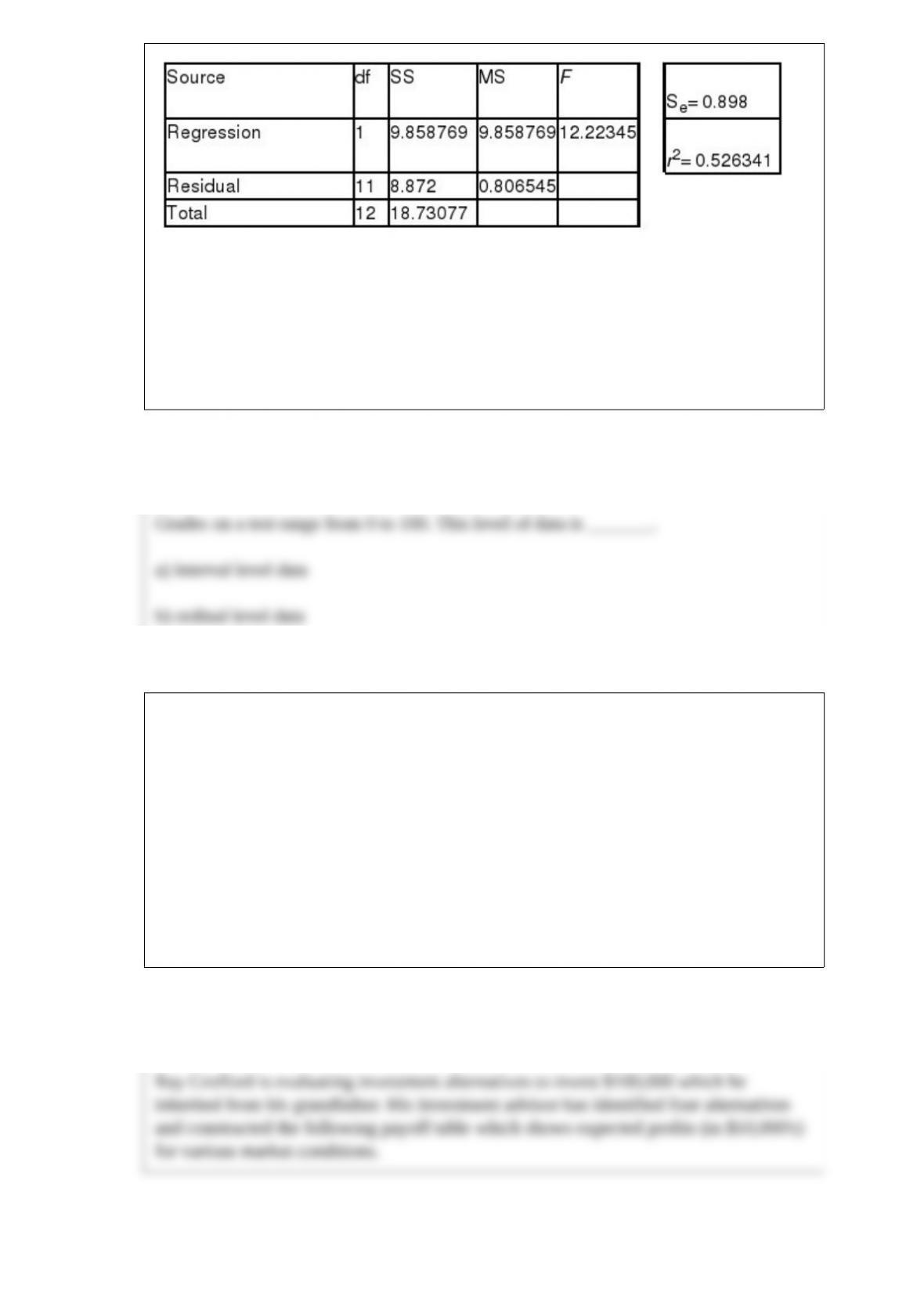
Using
= 0.05, Louis should ________________.
a) increase the sample size
b) suspend judgment
c) not reject H0:
1= 0
d) reject H0:
1= 0
e) do not reject H0:
0= 0
Grades on a test range from 0 to 100. This level of data is _______.
a) interval level data
b) ordinal level data
c) nominal level data
d) ratio level data
e) relative level data
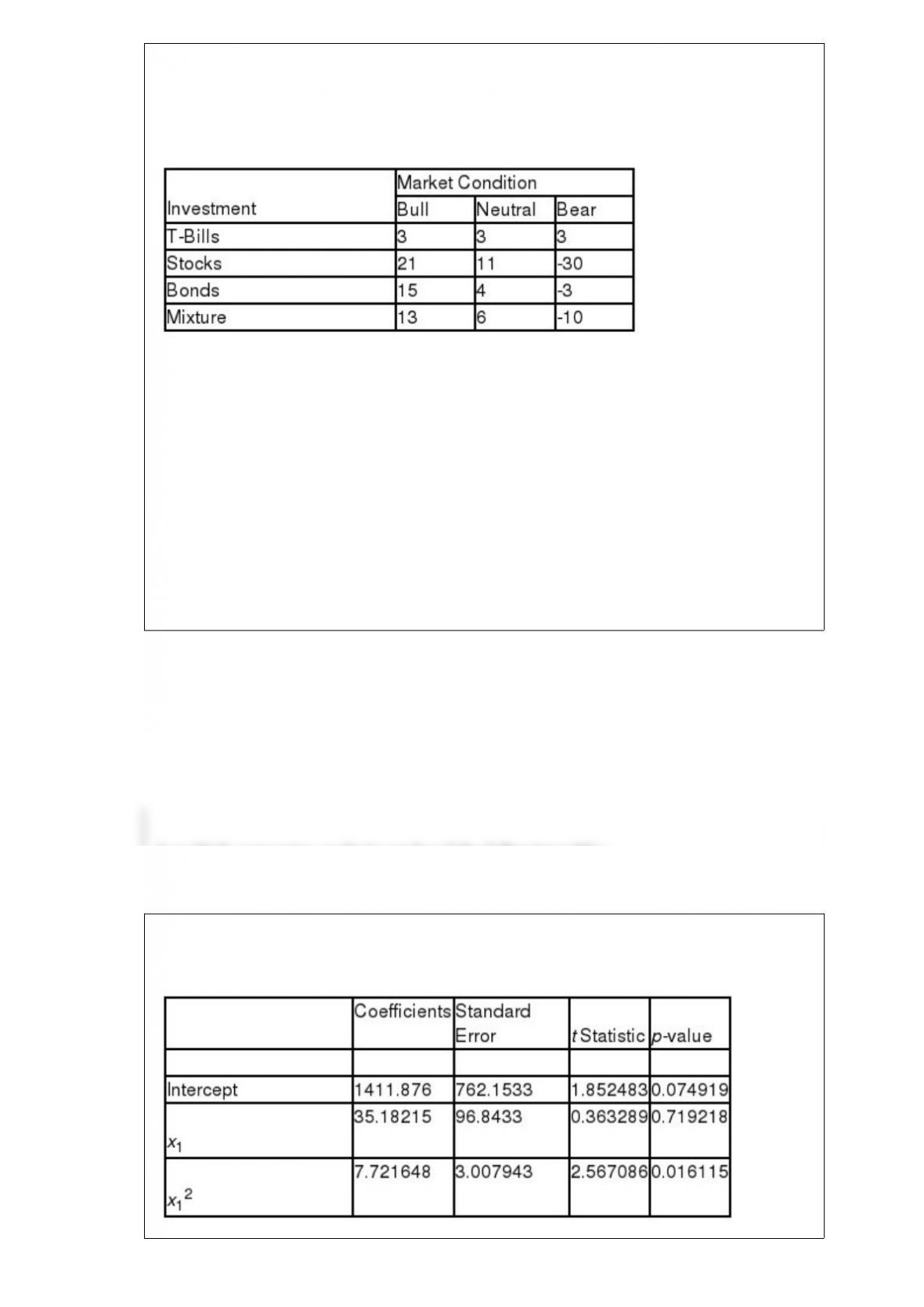
Ray Crofford is evaluating investment alternatives to invest $100,000 which he
inherited from his grandfather. His investment advisor has identified four alternatives
and constructed the following payoff table which shows expected profits (in $10,000’s)
for various market conditions.
For the combination of ‘Bear’ and ‘Mixture’, the opportunity loss is ______.
a) 0
b) 5
c) 13
d) 33
e) -10
A multiple regression analysis produced the following tables.
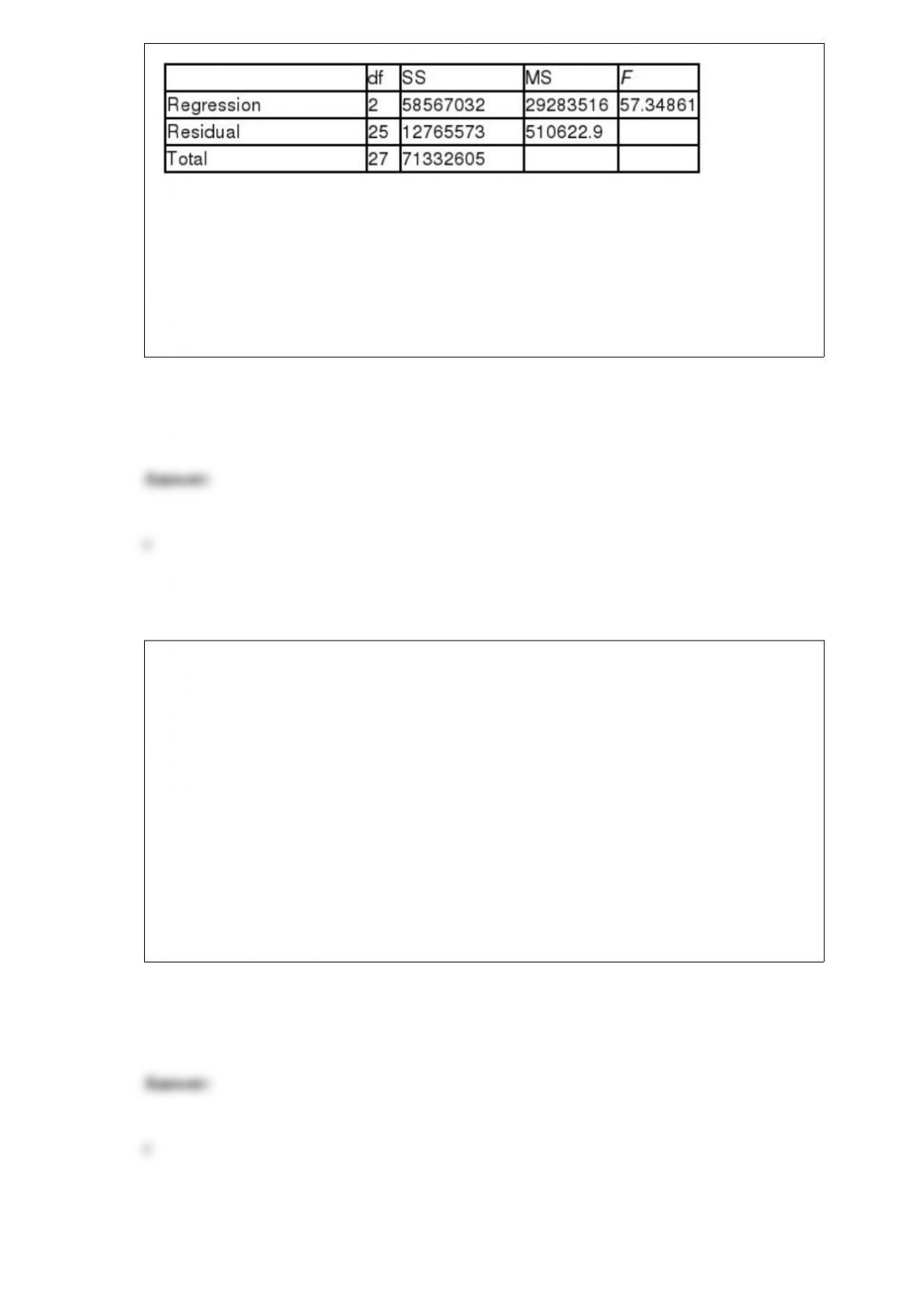
The regression equation for this analysis is ____________.
a) y = 762.1533 + 96.8433 x1+ 3.007943 x1
2
b) y = 1411.876 + 762.1533 x1+ 1.852483 x1
2
c) y = 1411.876 + 35.18215 x1+ 7.721648 x1
2
d) y = 762.1533 + 1.852483 x1+ 0.074919 x1
2
e) y = 762.1533 – 1.852483 x1+ 0.074919 x1
2
Suppose 40% of all college students have a computer at home and a sample of 100 is
taken. What is the probability that more than 50 of those in the sample have a computer
at home?
a) 0.4793
b) 0.9793
c) 0.0207
d) 0.5207
e) 0.6754
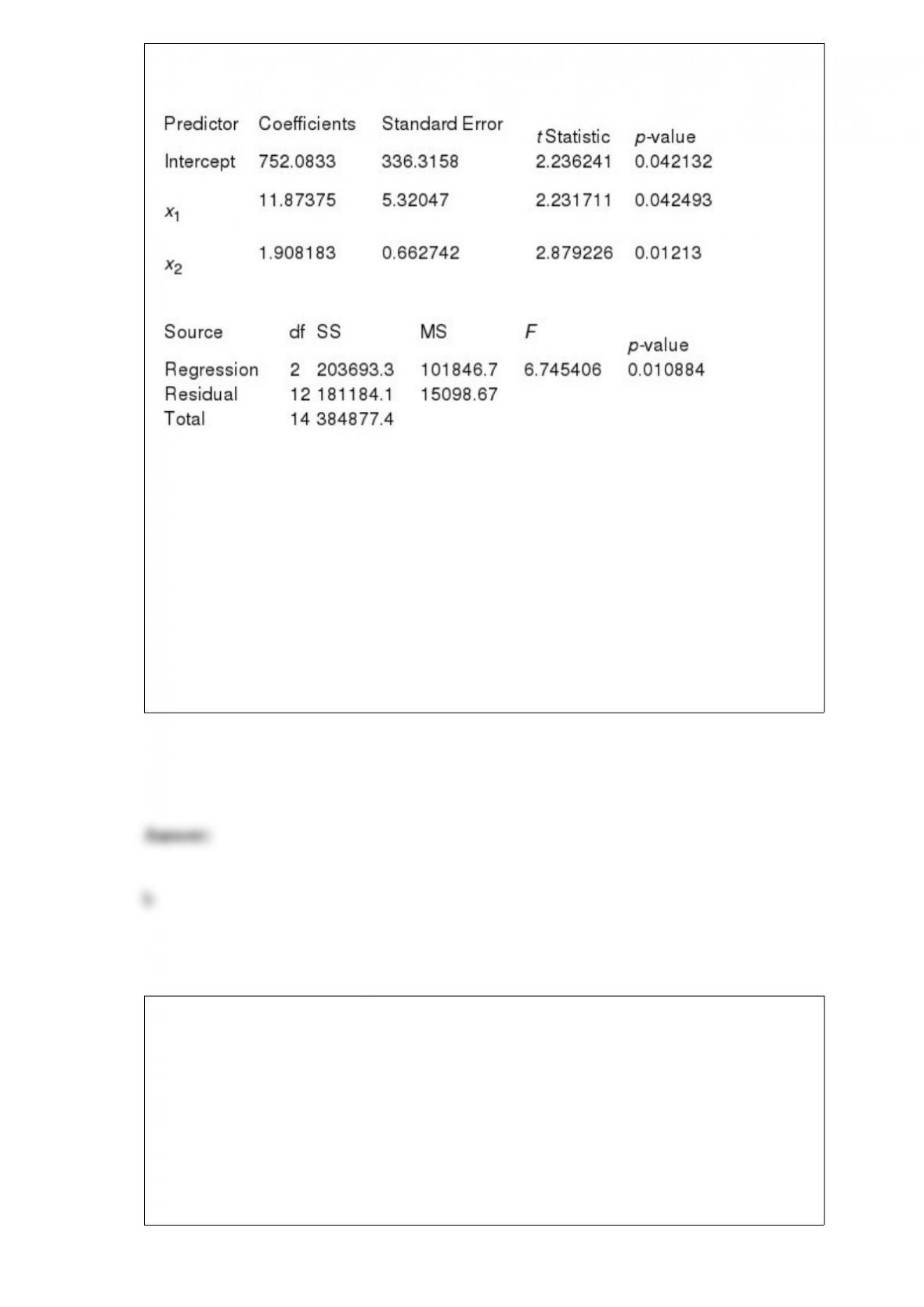
A multiple regression analysis produced the following tables.
Using a = 0.05 to test the null hypothesis H0: b1 = b2 = 0, the critical F value is ____.
a) 3.74
b) 3.89
c) 4.75
d) 4.60
e) 2.74
A quality manager is developing a regression model to predict the total number of
defects as a function of the day of week the item is produced. Production runs are done
10 hours a day, 7 days a week. The dependent variable is ______.
a) day of week
b) production run
c) percentage of defects
d) number of defects
e) number of production runs
The null hypothesis in the Kruskal-Wallis test is _______.
a) all populations are identical
b) all sample means are different
c) xand yare not correlated
d) the mean difference is zero
e) all populations are not identical
Nonparametric statistics are sometimes called _______________.
a) nominal statistics
b) interval statistics
c) distribution-dependent statistics
d) distribution-free statistics
e) qualitative statistics
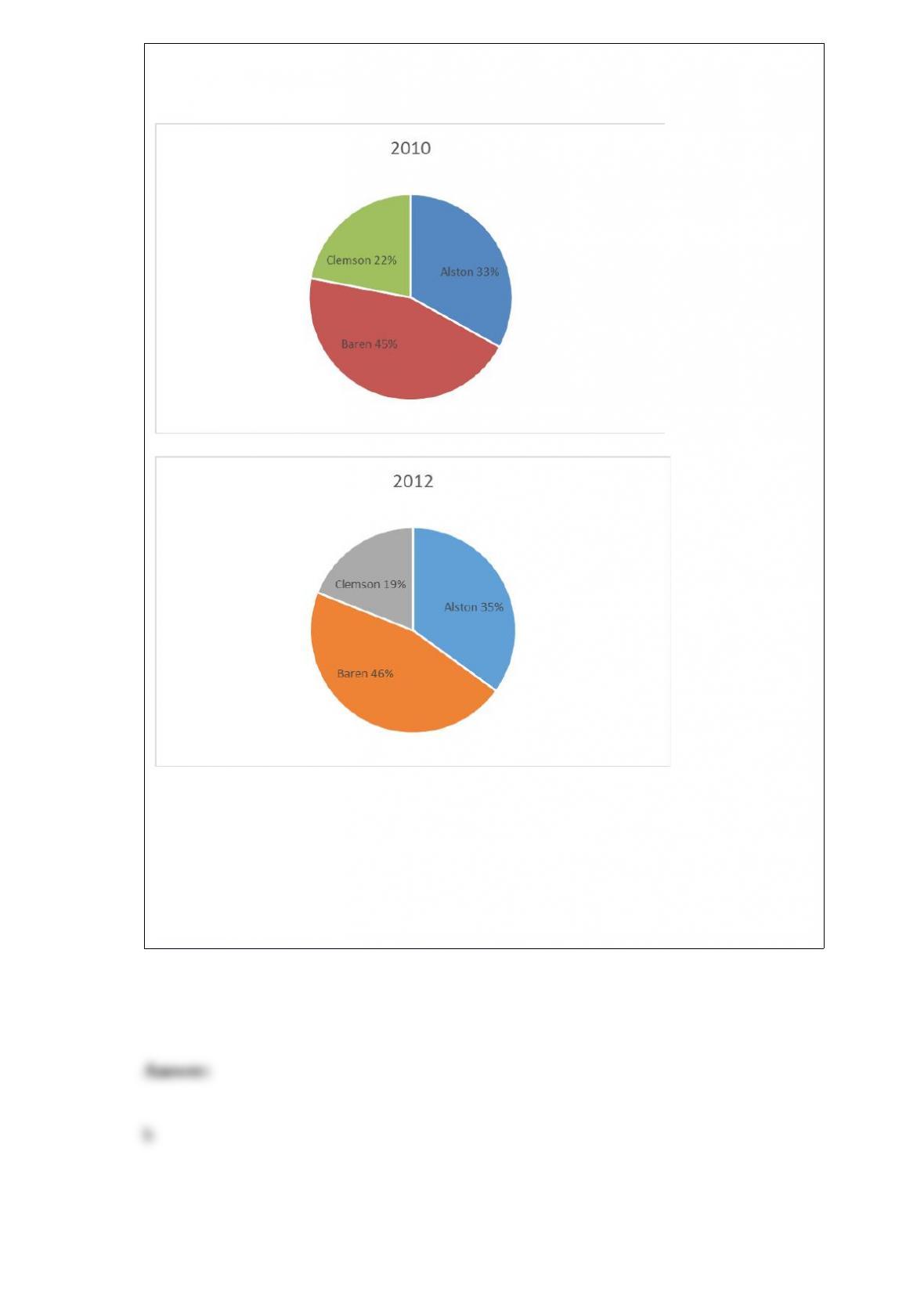
The 2010 and 2012 market share data of the three competitors (Alston, Baren, and
Clemson) in an oligopolistic industry are presented in the following pie charts.
Which of
the
following
is true?
a) Only
Baren
share.
b) Only
Clemson
lost
market
share.
c) Alston lost market share.
d) Baren lost market share.
e) All companies lost market share
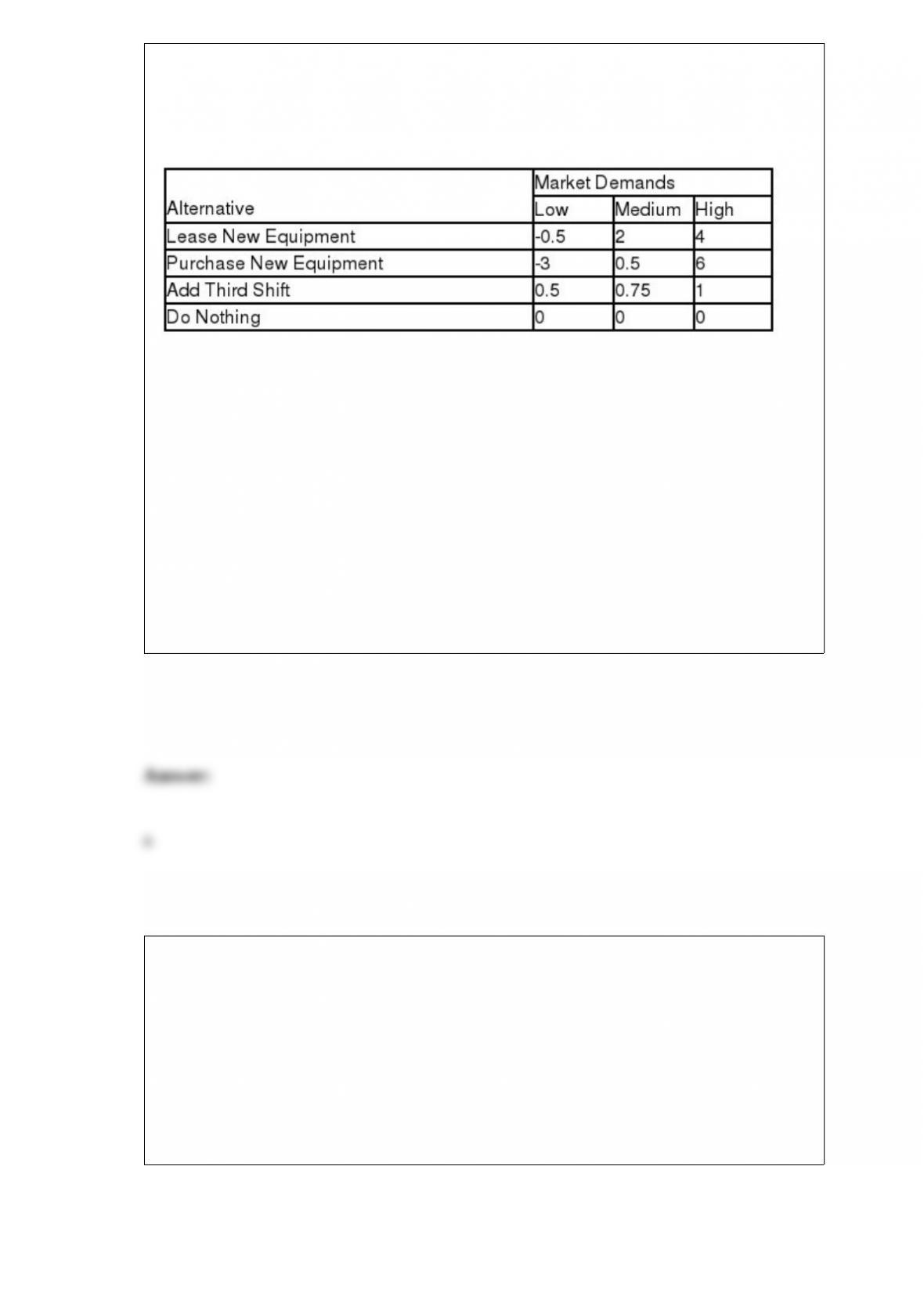
Trey Leeman, Operations Manager at National Consumers, Inc. (NCI), is evaluating
alternatives for increasing capacity at NCI’s Fountain Hill plant. He has identified four
alternatives, and has constructed the following payoff table which shows payoffs (in
$1,000,000’s) for the three possible levels of market demand.
If Trey uses the Hurwicz criterion with alpha = 0.4, the appropriate alternative would
be: _____________.
a) Lease New Equipment
b) Purchase New Equipment
c) Add Third Shift
d) Do Nothing
e) Do everything
If the number of parking spots at urban grocery stores is uniformly distributed over the
interval 90 to 140, inclusively (90 x 140), then the standard deviation of this
distribution is __________________.
a) 4.16
b) 50
c) 14.4
d) 7.07
e) 28.2
BigShots, Inc. is a specialty e-tailer that operates 87 catalog Web sites on the Internet.
Kevin Conn, Sales Director, feels that the style (color scheme, graphics, fonts, etc.) of a
Web site may affect its sales. He chooses three levels of design style (neon, old world
and sophisticated) and randomly assigns six catalog Web sites to each design style. In
Kevin’s experiment “sales at a Web site” is _______.
a) a blocking variable
b) a concomitant variable
c) a treatment variable
d) the dependent variable
e) the independent variable
A coffee-dispensing machine is supposed to deliver 8 ounces of liquid into each paper
cup, but a consumer believes that the actual mean amount is less. The consumer
obtained a sample of 49 cups of the dispensed liquid with average of 7.75 ounces. If the
sample variance of the dispensed liquid delivered per cup is 0.81 ounces, and =0.05, α
the appropriate decision is ________.
a) increase the sample size
b) reduce the sample size
c) fail to reject the 8-ounces claim
d) maintain status quo
e) reject the 8-ounces claim
The speed at which a jet plane can fly is an example of _________.
a) neither discrete nor continuous random variable
b) both discrete and continuous random variable
c) a continuous random variable
d) a discrete random variable
e) a constant