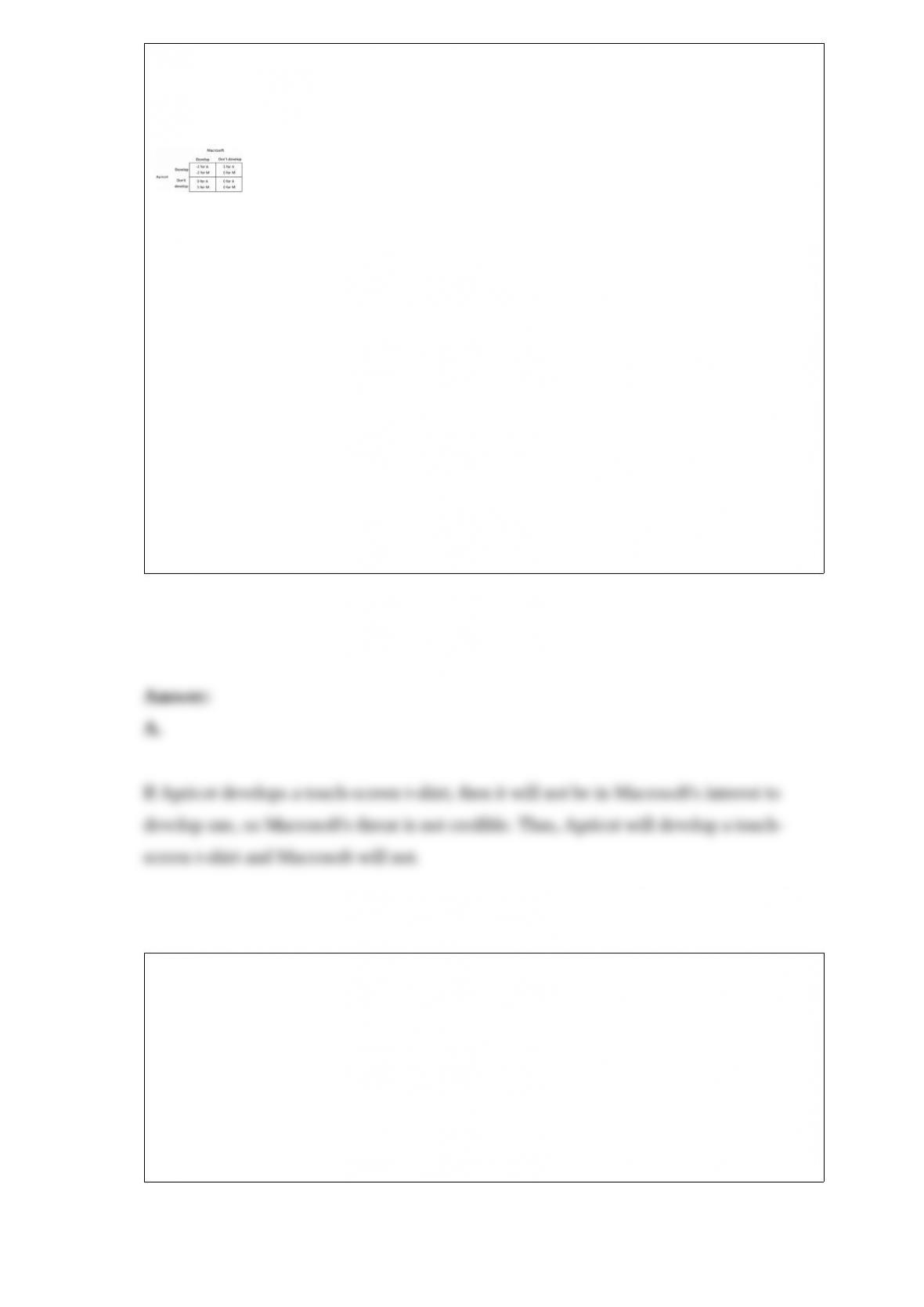
Suppose two companies, Macrosoft and Apricot, and considering whether to develop a
new product, a touch-screen t-shirt. The payoffs to each of developing a touch-screen
t-shirt depend upon the actions of the other, as shown in the payoff matrix below (the
payoffs are given in millions of dollars).
Suppose Apricot makes its decision first, and then Macrosoft makes its decision after
seeing Apricot’s choice. What will happen if, before Apricot chooses, Macrosoft
announces that it is going to develop a touch-screen t-shirt no matter what Apricot
does?
A. Apricot will develop a touch-screen t-shirt, and Macrosoft will not because
Macrosoft’s threat is not credible.
B. Macrosoft will develop a touch-screen t-shirt, and Apricot will not because it’s not in
Apricot’s interest to develop a touch-screen t-shirt if Macrosoft also develops one.
C. Both Apricot and Macrosoft will develop a touch-screen t-shirt because neither
company will want to back down.
D. Neither Apricot nor Macrosoft will develop a touch-screen t-shirt because they will
both realize that they are in a no-win situation.
As consumers’ incomes decrease, the demand curve for bologna sandwiches shifts to
the right. Therefore bologna sandwiches are:
A. normal goods.
B. complement goods.
C. substitute goods.
D. inferior goods.
A ______ describes the possible moves in a game in sequence and lists the payoffs to
each possible combination of moves.
A. decision tree
B. payoff matrix
C. game graph
D. multi-period game
An economy produces 500,000 tables valued at $100 each. Households purchase
100,000 tables, of which 50,000 are imported. Businesses purchase 200,000
domestically produced tables, the government purchases 100,000 domestically
produced tables, and 50,000 domestically produced tables are sold abroad. At the end of
the year, the table manufacturers hold the unsold tables in inventory. What is value of
GDP?
A. $5 million
B. $40 million

C. $45 million
D. $50 million
Which of the following events will decrease the domestic real interest rate in an open
economy?
A. An increase in domestic saving.
B. A decrease in the domestic saving.
C. An increase in the perceived riskiness of investing in the domestic economy.
D. An decrease in net capital inflow.
Start-up costs:
A. have no impact on the number of firms in an industry because they are sunk costs.
B. are inversely related to variable costs.
C. are the one-time costs incurred when beginning the production of a new product.
D. are always greater than marginal costs.

Spike pays $14,000 in taxes and earns $100,000. Ace earns $120,000. If the tax system
is progressive, Ace will pay ______ in taxes.
A. $15,500.
B. more than $16,800.
C. more than $15,500 but less than $16,800.
D. $16,800.
The table below shows a pizzeria’s fixed cost and variable cost at different levels of
output. Pizza’s sell for $20 each.
Between 25 and 50 pizzas per day, the pizzeria’s marginal cost is ______.
A. $4
B. $6
C. $8

D. $16
If sellers have more information about the quality of goods than do buyers, then:
A. buyers always will be exploited.
B. buyers will never make purchases.
C. sellers of better-than-average goods will have difficulty getting their asking price.
D. sellers of lower-than-average goods will have difficulty getting their asking price.
The union wage premium refers to the:
A. dues one must pay in order to be in a union.
B. union wage rate minus union membership dues.
C. deduction for union insurance.
D. amount by which union wages exceed nonunion wages.

The real costs of inflation to society include:
A. an increase in the general level of prices.
B. lost purchasing power of income.
C. higher relative prices.
D. interference with long-term planning.
The natural rate of unemployment is equal to the unemployment rate when there is
only:
A. structural and cyclical unemployment.
B. frictional unemployment.
C. cyclical unemployment.
D. structural and frictional unemployment.

Refer to the table below. The marginal benefit of the 5th unit of activity is:
A. $50
B. $44
C. $10
D. $5
For two goods, A and B, the rational spending rule is expressed as:
A. MUA = MUB.
B. MUA * MUB = PA * PB.
C. (MUA/PB) = (MUB/PA).
D. (MUA/PA) = (MUB/PB).
Adam Smith’s invisible hand only leads to an efficient outcome when:
A. buyers are fully informed about all relevant aspects of a product and the market in
which it is traded.
B. buyers collect information up to the point at which the marginal cost of having more
information equals the marginal benefit of having more information.
C. buyers have more information about the product being traded than do sellers.
D. buyers have less information about the product being traded than do sellers.
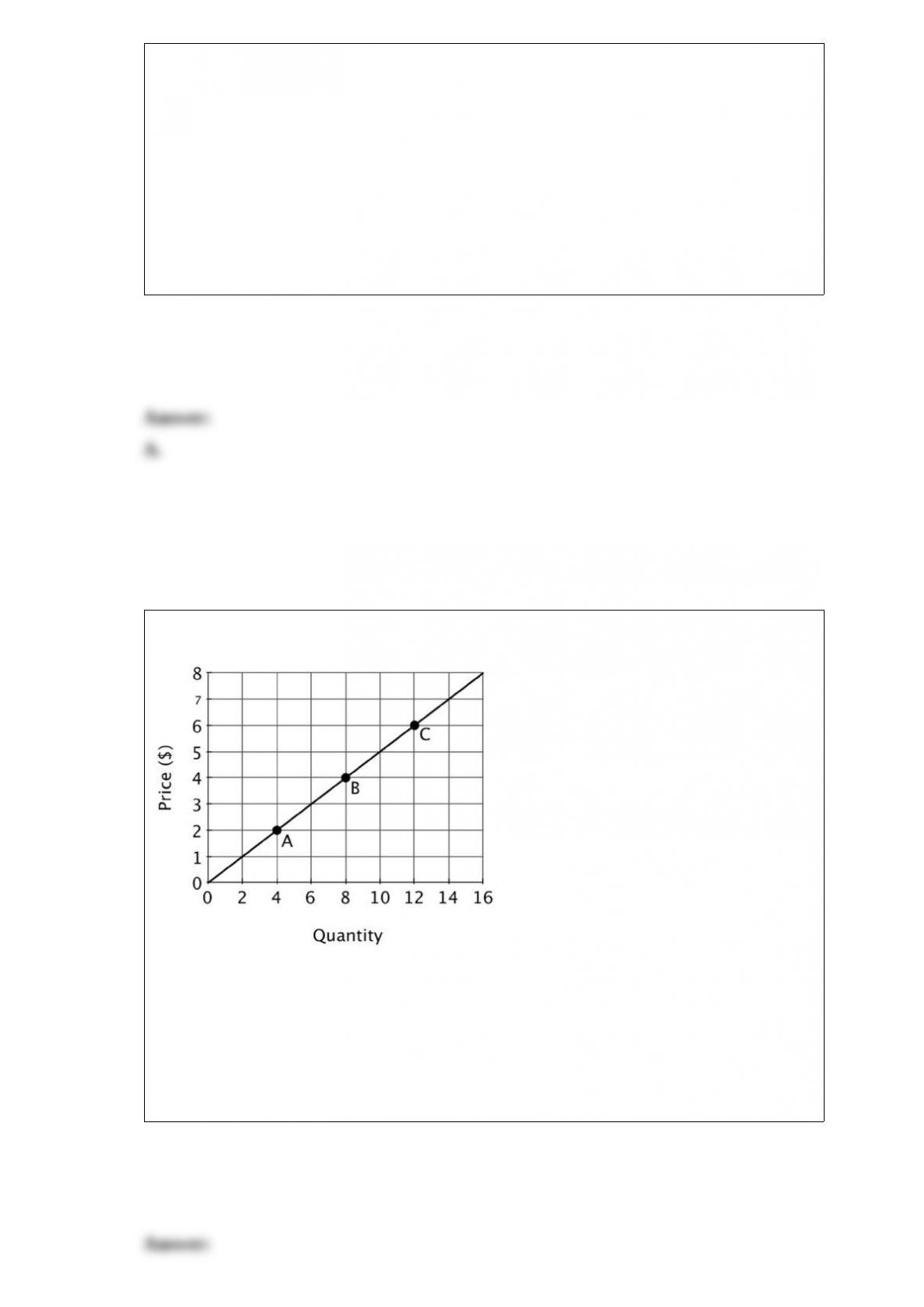
Refer to the figure below. What is the slope of the supply curve?
A. 4
B. 2
C. 1/2
D. 1
In order to understand how the price of a good is determined in the free market, one
must account for the desires of:
A. purchasers exclusively.
B. sellers exclusively.
C. governmental agencies exclusively.
D. purchasers and sellers.
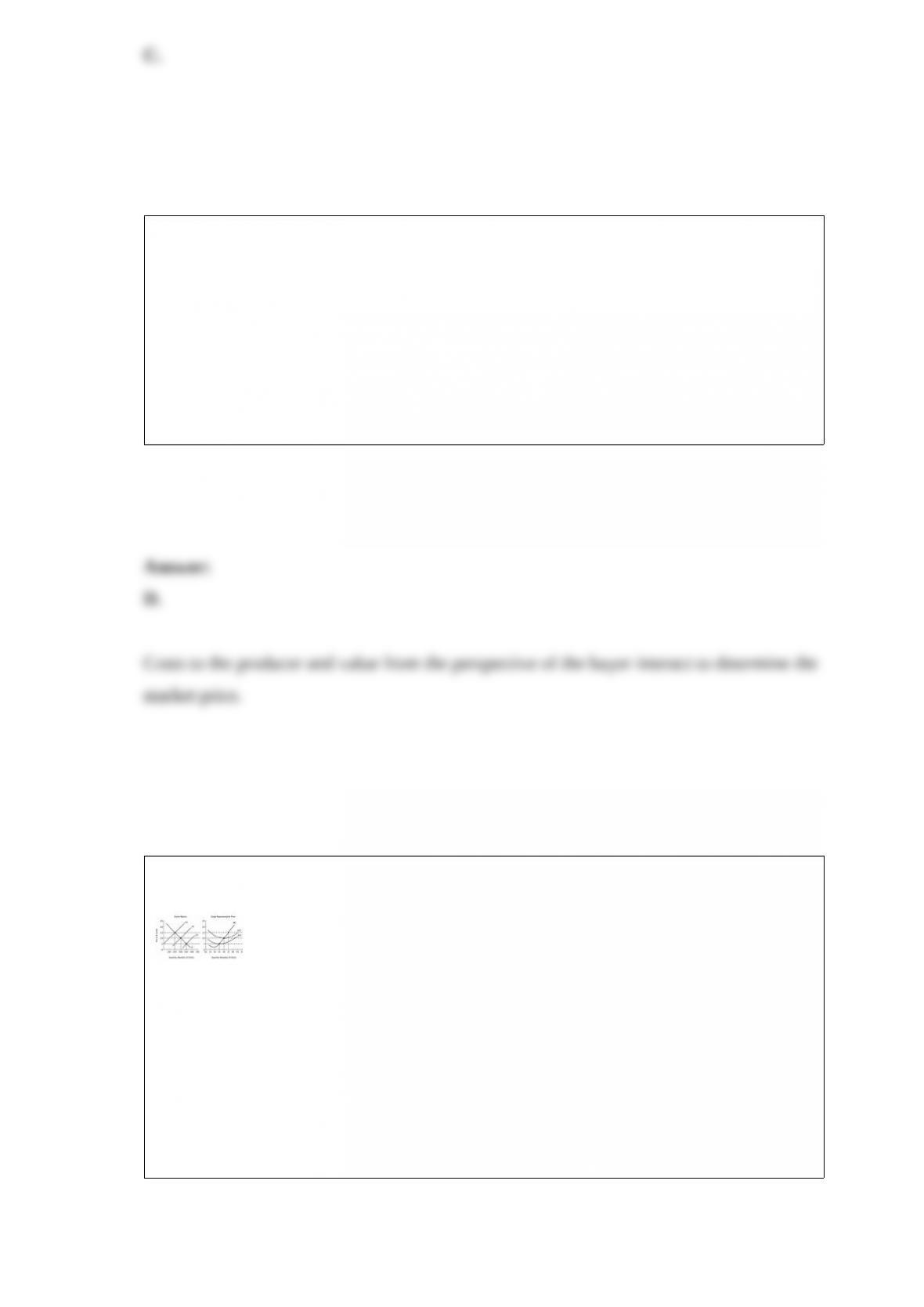
Assume that all firms in this industry have identical cost curves, and that the market is
perfectly competitive.
If the market supply curve is given by S3, then in the long run firms will:
A. exit the market, leading the market supply curve to shift back to S2.
B. exit the market, leading the market supply curve to shift back to S1.
C. enter the market, leading the market supply curve to shift back to S2.
D. neither enter nor exit the market, so the market supply curve will remain at S3.
Refer to the table below. At what output level or levels are this firm’s owners doing as
well as or better than they could do with the next best use of their resources?
A. 10 units
B. 10 and 15 units
C. 10, 15, and 20 units
D. 10, 15, 20, and 25 units
To ensure that a nominal payment represents a constant level of purchasing power over
time, one should:
A. add the price index to it.
B. subtract the price index from it.
C. divide it by the price index.
D. increase it by a percentage equal to the rate of inflation for that year.

Suppose that a government agency is trying to decide between two pollution reduction
policy options. Under the permit option, 100 pollution permits would be sold, each
allowing emission of one unit of pollution. Firms would be forced to shut down if they
produced any units of pollution for which they did not hold a permit. Under the
pollution tax option, firms would be taxed $250 for each unit of pollution emitted. The
regulated firms all currently pollute and face varying costs of pollution reduction,
though all face increasing marginal costs of pollution reduction. Because firms face
increasing marginal costs to reduce pollution, the demand curve for pollution permits
will be:
A. upward sloping.
B. downward sloping.
C. perfectly inelastic.
D. perfectly elastic.
Demand tends to be ______ in the short run than in the long run.
A. more elastic
B. less elastic
C. more variable
D. less important

If short-run equilibrium output equals 10,000, the income-expenditure multiplier equals
5, the mpc equals 0.8, and potential output (Y*) equals 9,000, then transfers must be
______ by approximately ______ to eliminate any output gap.
A. decreased; 250
B. decreased; 200
C. increased; 250
D. increased; 200
Refer to the figure below. At the equilibrium price, total consumer surplus is
A. $7.50 per day.
B. $10 per day.
C. $15 per day.

D. $40 per day.
If one fails to account for implicit costs in decision making, then applying the
cost-benefit rule will be flawed because:
A. the benefits will be overstated.
B. the costs will be understated.
C. the benefits will be understated.
D. the costs will be overstated.
If it is possible to place a commonly held resource under private ownership, then:
A. the tragedy of the commons can be solved.
B. the tragedy of the commons becomes even worse.
C. the privately held resource will be overused relative to the social optimum.
D. the privately held resource will be underused relative to the social optimum.
The cross-price elasticity of demand between two goods that are substitutes can never
be:
A. negative.
B. less than one.
C. greater than one.
D. positive.
Jay owns a classic car he purchased for $50,000. At a car rally a knowledgeable classic
car enthusiast offers him $75,000 for the car. Based on this information:
A. Jay’s saving this year has increased by $25,000.
B. Jay’s saving this year has decreased by $25,000.
C. Jay has experienced a $25,000 capital gain.
D. Jay’s wealth is unchanged.

Refer to the figure below.
Based on the figure, if autonomous spending increases from 400 to 600, then the new
short-run equilibrium output will equal:
A. 1,200.
B. 400.
C. 600.
D. 800.
Josh wants to go to the football game this weekend, but he has a paper due on Monday.
It will take him the whole weekend to write the paper. Josh decides to stay home and
work on the paper. According to the Scarcity Principle, the reason Josh doesn’t go to the
game is that:
A. Josh prefers schoolwork to football games.
B. writing the paper is easier than going to the game.
C. Josh can’t go the game and finish the paper.
D. going to the game won’t be fun.

Which of the following would increase the investment component of U.S. GDP?
A. You purchase a vacation at Disney World in Florida.
B. You purchase shares of Disney stock.
C. Disney World purchases tires for the monorail from a firm in Ohio.
D. A French man purchases a vacation at a Disney theme park in France.
An economy produces only 500,000 tables valued at $100 each. Of these, 100,000 are
sold to consumers, 200,000 are sold to businesses, 100,000 are sold to the government,
and 50,000 are sold abroad. No tables are imported. At the end of the year, the
tablemanufacturers hold the unsold tables in inventory. What is the value of the
investment component of GDP?
A. $2 billion
B. $10 million
C. $20 million
D. $25 million

If the nominal exchange rate is 4 Israeli shekels per U.S. dollar, and 0.178 Jordanian
dinars per Israeli shekel, then there are ______ Jordanian dinars per U.S. dollar.
A. 0.712
B. 0.045
C. 0.025
D. 5.618