According to the quantity theory of money, the inflation rate equals
A) money supply minus real GDP.
B) the growth rate of the money supply minus the growth rate of real GDP.
C) real GDP minus the money supply.
D) the growth rate of real GDP minus the growth rate of the money supply.
Table 2.4
2011 2012
Refer to Table 2.4. The inflation rate for 2012 is
A) -8.22%.
B) 95%.
C) 13%.
D) 89%.
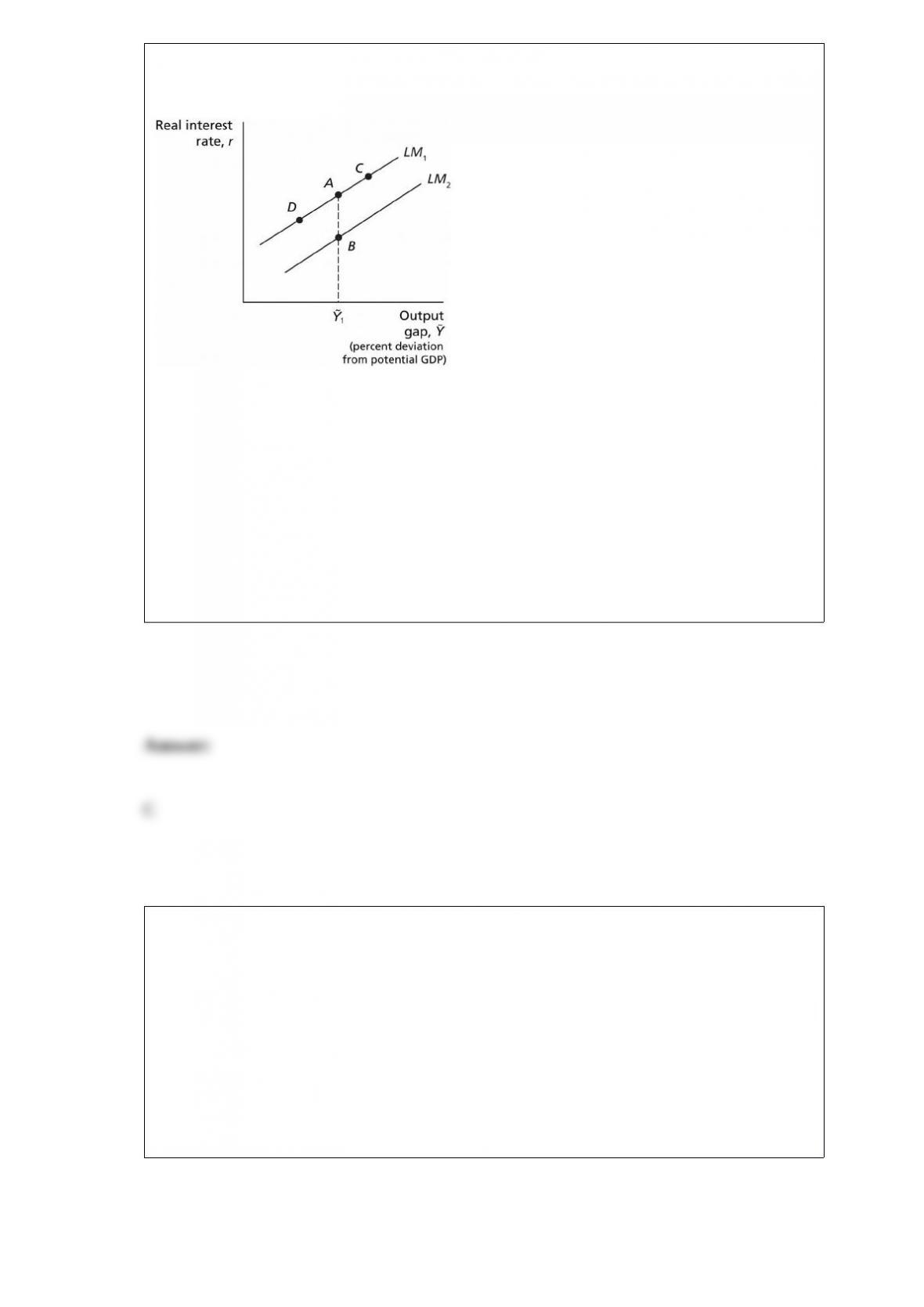
Figure 10.8
Refer to Figure 10.8. Other things equal, an increase in expected inflation would best
be represented by
A) a movement from point A to point C.
B) a movement from point A to point D.
C) a shift from LM1 to LM2.
D) a shift from LM2 to LM1.
Expansionary monetary policy causes a ________ the MP curve and a ________ the
aggregate demand curve.
A) movement to the right along; shift to the right of
B) downward shift of; shift to the right of
C) movement to the left along; movement down along
D) upward shift of; shift to the right of

Due to diminishing marginal returns, the ultimate source of economic growth in the
United States from 1949 to 2010 has been
A) capital.
B) labor.
C) total factor productivity.
D) Capital, labor, and total factor productivity are all subject to diminishing marginal
returns, and therefore are all equally responsible for economic growth.
In general, a formula that a central bank uses to set interest rates in response to
changing economic conditions is called a
A) rate-of-return equation.
B) Taylor rule.
C) central bank reaction function.
D) market adaptation identity.

In national income accounting, the value of worn out or obsolete capital is represented
by
A) depreciation.
B) transfer payments.
C) disposable income.
D) dividends.
Holding all else constant, an increase in consumption taxes, such as sales taxes or a
VAT, will ________ the price of consumption goods and ________ output.
A) increase; increase
B) increase; decrease
C) decrease; increase
D) decrease; decrease
Table 10.1
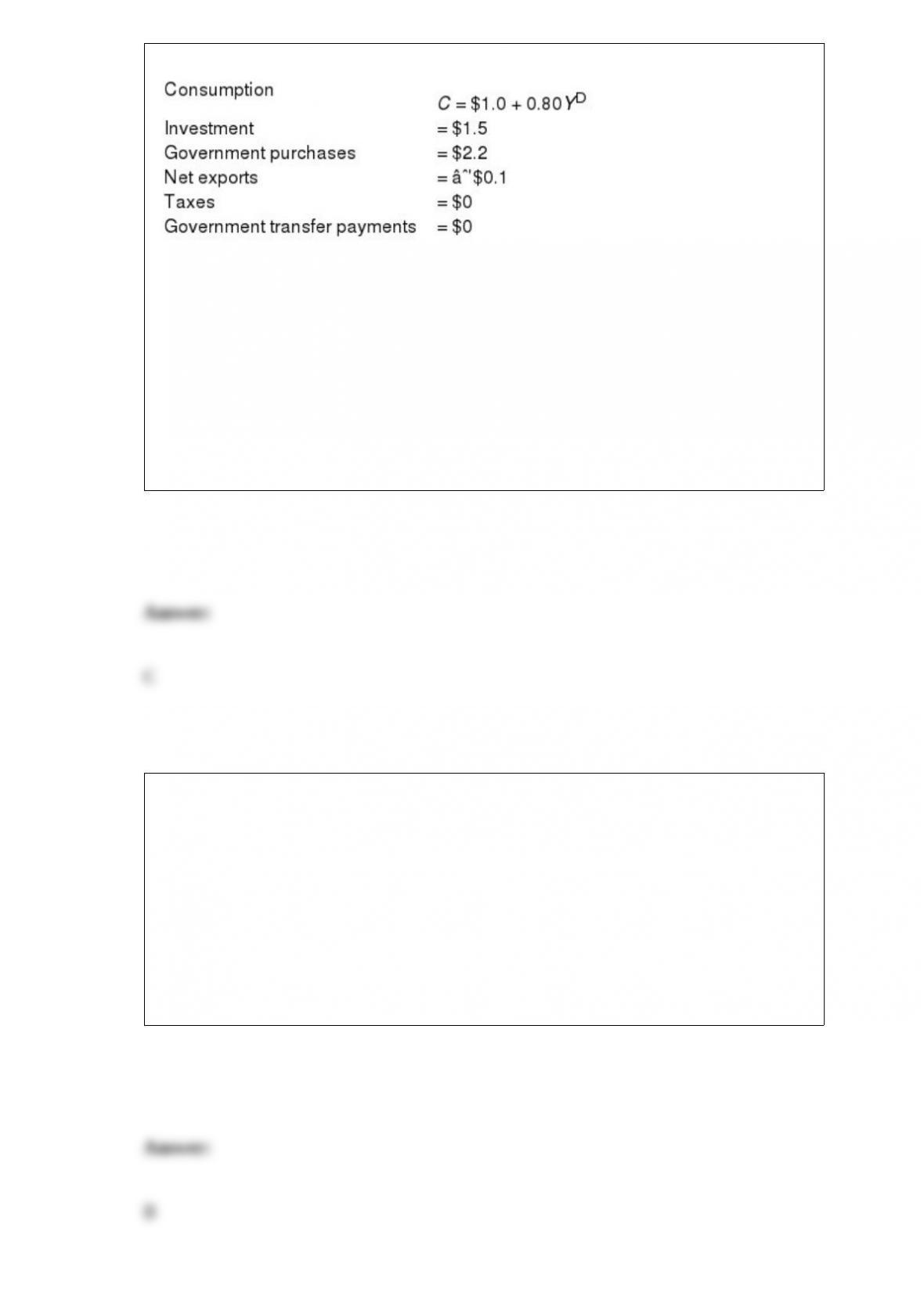
(all values are in billions of dollars)
Refer to Table 10.1. The value of the tax multiplier in this economy is
A) 0
B) -2
C) -4
D) -5
The supply of loanable funds is equal to the supply of saving in the economy. The three
sources of saving in an economy include all of the following except
A) households.
B) businesses.
C) the government.
D) the foreign sector.

The Fed believes there are three advantages to using the personal consumption
expenditures (PCE) price index instead of the CPI as a measure of inflation. These
advantages include all of the following except
A) the PCE is a chain-type index as opposed to the market-basket approach used for the
CPI, and the market-basket approach tends to overstate inflation.
B) the PCE includes the prices of more goods and services than the CPI, so it is a
broader measure of inflation.
C) the PCE allows the Fed to better track historical trends in inflation than does the CPI
because PCE values can be recalculated as new data becomes available.
D) the PCE includes the value of imported products purchased by consumers , whereas
the CPI does not, and imports make up a growing portion of consumer purchases in the
United States.
Economists initially viewed the Phillips curve as a structural relationship, meaning that
the relationship between the two measured variables
A) can change only slightly over time.
B) can change greatly over time.
C) will not change over time.
D) will change in the short run but not in the long run.
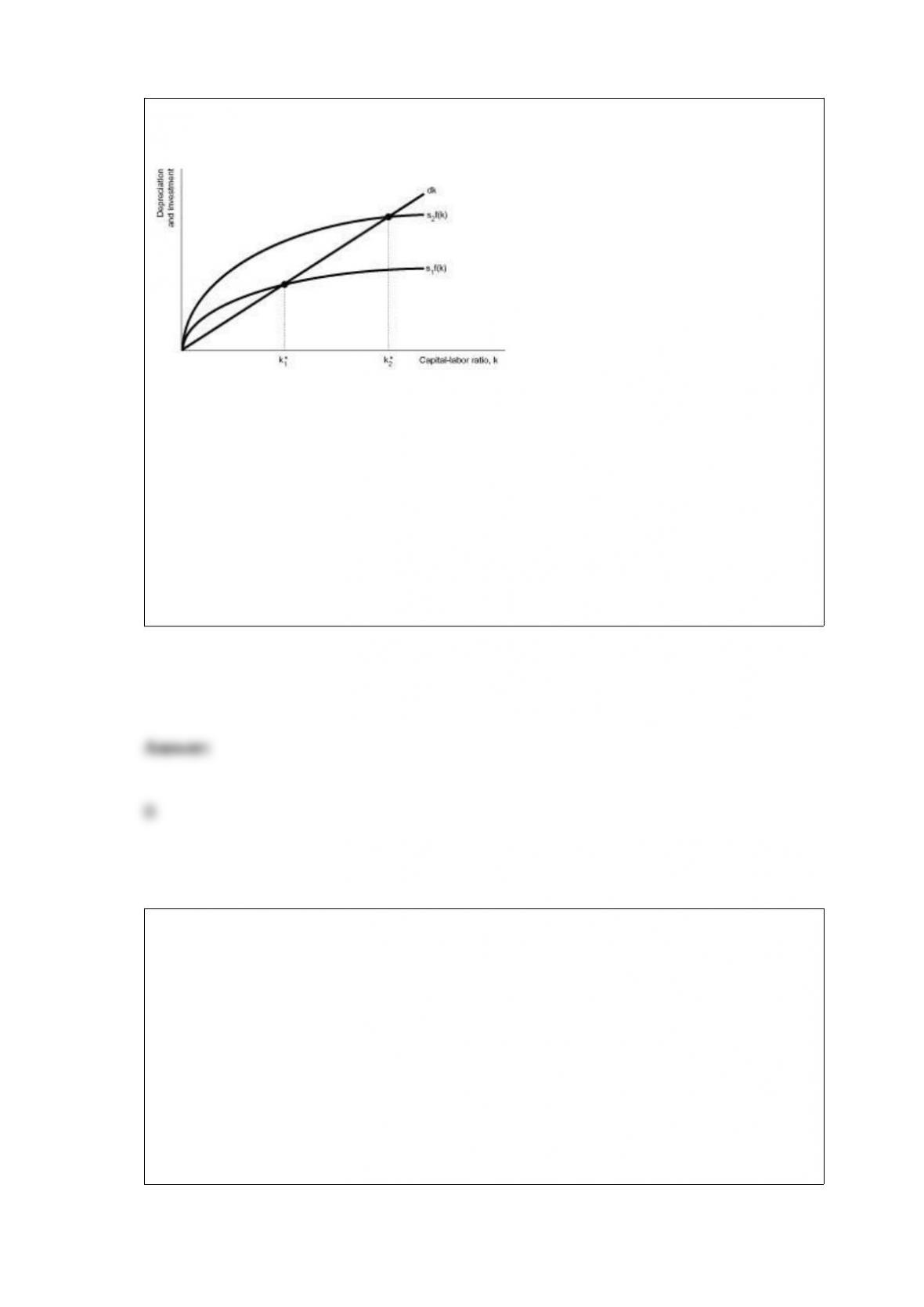
Figure 6.1
Refer to Figure 6.1. Suppose the economy is originally in steady state at k*1. If the
saving rate increases from s1 to s2,
A) depreciation becomes greater than investment.
B) investment becomes greater than depreciation.
C) investment becomes greater than saving.
D) saving becomes greater than investment.
In the Solow growth model, the growth rate of real GDP per worker depends on the
________, and in the AK growth model, the growth rate of real GDP per worker
depends on the ________.
A) rate of depreciation; rate of dilution
B) investment growth; rate of population growth
C) growth rate of the capital stock; growth rate of the labor force
D) rate of labor-augmenting technological change; national saving rate

In the aggregate production function, Y represents real GDP, K represents the capital
stock, L represents the quantity of labor, and A represents an index of efficiency. Which
of the following equations represents the aggregate production function?
A) Y = (K x L) / A
B) Y x A = (K x L)
C) Y = AF(K, L)
D) Y = (K x L) = A /FY
All of the following are reasons for the downward-sloping aggregate demand curve
except
A) as the price level decreases, the quantity demanded of real GDP decreases because
goods and services are more expensive.
B) as the price level increases, the real value of household wealth declines, reducing
consumption.
C) a higher price level increases the demand for money, causing an increase in the
interest rate which reduces spending on investment goods and consumer durables.
D) if the price level rises in a country relative to price levels in other countries, net
exports will decrease in the original country.

The aggregate demand curve is all of the equilibrium combinations of
A) the IS curve and the MP curve.
B) the output gap and the price level.
C) the price level and the real interest rate.
D) the real interest rate and the output gap.
The oil shock of 2007-2008 saw the price of oil rising from less than $60 a barrel in
March 2007 to over $145 a barrel in July 2008, and decreasing again to just over $30 a
barrel in December 2008. Assuming the economy was at potential GDP prior to the oil
shock, the increase in the price of oil, such as what occurred between March 2007 and
July 2008, acts as a negative supply shock, resulting in
A) a movement up along the Phillips curve.
B) a movement down along the Phillips curve.
C) an upward shift of the Phillips curve.
D) a downward shift of the Phillips curve.
Purchasing power parity does a ________ job in explaining movements in nominal
exchange rates in the short run and does a ________ job in explaining movements in
nominal exchange rates in the long run.
A) reasonable; reasonable
B) reasonable; poor
C) poor; reasonable
D) poor; poor
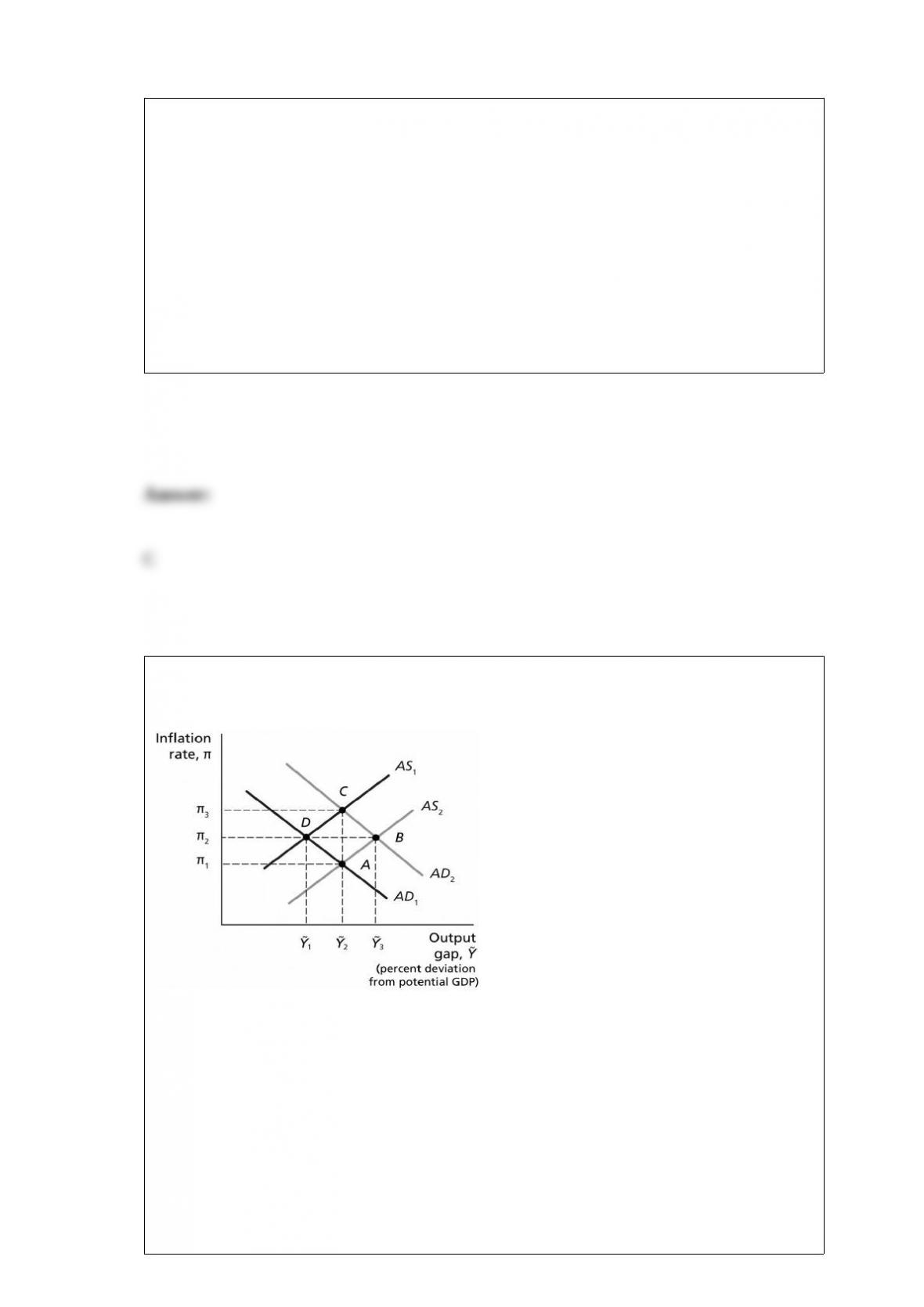
Figure 14.3
Refer to Figure 14.3. Suppose the economy is initially at long-run equilibrium and the
Fed increases the target inflation rate, and to hit this rate, it must reduce the real interest
rate. The economy then reaches a new, short-run equilibrium point. Assuming
expectations are adaptive, the next movement will result in the economy reaching a
new, long-run equilibrium at
A) point A.
B) point B.
C) point C.

D) point D.
If households spend $0.75 of each additional dollar of increased income, the
expenditure multiplier will be
A) 1.33
B) 4
C) 5
D) 7.5
When he was chairman of the Fed, Paul Volcker faced an economy with significant
stagflation which was a result of oil shocks. Volcker was determined to bring the
inflation rate down, which essentially acted like a decrease in the inflation target. In this
sense, Volcker’s action caused ________ and caused inflation to decrease and
________.
A) the AD curve to shift to the left; real GDP to increase.
B) the AD curve to shift to the left; real GDP to decrease.
C) the AS curve to shift to the right; real GDP to increase.
D) the AS curve to shift to the right; real GDP to decrease.
Suppose you deposit $5,000 in cash into your checking account at Wells Fargo Bank.
Assume that Wells Fargo Bank has no excess reserves at the time you make your
deposit and that the required reserve ratio is 10%.
a. Use a T-account to show the initial effect of this transaction on Wells Fargo’s balance
sheet.
b. Suppose that Wells Fargo makes the maximum loan they can from the funds you
deposited. Use a T-account to show the initial effect on Wells Fargo’s balance sheet
from making the loan. Also include in this T-account the transaction from question (a).
c. Now suppose that whoever took out the loan in question (b) writes a check for this
amount and that the person receiving the check deposits it in Comerica Bank. Show the
effect of these transactions on the balance sheets of Wells Fargo and Comerica, after the
check has been cleared. On the T-account for Wells Fargo, include the transactions from
questions (a) and (b).
d. What is the maximum increase in checking account deposits that can result from your
$5,000 deposit? What is the maximum increase in the money supply? Explain.
Which of the following equations best represents a Cobb-Douglas production function?
A) Y = AK1L1
B) Y = AK3/4L1/4
C) Y = AK1/3L3
D) Y = AK2/3L3/2
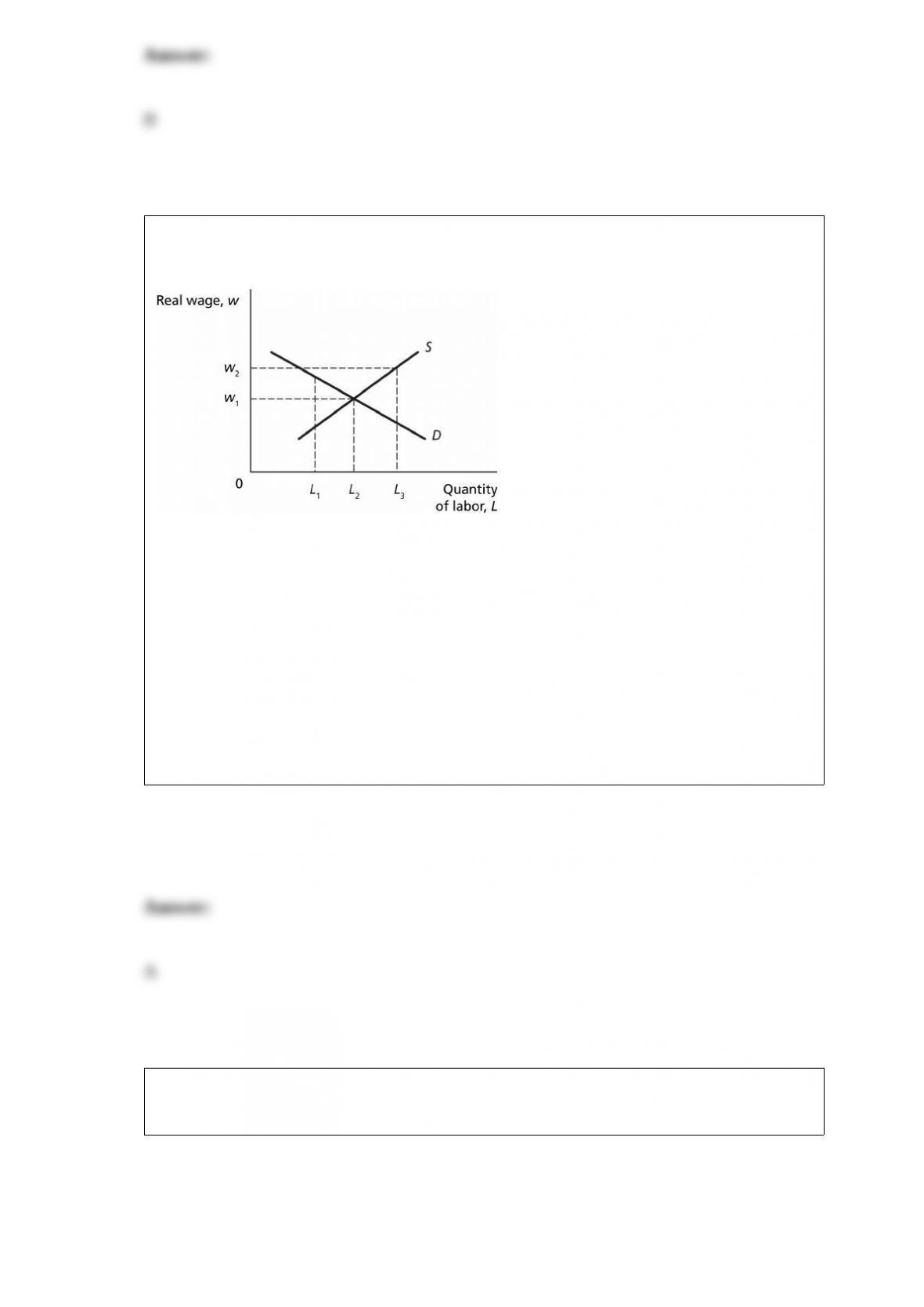
Figure 8.5
Refer to Figure 8.5. If the actual wage in this economy is represented by w2,
employment in this economy is represented by
A) L1.
B) L2.
C) L3.
D) 0
Figure 11.1
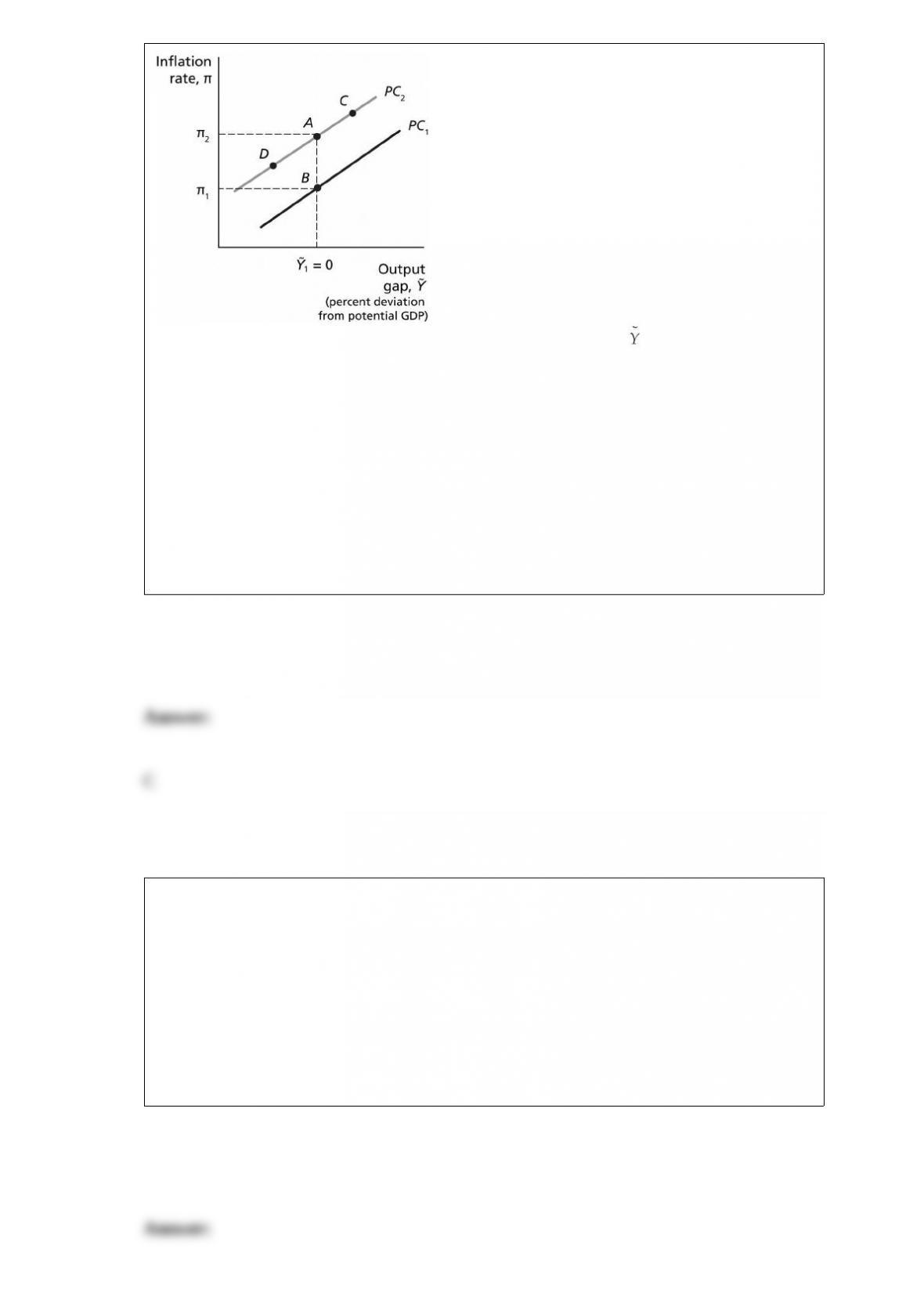
Refer to Figure 11.1. Assume the economy is in equilibrium at 1 = 0. Other things
equal, a surge in household wealth will result in a movement from point ________ to
point ________.
A) A; B
B) B; A
C) A; C
D) A; D
Once the Phillips curve has shifted up, the economy is ________ because ________.
A) better off; every unemployment rate becomes associated with a higher inflation rate
B) better off; every inflation rate becomes associated with a lower unemployment rate
C) worse off; every inflation rate becomes associated with a higher unemployment rate
D) worse off; every unemployment rate becomes associated with a lower inflation rate
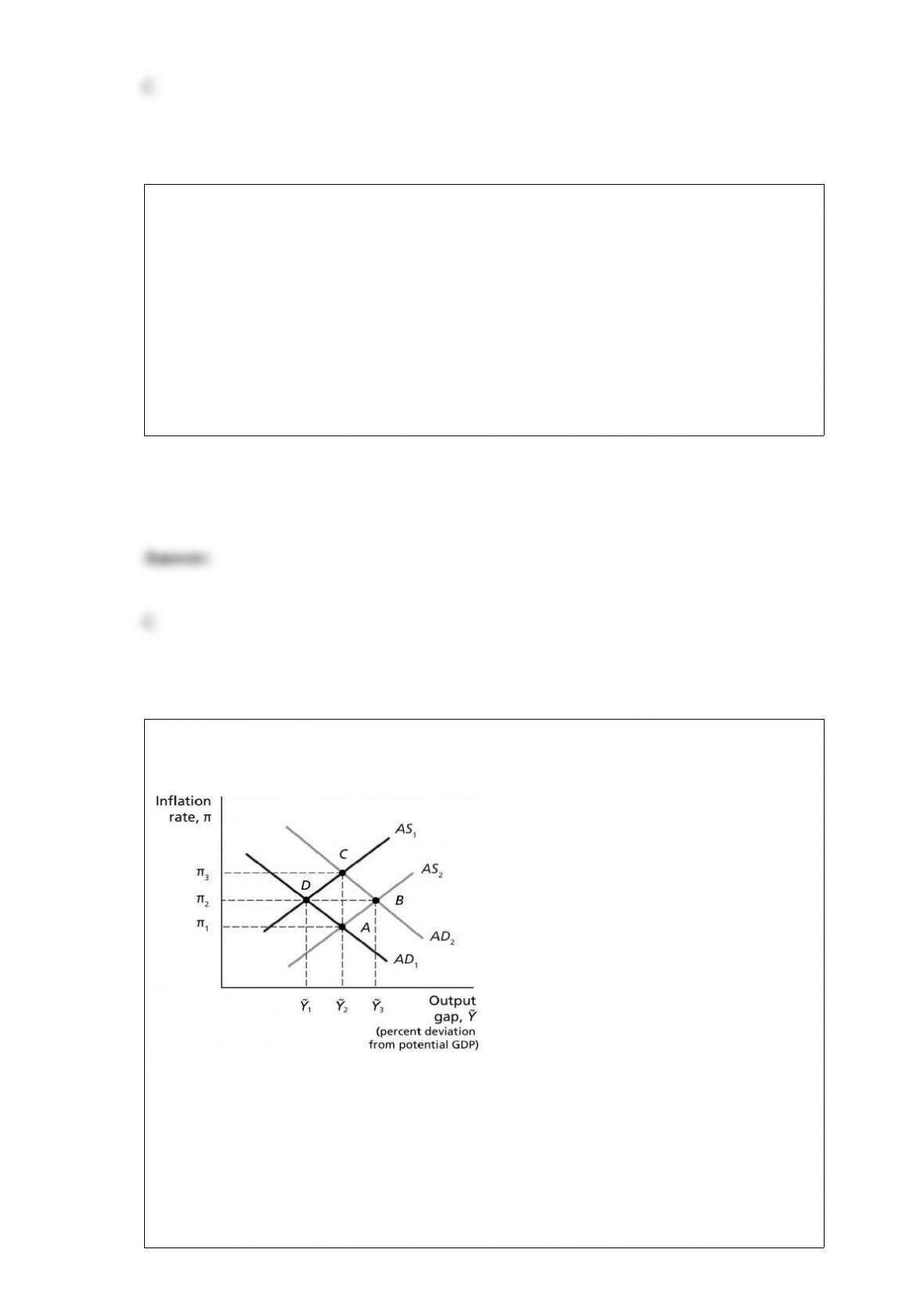
An increase in the price level causes a ________ the IS curve and a ________ the
aggregate demand curve.
A) movement up along; movement down along
B) shift to the right of; movement down along
C) movement down along; movement down along
D) shift to the left of; movement up along
Figure 14.3
Refer to Figure 14.3. Suppose the economy is initially at long-run equilibrium and the
economy experiences a demand shock such as a stock market crash. This is best
represented by an initial movement from
A) point C to point A.
B) point C to point B.
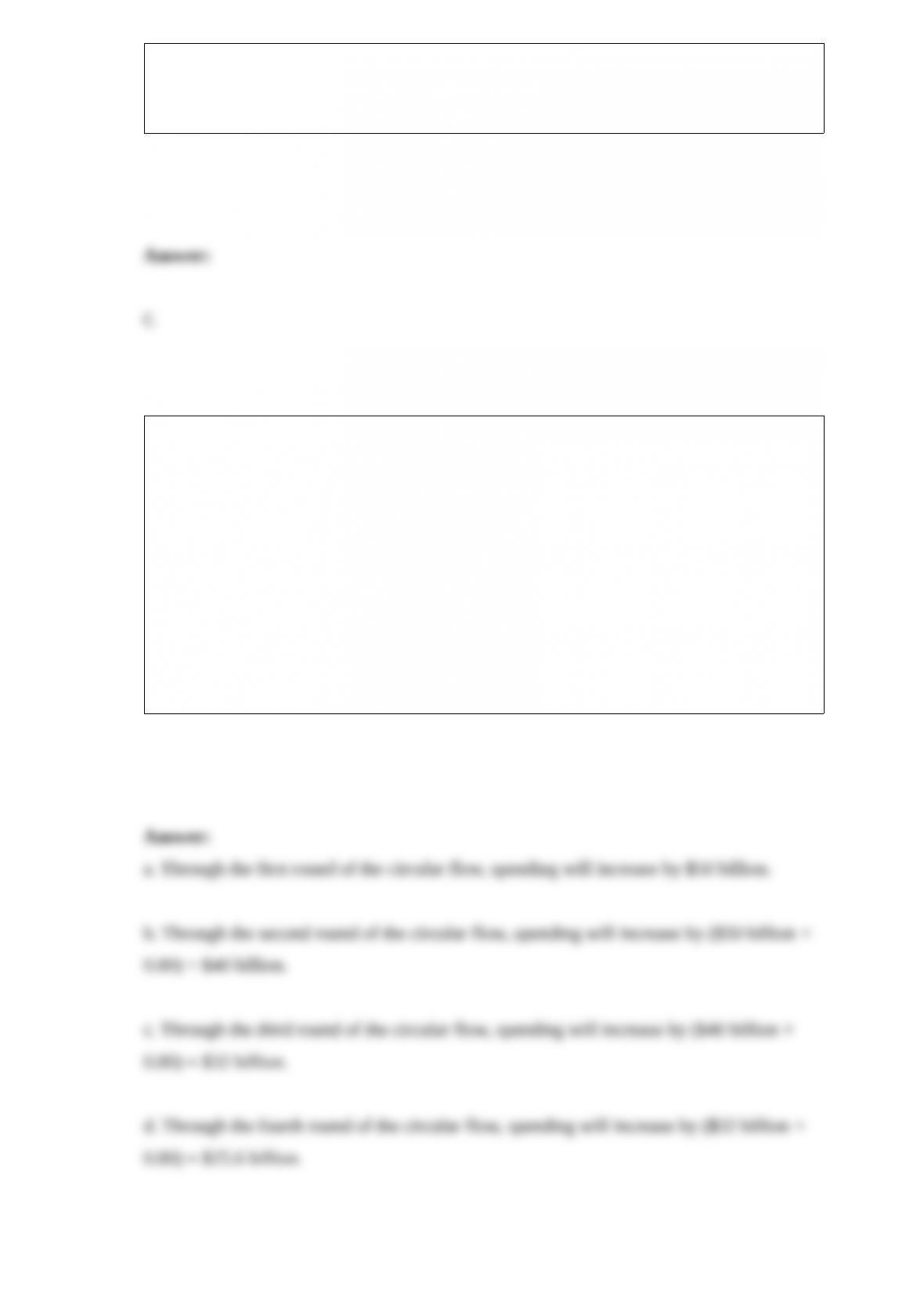
C) point C to point D.
D) point D to point A.
Suppose consumer confidence improves and as a result, consumer spending increases
by $50 billion dollars. Assume households spend $0.80 of each extra dollar of income
and save the remaining $0.20. Other things equal, calculate by how much spending will
increase during:
a. the first round through the circular flow.
b. the second round through the circular flow.
c. the third round through the circular flow.
d. the fourth round through the circular flow.
Which of the following could cause nominal GDP to increase and real GDP to
decrease?
A) The price level falls and the quantity of final goods and services produced falls.
B) The price level falls and the quantity of final goods and services produced rises.
C) The price level rises and the quantity of final goods and services produced falls.
D) The price level rises and the quantity of final goods and services produced rises.
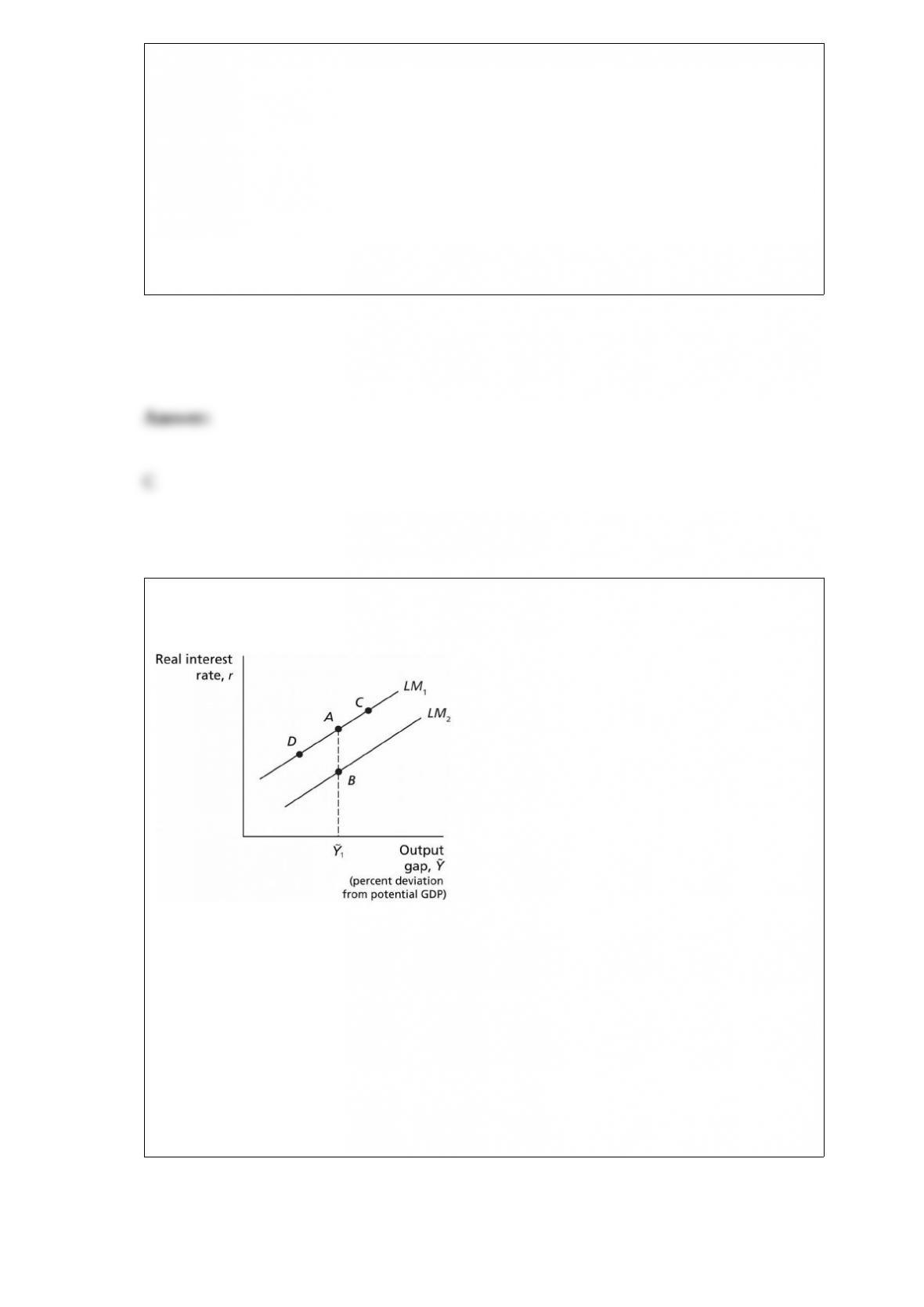
Figure 10.8
Refer to Figure 10.8. Other things equal, a decrease in the nominal interest rate on
money would best be represented by
A) a movement from point A to point C.
B) a movement from point A to point D.
C) a shift from LM1 to LM2.
D) a shift from LM2 to LM1.

As a percentage of GDP, the federal government expenditure which is expected to
increase the most between 2012 and 2042 is
A) Social Security.
B) Medicare and Medicaid.
C) the net interest on the federal debt.
D) national defense.
The price of a financial asset should equal the
A) present value of the payments to be received from owning the asset.
B) future value of the payments to be received from owning the asset.
C) face value of the asset less the future payments to be received from owning the asset.
D) coupon value of the asset divided by the effective interest rate at the time the asset
was purchased.
C = $750 + 0.75(1 – 0.4)Y
I = $600
G = $500
NX = -$50
Use the above data to:
a. Calculate the equilibrium level of GDP
b. Calculate the value of the expenditure multiplier
c. Find the change in the initial equilibrium GDP if autonomous investment increases
by $75.
d. Find the change in the initial equilibrium GDP if autonomous government purchases
decreases by $50.
e. Find the change in the initial equilibrium GDP if autonomous net exports increase by
$10.