An increase in the purchasing power of money need not lead to an increase in the
purchasing power of income because the falling price level would likely mean falling
wages and salaries.
Net foreign investment is a measure of net capital outflows, equal to capital outflows
minus capital inflows in a given period of accounting.
Most economists believe that only a small gap between the wages of white males and
the wages of other groups is due to education. Most of the gap is explained by
discrimination.
Liquidity increases as we move from the M1 to the M2 definition of the money supply.

“The distribution of income should be left to the market” is an example of a positive
economic statement.
The Fed can use contractionary monetary policy in an attempt to keep inflation from
increasing.
According to the U.S. Bureau of Labor Statistics, between 2000 and 2005, real wages in
concrete work fell by 16.5%, despite a soaring demand for workers. This implies that
the supply of workers in this field increased faster than the demand for workers.
Indirect finance includes the sale by a corporation of stocks or bonds, but does not
include borrowing money from a bank.

The household survey is compiled from firms who answer questions about the number
of persons who are employed and on the company payroll.
Monopolistically competitive firms face a perfectly elastic demand curve.
The income effect results in consumers increasing the quantity of normal goods
demanded when the price falls.
The Fed has more control over open market operations as compared to discount policy.

If Estonia has an absolute advantage in the production of two goods compared to
Norway, Estonia cannot benefit from trade with Norway.
If Abigail can make more candles in one day than Pierre, then Abigail has an absolute
advantage in making candles.
Until recently, many developing countries
A) were quite open to foreign investment.
B) encouraged foreign direct investment but discouraged foreign portfolio investment.
C) sealed themselves off from foreign investment.
D) encouraged foreign portfolio investment but discouraged foreign direct investment.

Which of the following is an example of foreign direct investment?
A) You purchase a plane ticket to China on American Airlines.
B) American Airlines builds a hub in China.
C) You buy a plane that was made in China.
D) A stock broker from China sells you a Chinese government savings bond.
The Taylor rule helps explain the relationship between the Fed’s ________ and
________.
A) money supply target; economic conditions
B) money supply target; the federal funds target
C) federal funds target; the monetary growth rule
D) federal funds target; economic conditions
The Industrial Revolution
A) marked the beginning of significant economic growth in the world.
B) started in France around the year 1750.

C) produced goods exclusively using human or animal power.
D) had no impact on standards of living in the world.
Two actions by the Fed during Alan Greenspan’s term as chairman have been identified
as possibly contributing to the financial crisis in 2008. Which of the following was one
of those actions?
A) decreasing the money supply to fight the possibility of disinflation
B) the decision to keep the federal funds rate at 1 percent from June 2003 to June 2004
C) working in concert with the European Central Bank to stabilize the dollar / euro
exchange rate
D) financing the first Gulf War by printing money and generating rapid inflation
Fiscal policy actions that are intended to have long-run effects on real GDP attempt to
increase ________ through changing ________.
A) aggregate demand; government spending
B) aggregate supply; taxes
C) aggregate demand; taxes
D) aggregate supply; government spending

A merger between U.S. Steel and General Motors would be an example of a
A) vertical merger.
B) horizontal merger.
C) conglomerate merger.
D) conspiracy in restraint of trade.
The aggregate demand curve illustrates the relationship between ________ and the
________, holding constant all other factors that affect aggregate expenditure.
A) the price level; quantity of planned aggregate expenditure
B) the inflation rate; quantity of planned aggregate expenditure
C) the price level; quantity of planned investment expenditure
D) the price level; quantity of consumption expenditure
Table 3-3
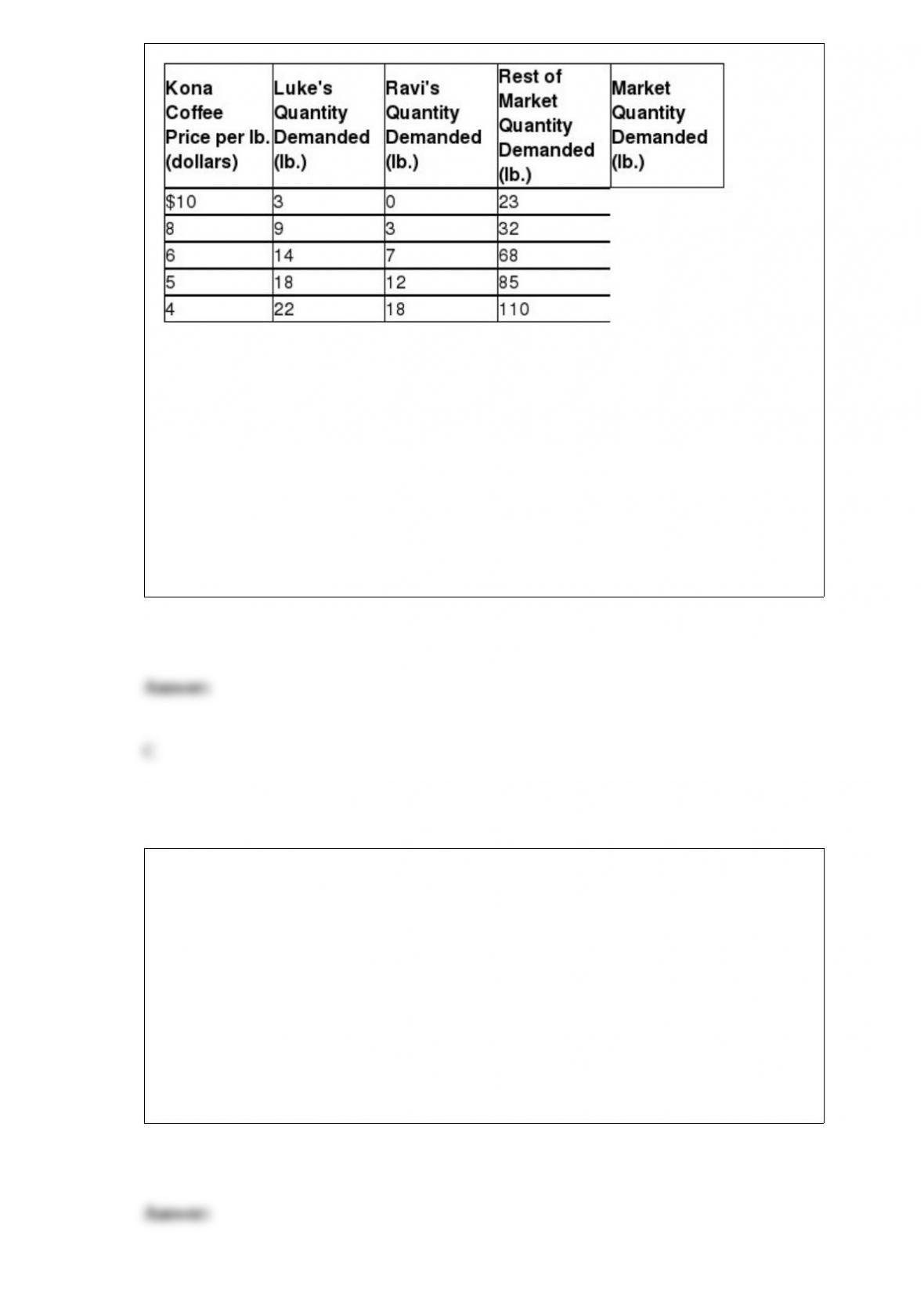
The table above shows the demand schedules for Kona coffee of two individuals (Luke
and Ravi) and the rest of the market. If the price of Kona coffee falls from $6 to $4, the
market quantity demanded would
A) decrease by 89 lb.
B) increase by 26 lb.
C) increase by 61 lb.
D) increase by 110 lb.
Part of the spending on the Caldecott Tunnel project in northern California came from
the American Reinvestment and Recovery Act, which is an example of discretionary
fiscal policy aimed at increasing
A) real GDP and employment.
B) tax revenues and the federal budget surplus.
C) disposable income and interest rates.
D) the money supply and money demand.
Scott is a manager at a pool cleaning business. He has hired 10 workers to clean pools
for him and is considering what type of payment scheme he should set up for his
workers. He can pay each of his workers $10 per hour to clean pools, or he can pay his
workers $20 for each pool a worker cleans. (It takes 2 hours, on average, for an
employee to clean a pool thoroughly.) If Scott wants to maximize the number of pools
his workers clean in one day, which payment scheme should he use? Explain.
Suppose that Federal Reserve policy leads to higher interest rates in the United States.
How will this policy affect real GDP in the short run if the United States is a closed
economy, and how will it affect real GDP in the short run if the United States is an open
economy?
Does the saving and investment equation imply that a country’s national saving must
always equal its domestic investment? Explain.
Why will there be less crowding out of private spending by government spending the
less sensitive consumption, investment, and net exports are to changes in interest rates?
If you own a bond with a 3 percent coupon rate and new bonds are paying 8 percent,
what will happen to your bond’s market price?
How might a monopolistically competitive firm continually earn economic profit
greater than zero?