1)
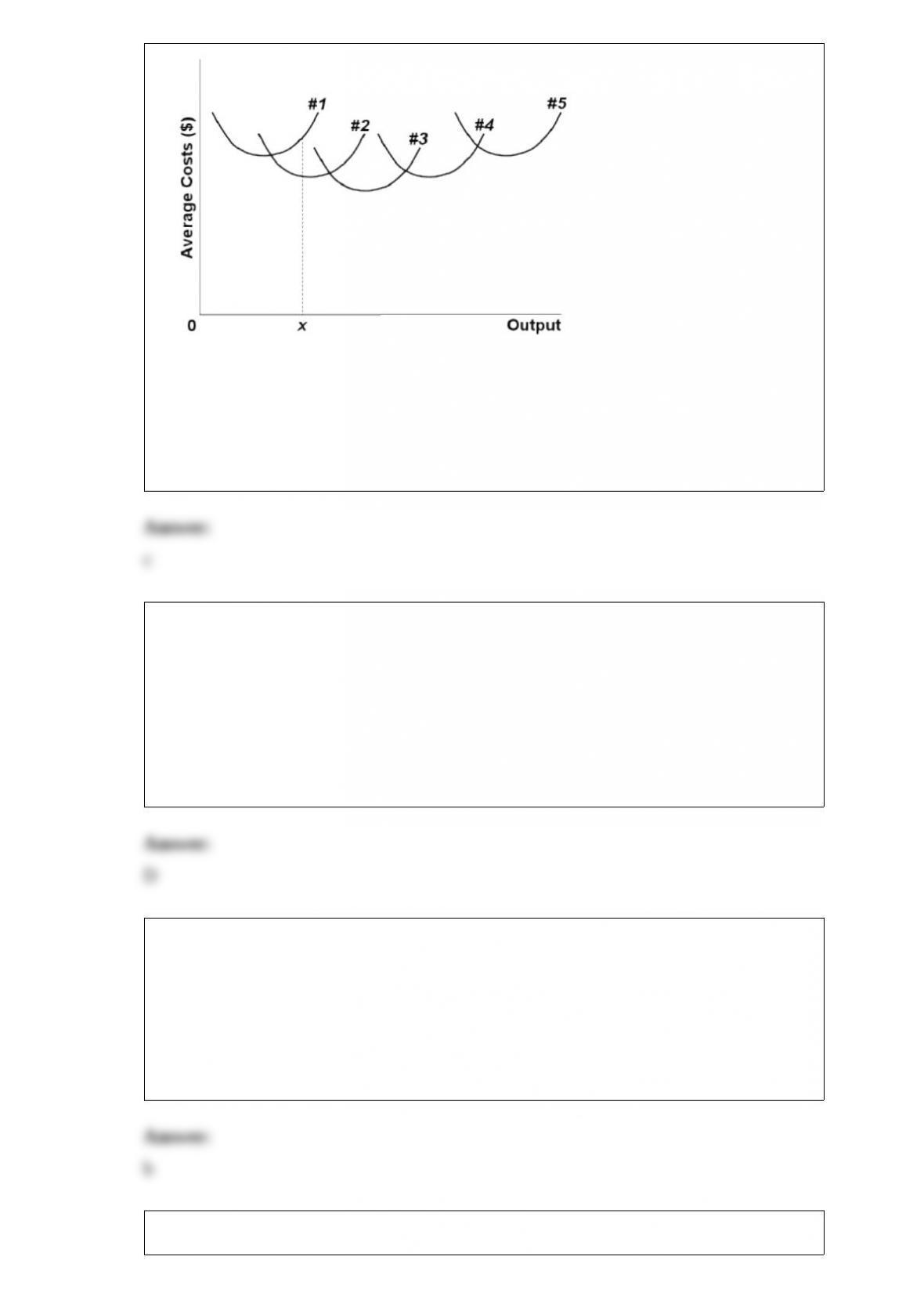
the above diagram shows the short-run average total cost curves for five different plant
sizes of a firm. in the long run the firm should produce output 0x with a plant of size:
a.#4.
b.#3.
c.#2.
d.#1.
2) Economists who contend that oligopolists have a strong incentive to engage in R&D
say that:
A.the undistributed profits of oligopolists give them a source of readily available,
relatively low cost funds for financing R&D.
B.entry barriers enable oligopolists to sustain the profit it gains from innovation.
C.the large size of oligopolists’ R&D departments allow them to use very specialized,
expensive R&D equipment and employ teams of specialized researchers.
D.all of these are true.
3) real gdp is:
a.the nominal value of all goods and services produced in the economy.
b.the nominal value of all goods and services produced in the domestic economy
corrected for inflation or deflation.
c.that aggregate output that is produced when the economy is operating at full
employment.
d.always greater than nominal gdp.
4) a person should consume more of something when its marginal:

a.benefit exceeds its marginal cost.
b.cost exceeds its marginal benefit.
c.cost equals its marginal benefit.
d.benefit is still positive.
5) answer the next question(s) on the basis of the following information: only three
goods are produced in an economy in the following amounts: a = 10, b = 30, c = 5. the
current year per unit prices of these three goods are a = $2, b = $3, and c = $1.
(advanced analysis) refer to the above information. if the per unit prices of the three
goods each were $1 in a base year used to construct a gdp price index, then the gdp
price index in the current year is:
a.205.5.
b.255.5.
c.39.3.
d.100.
6) Which of the following statements about U.S. agriculture is true as it relates to the
past several decades?
A.The demand for farm products has declined, the supply of farm products has
increased, and the price of farm products has declined.
B.The demand for farm products has become both more income elastic and more price
elastic.
C.Minimum efficient scale has increased, the price of farm products has declined, and
the number of farms has declined.
D.The price of farm products have increased, minimum efficient scale has declined, and
the supply of farm products has been stagnant.
7) A firm will employ more of an input whose relative price has fallen and, conversely,
will use less of an input whose relative price has risen. Thus a fall in the price of capital
will increase the relative price of labor and thereby reduce the demand for labor. This
describes the:
A.output effect.
B.substitution effect.
C.idea of derived demand.

8) Suppose that a hypothetical economy has the following relationship between its real
domestic output and the input quantities necessary for producing that level of output.
(a)What is the level of productivity in this economy?
(b)What is the unit cost of production if the price of each input is $2.00?
(c)If the input price decreases from $2 to $1.50, what is the new per unit cost of
production? In what direction would the aggregate supply curve move? What effect
would this shift have on the price level and the level of real domestic output if the
economy is initially operating in the intermediate range?
(d)Suppose that instead of the input price decreasing, the productivity had increased by
25 percent. What will be the new unit cost of production? In what direction would the
aggregate supply curve move? What effect would this shift have on the equilibrium
price and output level if the economy?
9) Which of the following is correct?
A.Money is a resource, but real capital is not.
B.Real capital is a resource, but money is not.
C.Neither money nor real capital is a resource.
D.Both money and real capital are resources.
10) determine, other things equal, the effects of a given change in a determinant of
demand or supply for product x upon (1) the demand (d) for, or supply (s) of, x, (2) the
equilibrium price (p) of x and (3) the equilibrium quantity (q) of x.
refer to the above. an increase in the price of a product that is a close substitute for x
will:
a.decrease d, increase p, and decrease q.
b.increase d, increase p, and decrease q.
c.increase d, increase p, and increase q.
d.increase d, decrease p, and increase q.
11)
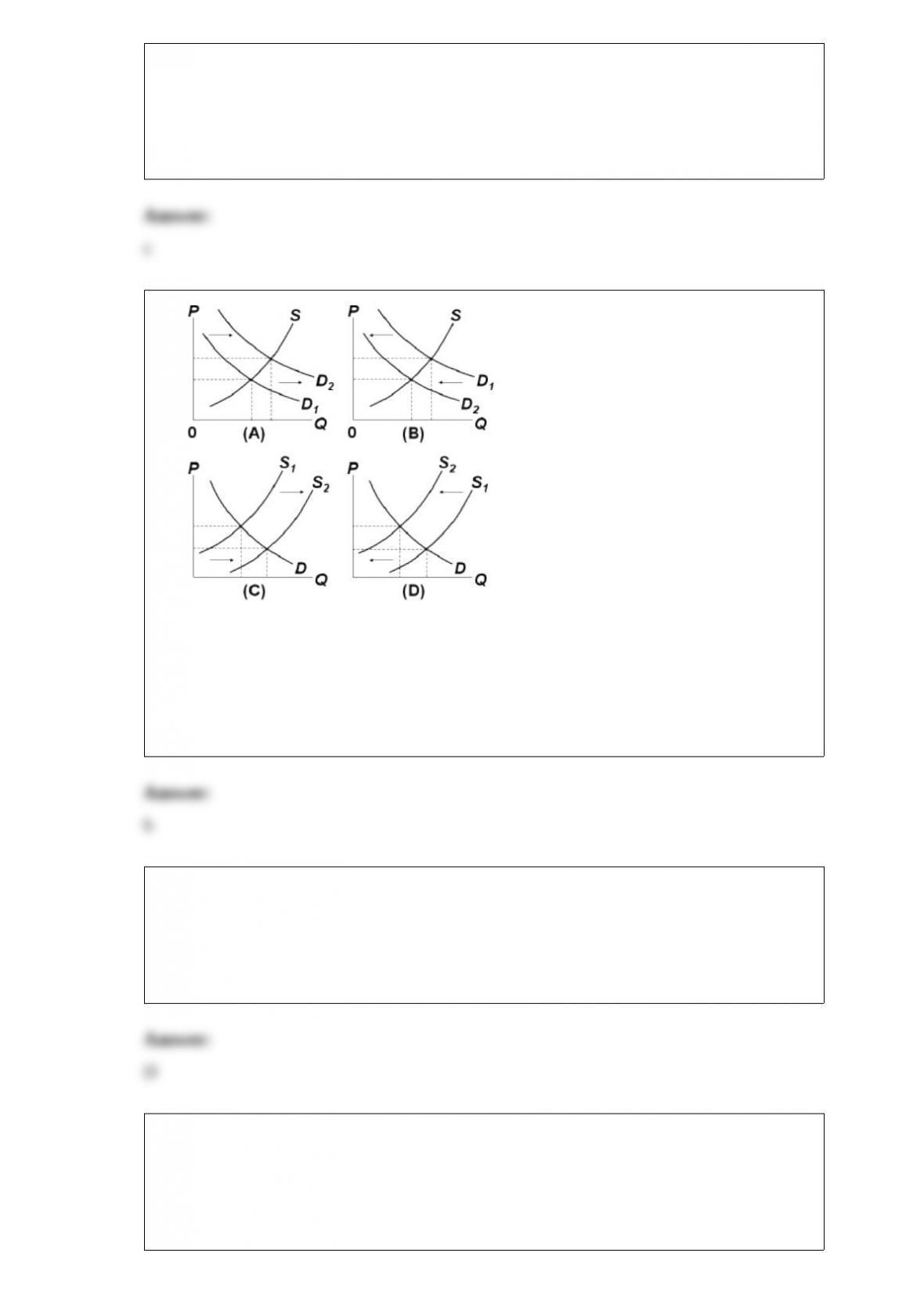
which of the above diagrams illustrate(s) the effect of an increase in the price of
budweiser beer on the market for coors beer?
a.a and c
b.a only.
c.b only.
d.c only.
12) Disinflation occurs when:
A.the price level is falling.
B.investment plans exceed saving.
C.a speculative investment “bubble” is bursting.
D.the inflation rate is declining.
13) The total supply of land is:
A.upsloping.
B.perfectly elastic.
C.perfectly inelastic.
D.greater in the short run than in the long run.

14) New scientific knowledge mainly comes from university and government
laboratories, not private firms, because:
A.large corporations do not have funds available to channel toward basic research.
B.government pays scientists higher salaries than do private firms.
C.entrepreneurs find it difficult to secure venture capital to finance innovation.
D.basic scientific principles, as such, cannot be patented and do not always have
commercial applicability.
15) Which of the following statements is correct?
A.Federal deficits were larger in the late 1990s than in the early 1990s.
B.Deep tax cuts always expand tax revenues and reduce the public debt.
C.The public debt has usually declined during wartime.
D.There is a tendency for the public debt to grow during recessions.
16) Suppose the ABC bank has excess reserves of $4,000 and outstanding checkable
deposits of $80,000. If the reserve requirement is 25 percent, what is the size of the
bank’s actual reserves?
A.$16,000
B.$84,000
C.$24,000
D.$20,000
17)
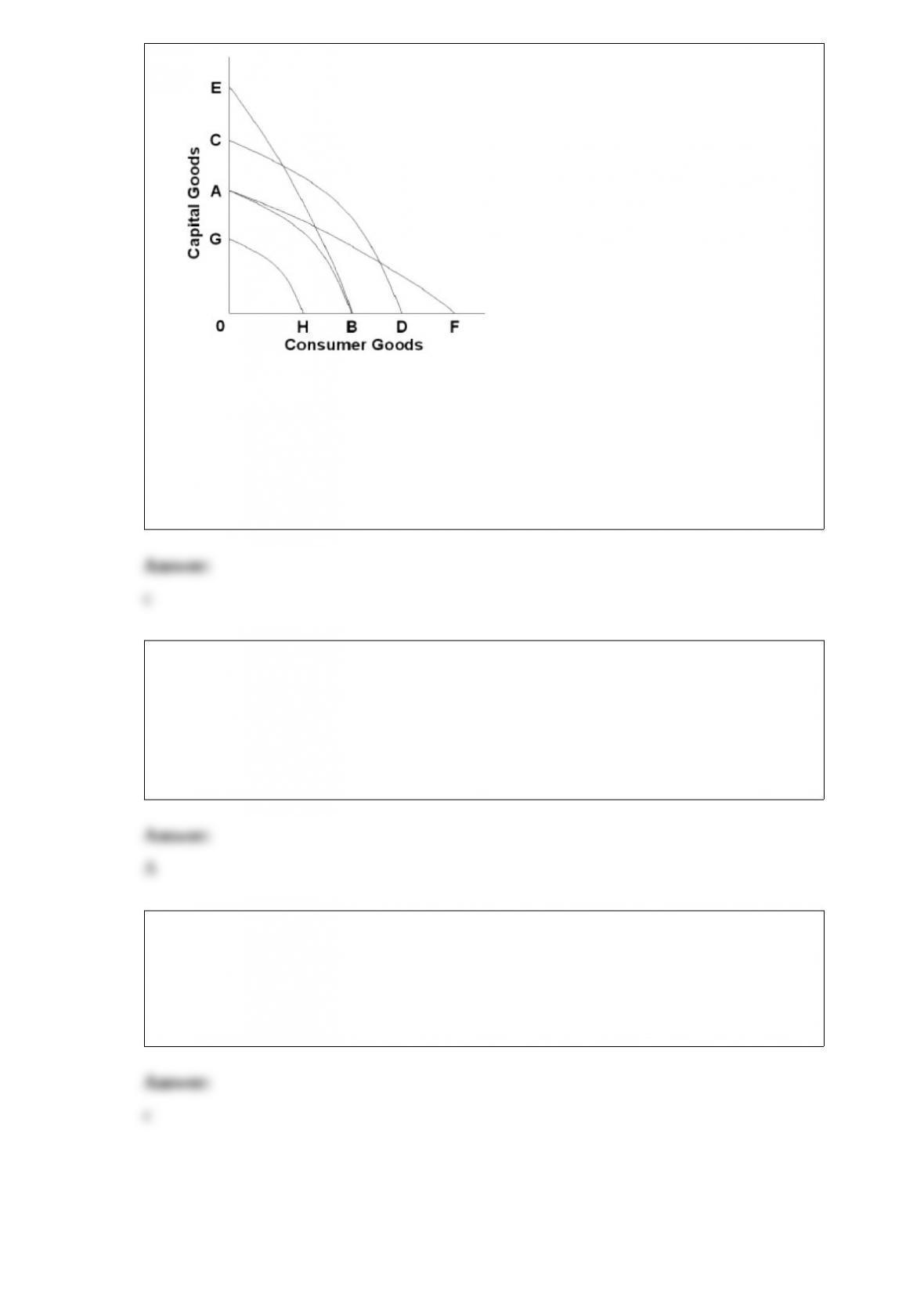
refer to the above diagram. technological advance that is useful in producing consumer
goods but not in producing capital goods is shown by the shift of the production
possibilities curve from ab to:
a.cd.
b.eb.
c.af.
d.gh.
18) Actual investment is $62 billion at an equilibrium output level of $620 billion in a
private closed economy. The average propensity to save at this level of output is:
A.0.10.
B.10.0
C.0.62.
D.0.84.
19) a product has utility if it:
a.takes more and more resources to produce successive units of it.
b.violates the law of demand.
c.satisfies consumer wants.
d.is useful.