An increase in the unemployment rate may be represented as a movement from a point
on the production possibilities frontier to a point inside the frontier.
An increase in government spending lowers interest rates and increases the rate of
investment in new capital.
When potential GDP increases, short-run aggregate supply also increases, but long-run
aggregate supply does not change.
Ceteris paribus, a real depreciation of the dollar will decrease net exports in the United
States.

The payment received by suppliers of entrepreneurial skills is called profit.
Changes in the health of the average person are relatively unimportant as an indicator of
changes in the standard of living.
The cyclically adjusted budget is calculated at potential GDP.
How do the owners of a partnership relate to the business?
A) The owners and the business are not separate legal entities.
B) The owners and the business are separate legal entities.
C) The assets of the owners are considered separate from the asset of the business.
D) None of these describe the legal relationship of the owners to the business.

After an unexpected ________ in the price of oil, the long-run adjustment decreases the
price level and ________ the unemployment rate as they return to their original levels.
A) increase; increases
B) increase; decreases
C) decrease; increases
D) decrease; decreases
According to the Centers for Disease Control and Prevention, ________ in 2013 in
which less than 20 percent of the population was considered obese.
A) Colorado was the only state
B) there were only 5 states
C) there were more than 25 states
D) there were no states

Table 7-6
Production and
Consumption Production
Without Trade With Trade
Estonia and Morocco can produce both swords and belts. Table 7-6 shows the
production and consumption quantities without trade, and the production numbers with
trade.
Refer to Table 7-6. Prior to trade, what was the opportunity cost to produce 1 belt in
Estonia?
A) 1/2 of a sword
B) 4/5 of a sword
C) 1.25 swords
D) 2 swords
A one-time tax rebate, which is not expected to be extended in future years, will
A) have a small positive effect on consumption and aggregate demand.
B) have no effect on consumption and aggregate demand.
C) have a significant positive effect on consumption and aggregate demand, with
aggregate demand growing by a multiple of the tax rebate.
D) increase aggregate supply and aggregate demand.

Figure 2-12
Refer to Figure 2-12. One segment of the circular flow diagram in the Figure shows the
flow of funds from market F to economic agents G. The funds represent spending on
goods and services. What is market F and who are economic agents G?
A) F = factor markets; G = households
B) F = product markets; G = households
C) F = factor markets; G = firms
D) F = product markets; G = firms
If stricter immigration laws are imposed and many foreign workers in the United States
are forced to go back to their home countries,
A) the long-run aggregate supply curve will shift to the right.
B) the long-run aggregate supply curve will shift to the left.
C) we will move up along the long-run aggregate supply curve.
D) we will move down along the long-run aggregate supply curve.
How does a decrease in the federal budget deficit affect the demand for dollars and the
supply of dollars on the foreign exchange market?
A) The demand for dollars falls, and the supply of dollars falls.
B) The demand for dollars rises, and the supply of dollars rises.
C) The demand for dollars rises, and the supply of dollars falls.
D) The demand for dollars falls, and the supply of dollars rises.
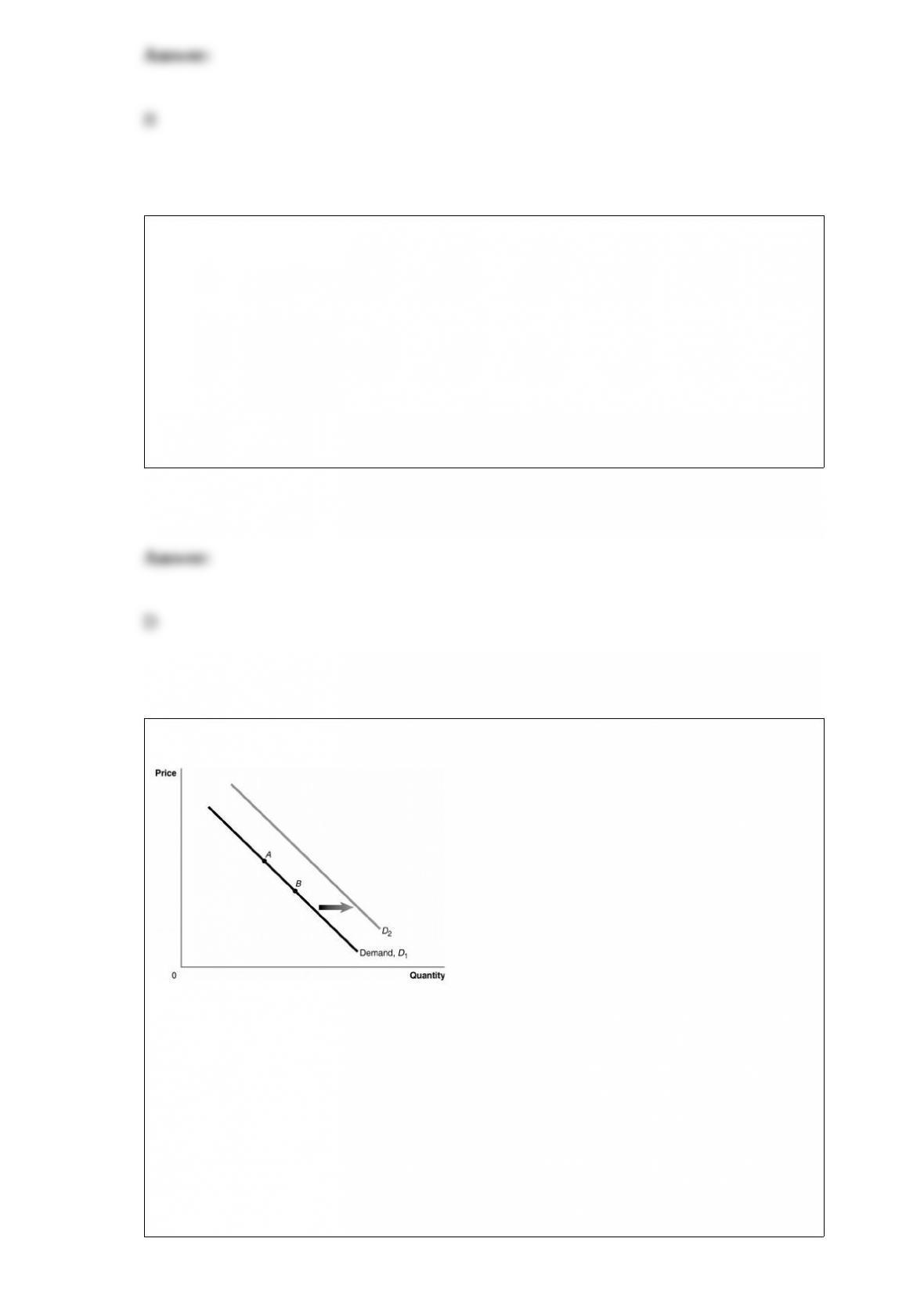
Figure 3-1
Refer to Figure 3-1. An increase in the price of the product would be represented by a
movement from
A) A to B.
B) B to A.
C) D1 to D2.
D) D2 to D1.
Of the following high-income countries, which has the highest female life expectancy at
age 65?
A) Canada
B) Japan
C) the United Kingdom
D) the United States
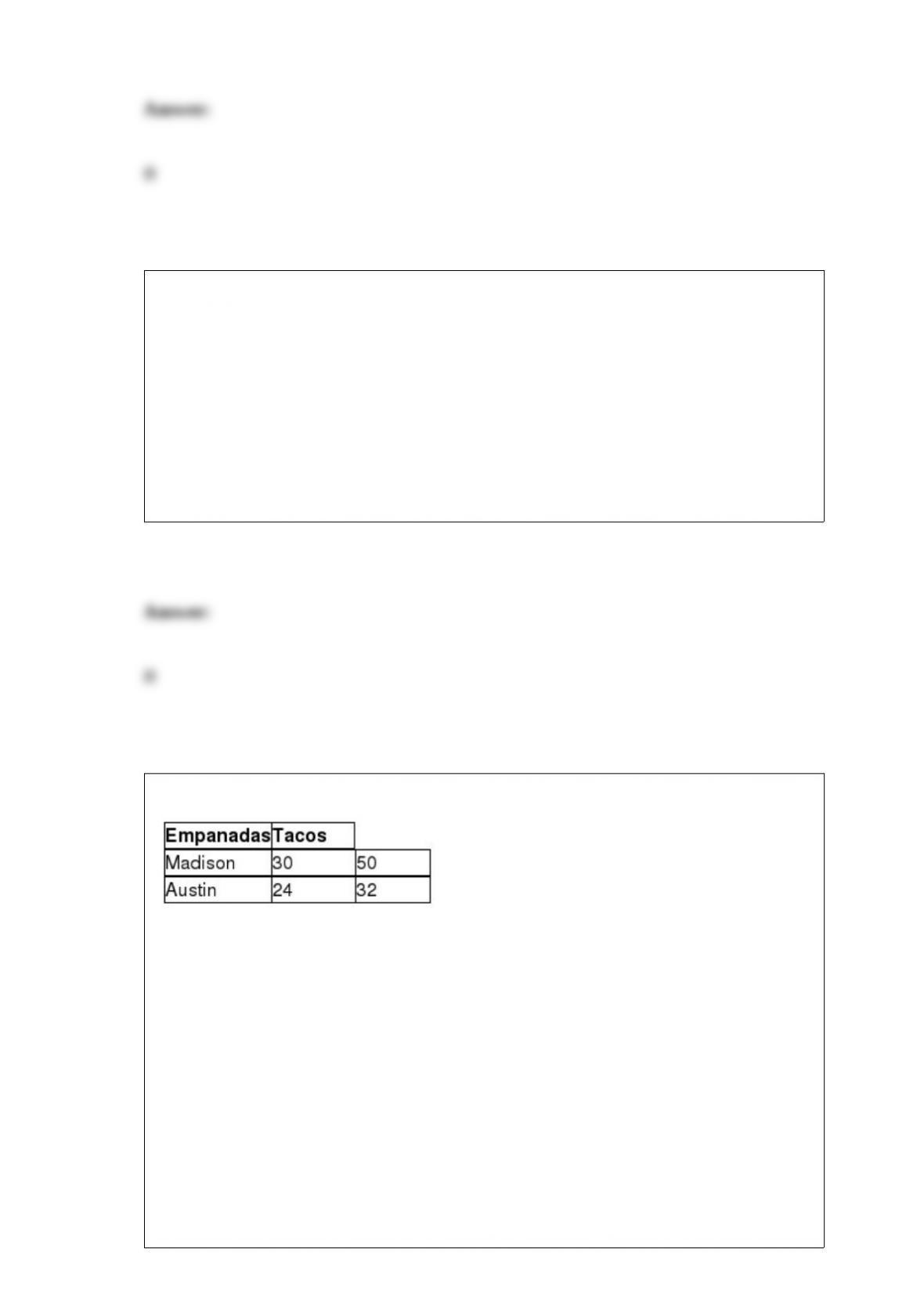
Table 7-2
Madison and Austin own Cafe Ole’. Table 7-2 lists the number of empanadas and tacos
Madison and Austin can each make in one hour.
Refer to Table 7-2. Select the statement that accurately interprets the data in the table.
A) Madison has an absolute advantage in making tacos and Austin has an absolute
advantage in making empanadas.
B) Madison has an absolute advantage in making empanadas and Austin has an absolute
advantage in making tacos.
C) Madison has an absolute advantage in making empanadas and tacos.
D) Austin has an absolute advantage in making empanadas and tacos.

What happens in the secondary market?
A) secondary inputs like electricity are sold
B) a corporate financial manager will raise funds for expansion of the firm
C) newly issued claims are sold by the borrowing firm to the initial buyer
D) already issued claims are sold from one investor to another
The federal budget deficit and the trade balance are often referred to as the
A) balance of payments.
B) dueling depreciators.
C) twin deficits.
D) national debt.
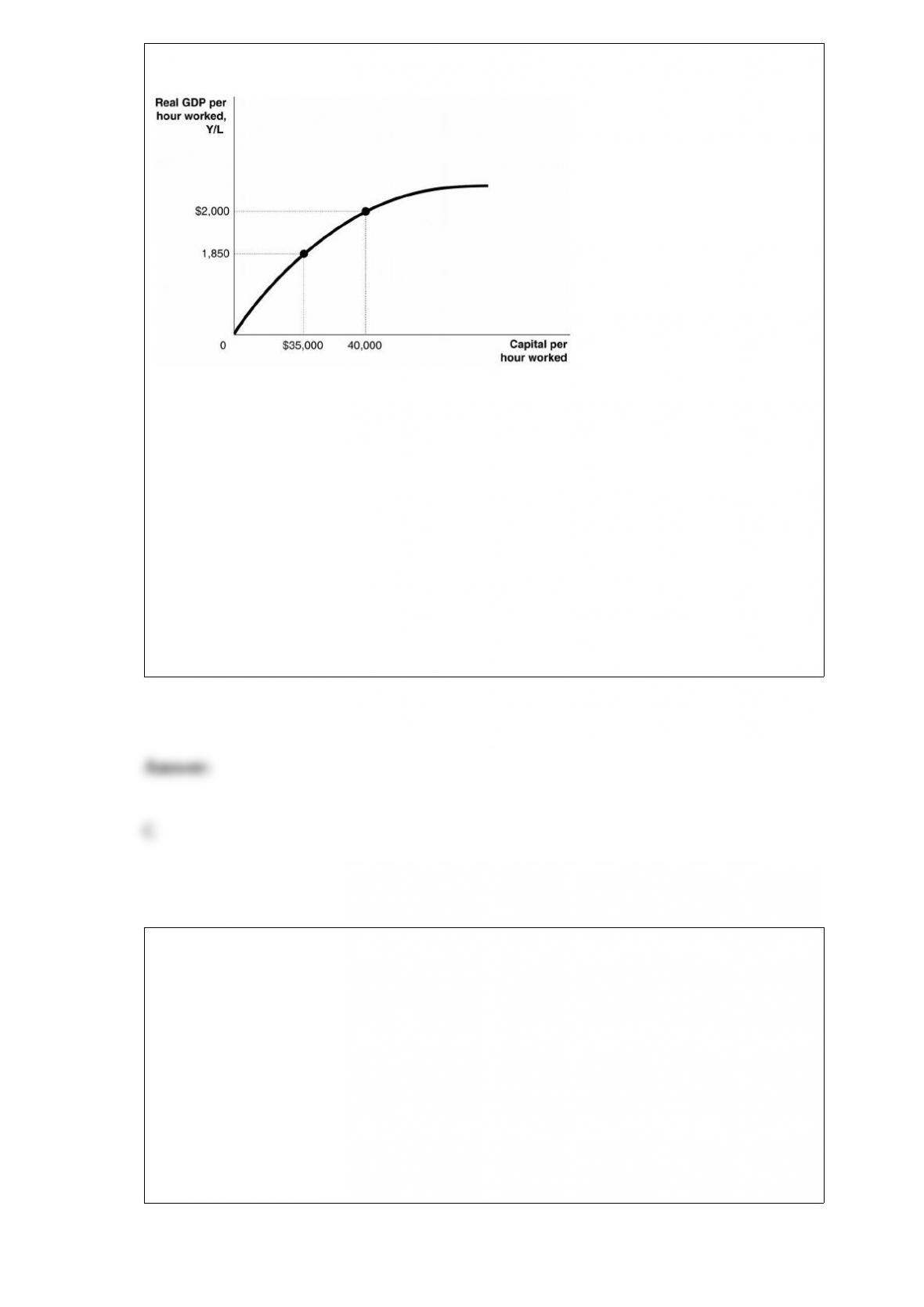
Figure 11-2
Refer to Figure 11-2. Assuming no technological change, if the United States increases
capital per hour worked by $40,000 every year between 2010 and 2014, we would
expect to see
A) real GDP per hour worked will increase by the same increment each year between
2010 and 2014.
B) real GDP per hour worked will be lower in 2014 than it was in 2010.
C) the per-worker production function will get flatter over time.
D) the per-worker production function will shift up every year there is increase in
capital per hour worked.
Which of the following is a true statement about the impact of World War II on the U.S.
economy?
A) U.S. GDP decreased dramatically from 1941 to 1945.
B) The war time years were a period of prosperity for U.S. consumers.
C) Less than 10% of the labor force was in the military or producing war goods.
D) Increased production of tanks, ships, planes, and munitions accounted for most of
the increase in GDP.

Workers laid off as a result of a recession suffer
A) frictional unemployment.
B) structural unemployment.
C) cyclical unemployment.
D) seasonal unemployment.
E) natural unemployment.
Suppose the GDP deflator in the United States is 125 and the GDP deflator in Japan is
100. Also assume the United States has trade barriers on Japanese goods in the form of
quotas. What does this imply about the exchange rate of yen per dollar under the theory
of purchasing power parity in the long run?
A) The exchange rate of yen per dollar will be equal to 1.25.
B) The exchange rate of yen per dollar will be greater than 0.8.
C) The exchange rate of yen per dollar will be equal to 0.8.
D) The exchange rate of yen per dollar will be less than 0.8.

There is public dissaving if
A) G + TR > T.
B) G + TR < T.
C) TR > G + T.
D) TR < G + T.
Why do most economists believe that it is important for a country’s central bank to be
independent of the rest of the country’s central government?
Does the saving and investment equation imply that a country’s national saving must
always equal its domestic investment? Explain.

What are the five steps by which economists arrive at a useful economic model?
The “Big Mac Theory of Exchange Rates” tests the accuracy of purchasing power
parity theory. In July 2013, The Economist reported that the average price of a Big Mac
in the United States was $4.56. In Switzerland, the average price of a Big Mac at that
time was 6.50 Swiss francs. If the exchange rate between the dollar and the Swiss franc
was 0.93 Swiss francs per dollar, explain how it would be profitable to buy Big Macs in
the United States instead of in Switzerland.
If the Federal Reserve wants to reduce inflation from 4 percent to 3 percent
permanently, how can that goal be achieved, and what impact will that have on
employment in the short run and the long run? Support your answer with a graph of the
Phillips curve in the short run and the long run.