
1) In the United States from 1929 to 1933, real GDP _____________, and the
unemployment rate ________________.
A.declined by 27 percent; rose to 25 percent.
B.increased by 21 percent; fell to 2 percent.
C.declined by 21 percent; rose to 27 percent.
D.declined by 40 percent; rose to 50 percent.
2) In a cap-and-trade program:
A.government fixes the price of pollution rights and firms choose how many permits to
purchase.
B.government fixes the maximum amount of a pollutant that firms can discharge and
issues permits that firms can buy from and sell to each other.
C.each firm is provided a fixed number of permits for a particular pollutant and no
individual firm is allowed to acquire additional permits.
D.firms can emit whatever type of pollutant they want, so long as the total tonnage does
not exceed a government established quantity.
3) About ____ percent of business R&D spending is for basic research.
A.1
B.4
C.13
D.20
4) At the equilibrium GDP for an open economy:
A.net exports may be either positive or negative.
B.imports will always exceed exports.
C.exports will always exceed imports.
D.exports and imports will be equal.
5) Monetary policy is expected to have its greatest impact on:
A.Xg.
B.Ig.
C.C.
D.G.
6) 1) W < MRP; W < MRC
2) W = MRP; W < MRC
3) W = MRP; W = MRC
4) W > MRP; W > MRC
Refer to the above list. The outcome in a monopsony labor market is shown by:
A.1
B.2
C.3
D.4
7) Suppose that Katie and Kelly each expect to receive $500 worth of marginal benefits
from a proposed new recreation center, whereas Kerry expects to receive only $100
worth. If the proposed tax levied on each for the center would be $400, a majority vote
will:
A.defeat this project and resources will be underallocated to it.
B.pass this project and resources will be efficiently allocated.
C.pass the this project and resources will be underallocated to it.
D.pass this project and resources will be overallocated to it.
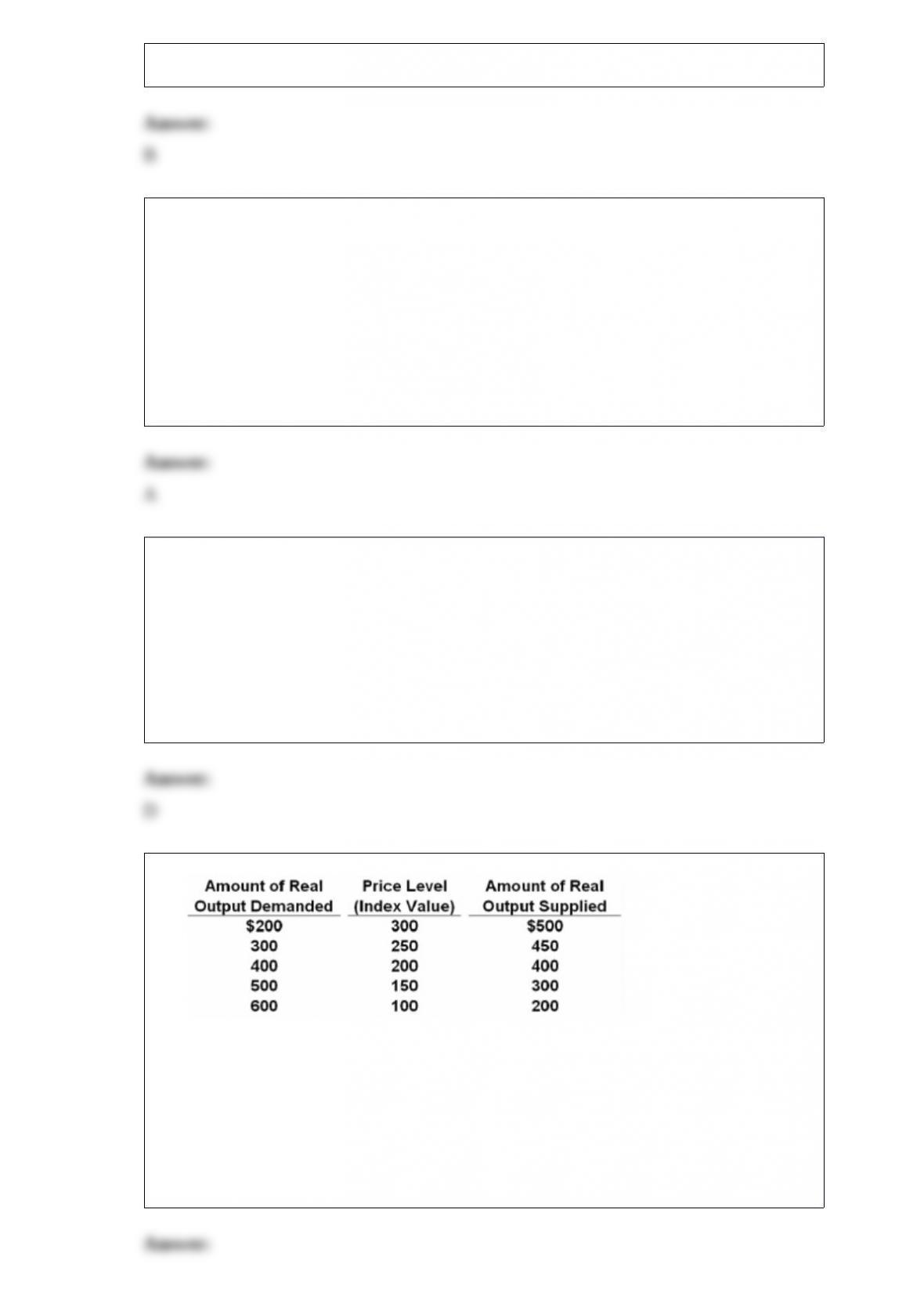
8)
Refer to the above data. If the amount of real output demanded at each price level falls
by $200, the equilibrium price level and equilibrium level of real domestic output will
fall to:
A.250 and $200, respectively.
B.200 and $300, respectively.
C.150 and $300, respectively.
D.150 and $200, respectively.
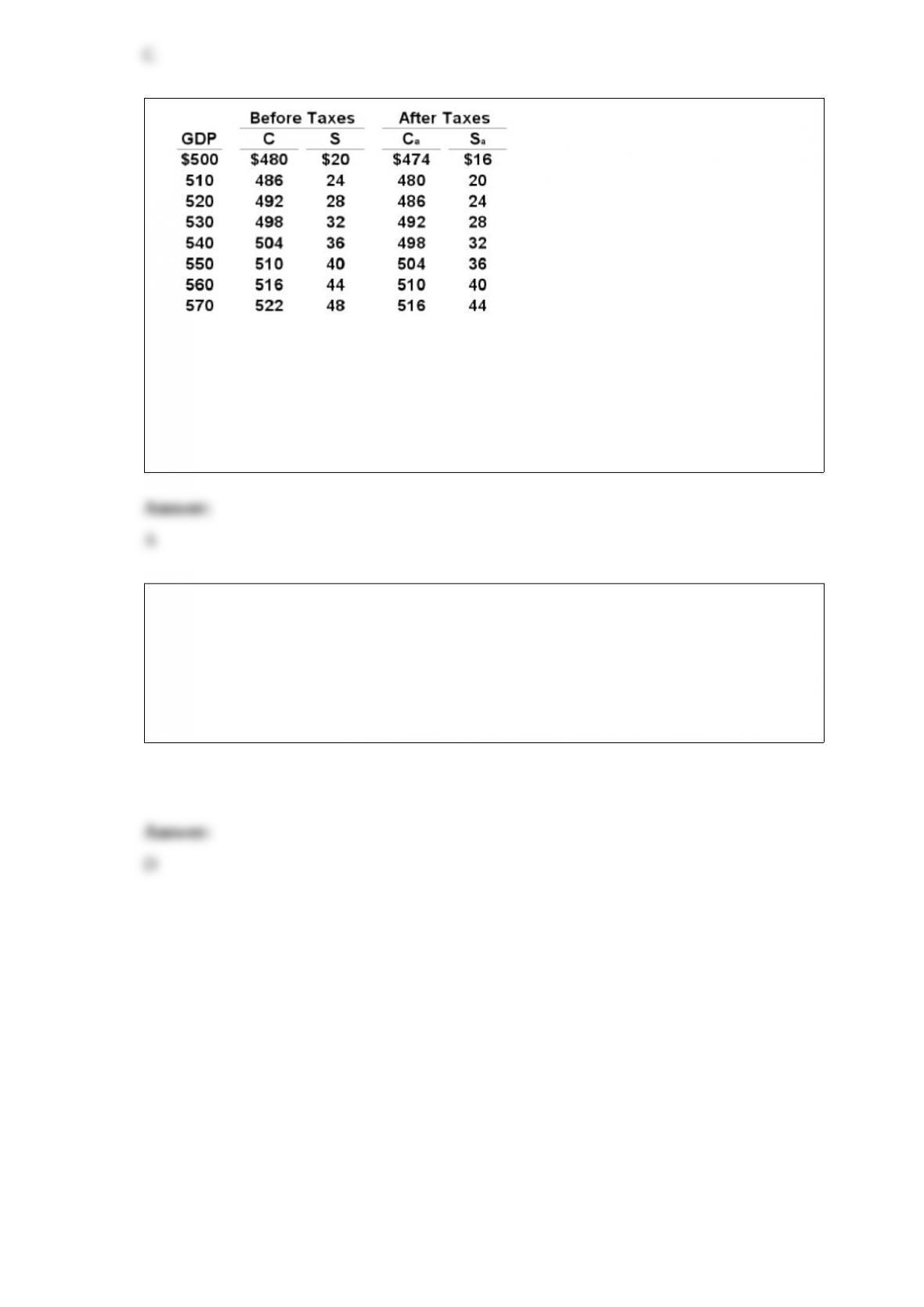
9)
Refer to the above table. If an additional lump-sum tax of $20 were imposed, we would
expect:
A.equilibrium GDP to fall by $30.
B.equilibrium GDP to fall by $20.
C.equilibrium GDP to fall by $50.
D.equilibrium GDP to rise by $24.
10)
(Consider This) The central idea illustrated by the vignette on “catgut” used as violin
strings is:
A.patent rights.
B.research and development activity.
C.derived demand.
D.trade secrets.