
Why does a prisoner’s dilemma lead to a noncooperative equilibrium?
A) because each player had agreed before the game started to minimize the harm that he
can inflict on the other players
B) because each player is uncertain how other players will play the game
C) because players must choose from a limited number of non-dominant strategies
D) because each rational player has a dominant strategy to play a certain way regardless
of what other players do
In a perfectly competitive industry, in the long-run equilibrium,
A) the typical firm is producing at the output where its long-run average total cost is not
minimized.
B) the typical firm is earning an accounting profit greater than its implicit costs.
C) the typical firm earns zero profit.
D) the typical firm is maximizing its revenue.
Making optimal decisions “at the margin” requires
A) making decisions according to one’s whims and fancies.
B) making consistently irrational decisions.
C) weighing the costs and benefits of a decision before deciding if it should be pursued.

D) making borderline decisions.
An important difference between the demand for a private good and the demand for a
public good is that
A) individuals reveal their preferences for a public good but they do not have to reveal
their preferences a private good.
B) the resources used to provide public goods are common resources or government
owned; the resources used to produce private goods are all privately owned.
C) individuals reveal their preferences for a private good but they do not have to reveal
their preferences for a public good.
D) the demand for a private good produces consumption externalities; the demand for a
public good produces production externalities.
Which of the following economists did not help to develop game theory analysis?
A) Adam Smith
B) John Nash
C) John von Neumann
D) Oskar Morgenstern

Bella can produce either a combination of 60 silk roses and 80 silk leaves or a
combination of 70 silk roses and 55 silk leaves. If she now produces 60 silk roses and
80 silk leaves, what is the opportunity cost of producing an additional 10 silk roses?
A) 2.5 silk leaves
B) 10 silk leaves
C) 25 silk leaves
D) 55 silk leaves
State whether each of the following goods and services is nonrival, nonexcludable or
both:
a. A toll road
b. A public park
c. A lighthouse
d. An art museum
e. A radio broadcast of “A Prairie Home Companion”
If the Fed chose to change its policy actions implemented during the heart of the
recession faster than the timing suggested by the White House, this would be an
indication of the Fed’s
A) lack of credibility.
B) independence.
C) changing its monetary policy target.
D) frictional relationship with the White House.
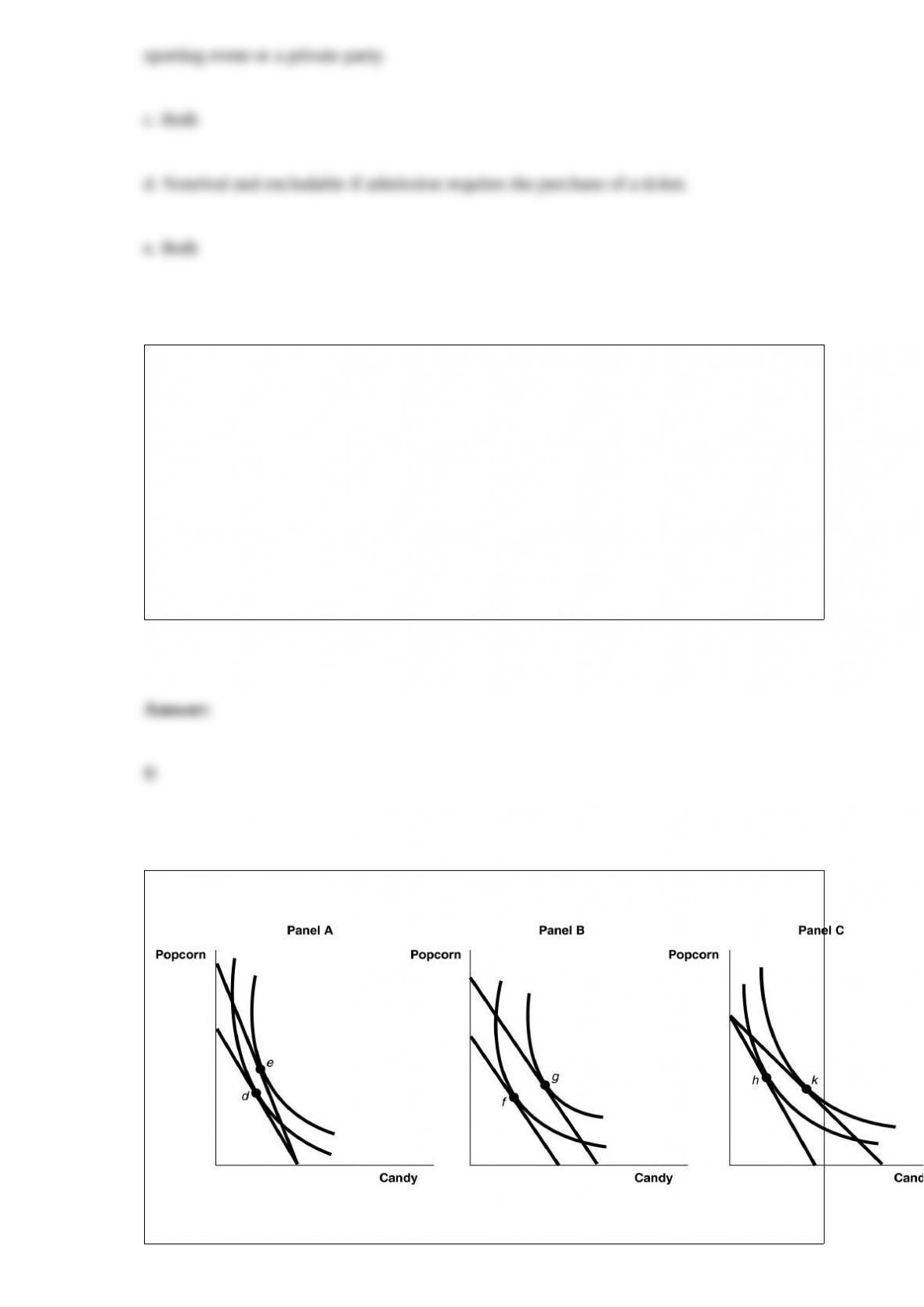
Figure 10-6
A change in the price of popcorn only is shown in

A) Panel A.
B) Panel B.
C) Panel C.
D) none of the above panels.
Which of the following statements about the importance of trade to the U.S. economy is
false?
A) Since 1950, both exports and imports have steadily increased as a fraction of U.S.
gross domestic product.
B) Overall, about 20 percent of U.S. manufacturing jobs depend directly or indirectly
on exports.
C) The United States is the second largest exporter in the world.
D) The U.S. economy is highly dependent on international trade for growth in its gross
domestic product.
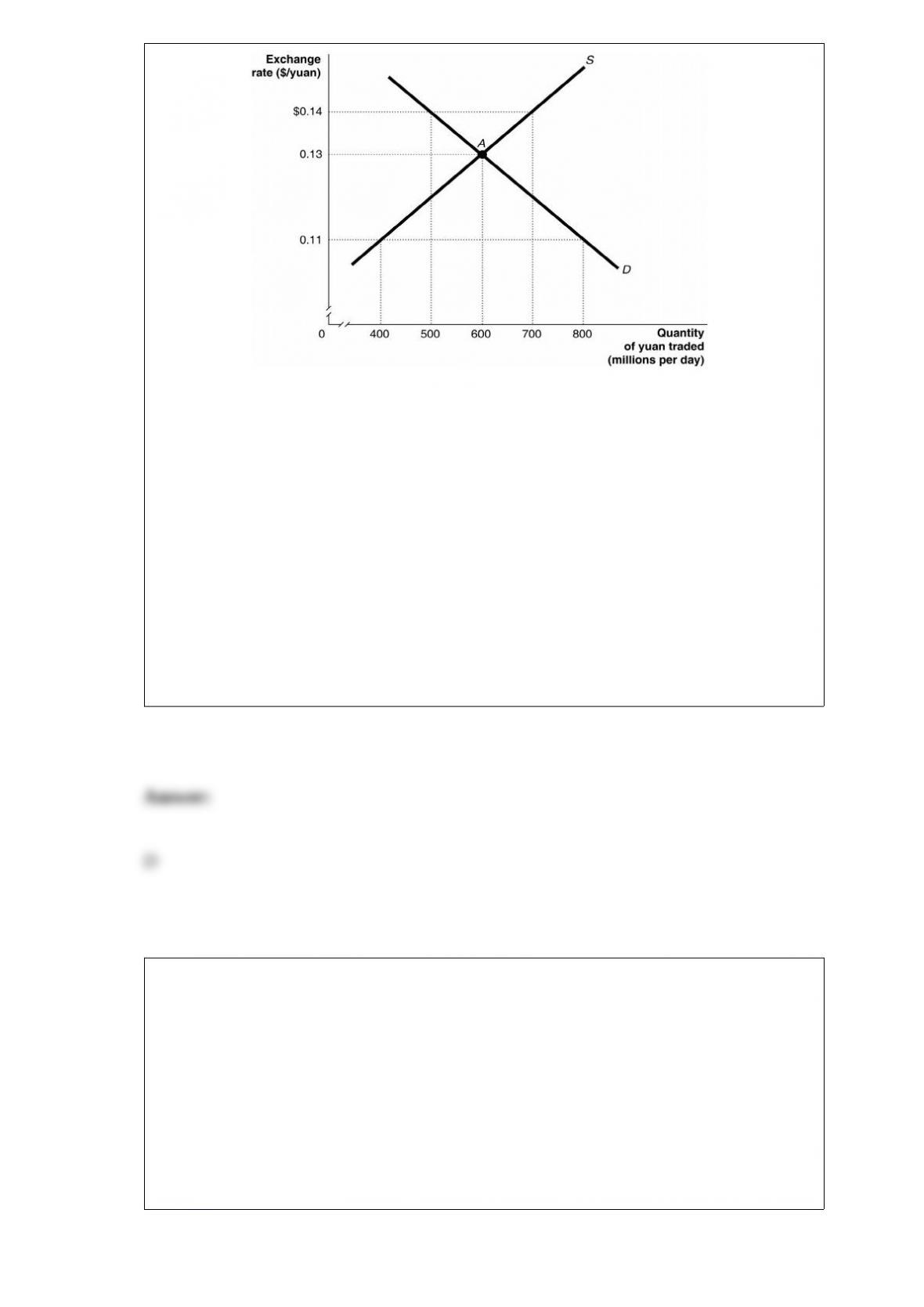
Figure 30-5
Suppose the Chinese government decides to abandon pegging the yuan to the dollar at a
rate which undervalues the yuan. Using the figure above, the equilibrium exchange rate
would be ________ and Chinese exports to the United States would ________ in price.
A) $0.11/yuan; decrease
B) $0.11/yuan; increase
C) $0.14/yuan; increase
D) $0.13/yuan; increase
E) $0.13/yuan; decrease
Which of the following could explain why the demand for table salt is inelastic?
A) Salt is a luxury good.
B) Salt is a rare commodity.
C) Households devote a very small portion of their income to salt purchases.
D) Salt is a luxury for high income consumers but a necessity for low income
consumers.

Liquidity is defined as
A) the ease with which a given asset can be converted to a store of value.
B) the ease with which a given asset can be converted to a unit of account.
C) the ease with which a given asset can be converted to a medium of exchange.
D) the ease with which a given asset can be converted to a standard of deferred
payment.
Robert Lucas, a Nobel laureate in economics, argues that there are increasing returns to
A) knowledge capital.
B) physical capital.
C) financial capital.
D) human capital.
The international trade effect states that

A) an increase in the price level will raise net exports.
B) an increase in the price level will lower net exports.
C) an increase in the price level will raise exports.
D) an increase in the price level will lower imports.
Of the following high-income countries, which has the highest female life expectancy at
age 65?
A) Canada
B) Japan
C) the United Kingdom
D) the United States
The approach economists use to analyze competition among oligopolists is called
A) marginal analysis.
B) game theory.
C) oligopoly theory.
D) competition among the few.
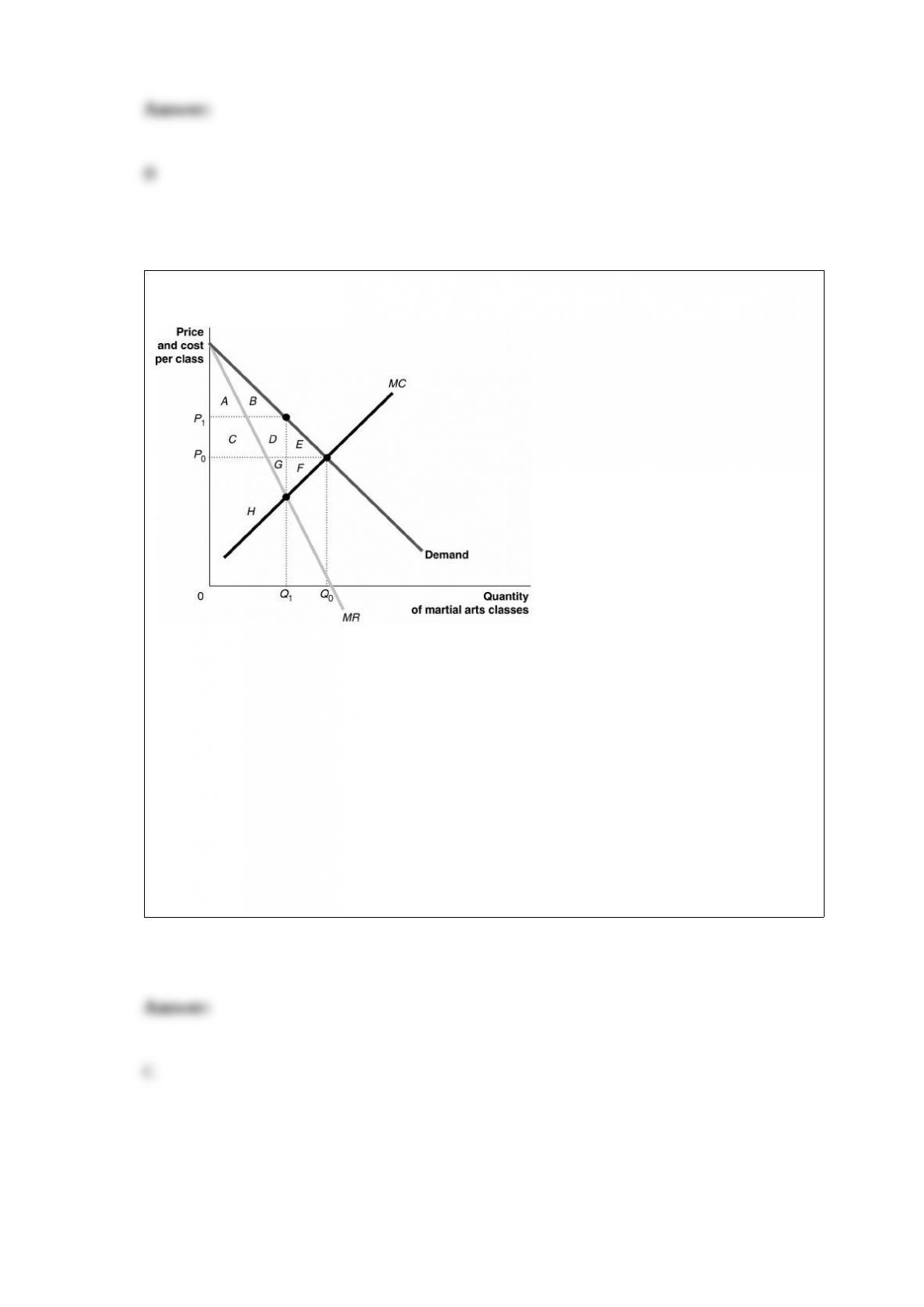
Figure 16-6
Watanabe Sensei operates the only
martial arts school in Hartfield. For simplicity, assume that consumers have identical
demand curves and that Sensei knows what this demand curve is. Figure 16-6 shows
this demand curve. If Sensei charges the competitive price for his classes, what is the
maximum amount of admission fee that he can collect from his customers?
A) the area A + B
B) the area A + B + C + D
C) the area A + B + C + D + E
D) the area A + C + D + G + H
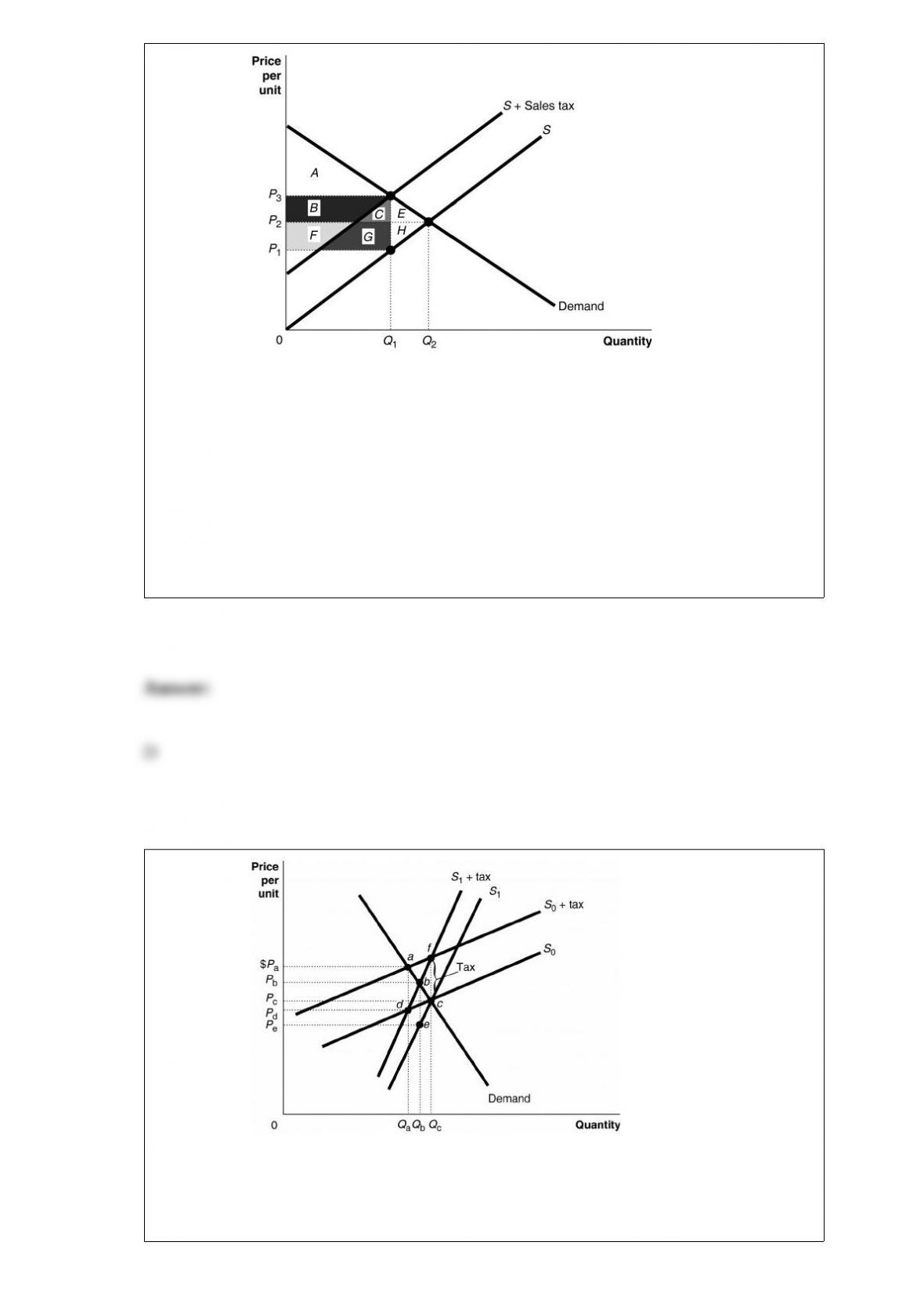
Figure 18-1
Area B + C + F + G represents
A) the portion of sales tax revenue borne by consumers.
B) the portion of sales tax revenue borne by producers.
C) the excess burden of the sales tax.
D) sales tax revenue collected by the government.
Figure 18-2 Figure 18-2 shows a
demand curve and two sets of supply curves, one set more elastic than the other.
If the government imposes an excise tax of $1.00 on every unit sold, the government’s
revenue from the tax

A) is larger if the supply curve is S0.
B) is larger if the supply curve is S1.
C) is identical under either supply curve.
D) is not maximized.