
Opportunity cost is the difference between the benefits and the costs of a choice.
a. True
b. False
A firm with positive accounting profit may be suffering an economic loss.
a. True
b. False
A disadvantage of the corporate form of business organization is that corporate income
is taxed twice.
a. True
b. False
If there are only three firms in an industry with 50 percent, 40 percent, and 10 percent
of the market, respectively, the Herfindahl Index is
a. 40
b. 100
c. 200
d. 33
e. 4,200
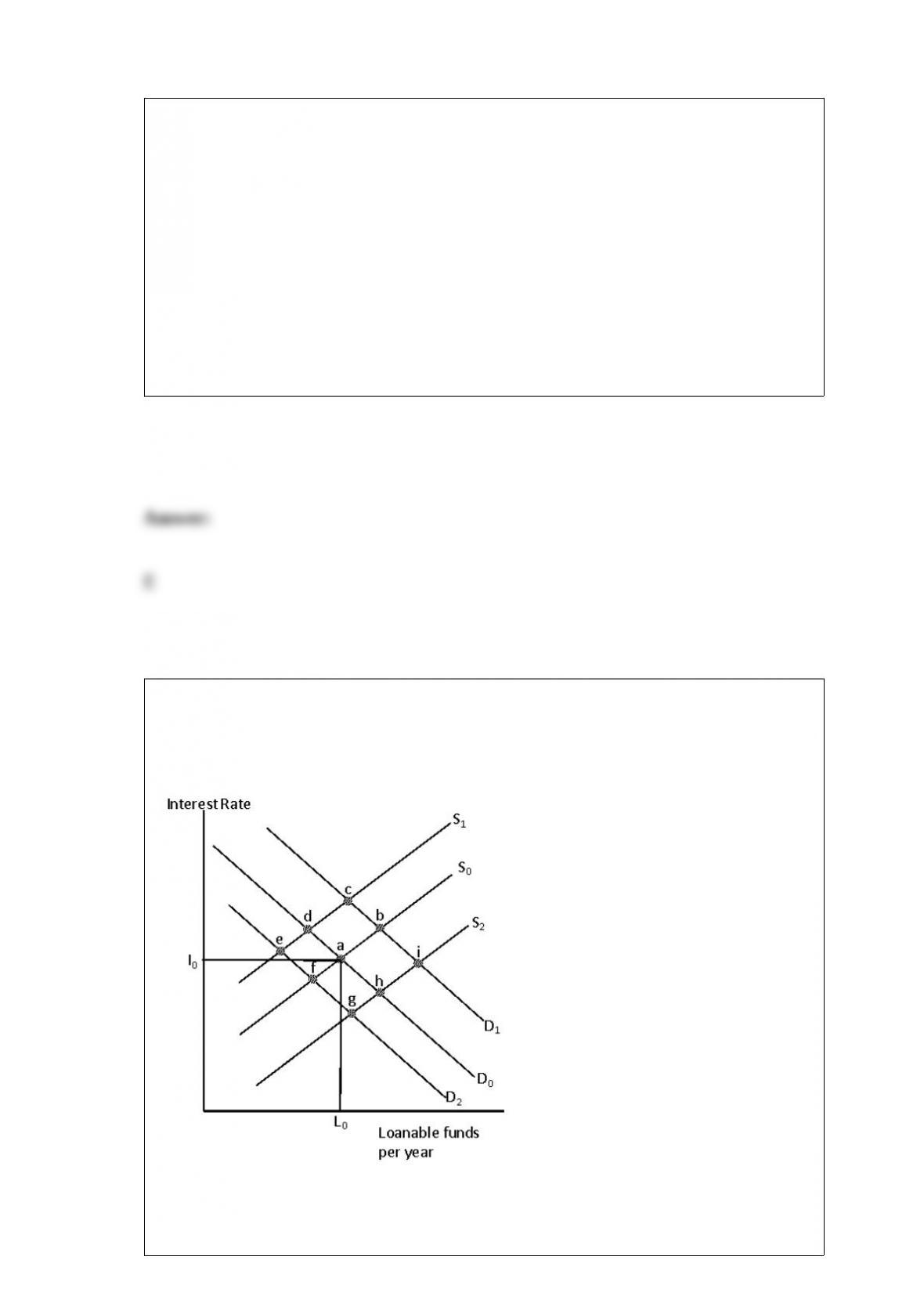
Exhibit 13-8
In Exhibit 13-8, D0 and S0represent the initial demand and supply of loanable funds. An
increase in the expected rate of inflation would shift the equilibrium in this market from
point a to

a. point b
b. point c
c. point d
d. point f
e. point g
The law firm of Cheep, Cheeper, and Cheeperstill offers a salary of $35,000 to
first-year lawyers. This firm will attract applications from
a. exactly the number of lawyers the firm wishes to hire
b. many lawyers whose marginal revenue product is greater than $35,000
c. many lawyers whose marginal revenue product is less than $35,000
d. only lawyers whose marginal revenue product is equal to $35,000
e. many lawyers whose marginal revenue cost is equal to $35,000
There are multiple models of pricing behavior in oligopolistic markets because
a. it is difficult to predict how rival firms will react to any pricing decision
b. the demand curve slopes upward for these firms
c. firms could earn profit in the long run unlike other markets

d. price has a direct impact on profit for a firm in oligopoly
e. the products are not identical in terms of quality, image, location
Which of the following taxes is based on the benefits-received principle?
a. corporate income taxes
b. personal income taxes
c. property taxes
d. gasoline excise taxes
e. user fees that collect the same amount from each person
Absolute advantage
a. is the same as comparative advantage
b. implies autarky
c. means that countries of the same size have the same opportunity cost of producing
both goods
d. means that a country can produce more of two goods than another country can

e. means that a country can produce less of two goods than another country can
If a firm experiences economies of scope,
a. its average cost falls as it increases output
b. its average cost rises as it increases output
c. average production costs fall when it produces more than one kind of product
d. it should integrate vertically
e. average production costs rise as it produces more kinds of products
Exhibit 9-21
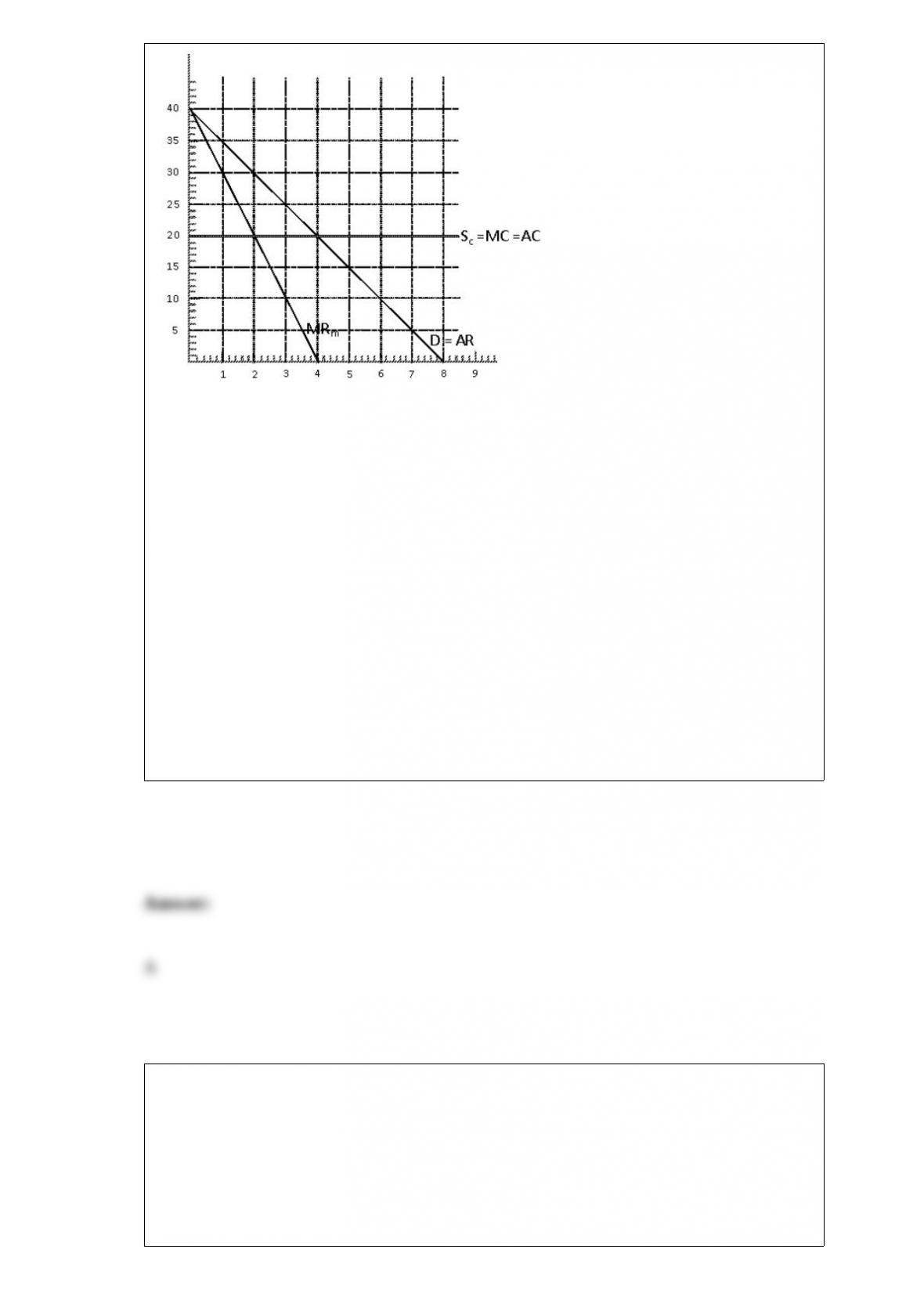
In Exhibit 9-21, D = AR represents the market demand curve for bicycles, MRm
represents the marginal revenue curve for a monopolist producer of bicycles and Sc =
MC = AC represents the marginal cost curve for a monopolist producer of bicycles and
the market supply curve when the market is perfectly competitive. The consumer
surplus in a monopolist market would be
a. $10
b. $20
c. $30
d. $40
e. $50
The demand curve facing a perfectly competitive firm is
a. perfectly elastic
b. perfectly inelastic
c. unit elastic
d. downward-sloping
e. identical to the industry demand curve

If the price of an inferior good falls, there will be no income effect.
You expect to rent out a vacation home on Sanibel Island for $800 a month as an
investment. Upkeep is estimated at $3,000 a year. If the current market interest rate is 5
percent, you are willing to pay __________ for the house.
a. $132,000
b. $100,000
c. $160,000
d. $192,000
e. $800,000
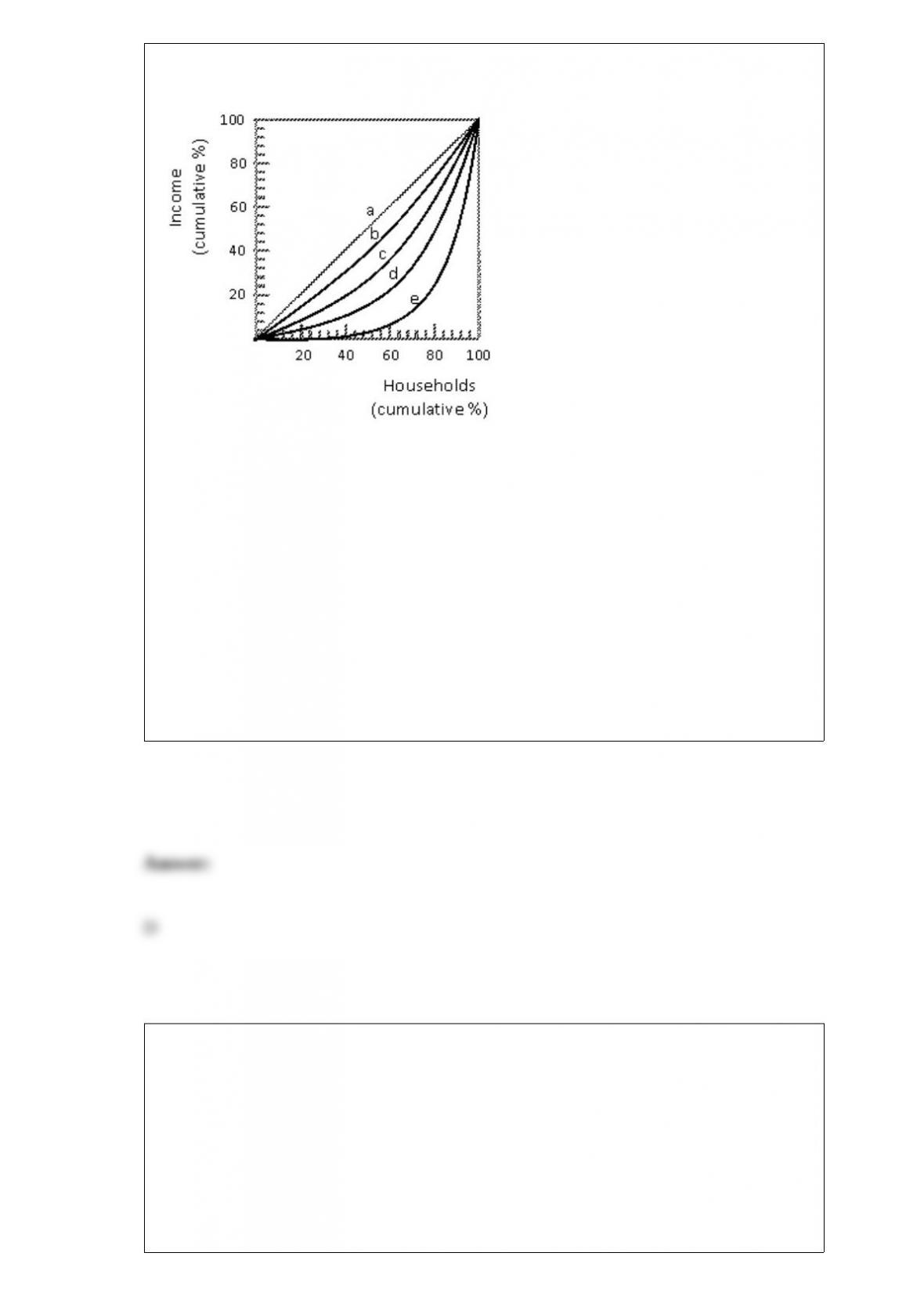
Exhibit 18-1
Exhibit 18-1 shows five different Lorenz curves. Along the Lorenz curve labelled e, the
poorest 60% of the population earns what proportion of the total income?
a. 100%
b. exactly 60%
c. more than 60%
d. less than 60%
e. cannot tell from the information provided
The horizontal (labor) intercept of Manny Motors’ isocost line is 3 million, and the
vertical (robot) intercept is 5 million. Which of the following best describes what would
happen to the isocost line if the wage increased?
a. It would shift to the right.
b. It would rotate outward along the horizontal axis.
c. It would rotate inward along the horizontal axis.

d. It would rotate outward along the vertical axis.
e. It would rotate inward along the vertical axis.
Absolute advantage is based on opportunity cost.
a. True
b. False
The basis for international trade is
a. established trade patterns
b. the size of gold holdings of two countries
c. shipping and transportation costs
d. absolute advantage
e. comparative advantage
Which form of business organization is the most common in the United States?
a. sole proprietorship
b. partnership
c. corporation
d. nonprofit organization
e. S-corporation
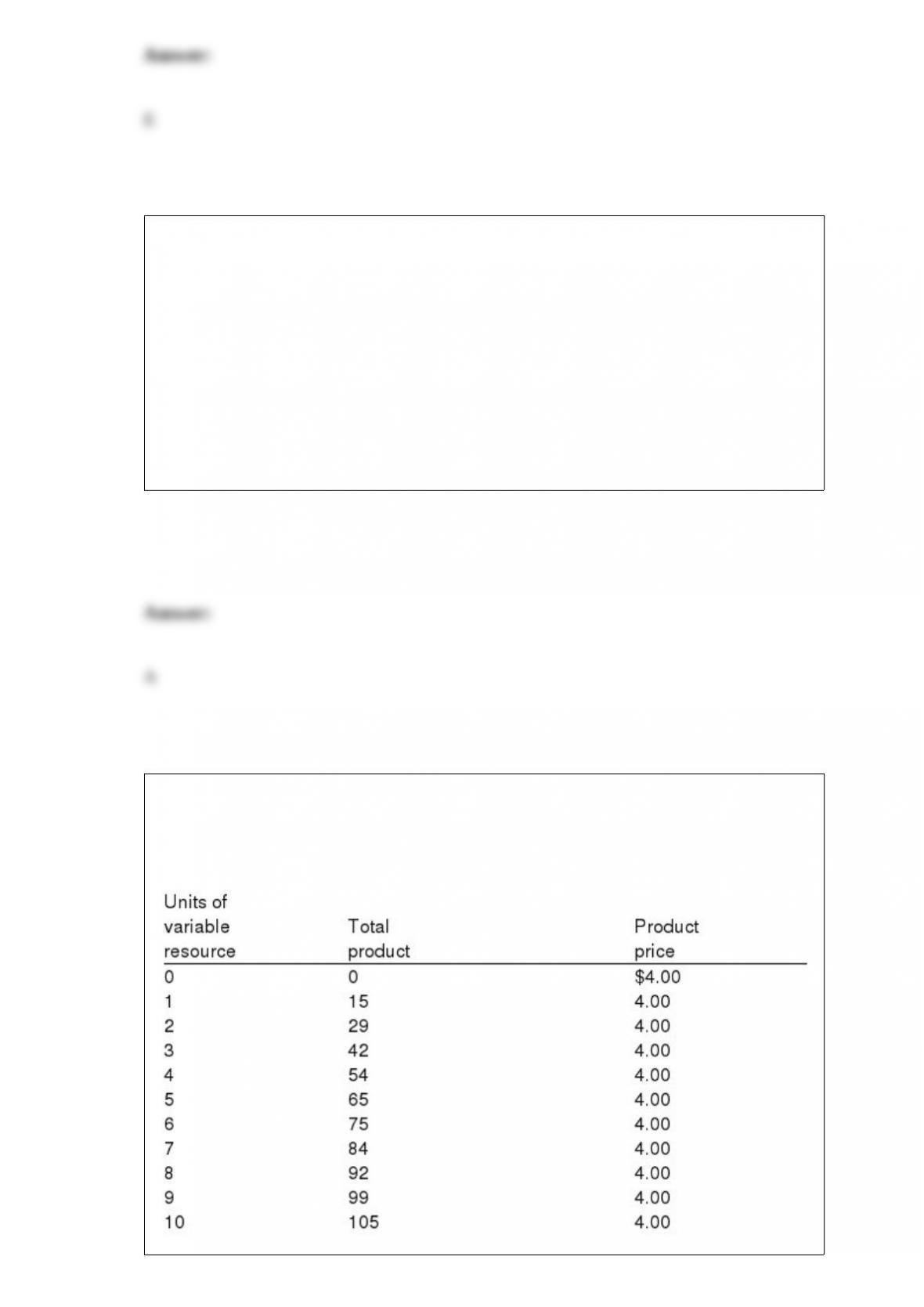
Exhibit 11-9

In Exhibit 11-9, how low would the wage rate have to fall before firms would hire nine
workers?
a. $4
b. $14
c. $28
d. $198
e. $396
If the U.S. dollar depreciates in the foreign exchange market, American exports will be
__________ and American imports will be __________.
a. more expensive; more expensive
b. cheaper; cheaper
c. less expensive; less expensive
d. less expensive; more expensive
e. there will be no change
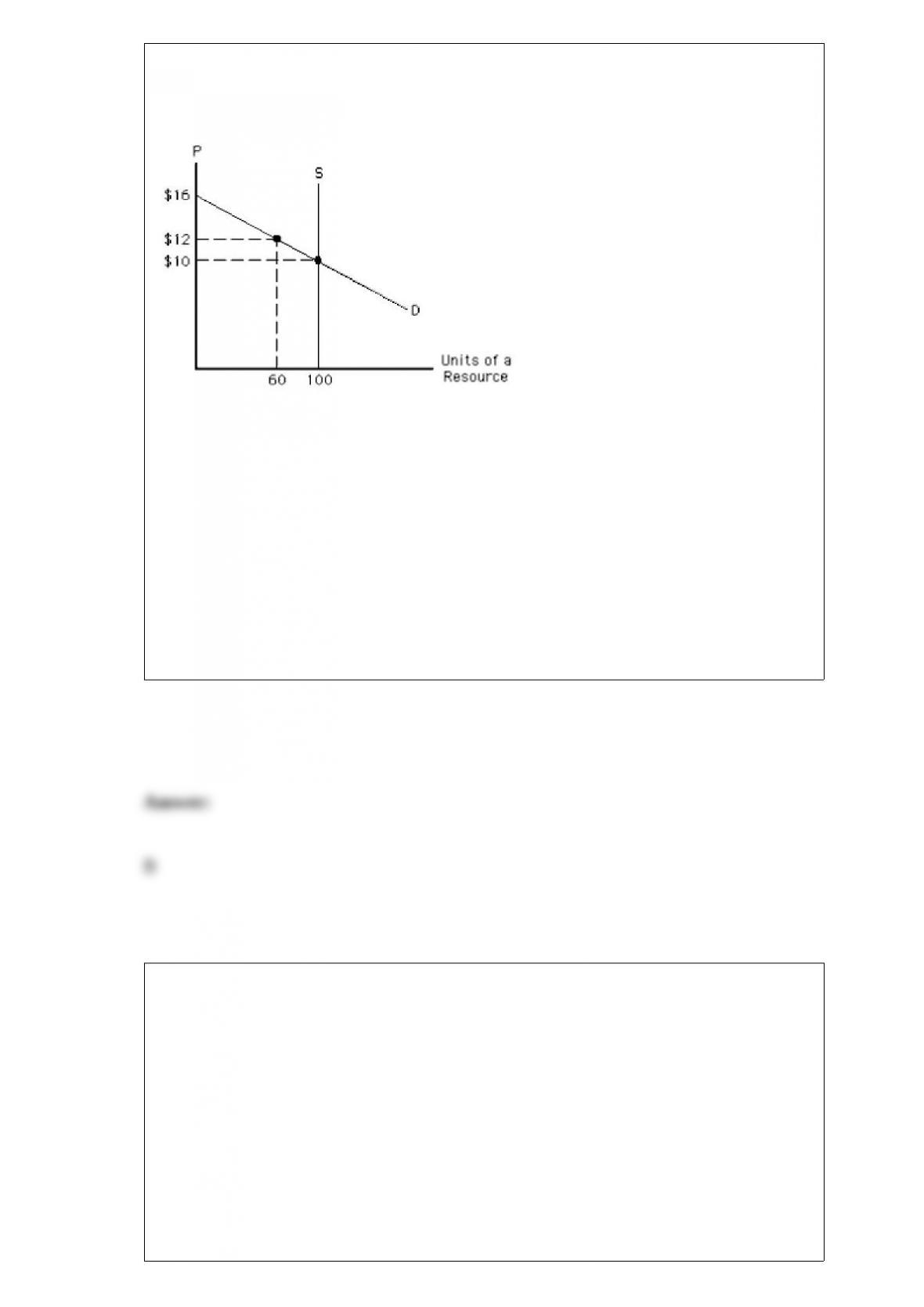
Exhibit 11-4
In Exhibit 11-4, the equilibrium quantity of the resource exchanged is
a. more than 100 units
b. 100 units
c. 60 units
d. less than 60 units
e. unable to tell from the information given
A principal-agent problem arises when
a. only less-qualified workers apply for a job
b. a firm must find a proxy for unobservable qualities needed in employees
c. potential employees have more information about their own productivity than do
prospective employers
d. a customer knows little about the service provided by a business
e. a customer knows little about the service provided by a business and is, therefore,

given poor service
Which of the following is true of perfect price discrimination compared to charging a
single price?
a. Output is greater.
b. Output is the same, but profit is higher.
c. Output is lower, but profit is higher.
d. Output is lower, and profit could be higher or lower.
e. Output is the same, but profit is lower.
One might commit the fallacy of composition by concluding that
a. statements that are true during prosperity are necessarily true during depression
b. what is good for the individual is necessarily good for the group
c. an event that precedes another is necessarily the cause of the latter
d. intentions need not coincide with actions
e. the composition of a complex product is not revealed by its exterior appearance

A firm’s marginal revenue product curve is downward sloping, which means the derived
demand curve for an input is downward sloping.
a. True
b. False
In order to predict the marginal rate of return on investment, producers must forecast
the interest rate.
a. True
b. False
If a firm triples all of its inputs and its output doubles, it is said to be experiencing
a. diminishing marginal returns
b. increasing marginal returns
c. diseconomies of scale

d. economies of scale
e. constant average costs
Direct majority-rule voting is a form of coercion in the sense that
a. all citizens must vote
b. all registered voters must vote
c. the median voter’s preferences determine the outcome for everyone
d. the majority gets exactly what they want, but the minority does not.
e. individuals with higher incomes get more votes
If a firm is experiencing diseconomies of scale, its long-run marginal cost curve is
upward sloping.
a. True
b. False
At each point on an isoquant, the marginal rate of technical substitution (MRTS) of
labor for capital is equal to the marginal product of labor divided by the marginal
product of capital.
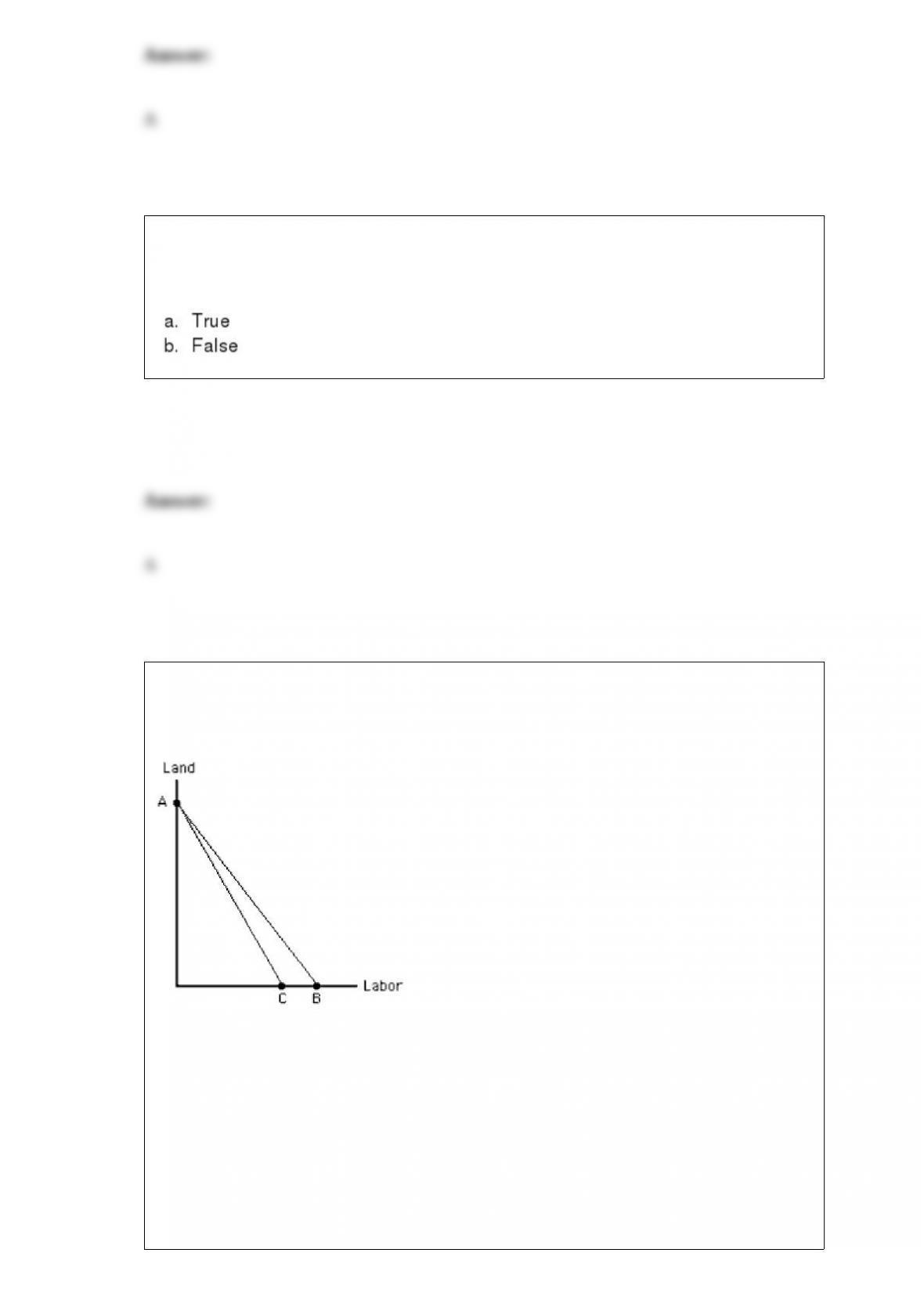
Exhibit 7-19
In Exhibit 7-19, the rotation from AB to AC reflects a(n)
a. increase in the price of labor
b. increase in the price of land
c. decrease in the price of labor
d. decrease in the price of land

e. increase in the amount the producer can spend
In the long run, all inputs are variable.
a. True
b. False