1) a consumer is maximizing her utility with a particular money income when:
a.the total utility derived from each product consumed is the same.
b.mua/pa = mub/pb = muc/pc = … = mun/pn.
c.mua = mub = muc = … = mun.
d.pa = pb = pc = … = pn.
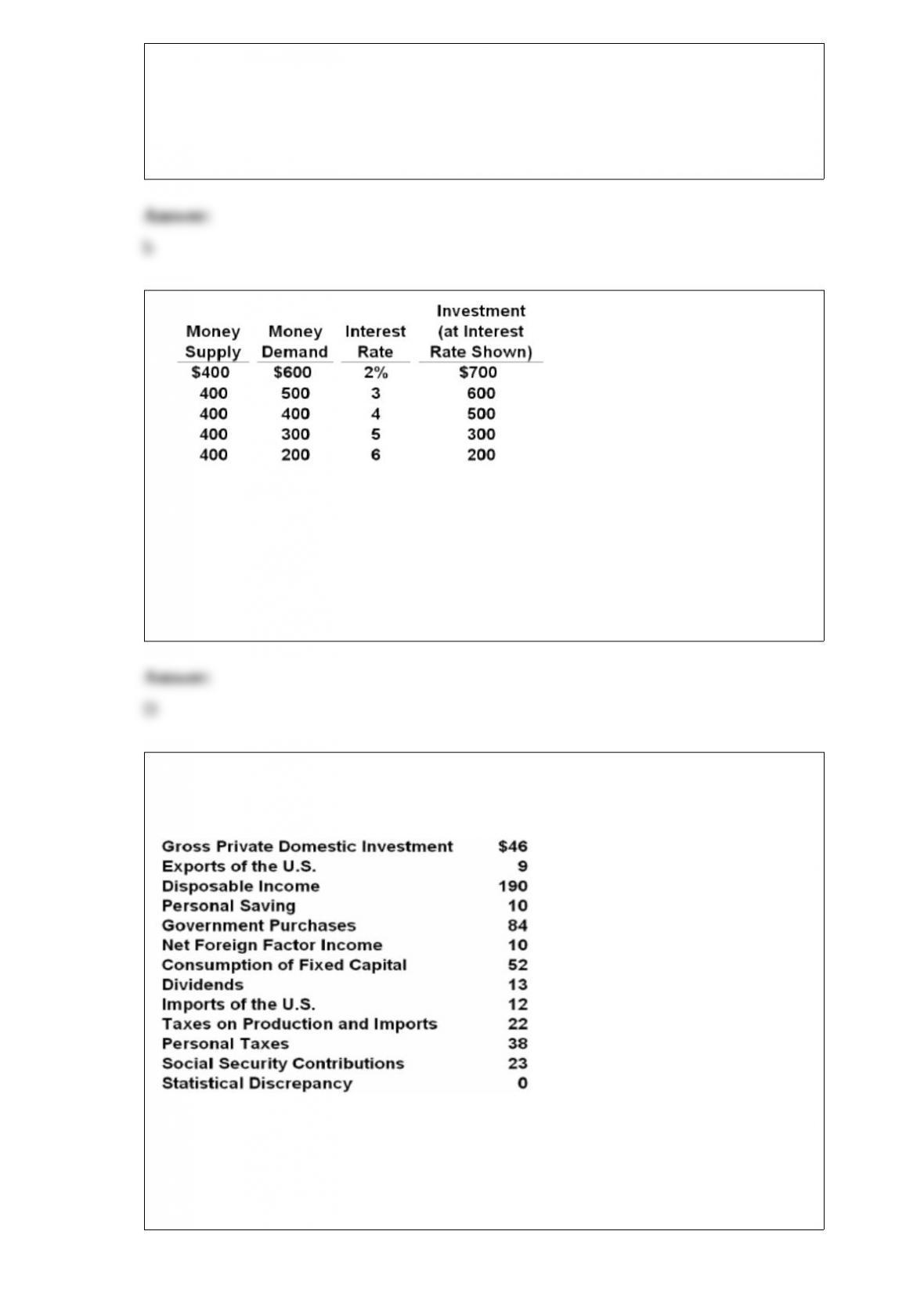
2)
Refer to the above table. Suppose the legal reserve requirement is 10 percent and
initially there are no excess reserves in the banking system. If the Fed wished to reduce
the interest rate by 1 percentage point, it would:
A.sell $10 of government bonds in the open market.
B.buy $100 of government bonds in the open market.
C.sell $100 of government bonds in the open market.
D.buy $10 of government bonds in the open market.
3) answer the next question(s) on the basis of the following data. all figures are in
billions of dollars.
refer to the above data. the gross domestic product is:
a.$326.
b.$282.
c.$307.
d.$300.

4) The poverty rate in the United States was:
A.5 percent in 2006.
B.higher in 2006 than in 1960.
C.lower in 2006 than in 1993.
D.15 percent in 2006.
5) The Food, Conservation, and Energy Act of 2008 does not address the fundamental
problem of agricultural subsidies, which is that those subsidies:
A.reduce work incentive for farmers, thus reducing agricultural production.
B.slow the exodus of resources from agriculture, increase production of agricultural
products, and reduce crop prices and market incomes.
C.increase the exodus of resources from agriculture and reduce investments by farmers
in land and equipment.
D.are based on past agricultural production and not on current agricultural production.
6) What effect, if any, will each of the following have upon the elasticity or the location
of the demand curve for resource J that is being used in the production of commodity
X? If there is uncertainty as to the precise effect, explain the sources of that uncertainty.
(a)A decline in the demand for product X.
(b)An increase in the price of Y, a substitute product for X.
(c)A decline in the price of substitute resource K.
(d)A decline in the number of available resources that are substitutable for J in the
production of X.
(e)An increase in the price of complementary resource L.
(f)An increase in the elasticity of demand for product X due to an increase in the
number of sellers in the market.
7)
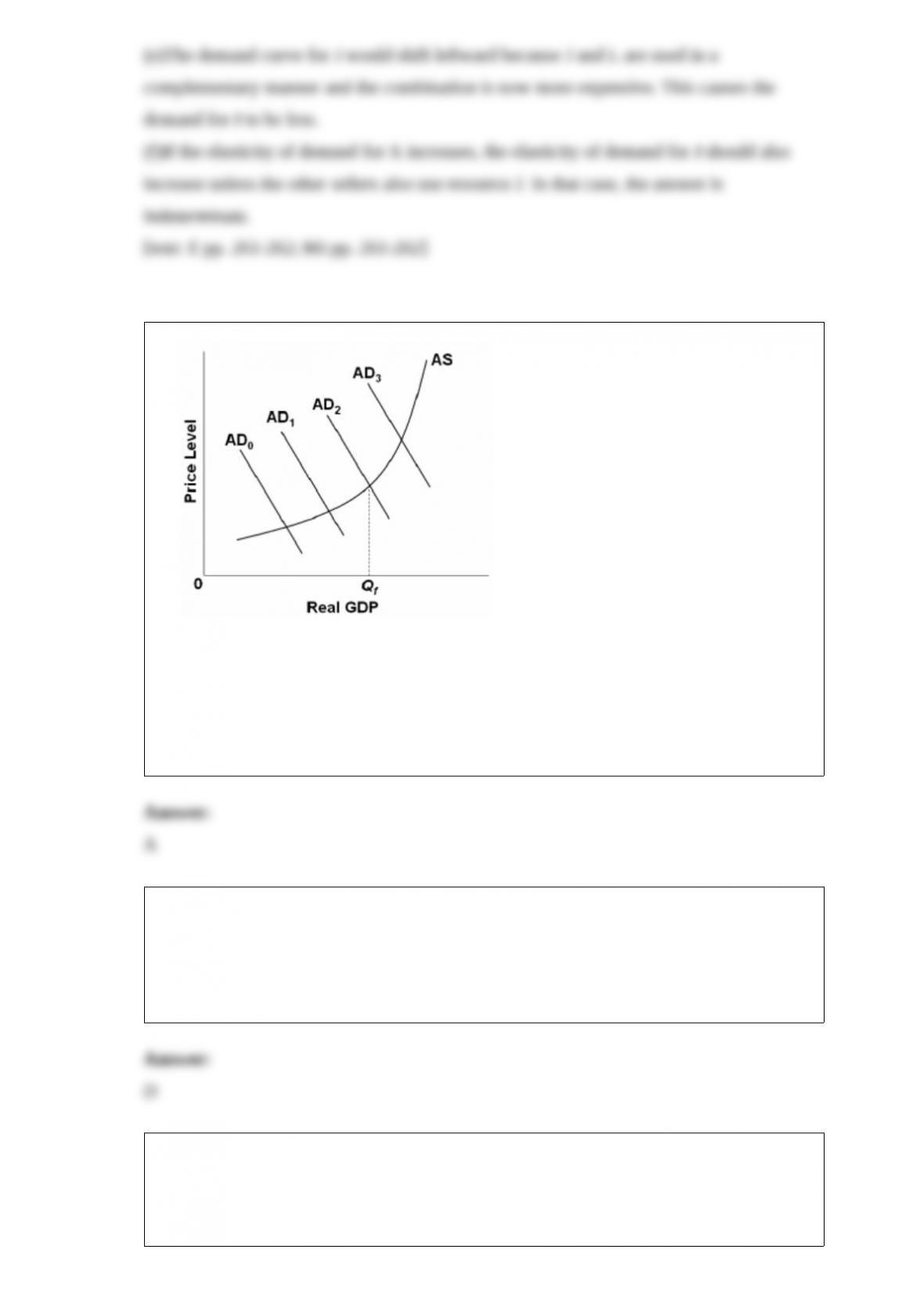
Refer to the above diagram, in which Qf is the full-employment output. If the
economy’s current aggregate demand curve is AD3, it is experiencing:
A.a positive GDP gap.
B.a negative GDP gap.
C.a recession.
D.cost-push inflation.
8) In 2007, the U.S. Federal government legislation authorized:
A.4,800 earmarks totaling $5.8 billion.
B.22,300 earmarks totaling $14.8 billion.
C.16,500 earmarks totaling $22.9 billion.
D.11,700 earmarks totaling $16.9 billion.
9) when the price of a product falls, the purchasing power of our money income rises
and thus permits consumers to purchase more of the product. this statement describes:
a.an inferior good.
b.the rationing function of prices.
c.the substitution effect.
d.the income effect.
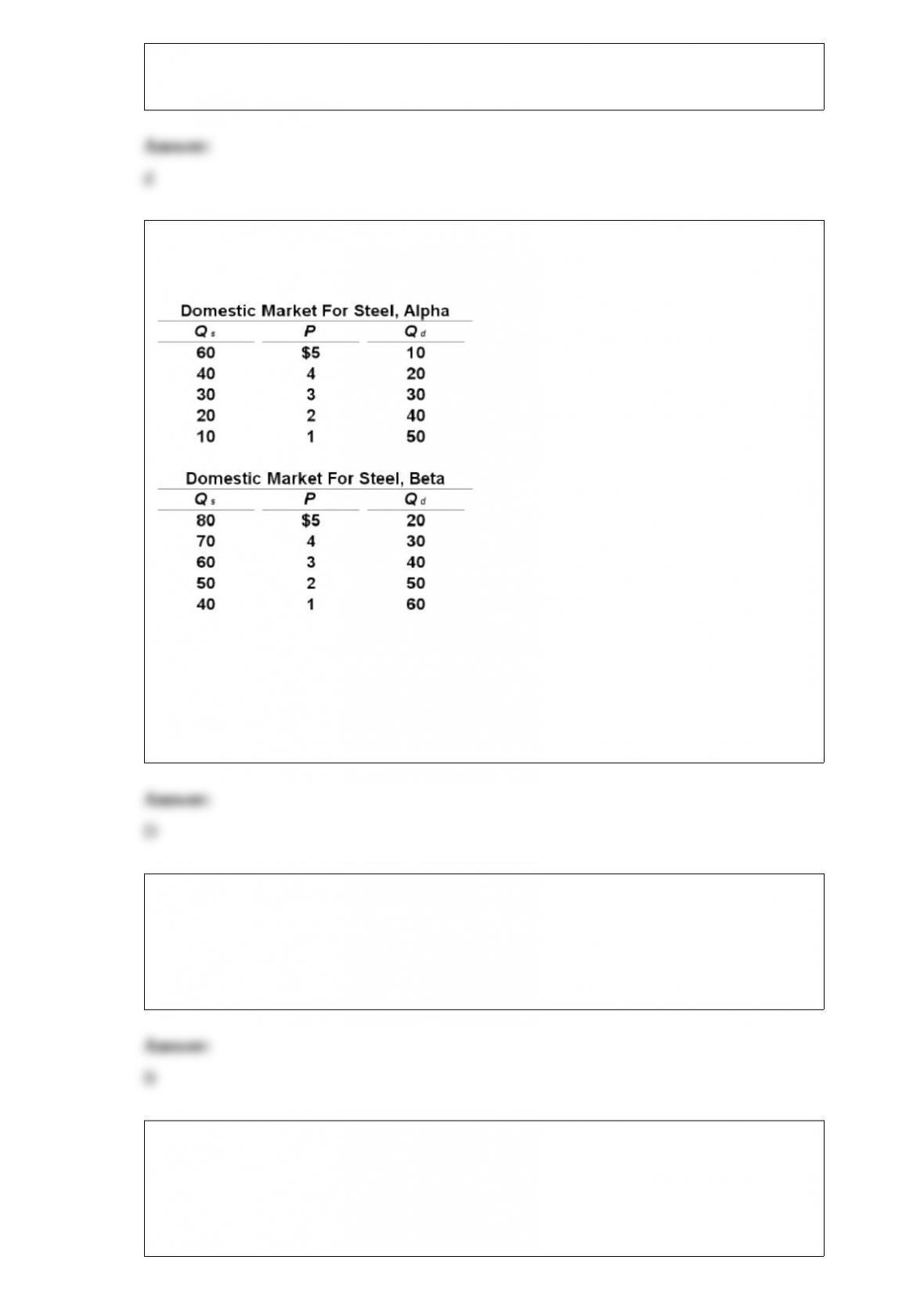
10) The following data for the hypothetical nations of Alpha and Beta. Qs is domestic
quantity supplied and Qd is domestic quantity demanded.
Refer to the above data. The equilibrium world price must be higher than $1 because at
$1:
A.Beta wants to import more than Alpha.
B.Alpha wants to export more than Beta.
C.both nations want to export steel.
D.both nations want to import steel.
11) The Federal funds rate is:
A.higher than the prime interest rate.
B.lower than the prime interest rate.
C.always equal to the Fed’s discount rate.
D.equal to the prime interest rate minus the Fed’s discount rate.
12) Structuralists take the position that:
A.the rule of reason is appropriate and desirable in interpreting the Sherman Act.
B.only unreasonable anticompetitive acts should be regarded as violations of the
antitrust laws.
C.industries should be judged on the basis of their technological progress and their
price-output behavior.
D.an industry that is highly concentrated will behave monopolistically.
13) cost-push inflation:
a.is caused by excessive total spending.
b.shifts the nation’s production possibilities curve leftward.
c.moves the economy inward from its production possibilities curve.
d.is a mixed blessing because it has positive effects on real output and employment.
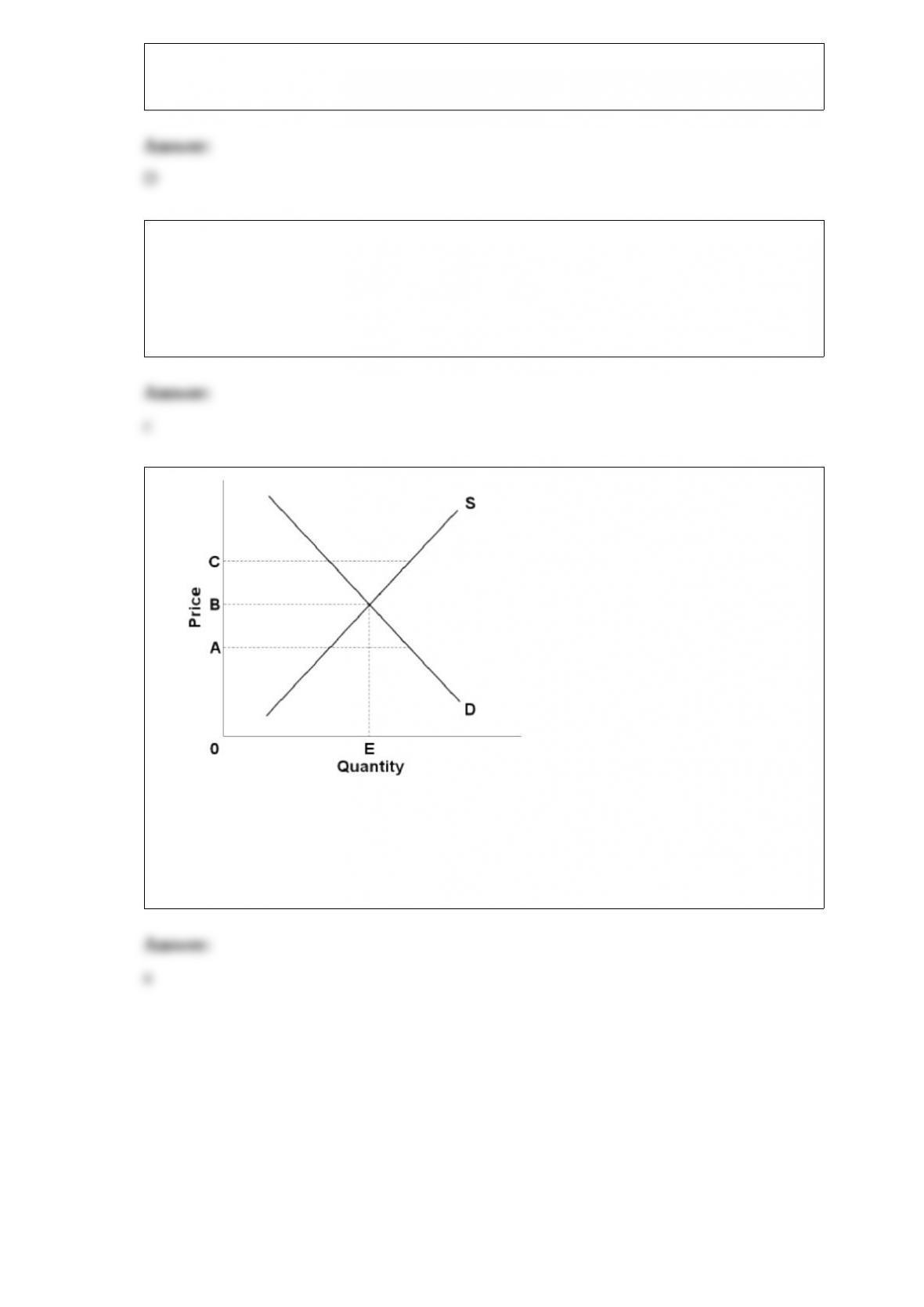
14)
refer to the above diagram. rent controls are best illustrated by:
a.price a.
b.quantity e.
c.price c.
d.price b.
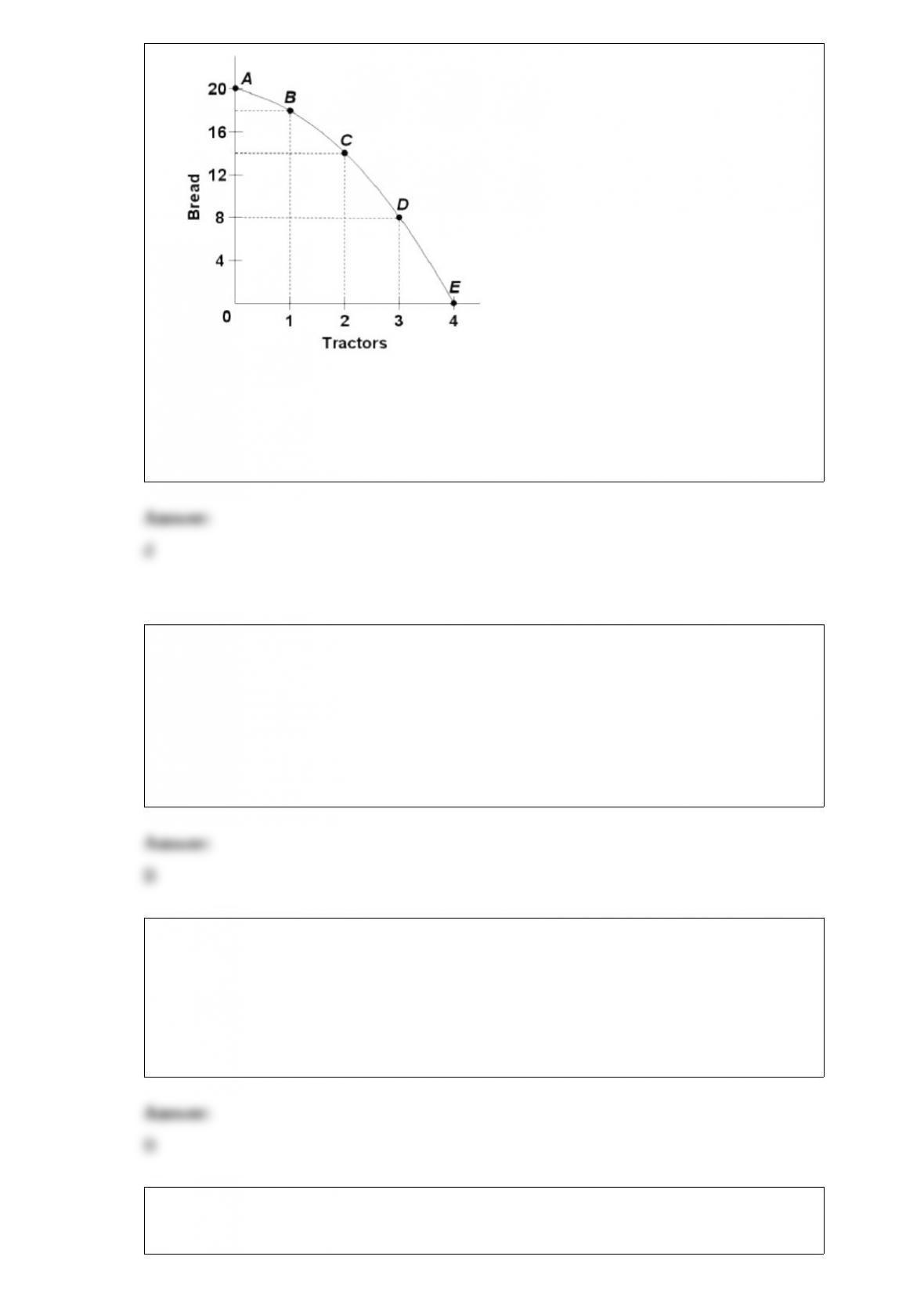
15)
refer to the above diagram. this production possibilities curve is constructed so that:
a.resources are presumed to be perfectly shiftable between bread and tractors.
b.the opportunity cost of bread diminishes as more bread is produced.
c.the opportunity cost of tractors increases as more bread is produced.
d.the opportunity cost of both bread and tractors increases as more of each is produced.
16) Capital flight refers to:
A.the tendency of large corporations of IACs to build new plants in the DVCs because
labor is cheaper.
B.DVC citizens accumulating or investing their savings in the IACs.
C.the high international mobility of speculative funds caused by variations in exchange
rates.
D.the tendency of DVCs to overinvest in commercial aircraft.
17) In moving from a private closed economy to a mixed closed economy in the
aggregate expenditures model, government spending must be:
A.added to saving.
B.added to consumption and gross investment.
C.subtracted from consumption and gross investment.
D.added to gross investment and saving.
18) the estimated fiscal burden of illegal immigrant households in the united states is:
a.$800 million per year.

b.$20 billion per year.
c.$50 billion per year.
d.$4.5 billion per year.
19) Which of the following is correct?
A.Government expenditures and taxes both increase GDP.
B.Government expenditures and taxes both decrease GDP.
C.Government expenditures increase, but taxes decrease, GDP.
D.Government expenditures decrease, but taxes increase, GDP.