
If Tanisha can audit more tax returns in one hour than Libby, then Tanisha has an
absolute advantage in auditing tax returns.
When products that create positive externalities are produced, at the market equilibrium
output, the social benefit generated by consuming the product exceeds the private
benefit.
An increase in the price level in the United States will reduce exports and increase
imports.
An increase in the quantity of a product supplied is caused by an increase in the price of
the product.

The substitution effect of a price increase causes a decrease in the quantity demanded of
an inferior good.
If a country produces only two goods, it is possible to have an absolute advantage in the
production of both those goods.
If the quantity of nail polish supplied is represented by the equation QS = -3 + 2P then
the corresponding price of nail polish is represented by the equation
A) P = 0.5QS + 1.5.
B) P = 2QS + 6.
C) P = 2QS – 6.
D) P = 1.5 – 0.5QS.

Article Summary. Although growing at only half the average rate following the
seven previous recessions, consumer spending has increased 9 percent since the
end of the 2007-2009 recession, and consumer confidence has been on the rise as
household finances, the job market, and the housing market continue to improve.
The Federal Reserve projects a 3% – 3.5% growth rate for the economy in 2014,
up from the recent average of 2%. Debt payments have fallen to an average of
15.69% of after-tax income for households, the lowest level in 30 years, and lower
debt payments leave households with more to spend on consumer goods. Source:
Neil Shah, “Pocketbooks Begin to Open As Household Wealth Grows,” Wall Street
Journal, June 25, 2013.
The increase in consumer spending discussed in the article summary was due in part to
lower debt payments which have resulted in an increase in disposable income. The
increase in consumption resulting from the increase in disposable income caused a(n)
________ the aggregate expenditure curve.
A) movement up along
B) movement down along
C) downward shift of
D) upward shift of
If the demand for labor is unchanged, an increase in the supply of labor will lead to
A) a decrease in the quantity of labor demanded and a decrease in the equilibrium
wage.
B) an increase in the quantity of labor demanded and a decrease in the equilibrium
wage.
C) an increase in the quantity of labor demanded and an increase in the equilibrium
wage.
D) a decrease in the quantity of labor demanded and an increase in the equilibrium
wage.

Which of the following characteristics isnot common to monopolistic competition and
perfect competition?
A) Firms act to maximize profit.
B) Entry barriers into the industry are low.
C) The market demand curve is downward sloping.
D) Firms take market prices as given.
Consider the following characteristics:
a. a market structure with barriers to entry
b. demand curves that are easily identified
c. firm cannot make zero profits in the long run
d. firm can reap long-run profits. Which of the characteristics in the list above is shared
by an oligopolist and a monopolist?
A) a, b, c and d
B) a, b and d
C) a, c, and d
D) a and d

Figure 5-5
Figure 5-5 shows a market with an externality. The current market equilibrium output of
Q1 is not the economically efficient output. The economically efficient output is Q2. If,
because of an externality, the economically efficient output is Q2 and not the current
equilibrium output of Q1, what does D1 represent?
A) the demand curve reflecting external benefits
B) the demand curve reflecting social benefits
C) the demand curve reflecting private benefits
D) the demand curve reflecting the sum of private and social benefits
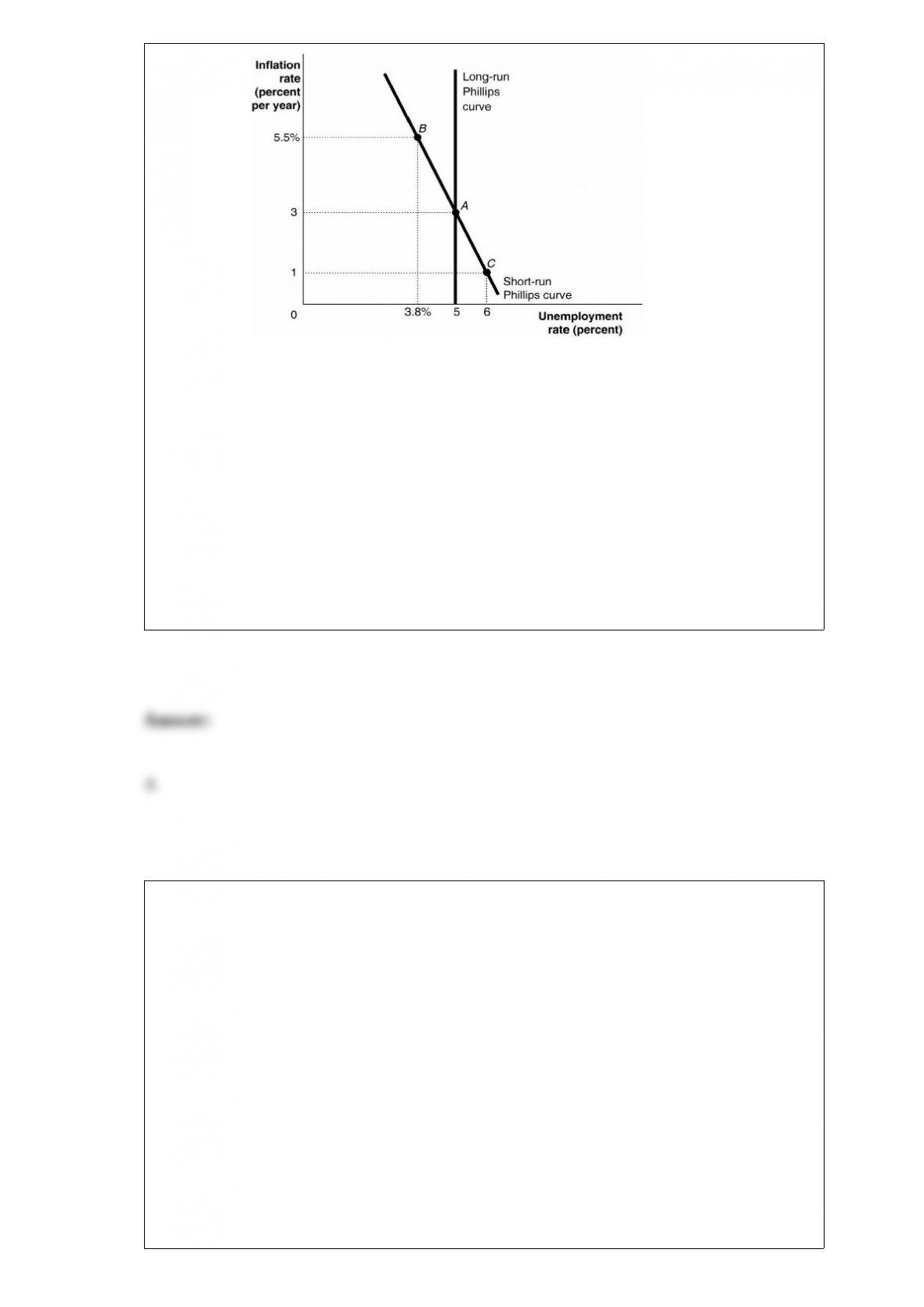
Figure 17-2
Suppose the economy is at point B. If the Fed increases the money supply so that
inflation increases, the economy will ________ in the short run, holding all else
constant.
A) eventually move to point A
B) stay at point B
C) eventually move to point C
D) move to point A and then back to point B
The average price of gasoline in your neighborhood is $3.53 per gallon. Your neighbor,
Diana tells you that you can ‘save a lot” by frequenting a gas station 20 miles outside
your neighborhood where the price of gasoline is $3.46 per gallon However, she
cautions you that there usually long lines at that station. Is her suggestion beneficial to
you?
A) Yes, since gasoline is a necessity for car owners, the total cost savings would be
relatively substantial.
B) No, if one factors in the non-monetary opportunity costs (driving time and waiting in
line), it could prove more costly to go to the lower-priced gasoline station.
C) Yes, the lower price of gasoline at the rival station increases my purchasing power
and enables me to consume more of other goods.

D) No, my friend is misled; clearly, the lower priced gasoline must be of inferior quality
and could damage vehicles.
As the economy nears the end of an expansion, which of the following do we typically
see?
A) rising firm profits
B) rising levels of firm investment
C) rising interest rates
D) falling wages relative to output prices
What do the highest stock price and the lowest stock price over the previous year
indicate?
A) Add them together and divide by two to get the stock’s current market price.
B) what the stock’s price-earnings ratio is
C) how volatile the stock’s market price has been
D) They generate the dividend yield.

An economist observes two consumers in a supermarket. One of the consumers buys a
case of Coca-Cola and the other buys a case of Pepsi-Cola. Both colas sell for the same
price and the ages and incomes of the consumers are also the same. Based on this
information, how would the economist explain the consumers’ choices?
A) One of the consumers made the wrong choice, but it is impossible to say which one.
B) Both consumers should have considered buying other colas that had lower prices.
C) Both consumers should have purchased less than a case because they would be able
to buy more later.
D) Apparently, the consumers had different tastes.
The following equations represent the demand and supply for silver pendants.
QD = 50 – 2P
QS = -10 + 2P What is the equilibrium price (P) and quantity (Q – in thousands) of
pendants?
A) P = $15; Q = 20 thousand
B) P = $50; Q = 10 thousand
C) P = $20; Q = 15 thousand
D) P = $10; Q = 30 thousand
Tax increases on business income decrease aggregate demand by decreasing
A) business investment spending.
B) consumption spending.
C) government spending.
D) wage rates.
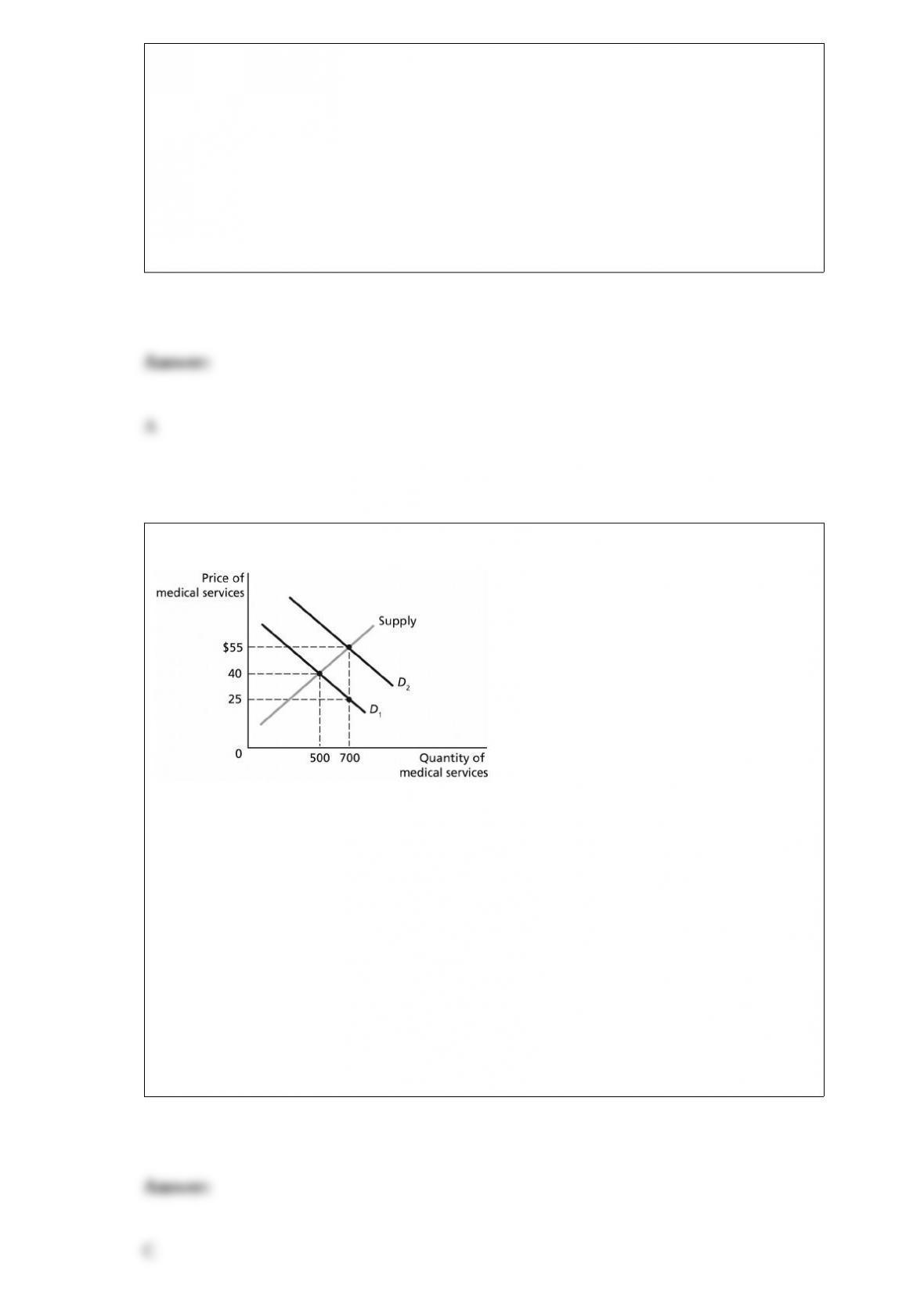
Figure 7-2
Figure 7-2 represents the market for
medical services with and without insurance, and the effect of a third-party payer
system on the demand for medical services.
With insurance and a third-party payer system, what price do doctors receive for
medical services?
A) $25
B) $40
C) $55
D) >$55
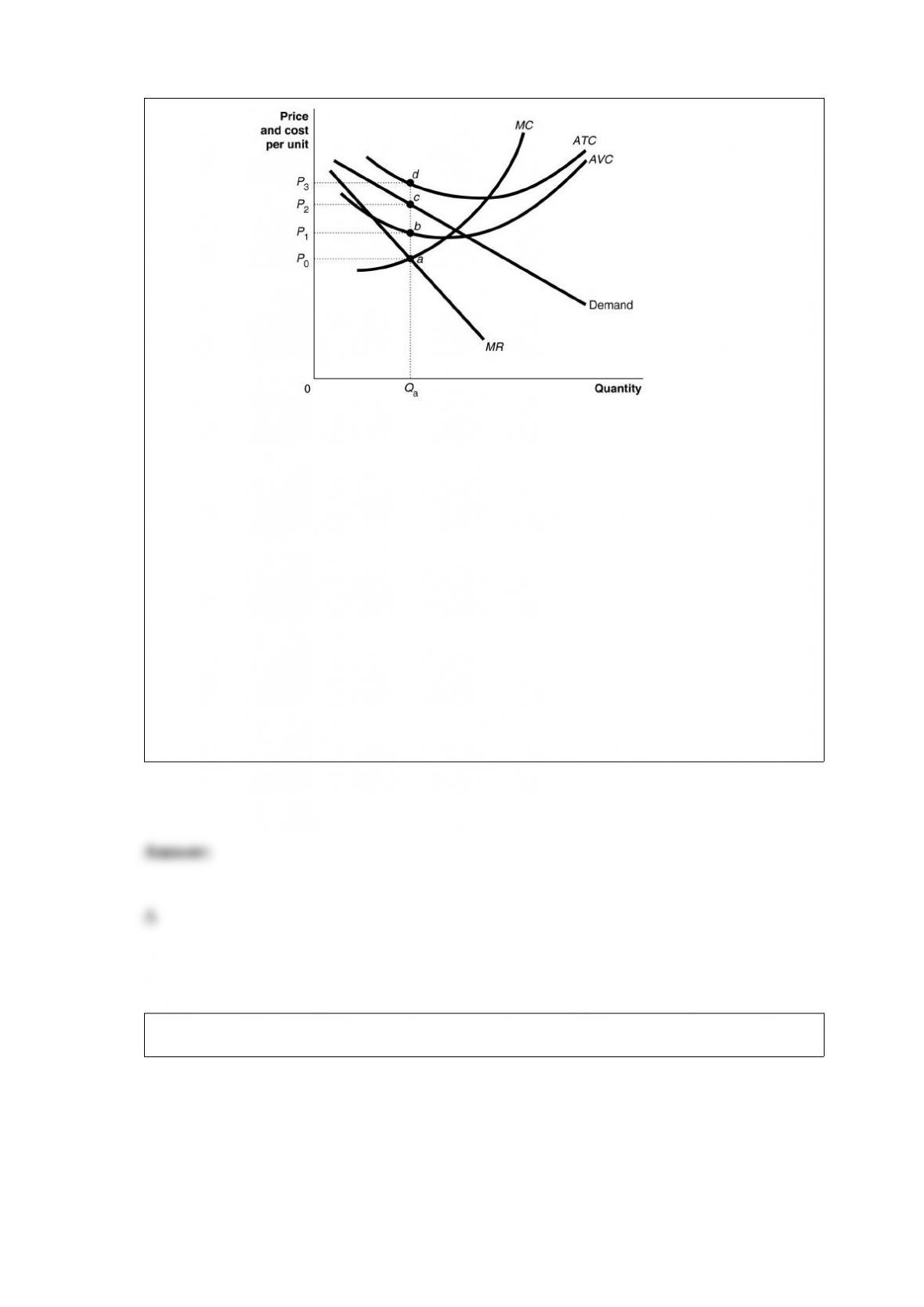
Figure 13-12 Figure 13-12 shows
short-run cost and demand curves for a monopolistically competitive firm in the market
for designer watches.
If the diagram represents a typical firm in the designer watch market, what is likely to
happen in the long run?
A) Some firms will exit the market causing the demand to increase for firms remaining
in the market.
B) The firms that are making losses will be purchased by their more successful rivals.
C) Inefficient firms will exit the market and new cost efficient firms will enter the
market.
D) Firms will have to raise their prices to cover costs of production.
Figure 3-4
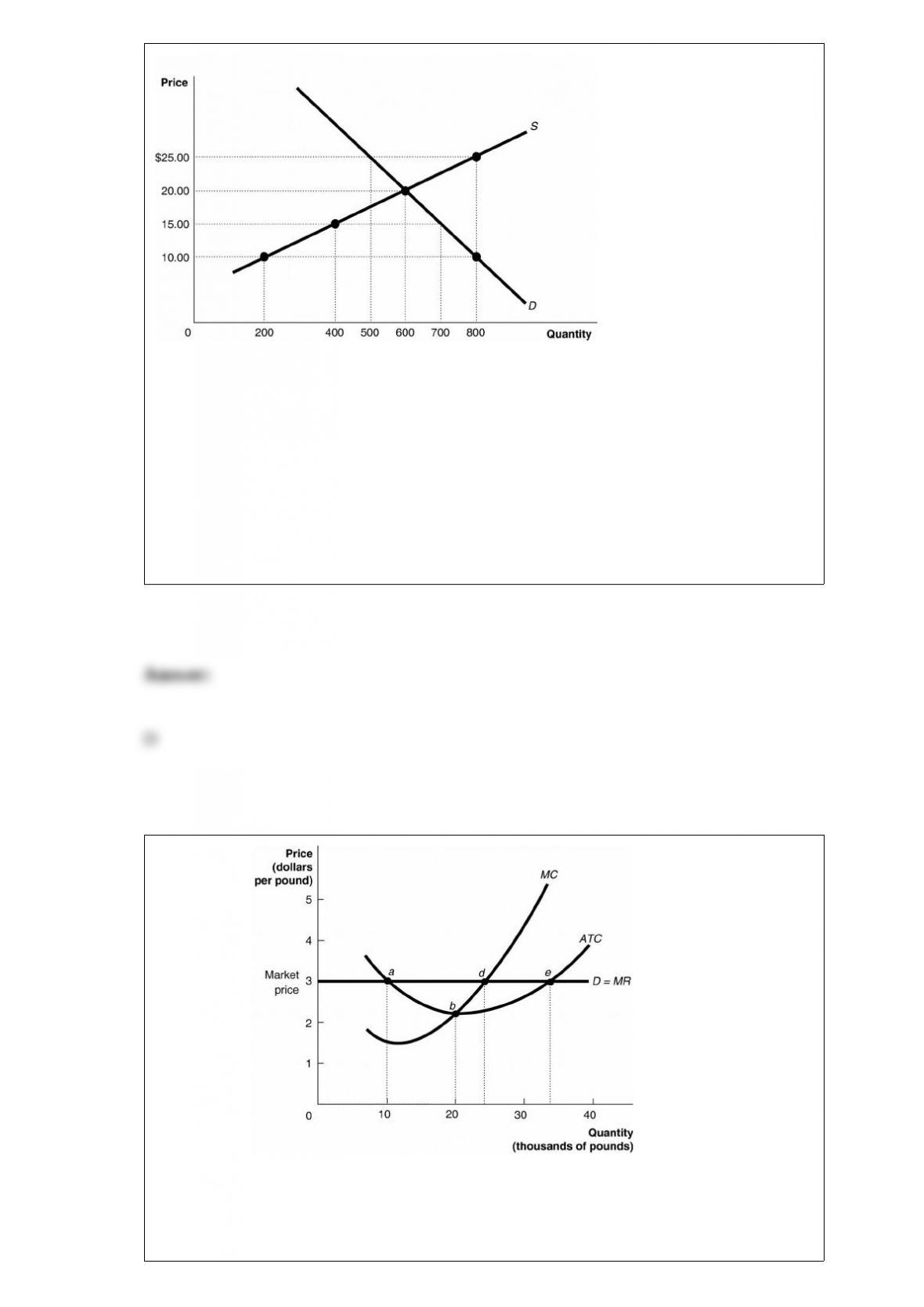
If the price is $20,
A) there would be a surplus of 600 units.
B) there would be a shortage of 600 units.
C) quantity demanded is zero.
D) the market is in equilibrium.
Figure 12-6 Figure 12-6 shows the
demand, marginal cost (MC) and average total cost (ATC) curves for Jason’s House of
Apples. Jason is currently producing 20 thousand pounds of apples. To maximize his
profit Jason should
A) keep production at 20 thousand pounds.
B) increase production to the output rate indicated by point d.
C) increase production to the output rate indicated by point e.
D) decrease production to the output rate indicated by point a.
What is a surplus? What is a shortage?
What is scarcity, and why is it a fundamental concept in economics?
What is meant by the term “free market”?
What is moral hazard?
If you pay $3,000 in taxes on an income of $28,000, and $4,450 in taxes on an income
of $38,000, what is your marginal tax rate? Show your work.
Suppose you withdraw $1,000 in cash from your checking account. Draw a T-account
to show the effect of this transaction on your bank’s balance sheet.
What is economic growth?