In a competitive market equilibrium,
A) total consumer surplus equals total producer surplus.
B) marginal benefit and marginal cost are maximized.
C) consumers and producers benefit equally.
D) the marginal benefit equals the marginal cost of the last unit sold.
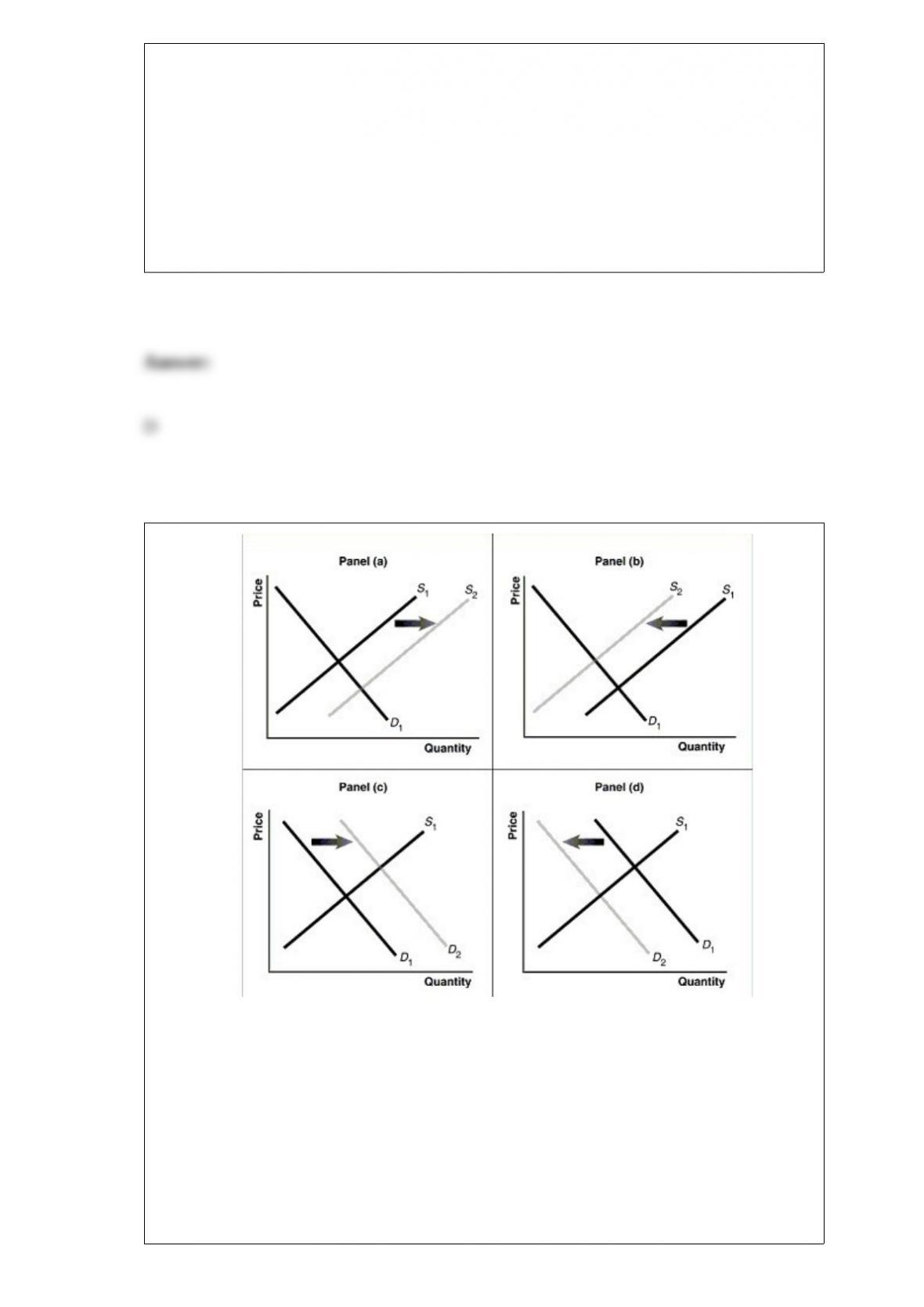
Figure 3-7
Assume that the graphs in this figure represent the demand and supply curves for
women’s clothing. Which panel best describes what happens in this market when the
wages of seamstresses rise?
A) Panel (a)
B) Panel (b)
C) Panel (c)

D) Panel (d)
For people who live near a bus route, a subway station, or a commuter rail line, public
transportation provides a substitute to driving their own cars. So, for these people, the
cross-price elasticity of demand between gasoline and public transportation is
A) positive.
B) negative.
C) zero.
D) infinity.
Article Summary
In an August 2013 speech from the Lincoln Memorial, President Obama was expected
to emphasize that increased economic equality is needed to improve racial equality.
Economic gaps based on race have endured for 50 years, with the differences in
unemployment rates between blacks and whites remaining virtually unchanged and the
gap in wealth actually increasing. “If you look at 50 years after the 1960s civil rights
movement, the most stubborn and persistent challenge when it comes to the nation’s
racial challenge remains in the areas of economics and wealth,” said Marc Morial,
president of the National Urban League. Source: Zachary A. Goldfarb, “For Obama, 50
years after historic march, economic equality the path to racial justice,” Washington
Post, August 17, 2013.The article mentions increased economic equality is needed in
terms of wealth, and for some people this means a more equitable distribution of
wealth. Would an equitable distribution of wealth necessarily be the most efficient
distribution of wealth?

A) Yes, equitable and efficient are two different words which have the same definition.
B) Yes, in order for the distribution to be equitable, it must also be efficient.
C) No, it is impossible to have an economically efficient distribution which is also an
equitable distribution.
D) No, an economically efficient distribution of wealth would not necessarily be
equitable.
Nominal GDP is another term for
A) inflation-adjusted GDP.
B) real GDP.
C) constant-dollar GDP.
D) current-dollar GDP.
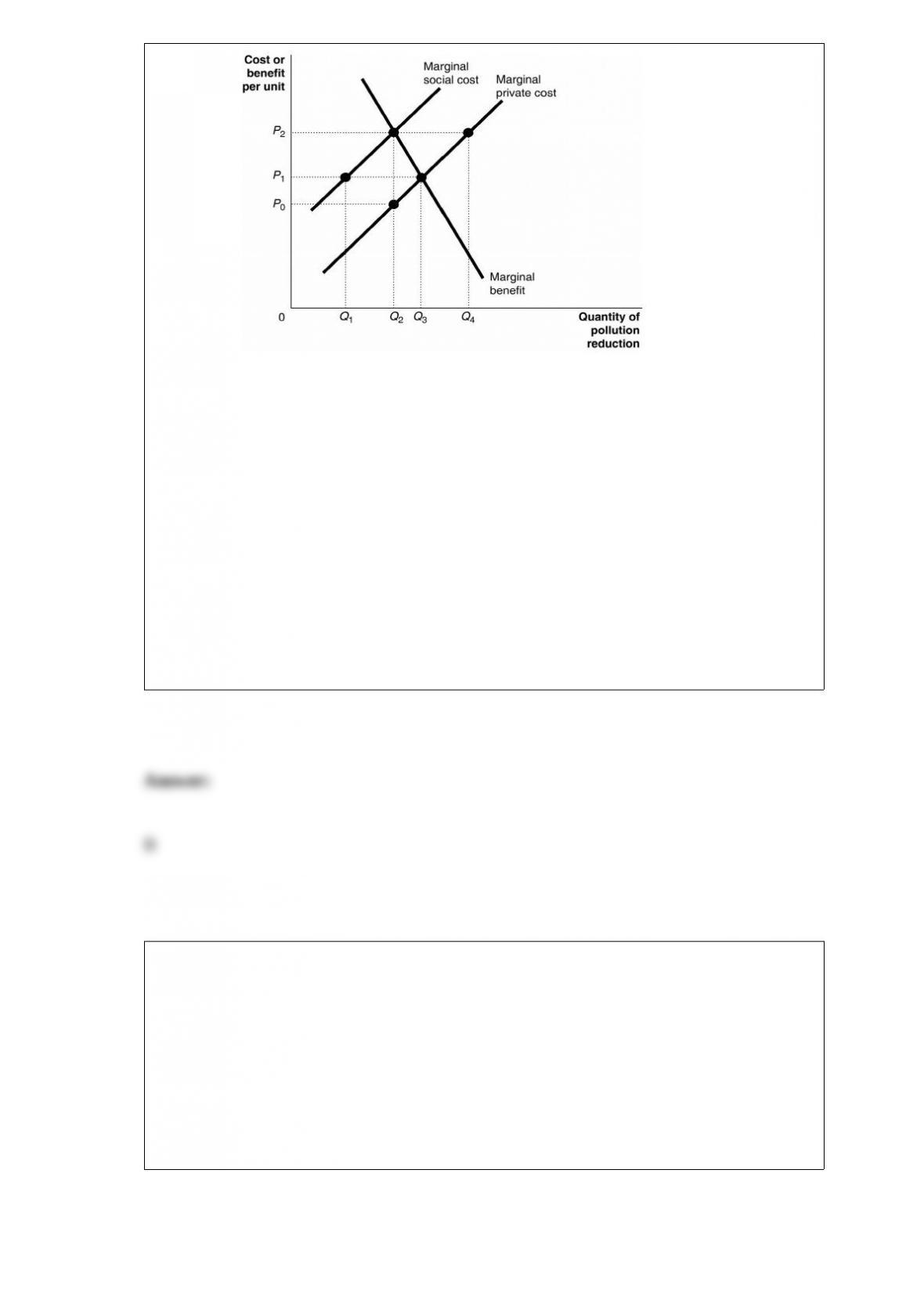
Figure 5-9 Companies producing
toilet paper bleach the paper to make it white. The bleach is discharged into rivers and
lakes and causes substantial environmental damage. Figure 5-9 illustrates the situation
in the toilet paper market.An efficient way to get the firm to produce the socially
optimal output level is
A) for government to set a quota on the quantity of toilet paper that the toilet paper
industry can produce.
B) to impose a tax to make the industry bear the external costs it creates.
C) to grant a subsidy to enable the industry to internalize the external costs of
production.
D) to assign property rights to the firms in the industry.
The five competitive forces model was developed by
A) Michael Porter.
B) John Nash.
C) Michael Spence.
D) Porter Smith.
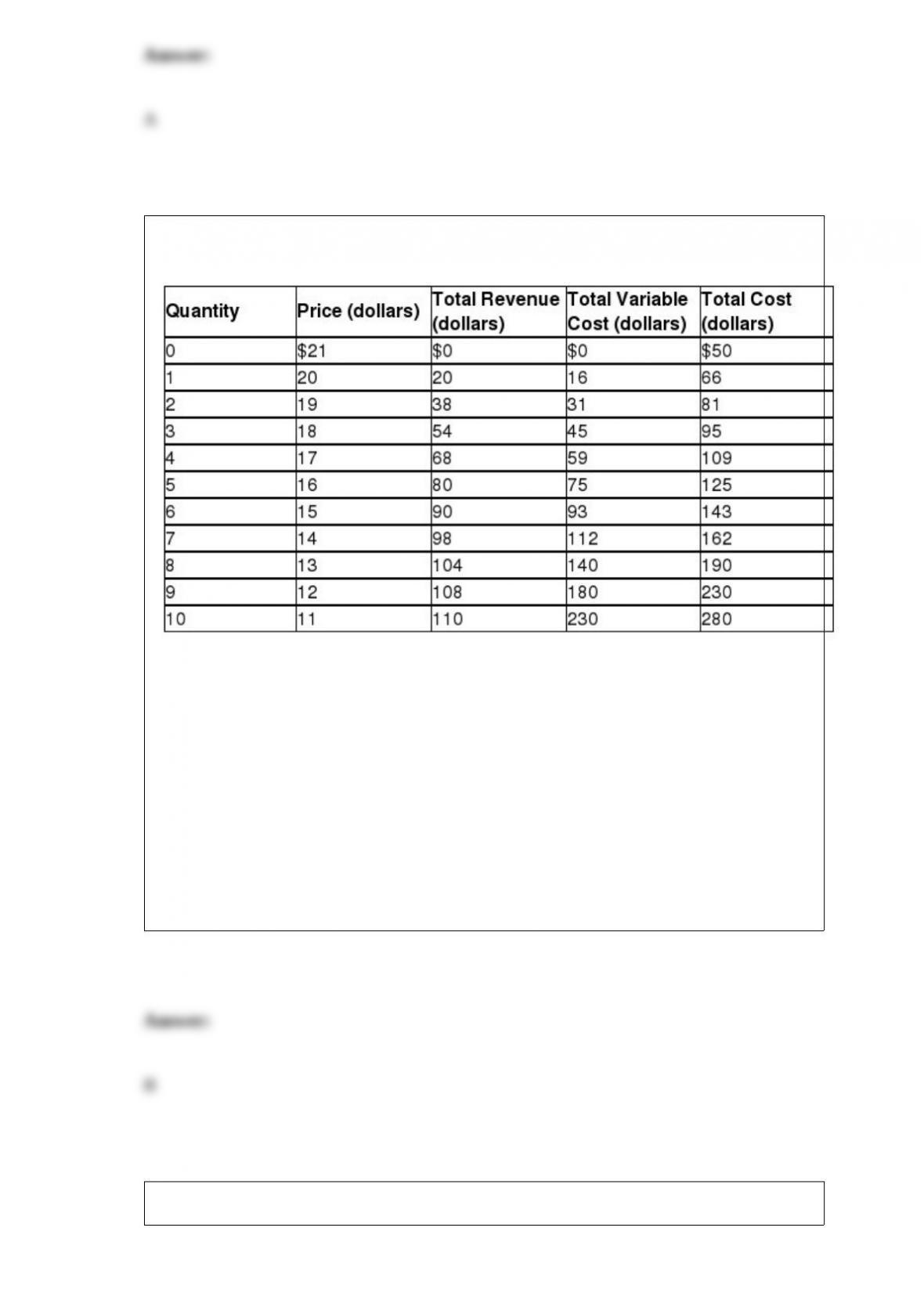
Table 13-3
Table 13-3 shows the demand and cost schedules for a monopolistically competitive
firm.
What is the best course of action for the firm in the short run?
A) It should shut down.
B) It should stay in business because it covers some of its fixed cost.
C) It should increase its sales by lowering its price.
D) It should not cut its price but it should increase its sales by advertising.
Figure 12-17
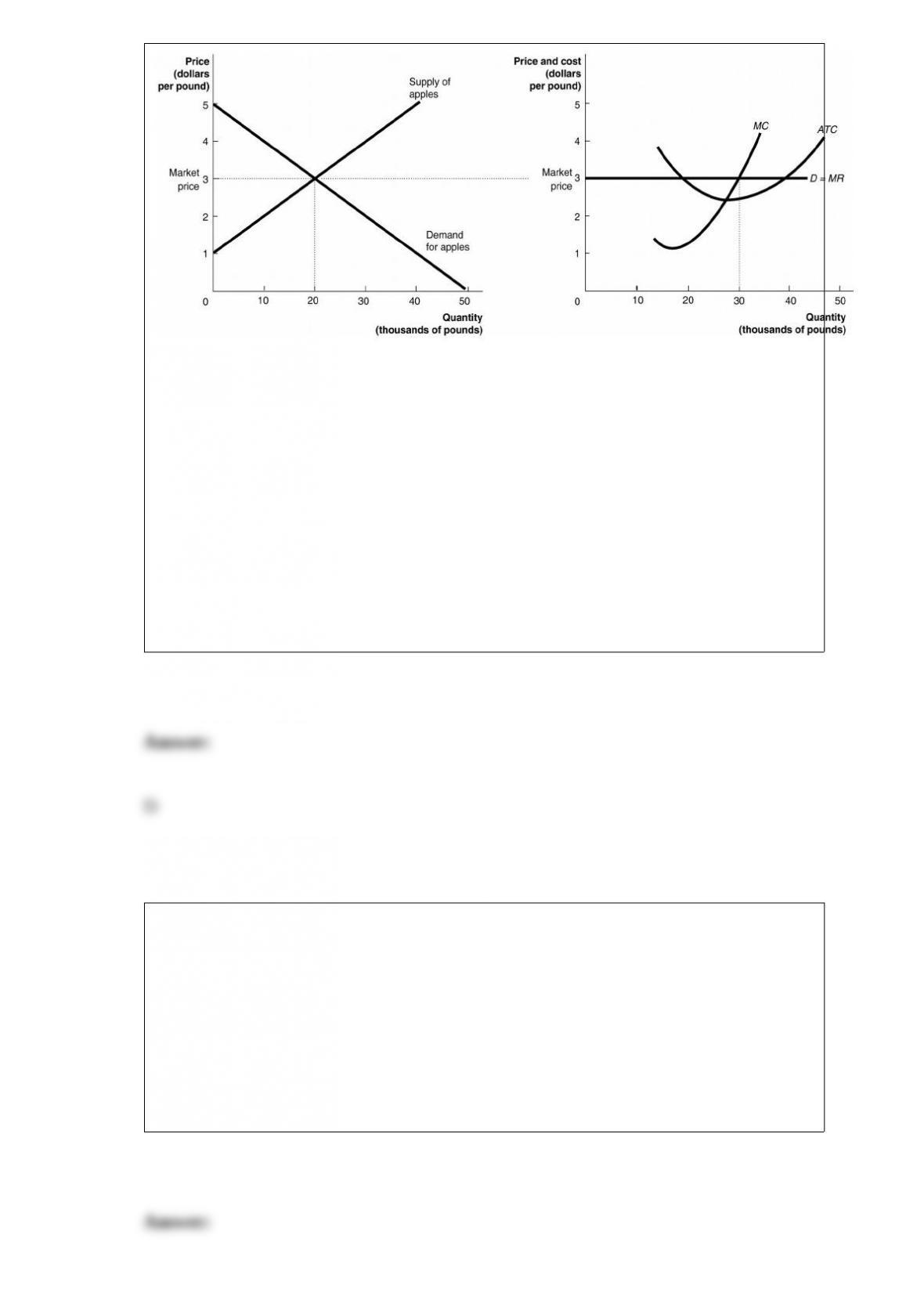
The graphs in Figure 12-17 represent the perfectly competitive market demand and
supply curves for the apple industry and demand and cost curves for a typical firm in
the industry. The graphs depicts a short run equilibrium. How will this differ from the
long-run equilibrium? (Assume this is a constant-cost industry.)
A) Fewer firms will be in the market in the long run than in the short run.
B) The price will be higher in the long run than in the short run.
C) The market supply curve will be further to the left in the long run than in the short
run.
D) The firm’s profit will be lower in the long run than in the short run.
A merger between firms at different stages of production of a good
A) is a vertical merger.
B) was made illegal by the Sherman Act.
C) was made legal by the Clayton Act.
D) is a horizontal merger.

Specializing in the production of a good or service in which one has a comparative
advantage enables a country to do all of the following except
A) engage in mutually beneficial trade with other nations.
B) increase the variety of products that it can consume with no increase in resources.
C) consume a combination of goods that lies outside its own production possibilities
frontier.
D) produce a combination of goods that lies outside its own production possibilities
frontier.
A firm will make a profit when
A) P > AVC.
B) P > ATC.
C) P = ATC.
D) P = MC.

Compensating differentials are associated most closely with which of the following?
A) hazardous jobs
B) comparable worth
C) economic discrimination
D) differences in education
Which of the following best explains why airlines often cut their ticket prices at the
last-minute in order to fill the remaining empty seats on their flights?
A) Fixed costs in the airline industry are very large, but the marginal cost of flying one
more passenger is very low.
B) Airlines receive a subsidy from the government for each flight that is fully booked
and departs on time.
C) The Federal Aviation Administration ranks each airline based on the percentage of
flights that are fully booked. These rankings affect the decisions of firms to use a
particular airline to fly their employees to business meetings.
D) Cutting prices makes the airlines more popular with their customers, who may fly
with the same airline in the future as the result of buying low-price tickets.
Women typically earn less than men, even in the same occupation. Which of the
following is an explanation for this discrepancy?
A) Women do not work as hard as men because of cultural influences.

B) Women have, on average, less workforce experience than men of the same age.
C) Women are, on average, less motivated than men and therefore tend to avoid taking
on more responsibilities.
D) Women tend to take riskier jobs and earn compensating wage differentials.