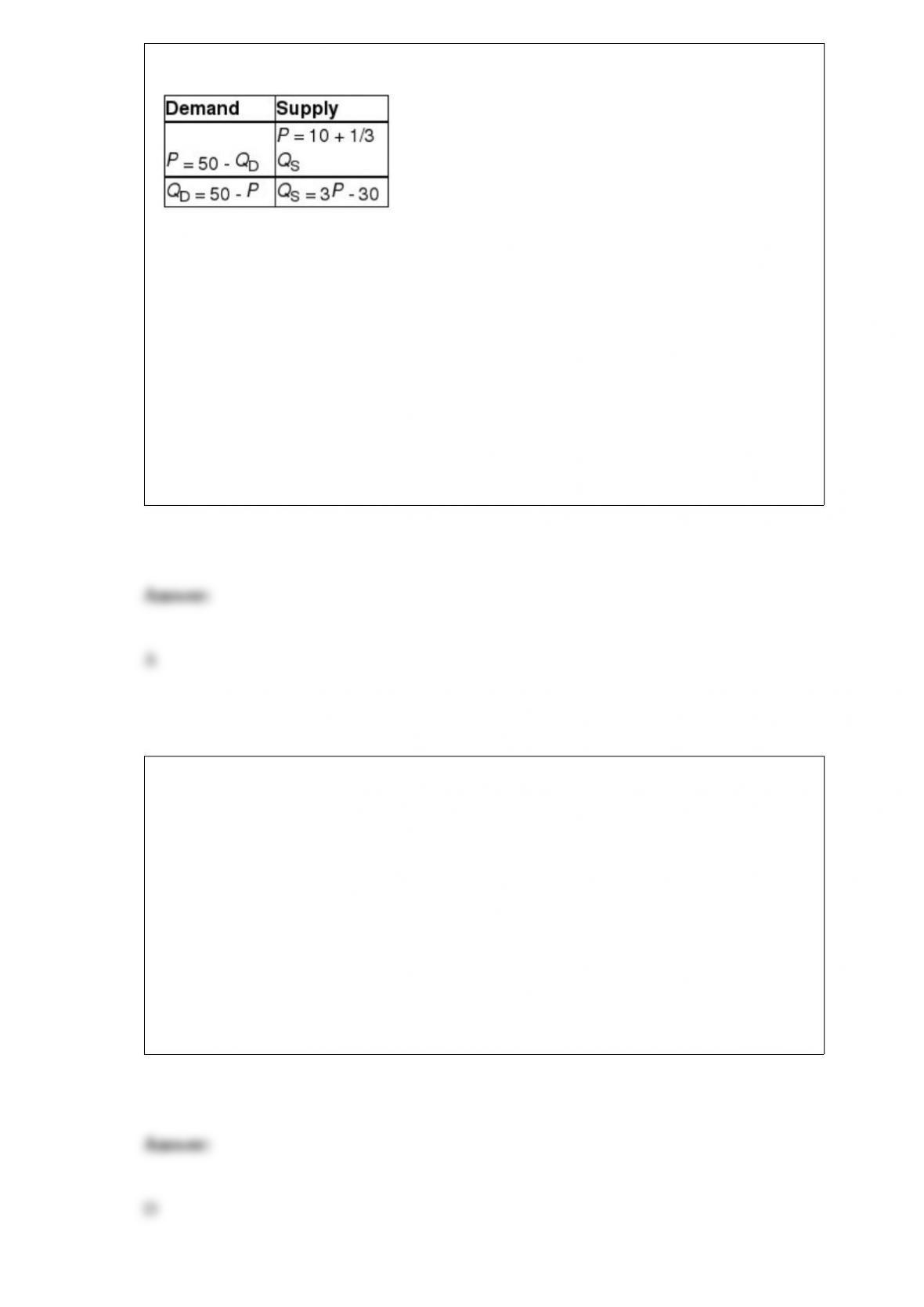
Table 4-6
Refer to Table 4-6. The equations above describe the demand and supply for Aunt
Maud’s Premium Hand Lotion. The equilibrium price and quantity for Aunt Maud’s
lotion are $20 and 30 thousand units. What is the value of economic surplus in this
market?
A) $600 thousand
B) $1,050 thousand
C) $1,500 thousand
D) $2,100 thousand
If the nominal rate of interest is 6.5% and the inflation rate is 3.0%, what is the real rate
of interest?
A) -9.5%
B) -3.5%
C) 1.5%
D) 3.5%
E) 9.5%

The United States has developed a comparative advantage in digital computers,
airliners and many prescription drugs. The source of its comparative advantage in these
products is
A) a favorable climate.
B) technology.
C) abundant supplies of natural resources.
D) a strong central government.
The difference between a firm’s assets and liabilities is its
A) accounting profit.
B) economic profit.
C) net worth.
D) implicit costs.
Ceteris paribus, in the long run, a negative supply shock causes
A) the long-run aggregate supply curve to shift to the left.
B) the price level to rise initially, and then return to its lower level.

C) unemployment to fall below its short-run level.
D) equilibrium real GDP to fall.
Which of the following are goals of monetary policy?
A) maximizing the value of the dollar relative to other currencies, economic growth,
and high employment
B) price stability, maximizing the value of the dollar relative to other currencies, and
high employment
C) price stability, economic growth, and high employment
D) price stability, economic growth, and maximizing the value of the dollar relative to
other currencies
You decide to work in Japan for the next 10 years, accumulate some savings, then move
back to the United States and convert your savings from yen to dollars. At the time of
your move, economists predict that consumers in the United States have reignited their
love of Japanese products, especially hybrid cars, and expect that this strong preference
for Japanese products will continue for the next decade. How should this influence your
decision to work and save in Japan?
A) You should be discouraged as the growing U.S. preference for Japanese goods
should increasethe value of the yen to the dollar and decrease the value of your savings
when converted to dollars.
B) You should be discouraged as the growing U.S. preference for Japanese goods
should decrease the value of the yen to the dollar and decrease the value of your savings
when converted to dollars.
C) You should be encouraged as the growing U.S. preference for Japanese goods should
decrease the value of the yen to the dollar and raise the value of your savings when
converted to dollars.
D) You should be encouraged as the growing U.S. preference for Japanese goods should
increase the value of the yen to the dollar and raise the value of your savings when
converted to dollars.
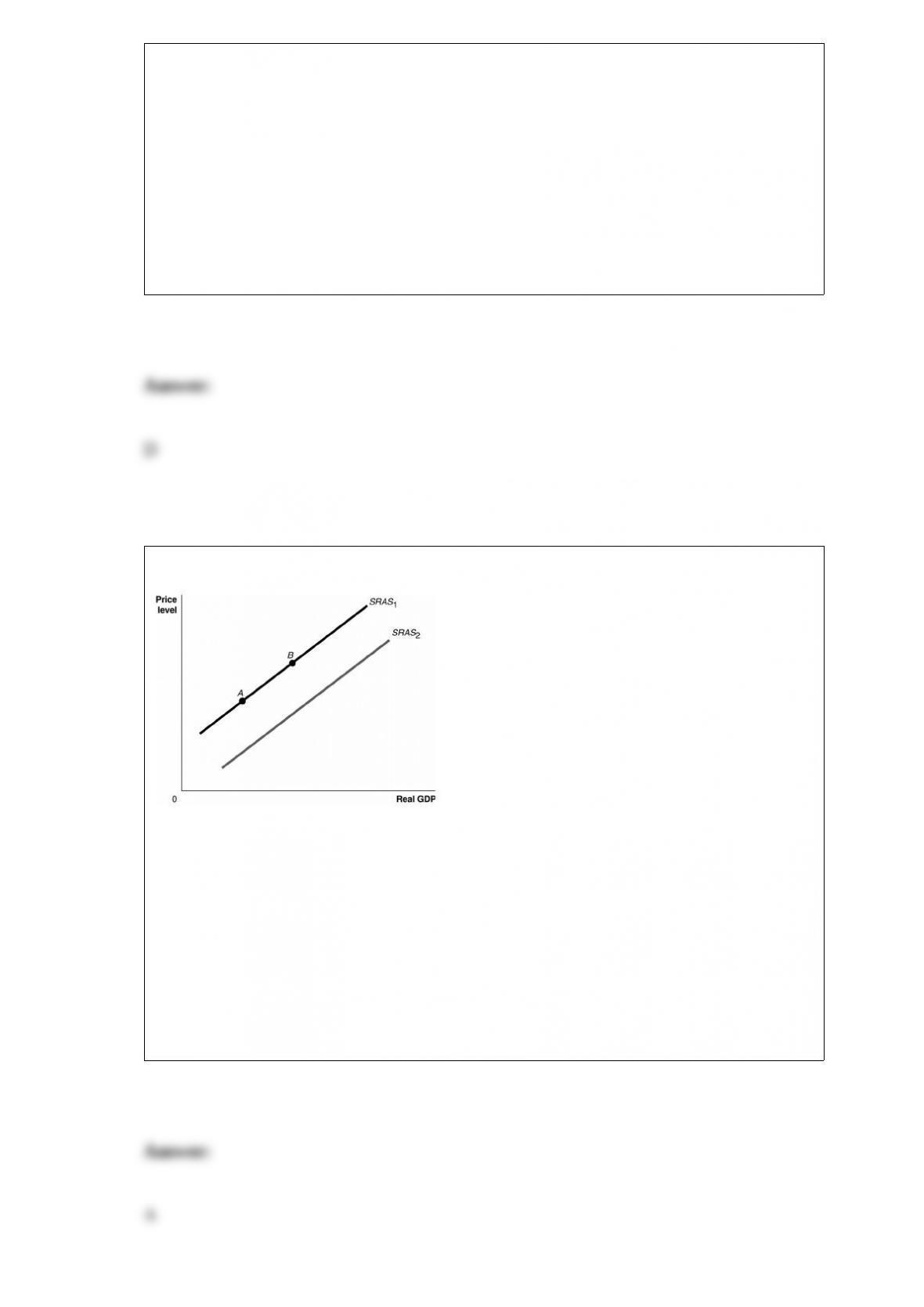
Figure 13-2
Refer to Figure 13-2. Ceteris paribus, an increase in the labor force would be
represented by a movement from
A) SRAS1 to SRAS2.
B) SRAS2 to SRAS1.
C) point A to point B.
D) point B to point A.
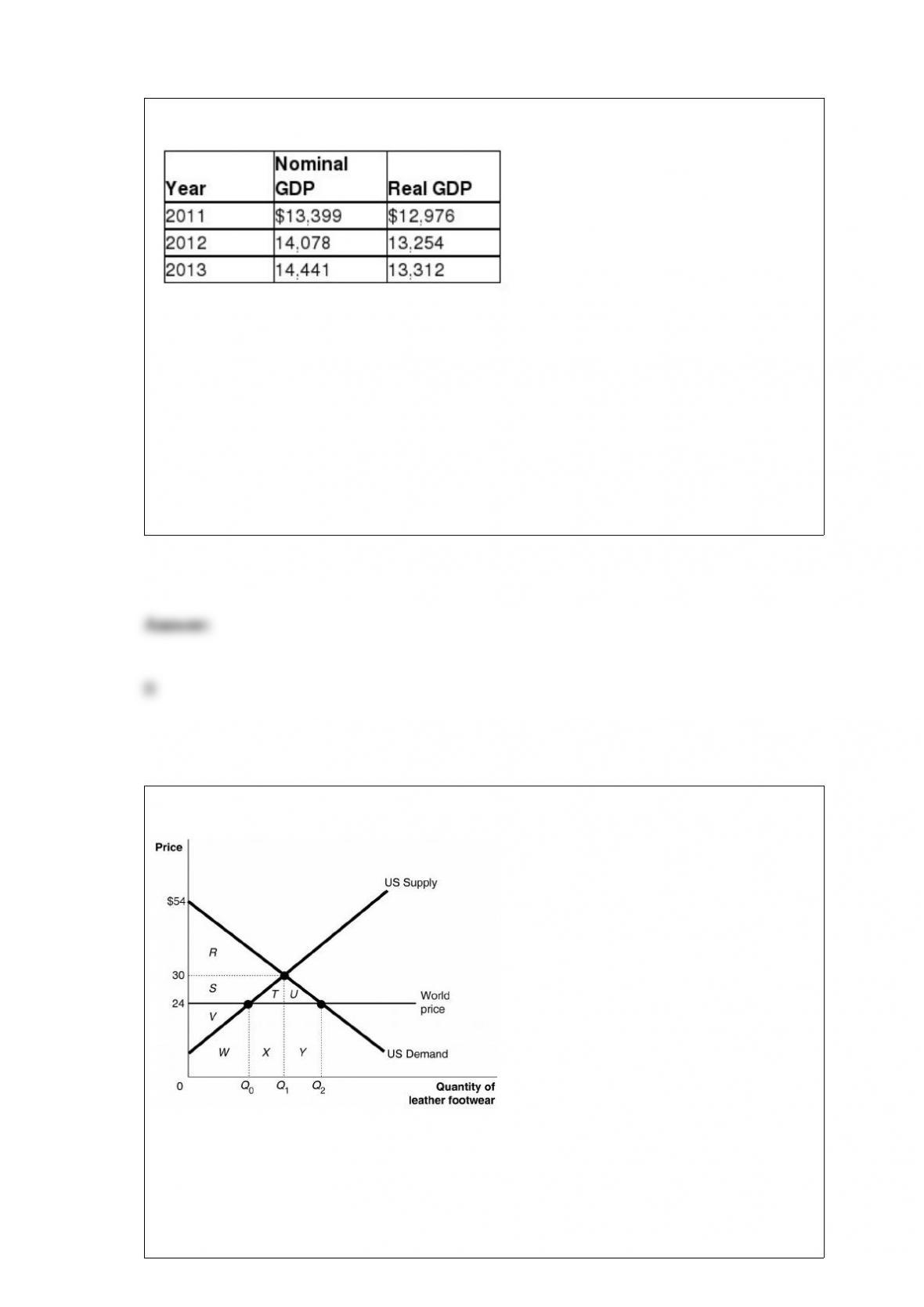
Table 8-15
Refer to Table 8-15. Consider the following data on nominal GDP and real GDP (values
are in billions of dollars): The GDP deflator for 2012 equals
A) 94.1.
B) 105.1.
C) 106.2.
D) 108.5.
Figure 7-1
Figure 7-1 shows the U.S. demand and supply for leather footwear.
Refer to Figure 7-1. Suppose the government allows imports of leather footwear into
the United States. The market price falls to $24. What area represents consumer
surplus?

A) R + S
B) R + S + T + U
C) V + W + X + Y
D) R + S + V