
If patients were allowed to sue their HMO, we would expect
a. the demand curve for health care services provided by the HMO to shift to the left
and the price of HMO-provided health care coverage to fall.
b. the supply curve for health care services provided by the HMO to shift to the left and
the price of HMO-provided health care coverage to rise.
c. the supply curve for health care services provided by the HMO to shift to the right
and the price of HMO-provided health care coverage to fall.
d. a and b
e. none of the above
The coordinates of point A are 400 units of X and 40 units of Y. The coordinates of
point B are 480 units of X and 60 units of Y. With X on the horizontal axis and Y on the
vertical axis, the slope of the line between points A and B is
a. + 0.25
b. + 4.00
c. + 0.33
d. – 4.00
e. – 0.25
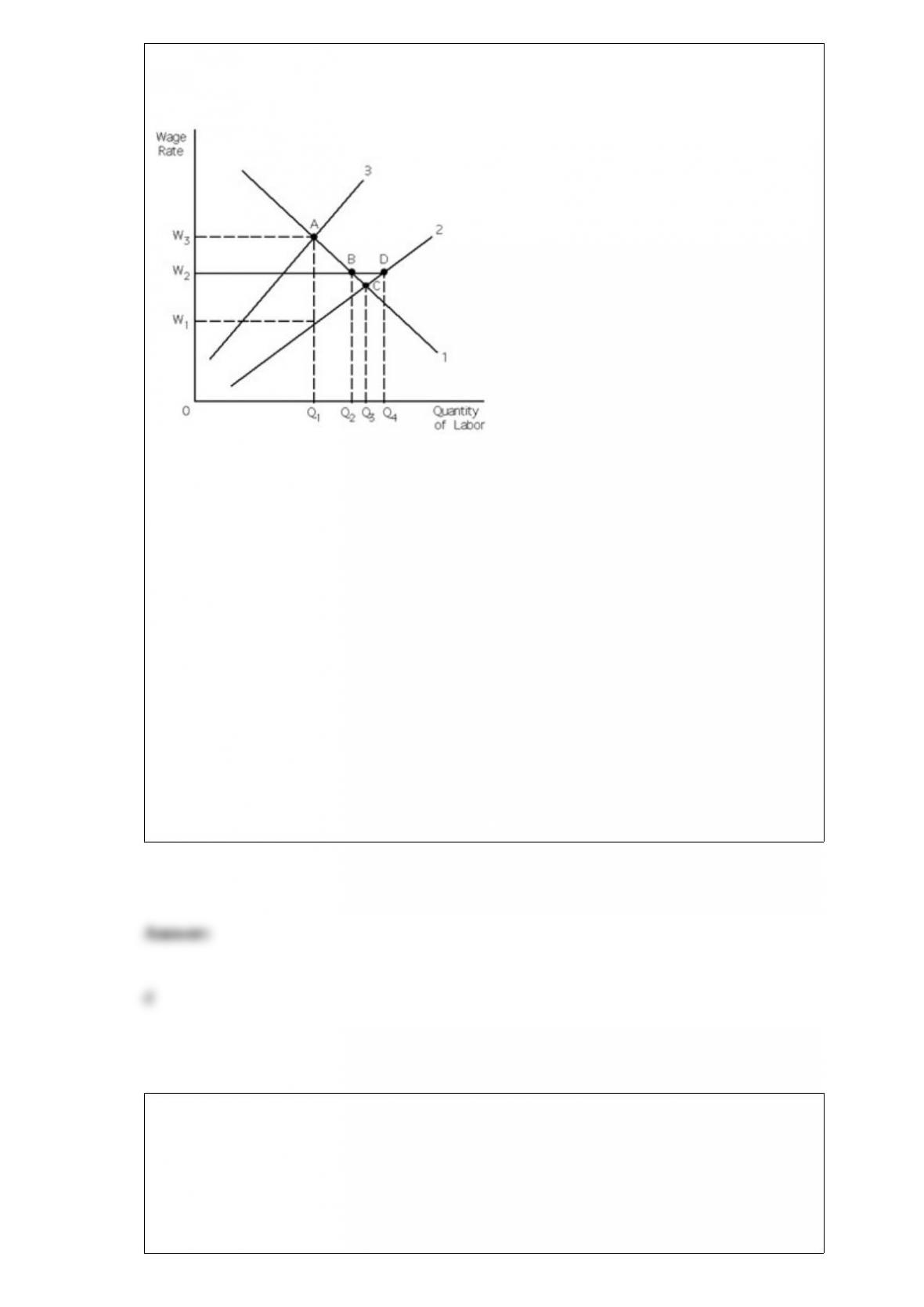
Exhibit 28-11
The firm in the exhibit is a monopsony. We have deliberately not identified the three
curves in the exhibit. They are simply curves 1, 2, and 3. If (union) collective
bargaining with the monopsony guarantees the wage rate that workers will be paid is
W2, then the factor supply curve is
a. curve 2.
b. curve 3.
c. the curve that starts at W2, goes to point B, then down to point C, then moves up
curve 2.
d. the curve that starts at W2, goes to point D, and then moves up curve 2.
e. the curve that starts at W2 and goes to point D.
Which of the following is a theory of the source of profit?
a. uncertainty is the source of profit
b. the alertness to broadly defined arbitrage opportunities is the source of profit

c. the return to the entrepreneur for innovation is the source of profit
d. a and c
e. a, b and c
Which of the following statements is true?
a. Larger loans are likely to be cheaper to process (per dollar) than smaller loans;
therefore, larger loans will carry a lower interest rate than smaller loans, ceteris paribus.
b. Larger loans are likely to be more expensive to process (per dollar) than smaller
loans; therefore, larger loans will carry a higher interest rate than smaller loans, ceteris
paribus.
c. Larger loans are likely to be cheaper to process (per dollar) than smaller loans;
therefore, larger loans will carry a higher interest rate than smaller loans, ceteris
paribus.
d. Larger loans are likely to be more expensive to process (per dollar) than smaller
loans; therefore, larger loans will carry a lower interest rate than smaller loans, ceteris
paribus.
Which antitrust legislation made price discrimination illegal?
a. the Sherman Act
b. the Clayton Act
c. the Federal Trade Commission Act
d. the Robinson-Patman Act
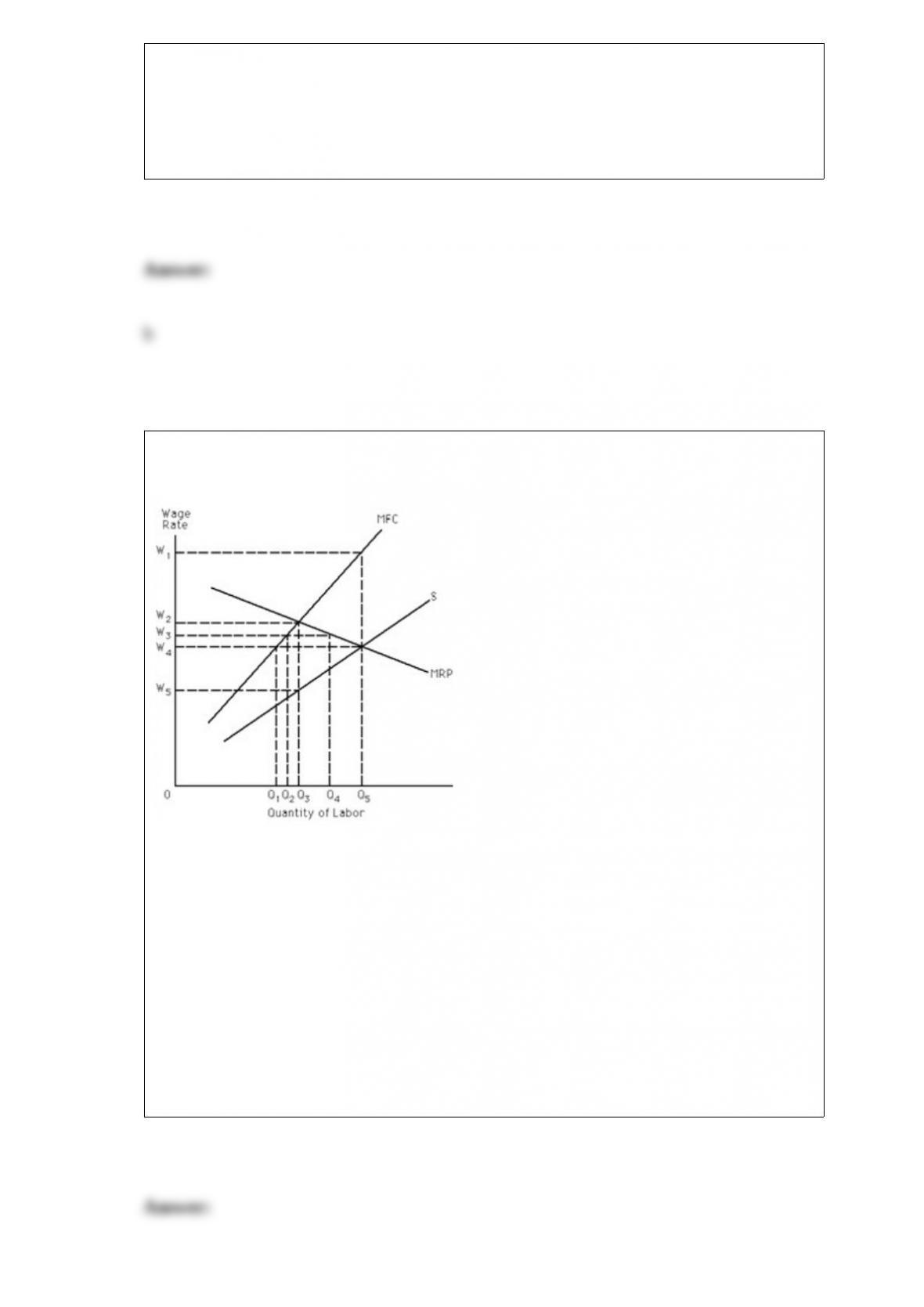
Exhibit 28-8
Suppose that initially there is no collective bargaining and the monoposonist maximizes
profit. Then the workers form a union and negotiate a wage of W3. What will happen to
the total wage bill?
a. It will definitely rise.
b. It will definitely fall.
c. It will definitely stay the same.
d. It may rise, fall, or remain the same.

If, as a person consumes additional units of a good, total utility rises by a constant
amount, it follows that
a. marginal utility is rising.
b. marginal utility is falling.
c. total utility and marginal utility are equal.
d. marginal utility is constant.
e. marginal utility is negative.
In general, there is a ______________ relationship between the number of hours spent
studying for a test and the grade earned on the test.
a. independent
b. direct
c. inverse
d. smooth

If a person’s asset income rises and his or her transfer payments (received) decline, it
follows that that person’s
a. overall income rises.
b. overall income falls.
c. overall income stays constant.
d. labor income will rise as his or her asset income rises.
e. none of the above
Smith says that criminals are rational and that they consider both the benefits and costs
of criminal activity.Jones disagrees.He says criminals are irrational and can’t possibly
be considering both the benefits and costs of criminal activity.If they did, he argues,
they wouldn’t be criminals.An economist who wants to figure out if criminals are
rational, would most likely build a
a. falsifiable theory built on a rational criminal and then test the theory.
b. non-falsifiable theory built on a rational criminal and then test the theory.
c. falsifiable theory built on a rational criminal, but not test the theory.
d. non-falsifiable theory built on a rational criminal, but not test the theory.

The theory of contestable markets places more emphasis than orthodox market structure
theories on
a. the number of sellers in an industry.
b. the type of product produced in an industry.
c. the issue of entry into and exit from an industry.
d. who has access to relevant information.