
1) Some states do not have a state income tax.
a.True
b.False
2) In the former Soviet Union, producers were paid for meeting output targets, not for
selling products. Under those circumstances, what were the economic incentives for
producers?
a.to produce good quality products so that society would benefit from the resources
used
b.to conserve on costs, so as to maintain efficiency in the economy
c.to produce enough to meet the output target, without regard for quality or cost
d.to produce those products that society desires most
3) An efficient tax system is one that
(i)maximizes tax revenues.
(ii)minimizes deadweight losses from taxes.
(iii)minimizes administrative burdens from taxes.
(iv)promotes equity across taxpayers.
a.(i) only
b.(ii) and (iii) only
c.(i), (ii), and (iii) only
d.(i), (ii), (iii), and (iv)
4) In the case of a technology spillover, the government can encourage firms to
internalize a positive externality by
a.taxing production, which would decrease supply.
b.taxing production, which would increase supply.
c.subsidizing production, which would decrease supply.
d.subsidizing production, which would increase supply.
5) Under which of the following conditions would the interdiction of illegal drugs result
in a decrease in the quantity of drugs sold and in a decrease in total spending on illegal
drugs by drug users?
a.The interdiction has the effect of shifting the demand curve for illegal drugs to the
right.
b.The for illegal drugs is 1.3.
c.The price elasticity of supply for illegal drugs is 0.8.
d.As a result of the interdiction, the price of illegal drugs increases by 20 percent and
the quantity of illegal drugs sold decreases by 16 percent.
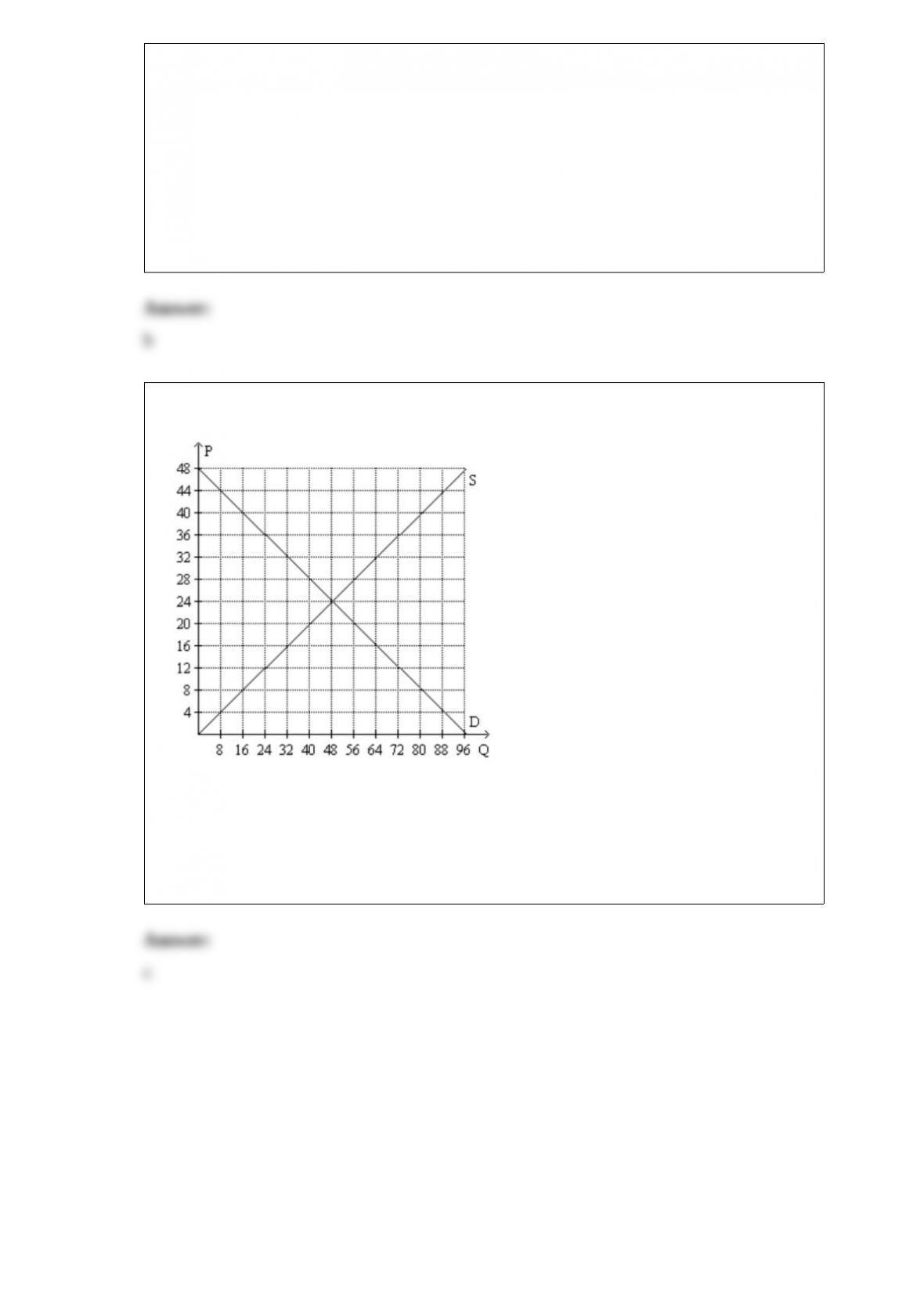
6) Figure 7-25
Refer to Figure 7-25. At the equilibrium price, total surplus is
a. $288.
b. $576.
c. $1,152.
d. $2,304.
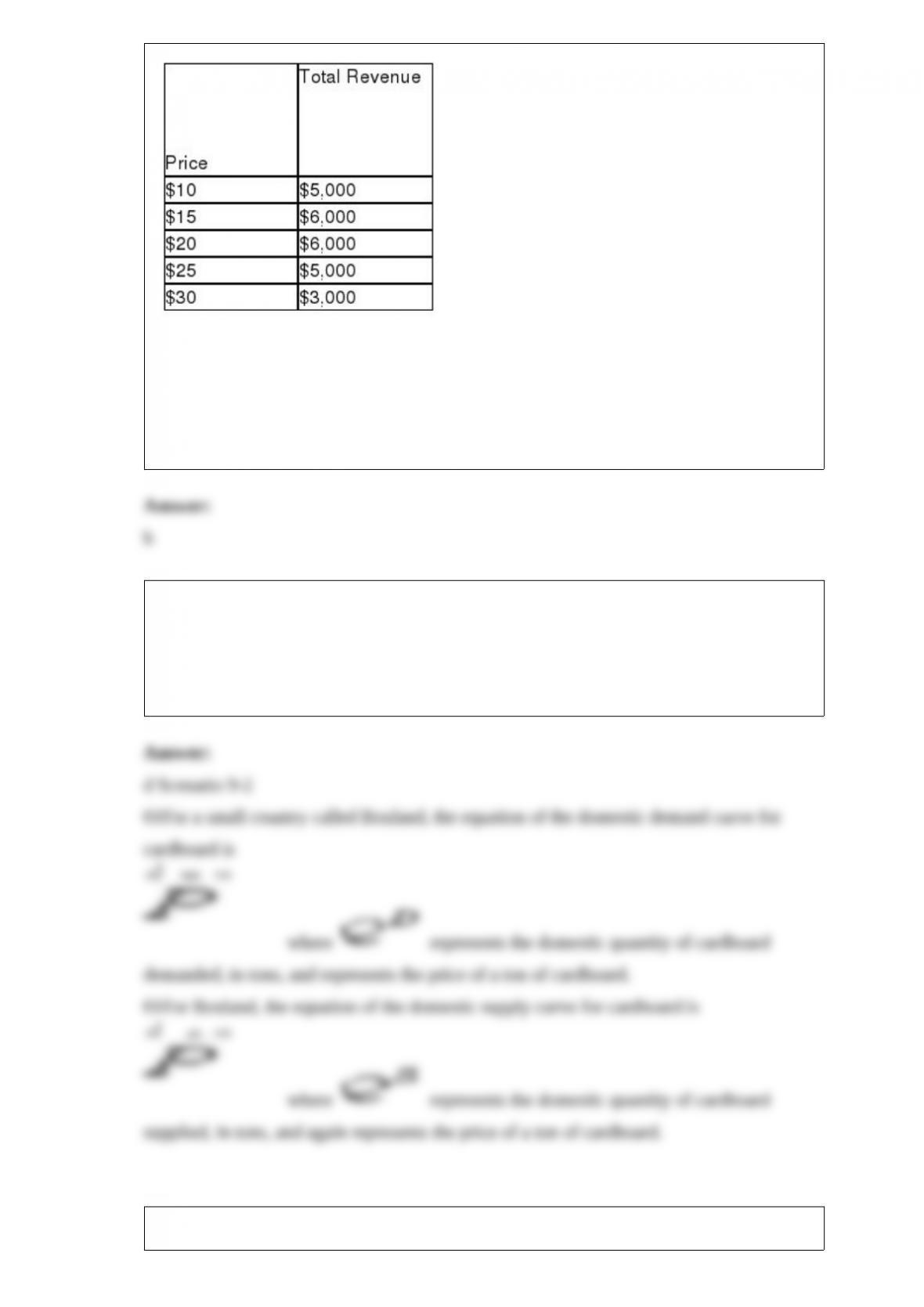
7) Using the midpoint method, demand is unit elastic when quantity demanded changes
from
a. 500 to 400
b. 400 to 300
c. 300 to 200
d. 200 to 100
8) Refer to Figure 9-20. Vietnam’s gains from trade in rice amount to
a.750.
b. 1,000.
c. 1,250.
d. 1,500.
9) The use of specialization to achieve economies of scale is one reason modern

societies are as prosperous as they are.
a.True
b.False
10) The Coase theorem suggests that private markets may not be able to solve the
problem of externalities
a.if the government does not become involved in the process.
b.when the number of interested parties is large and bargaining costs are high.
c.if the firm in the market is a monopoly.
d.if some people benefit from the externality.
11) If an increase in the interest rate raises savings, then
a.the substitution effect is greater than the income effect.
b.the income effect is greater than the substitution effect.
c.the income effect and the substitution effect move in the same direction.
d.we are unable to determine the sizes of the income and substitution effects without
more information.
12) The short-run supply curve in a competitive market must be more elastic than the
long-run supply curve.
a.True
b.False
13) Consider a market served by a monopolist, Firm A. A new firm, Firm B, enters the
market and, as a result, Firm A lowers its price to try to drive Firm B out of the market.
This practice is known as
a.resale price maintenance.
b.predatory tying.
c.tying.
d.predatory pricing.