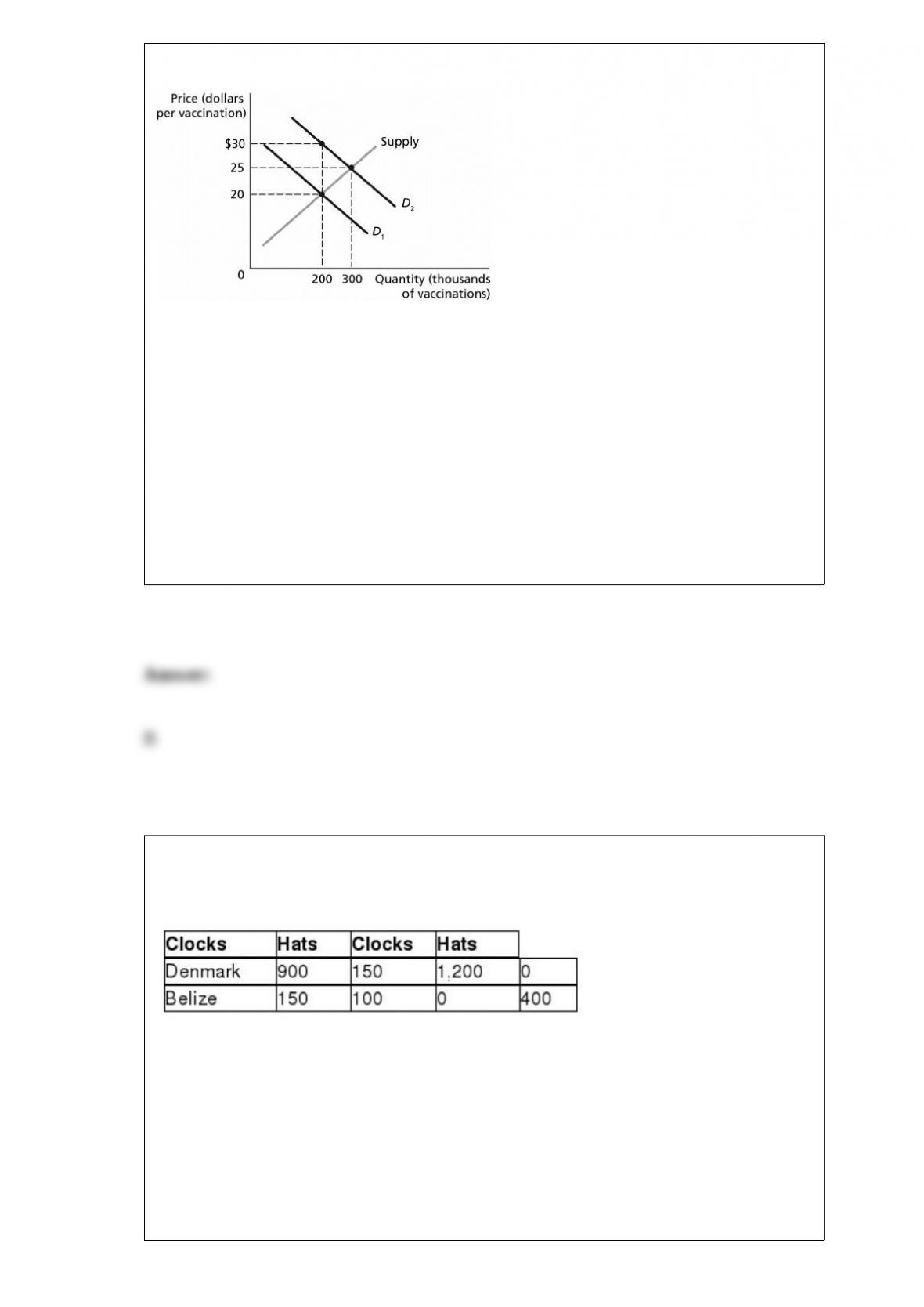
Figure 7-1
Figure 7-1 represents the market for
vaccinations. Vaccinations are considered a benefit to society, and the figure shows both
the marginal private benefit and the marginal social benefit from vaccinations. Marginal
social benefit is represented by which curve?
A) D1
B) D2
C) Supply
D) All of the above represent marginal social benefit.
Table 9-11 Production and
Consumption Production
Without Trade With Trade
Denmark and Belize can produce both clocks and hats. Table 9-11 shows the production
and consumption quantities without trade, and the production numbers with trade.
Prior to trade, what was the opportunity cost to produce 1 clock in Denmark?
A) 1/6 of a hat
B) 2/3 of a hat

C) 1.5 hats
D) 6 hats
Which of the following best describes an assumption economists make about human
behavior?
A) They assume that individuals act rationally all the time in all circumstances.
B) They assume that rational behavior is useful in explaining choices people make even
though people may not behave rationally all the time.
C) They assume that people take into account the question of fairness in all decisions
they make.
D) They assume that individuals act randomly.
Jeremy is thinking of starting up a small business selling NASCAR memorabilia. He
asks his friend, Carmen, if she’d like to join him in setting up a partnership to start the
business. What is one disadvantage in joining the partnership that Carmen should
consider?
A) Carmen should realize that profits in the partnership will be reduced by dividend
payments to shareholders.
B) Carmen should realize that, as an owner of the business, she will be personally
responsible for the debts of the business.
C) Carmen should realize that the profits of the business will also be taxed as dividend
income, so she faces the potential for double taxation of that business income.

D) Carmen should realize that the Jeremy will have complete control over the business
because it was his idea.
If the required reserve ratio is 10 percent, an increase in bank reserves of $1,000 can
support an increase in checking account deposits (including the original deposit) in the
banking system as a whole of up to
A) $100.
B) $1,000.
C) $10,000.
D) $100,000.
Haiti was once a heavily forested country. Today, 80 percent of Haiti’s forests have been
cut down, primarily to be burned to create charcoal. The reduction in the number of
trees has lead to devastating floods when it rains heavily. This is an example of
A) tragic externalities.
B) the tragedy of the commons.
C) human greed.
D) the consequences of not having a market economic system.

According to public choice theory, policymakers
A) place the interests of the public above their own self-interest.
B) are likely to pursue their own self-interest, even if their self-interest conflicts with
the public interest.
C) act in ways to maximize economic efficiency.
D) act in ways to bring about an equitable distribution of society’s wealth.
If firms pay what are called “efficiency wages,” they pay wages that
A) motivate workers to increase their productivity.
B) are lower than average to ensure maximum profit.
C) will eventually lower the unemployment rate.
D) are mandated by the government.
A bank’s largest liability is its

A) short-term borrowing.
B) long-term debt.
C) deposits of its customers.
D) shareholder equity.
Article Summary. Administrative overhead costs resulting from insurance
companies handling reimbursement claims is in large part the reason that health
care in the United States is much more expensive than in other countries. An
analysis on the administration costs of health care in the United States found that
roughly 30 percent of the costs of health care are administrative and that more
than 25 percent of health-sector employees work in administration. Health
insurance companies are often paid a fixed percentage of the claims they
administer, which gives them little to no impetus to increase efficiency and keep
costs down. Source: Jeffrey Pfeffer, “The Reason Health Care Is So Expensive:
Insurance Companies,” Bloomberg Businessweek, April 10, 2013.
Even if insurance companies were more efficient and brought administrative costs
down, consumers would ________ the full cost of medical treatment. This would result
in the market equilibrium price and quantity of medical services being ________ than
the efficient equilibrium price and quantity.
A) pay less than; less than
B) pay more than; less than
C) pay more than; more than
D) pay less than; more than
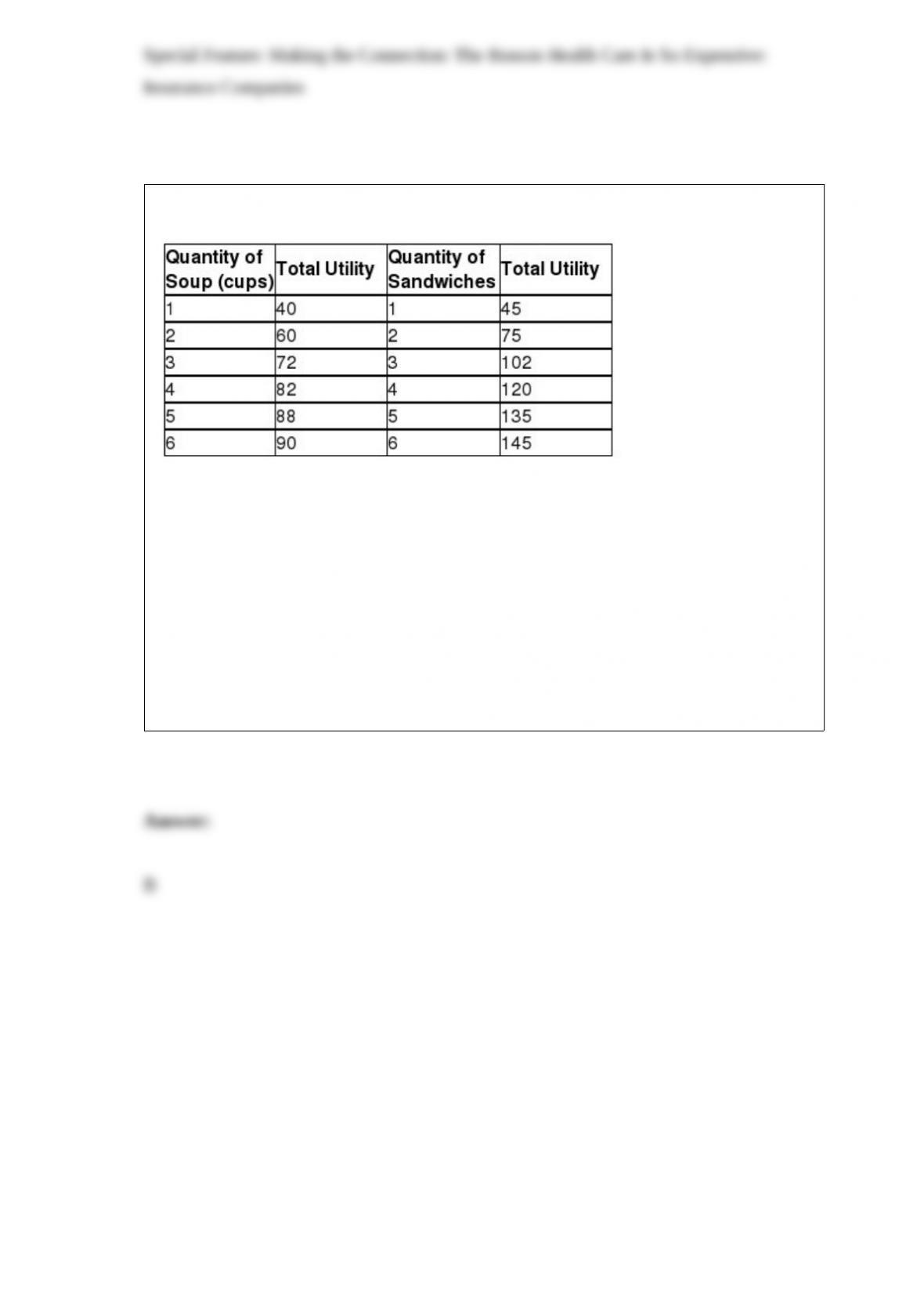
Table 10-2
Table 10-2 above shows Keira’s utility from soup and sandwiches. The price of soup is
$2 per cup and the price of a sandwich is $3. Keira has $18 to spend on these two
goods. If Keira maximizes her utility, how many units of each good should she buy?
A) 1 cup of soup and 5 sandwiches
B) 3 cups of soup and 4 sandwiches
C) 6 cups of soup and 2 sandwiches
D) 4 cups of soup and 3.5 sandwiches