If an Engel curve has a positive slope
A) both goods are normal.
B) the good on the horizontal axis is normal
C) as the price of the good on the horizontal axis increases, more of both goods in
consumed.
D) as the price of the good on the vertical axis increases, more of the good on the
horizontal axis is consumed.
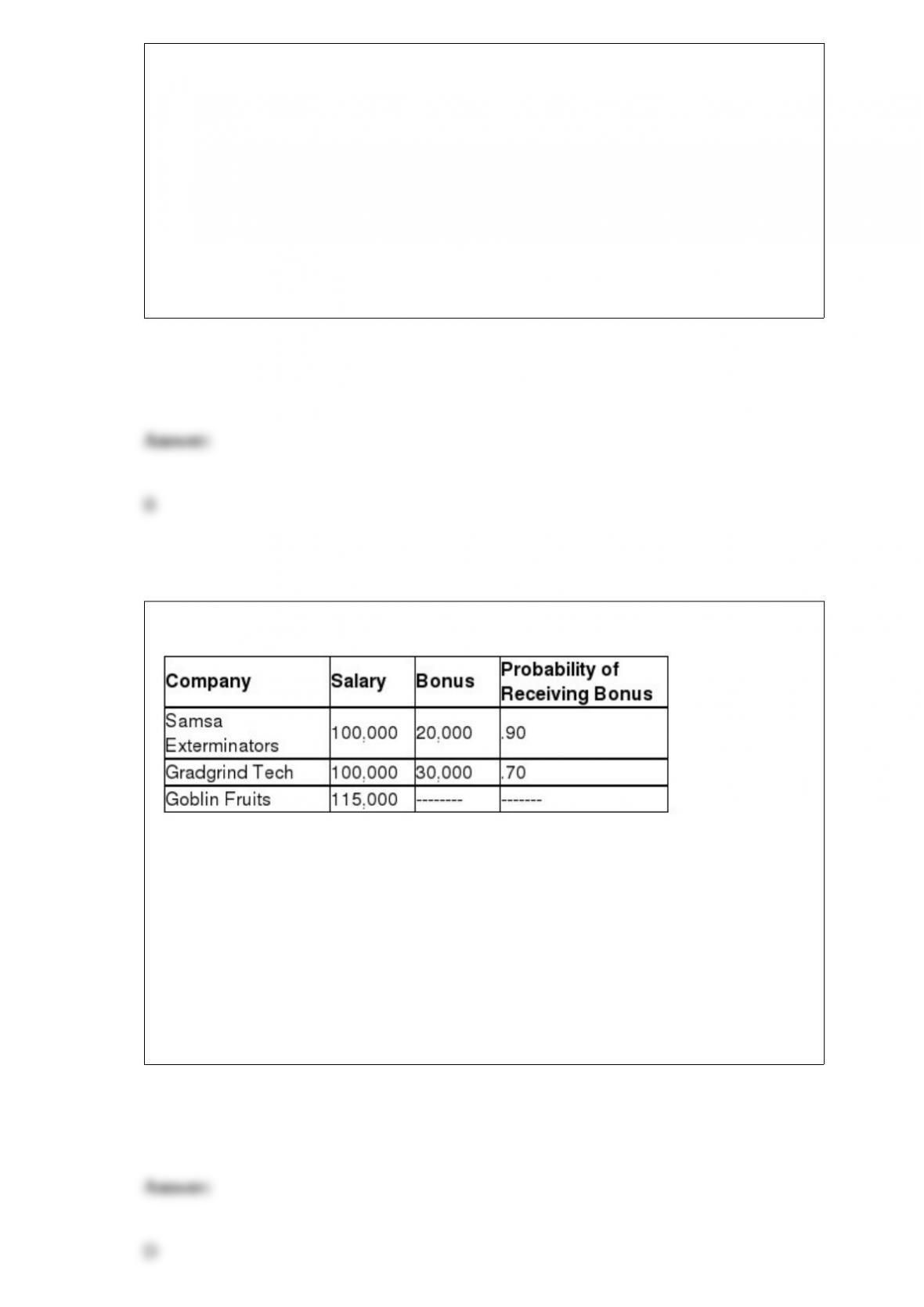
Upon graduation, you are offered three jobs.
Which of the following is true?
A) If you’re risk-neutral, you go work for Goblin Fruits.
B) If you’re risk-loving, you go work for Goblin Fruits.
C) If you’re risk-neutral, you go work for Samsa Exterminators.
D) If you’re risk-neutral, you go work for Gradgrind Tech.
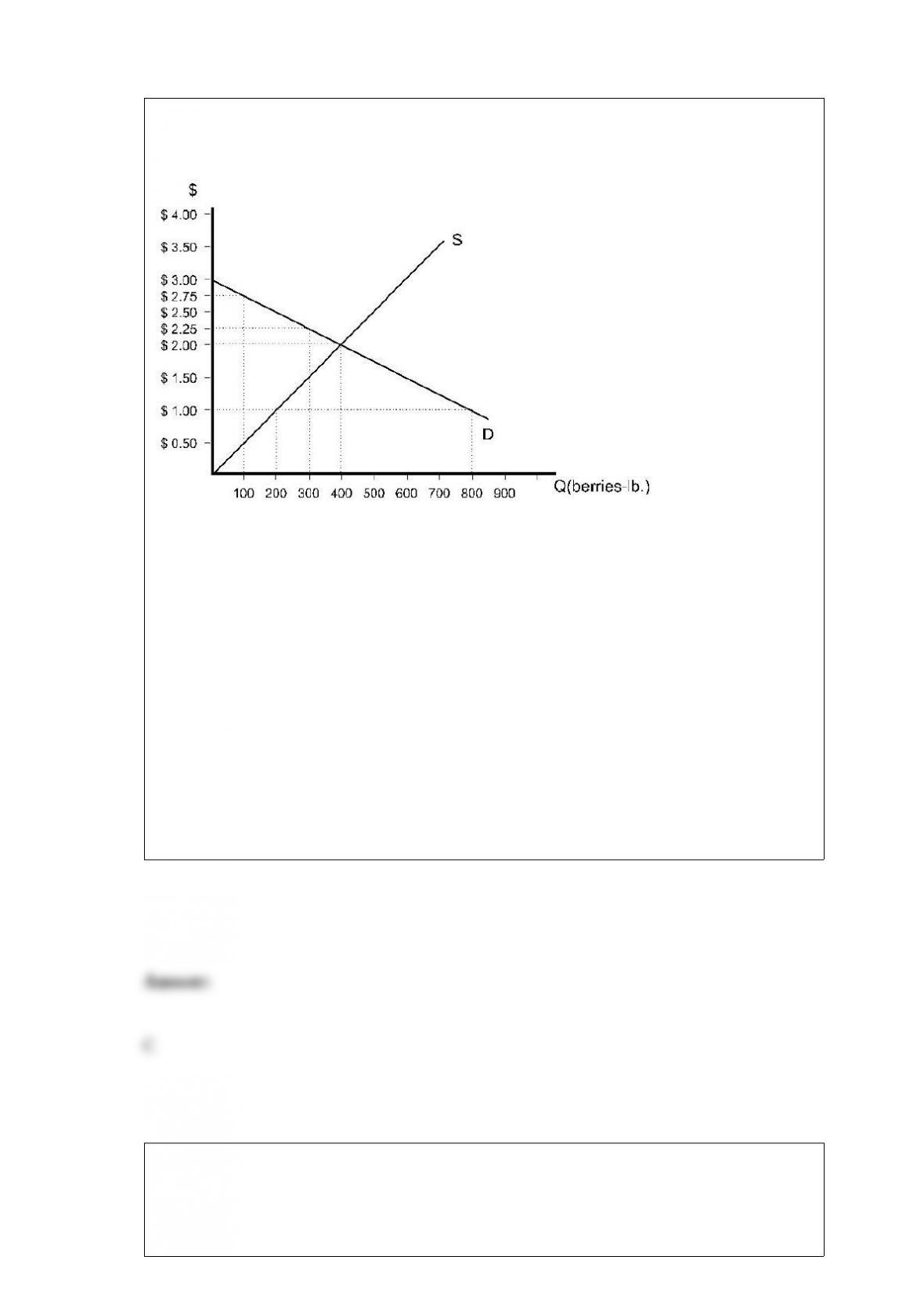
Figure 9.5
Refer to Figure 9.5. If the government establishes a price floor of $2.50 and farmers
grow only the amount of berries that will be sold, total consumer and producer surplus
will be
A) $1.50.
B) $300.
C) $450.
D) $500.
E) $600.
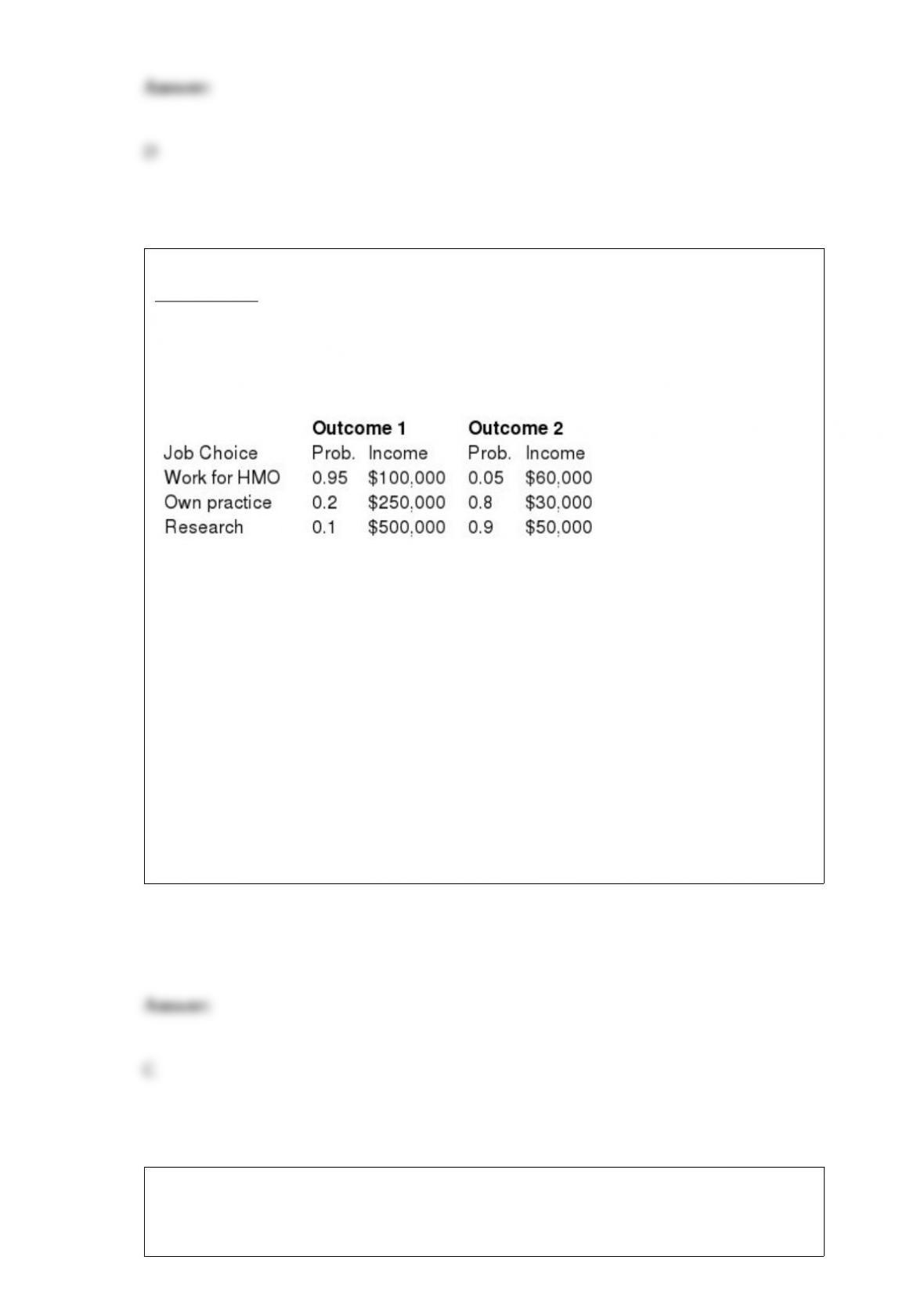
The information in the table below describes choices for a new doctor. The outcomes
represent different macroeconomic environments, which the individual cannot predict.
Table 5.3

Refer to Table 5.3. The expected returns are highest for the physician who
A) works for an HMO.
B) opens her own practice.
C) does research.
D) either opens her own practice or does research.
E) either works for an HMO or does research.
DVDs can be produced at a constant marginal cost of $10 per disk, and Roaring Lion
Studios is releasing the DVDs for its last two major films. The DVD for Rambeau 17 is
priced at $20 per disk, and the DVD for Schreck 10 is priced at $30 per disk. What are
the Lerner indices for these two movies?
A) Both equal one.
B) 2 and 3, respectively
C) 5 and 0.67, respectively
D) 1 and 2, respectively

Roaring Lion Studios can produce DVDs at a constant marginal cost of $5 per disk, and
the studio has just releasing the DVD for its latest hit film, Ernest Goes to the
Hamptons. The retail price of the DVD is $25, and the elasticity of demand for this film
is -2. Has the studio selected the profit-maximizing retail price for this DVD?
A) Yes
B) No, the retail price is too low
C) No, the retail price is too high
D) We do not have enough information to answer this question.
What happens if price falls below the market clearing price?
A) Demand shifts out.
B) Supply shifts in.
C) Quantity demanded decreases, quantity supplied increases, and price falls.
D) Quantity demanded increases, quantity supplied decreases, and price rises.

If the interest rate is 10%, the present value of $1 next year is
A) $1.20.
B) $1.10
C) 91 cents.
D) 10 cents.
E) 9 cents.
Under the kinked demand curve model, a small increase in marginal cost will lead to
A) an increase in output level and a decrease in price.
B) a decrease in output level and an increase in price.
C) a decrease in output level and no change in price.
D) neither a change in output level nor a change in price.
The monopolist has no supply curve because
A) the quantity supplied at any particular price depends on the monopolist’s demand
curve.
B) the monopolist’s marginal cost curve changes considerably over time.
C) the relationship between price and quantity depends on both marginal cost and
average cost.
D) there is a single seller in the market.
E) although there is only a single seller at the current price, it is impossible to know
how many sellers would be in the market at higher prices.
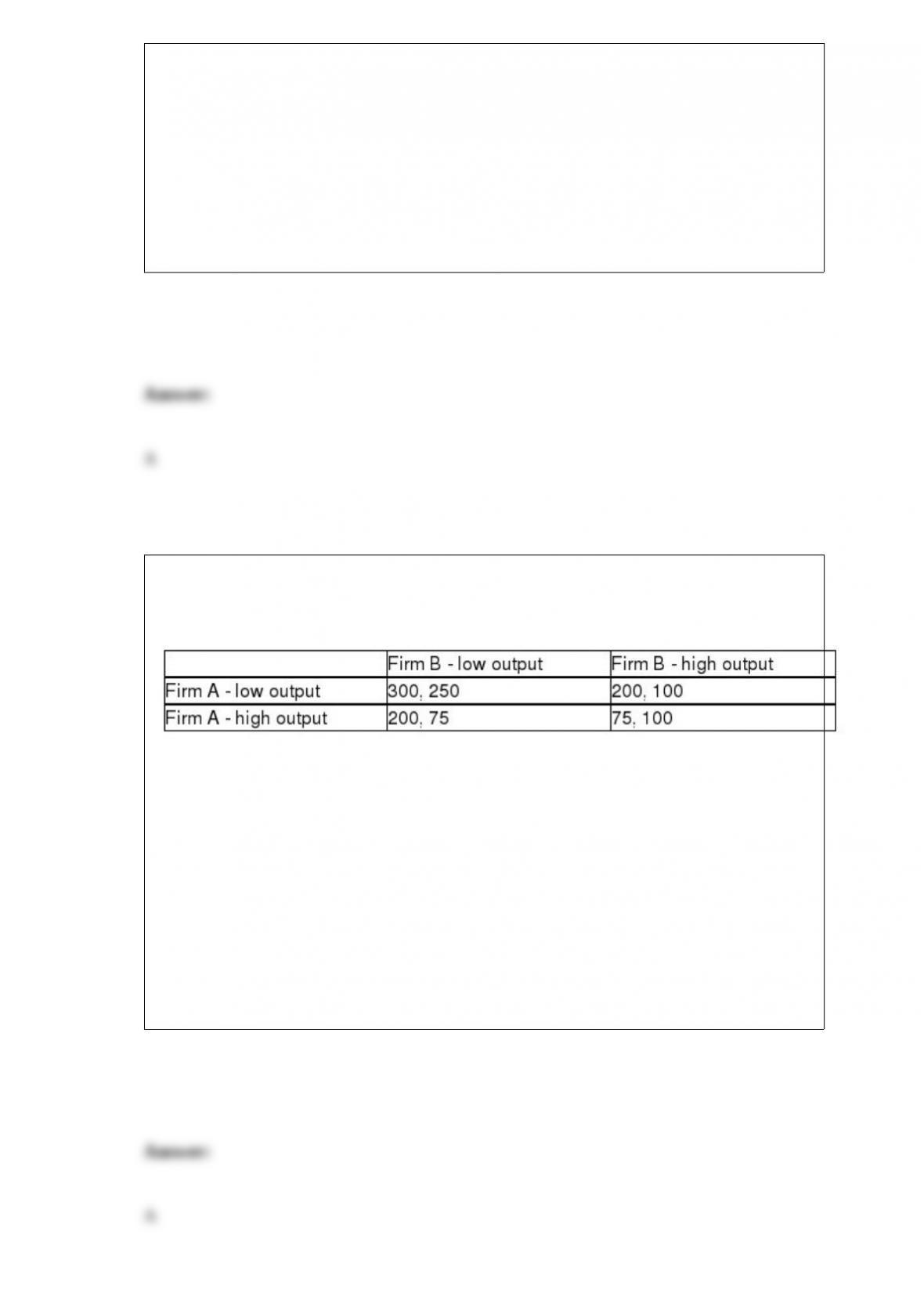
Consider the following game in which two firms decide how much of a homogeneous
good to produce. The annual profit payoffs for each firm are stated in the cell of the
game matrix, and Firm A’s payoffs appear first in the payoff pairs:
What is the Nash equilibrium for this game?
A) Both firms producer low levels of output
B) Both firms produce high levels of output
C) Firm A produces low levels of output, and Firm B produces high output.
D) Firm A produces high levels of output, and Firm B produces low output.
E) There is more than one Nash equilibrium for this game
The slope of the budget line, faced by an investor deciding what percentage of her
portfolio to place in a risky asset, increases when the
A) standard deviation of the portfolio gets smaller.
B) standard deviation of the risky asset gets larger.
C) rate of return on the risk-free asset gets larger.
D) rate of return on the risky asset gets larger.
E) rate of return on money gets larger.
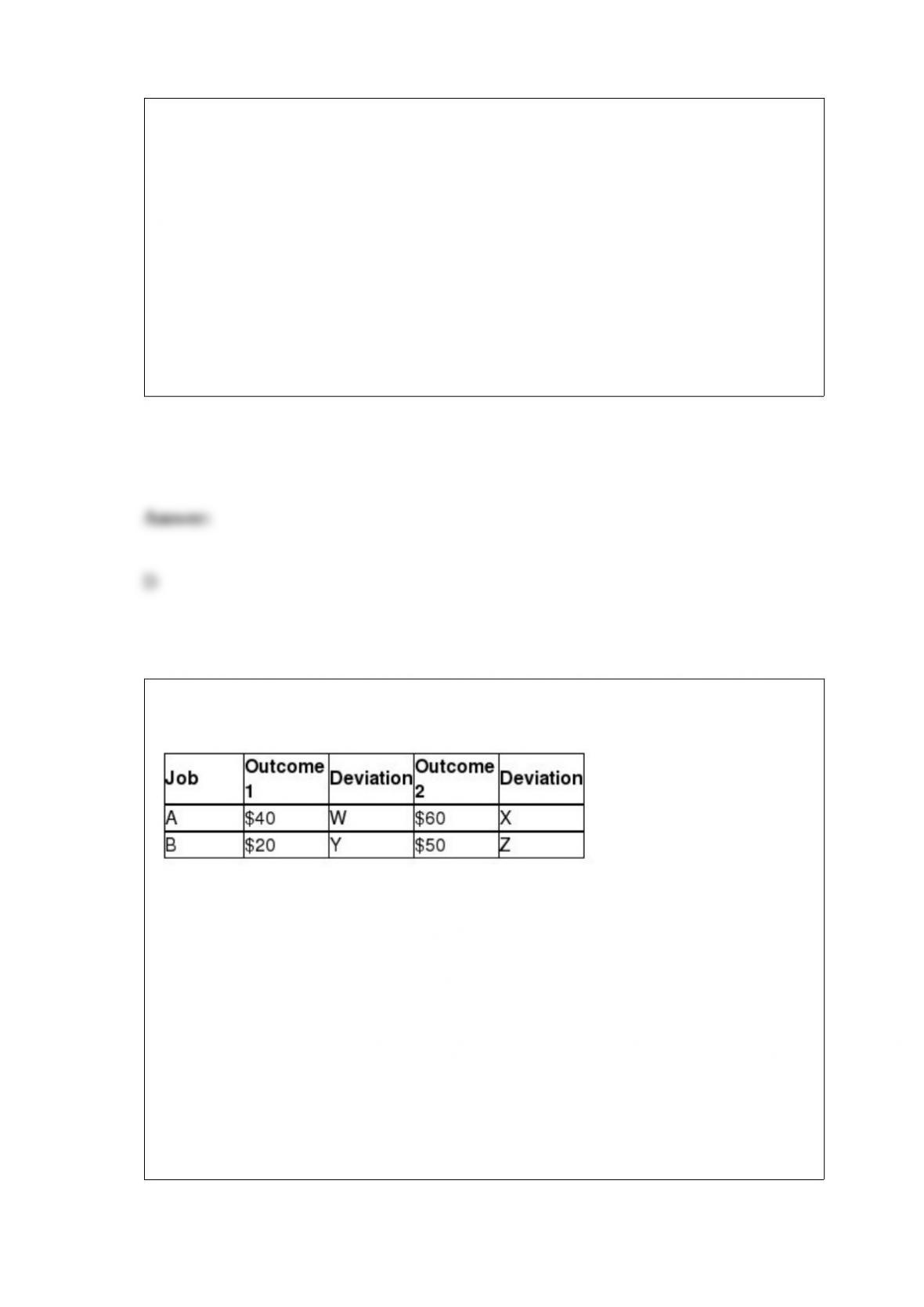
Table 5.4
Refer to Table 5.4. If at Job B the $20 outcome occurs with probability .2, and the $50
outcome occurs with probability .8, then in absolute value
A) Y = Z = $6.
B) Y = Z = $24.
C) Y = Z = $35.
D) Y = $24; Z = $6.
E) Y = $6; Z = $24.
Scenario 5.6:
Consider the information in the table below, describing choices for a new doctor. The
outcomes represent different macroeconomic environments, which the individual
cannot predict.
Refer to Scenario 5.6. If the doctor is risk-averse, she would accept
A) $50,000 for sure rather than take the risk of being a researcher.
B) $60,000 for sure (the minimum HMO outcome) rather than take the risk of being a
researcher.
C) $95,000 for sure rather than face option 1 and option 2 in research.
D) $275,000 for sure (the average of option 1 and option 2 in research), but not less,
rather than face the risk of those two options.
E) the research position because it has the highest possible income.
A person with a diminishing marginal utility of income
A) will be risk averse.

B) will be risk neutral.
C) will be risk loving.
D) cannot decide without more information
The law of diminishing returns applies to
A) the short run only.
B) the long run only.
C) both the short and the long run.
D) neither the short nor the long run.
E) all inputs, with no reference to the time period.
Theodore’s budget line has changed from A to B. Which of the following explains the
change in Theodore’s budget line?
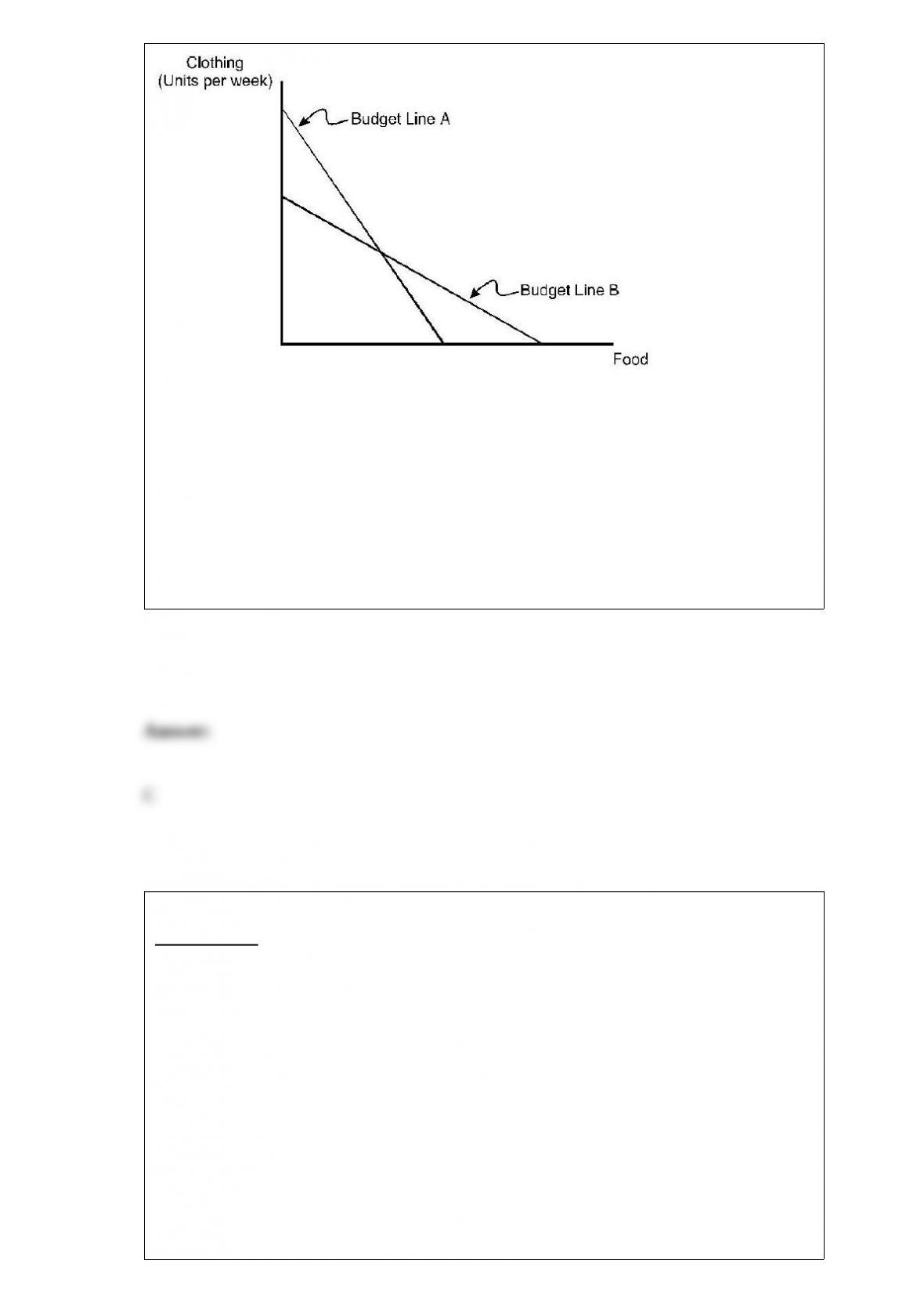
A) The price of food and the price of clothing increased.
B) The price of food increased, and the price of clothing decreased.
C) The price of food decreased, and the price of clothing increased.
D) The price of food and the price of clothing decreased.
E) none of the above
Scenario 5.5:
Engineers at Jalopy Automotive have discovered a safety flaw in their new model car. It
would cost $500 per car to fix the flaw, and 10,000 cars have been sold. The company
works out the following possible scenarios for what might happen if the car is not fixed,
and assigns probabilities to those events:
Scenario Probability Cost
A. No one discovers flaw .15 $0
B. Government fines firm .40 $10 million
(no lawsuits)

C. Resulting lawsuits are lost .30 $12 million
(no government fine)
D. Resulting lawsuits are won .15 $2 million
(no government fine)
Refer to Scenario 5.5. Which of the following statements is true?
A) The expected cost of not fixing the car is less than the cost of fixing it.
B) The expected cost of not fixing the car is greater than the cost of fixing it.
C) It is not possible to tell whether the expected cost of fixing the car is less than the
cost of fixing it, because the probabilities are subjective.
D) It is not possible to tell whether the expected cost of fixing the car is less than the
cost of fixing it, because the probabilities are not equal.
Halifax & Smyth (H&S) is a clothier that specializes in expensive men’s suits, and the
firm makes the suits from wool fabrics that are woven by one of the firm’s divisions.
This division is not the only source for this material, and H&S could buy or sell wool
fabric in the outside competitive market. H&S will buy some of the wool fabric that it
needs for suits from the outside market if the:
A) market price is less than the optimal transfer price if the outside market did not exist.
B) market price is less than the point where the net marginal revenue of weaving wool
fabric intersects the marginal cost of wool fabric.
C) market price is less than the point where the net marginal revenue of assembling
men’s suits intersects the marginal cost of assembly.
D) Both A and B are correct.

In a perfectly competitive market:
A) there are a few buyers.
B) there is a single seller.
C) there is a cartel.
D) no single buyer or seller can significantly affect the market price.
Natasha derives utility from attending rock concerts (r) and from drinking colas (c) as
follows:
U(c,r) = c.9r.1
The marginal utility of cola (MUc) and the marginal utility of rock concerts (MUr) are
given as follows:
MUc = .9c-.1r.1 MUr = .1c.9r-.9
a. If the price of cola (Pc) is $1 and the price of concert tickets (Pr) is $30 and Natasha’s
income is $300, how many colas and tickets should Natasha buy to maximize utility?
b. Suppose that the promoters of rock concerts require each fan to buy 4 tickets or none
at all. Under this constraint and given the prices and income in (a), how many colas and
tickets should Natasha buy to maximize utility?
c. Is Natasha better off under the conditions in (a) or (b)? Explain your answer.
The local cable TV company charges a “hook-up” fee of $30 per month. Customers can
then watch programs on a “pay-per-view” basis (a fee is charged for every program
watched). This is an example of
A) peak-load pricing.
B) second-degree price discrimination.
C) a two-part tariff.
D) intertemporal price discrimination.
E) none of the above

Deadweight loss from monopoly power is expressed on a graph as the area between the
A) competitive price and the average revenue curve bounded by the quantities produced
by the competitive and monopoly markets.
B) competitive price line and the marginal cost curve bounded by the quantities
produced by competitive and monopoly markets.
C) competitive price line and the monopoly price line bounded by zero output and the
output chosen by the monopolist.
D) average revenue curve and the marginal cost curve bounded by the quantities
produced by competitive and monopoly markets.
Use the following statements to answer this question:
I. Subjective probabilities are based on individual perceptions about the relative
likelihood of an event.
II. To be useful in microeconomic analysis, all interested parties should agree on the
values of the relevant subjective probabilities for a particular problem.
A) I and II are true.
B) I is true and II is false.
C) II is true and I is false.

D) I and II are false.
Suppose a labor market has perfectly inelastic supply that is composed of union and
non-union workers, and both groups of workers initially earn the perfectly competitive
wage. What happens to the equilibrium employment level and wage for union workers
if the union exercises its bargaining power?
A) Both increase.
B) Employment increases and wage declines.
C) Wage increases and employment declines.
D) Both decline.
Menell’s study showed that in terms of effectiveness,
A) mandatory separation of recyclables was best, followed by curbside charges and
finally refundable deposits.
B) mandatory separation of recyclables was best, followed by refundable deposits and
finally curbside charges.
C) curbside charges were best, followed by refundable deposits and finally mandatory
separation of recyclables.
D) curbside charges were best, followed by mandatory separation of recyclables and

finally refundable deposits.
E) refundable deposits were best, followed by curbside charges and finally mandatory
separation of recyclables.
Over the next few years, several newly constructed office blocks will become available
at the World Trade Center site. As well, economists expect the New York economy will
continue to exhibit modest growth. What is the expected outcome for the office space
market in downtown Manhattan?
A) Unambiguously higher equilibrium rental rates and quantity
B) Unambiguously lower equilibrium rental rates and quantity
C) Unambiguously higher rental rates, and equilibrium quantity could be higher or
lower
D) Unambiguously higher equilibrium quantity, and equilibrium rental rates could be
higher or lower
Consider a graph on which one good Y is on the vertical axis and the only other good X
is on the horizontal axis. On this graph the income-consumption curve has a positive
slope for low incomes, then it takes a zero slope for a higher income, and then it takes a
negative slope for even higher incomes (the curve looks like an arc, first rising and then
falling as income increases). This curve illustrates that, for all income levels,
A) both X and Y are normal.

B) only Y is normal.
C) both X and Y are inferior.
D) only X is normal.
A risk-averse individual has
A) an increasing marginal utility of income.
B) an increasing marginal utility of risk.
C) a diminishing marginal utility of income.
D) a diminishing marginal utility of risk.
E) a constant marginal utility of income, but a diminishing marginal utility of risk.
A pricing strategy that requires consumers pay an up-front fee plus an additional fee for
each unit of product purchased is a
A) tying contract.
B) two-part tariff.
C) form of perfect price discrimination.

D) none of these.
Suppose the supply and demand of land for natural gas extraction are imperfectly
elastic. Given that coal is a potential substitute for natural gas in energy applications, a
change in the price of coal may shift the demand curve for natural gas. What happens to
the economic rents assigned to land on which natural gas is extracted if the price of coal
declines?
A) Rents increase
B) Rents are positive and remain unchanged
C) Rents decrease
D) Rents are zero before and after the change
Consider a particular market-clearing price and quantity under a perfectly competitive
equilibrium. As the demand curve at this point becomes more inelastic, the consumer
surplus in the market tends to:
A) increase.
B) decrease.
C) remain the same.

D) We do not have enough information to answer this question.