
A corporation’s earnings are the amount of revenue it receives for the sale of its
products
a. minus its cost of production as measured by its accountants. Earnings must be paid
out as dividends.
b. minus its cost of production as measured by its accountants. Earnings may be paid
out as dividends or retained by the corporation.
c. minus its direct and indirect costs as measured by its economists. Earnings must be
paid out as dividends.
d. minus its direct and indirect cost as measure by its economists. Earnings may be paid
out as dividends or retained by the corporation.
Which of the following changes would decrease the present value of a future payment?
a. an increase in the size of the payment
b. an increase in the time until the payment is made
c. a decrease in the interest rate
d. All of the above are correct.
The production possibilities frontier is a graph that shows the various combinations of
outputs that the economy can possibly produce given the available factors of production

and the available production technology.
a. True
b. False
When the value of money is on the vertical axis, the money supply curve slopes upward
because an increase in the value of money induces banks to create more money.
a. True
b. False
Suppose a country has a consumption tax that is similar to a state sales tax. If its
government were to eliminate the consumption tax and replace it with an income tax
that includes an income tax on interest from savings, what would happen?
a. There would be no change in the interest rate or saving.
b. The interest rate would decrease and saving would increase.
c. The interest rate would increase and saving would decrease.
d. None of the above is correct.

Trade can benefit everyone in society because it allows people to specialize in activities
in which they have a comparative advantage.
a. True
b. False
In the circular-flow diagram, firms consume all the goods and services that they
produce.
a. True
b. False
One way to express the classical idea of monetary neutrality is to draw
a. a downward-sloping short-run Phillips curve.

b. an upward-sloping short-run Phillips curve.
c. a downward-sloping long-run Phillips curve.
d. a vertical long-run Phillips curve.
Jennifer lives in a home that was newly constructed in 2011 for which she paid
$240,000. In 2014 she sold the house for $260,000. Which of the following statements
is correct regarding the sale of the house?
a. The 2014 sale increased 2014 GDP by $260,000 and had no effect on 2011 GDP.
b. The 2014 sale increased 2014 GDP by $20,000 and had no effect on 2011 GDP.
c. The 2014 sale increased 2014 GDP by $260,000; furthermore, the 2014 sale caused
2011 GDP to be revised upward by $20,000.
d. The 2014 sale affected neither 2014 GDP nor 2011 GDP.
Table 28-2
Labor Data for Aridia

RefetoTable28-2.The labor-force participation rate of Aridia in 2010 was
a. 70%.
b. 77.8%.
c. 80%.
d. 87.5%.
Paul Samuelson, a famous economist, said that
a. “the bond market has predicted zero out of the past nine recessions.”
b. “the stock market has predicted zero out of the past nine recessions.”
c. “the bond market has predicted nine out of the past five recessions.”
d. “the stock market has predicted nine out of the past five recessions.”
In the short run, which of the following rates of growth in the money supply is likely to
lead to the highest level of unemployment in the economy?
a. 1 percent per year
b. 2 percent per year

c. 3 percent per year
d. 4 percent per year
A double coincidence of wants
a. is required when there is no item in an economy that is widely accepted in exchange
for goods and services.
b. is required in an economy that relies on barter.
c. is a hindrance to the allocation of resources when it is required for trade.
d. All of the above are correct.
When a country experiences capital flight, which of the following rise?
a. its real interest rate and its real exchange rate
b. its real interest rate but not its real exchange rate
c. its real exchange rate but not its real interest rate
d. neither its real interest rate nor its foreign exchange rate

Three years ago Dawn put $1,200 into an account paying 2 percent interest. How much
is Dawn’s account worth today?
a. $1,225.38
b. $1,248.48
c. $1,264.72
d. $1,273.45
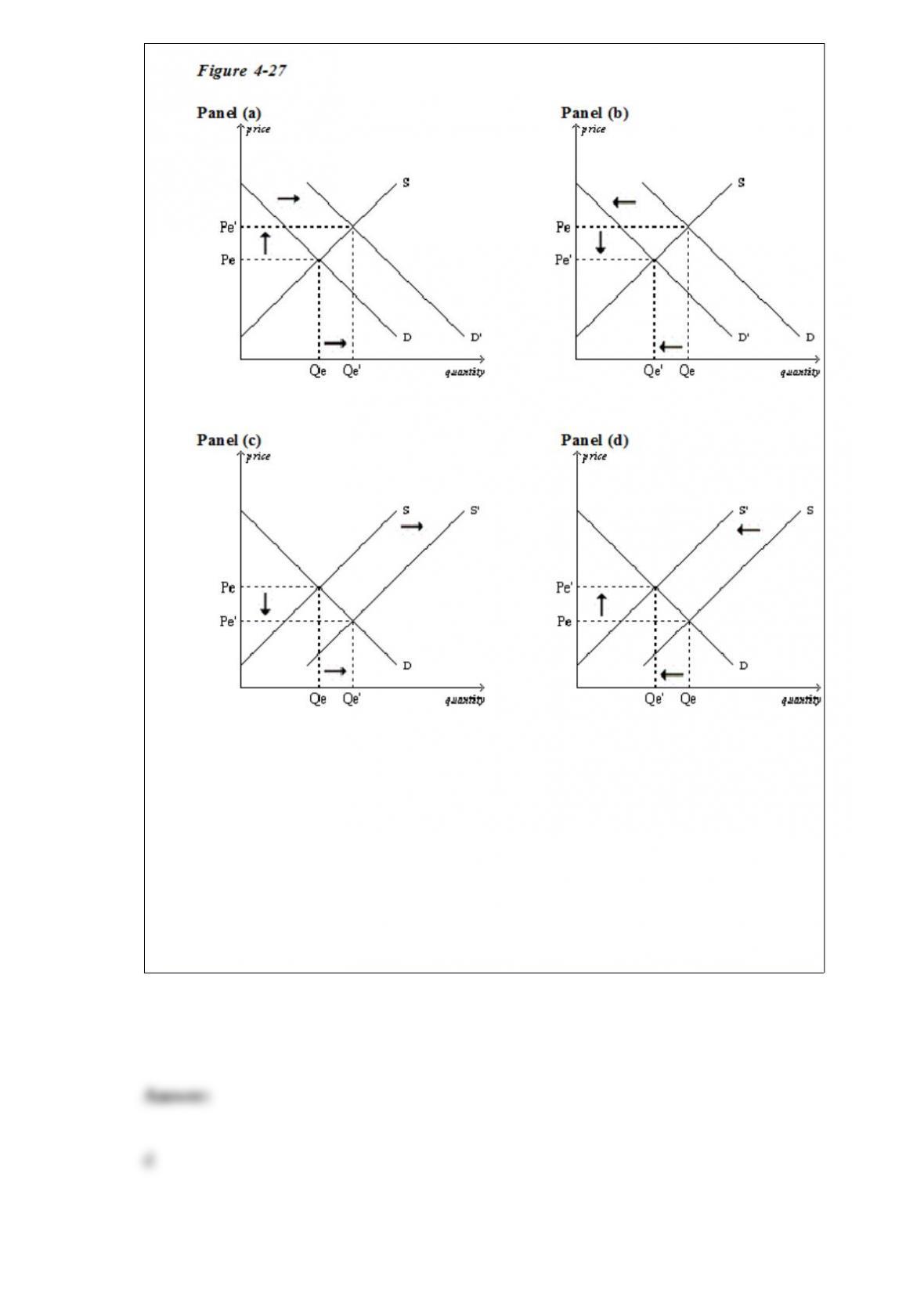
RefertoFigure4-27. Which of the four panels represents the market for peanut butter
after a major hurricane hits the peanut-growing south?
a. Panel (a)
b. Panel (b)
c. Panel (c)
d. Panel (d)

Initially, the economy is in long-run equilibrium. Aggregate demand then shifts leftward
by $50 billion. The government wants to increase its spending in order to avoid a
recession. If the crowding-out effect is always one- third as strong as the multiplier
effect, and if the MPCequals 0.6, then by how much do government purchases have to
increase in order to offset the $50 billion leftward shift?
a. by $90 billion
b. by $60 billion
c. by $20 billion
d. by $30 billion
A central bank sets out to reduce unemployment by changing the money supply growth
rate. The long-run Phillips curve shows that in comparison to their original rates, this
policy will eventually lead to
a. an increase in both the inflation rate and the unemployment rate.
b. an increase in the inflation rate and a reduction in the unemployment rate.
c. no change in either the inflation rate or the unemployment rate.
d. an increase in the inflation rate and no change in the unemployment rate.
If the exchange rate is .60 British pounds = $1, a bottle of ale that costs 3 pounds costs

a. $1.80.
b. $4.80.
c. $5.
d. None of the above is correct.
The reserve ratio is 10 percent, banks do not hold excess reserves, and people hold only
deposits and no currency. When the Fed sells $20 million worth of bonds to the public,
bank reserves
a. increase by $20 million and the money supply eventually increases by $20 million.
b. increase by $20 million and the money supply eventually increases by $200 million.
c. decrease by $2 million and the money supply eventually increases by $20 million.
d. decrease by $20 million and the money supply eventually decreases by $200 million.
Suppose you will receive $500 at some point in the future. If the annual interest rate is
7.5 percent, then the present value of the $500 is
a. $411.26 if the $500 is to be received in 5 years and $338.95 if the $500 is to be
received in 10 years.

b. $348.28 if the $500 is to be received in 5 years and $242.60 if the $500 is to be
received in 10 years.
c. $291.11 if the $500 is to be received in 5 years and $272.89 if the $500 is to be
received in 10 years.
d. $291.11 if the $500 is to be received in 5 years and $236.49 if the $500 is to be
received in 10 years.
Over the past two decades, the U.S. has persistently exported more goods and services
than it has imported.
a. True
b. False
Bob deposits $100 in a bank account that pays an annual interest rate of 5 percent. A
year later, Bob withdraws his $105. If inflation was 7 percent during the year the money
was deposited, then Bob’s purchasing power has increased by 2 percent.
a. True
b. False
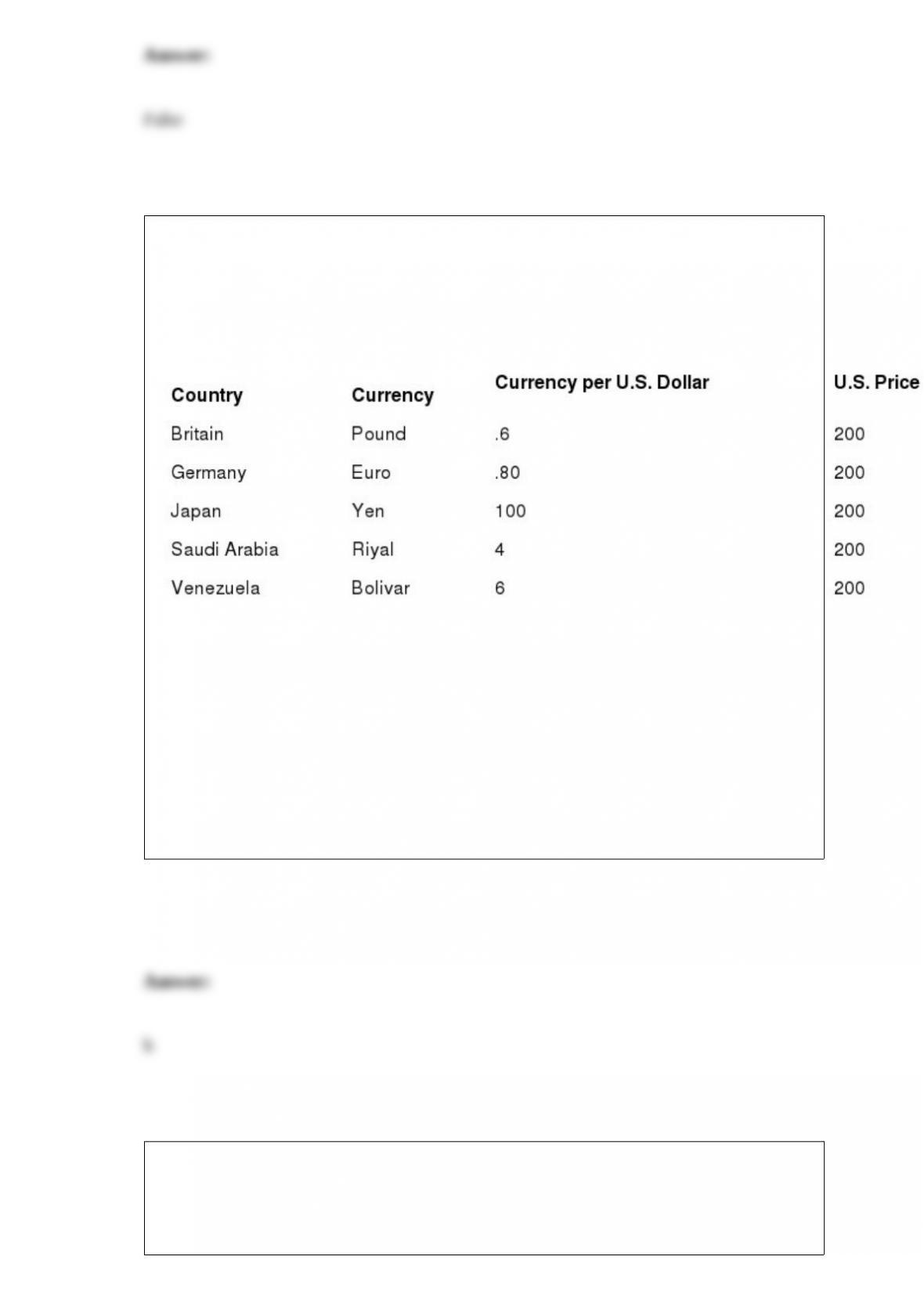
Table31-2
RefertoTable31-2. In real terms, U.S. goods are less expensive than goods in which
country(ies)?
a. Britain and Japan
b. Germany and Saudi Arabia
c. Germany and Venezuela
d. Japan
When a society decides to increase its quantity of physical capital, the society
a. can avoid the usual need to face trade-offs.

b. is apparently not very concerned about its rate of economic growth in the future.
c. is in effect deciding to consume fewer goods and services in the present.
d. is in effect deciding to save less of its current income in the present.
Which of the following shifts aggregate demand to the right?
a. the Federal Reserve buys bonds.
b. a decrease in net exports due to something other than a change in domestic prices.
c. an increase in household saving.
d. All of the above are correct.
Figure 3-7
Refer to Figure3-7. If Bintu and Juba both spend all of their time making bowls, then
total production is
a. 2 bowls.
b. 3 bowls.
c. 4 bowls.

d. 6 bowls.
In 2010, the typical Bangladeshi had about
a. less than half the real income of a typical American a century ago.
b. about the same real income of a typical American a century ago.
c. 2 times as much real income as that of a typical American a century ago.
d. 4 times as much real income as that of a typical American a century ago.
If P= 2 and Y= 1000, then which of the following pairs of values are possible?
a. M=$500,V=4.
b. M= $250, V= 8.
c. M= $1,000, V= 2.
d. All of the above are correct.

Suppose that the adult population is 6 million, the number of employed is 3.8 million,
and the labor-force participation rate is 70%. What is the unemployment rate?
a. 6.7%
b. 9.5%
c. 10.5%
d. 28%
Which costs of inflation could the government take action to reduce without reducing
inflation?
a. shoeleather costs
b. unintended changes in tax liabilities
c. menu costs
d. none of the above is correct.

John, a U.S. citizen, opens up a Sports bar in Tokyo. This is an example of U.S.
a. exports.
b. imports.
c. foreign portfolio investment.
d. foreign direct investment.