In the circular flow model, households supply resources such as labor services in the
product market.
Some researchers have been unable to find evidence of increasing returns to human
capital.
If net exports are positive for China, it must be true that China is experiencing net
outflows of capital.
If at a price of $10, a vendor sells 5 units of a product and at a price of $8, 6 units are
sold, then, using the midpoint formula, the demand for this good is inelastic.
The equilibrium in the prisoner’s dilemma is a dominant strategy Nash equilibrium.
The majority of the federal government debt is held by government agencies.
The inflation rate measures the average prices of goods and services in the economy.
A profit-maximizing monopoly produces a lower output level than would be produced
if the
industry was perfectly competitive.

Dumping refers to countries exporting unwanted and inferior products to other
countries.
In a small Asian country, it is estimated that changing the level of capital from $8
million to $12 million will increase real GDP from $4 million to $6 million. What level
of GDP would you expect the economy to be able to reach if spending on capital
continued to rise to $16 million, assuming no technological change and no change in
the hours of work?
A) GDP would increase further, but by less than $2 million.
B) GDP would increase further by exactly $2 million.
C) GDP would increase further by more than $2 million
D) GDP would increase further by exactly $8 million.
Investment, as defined by economists, would include the purchase of a
A) corporate bond.
B) government bond.
C) share of stock in ExxonMobil.
D) computer by an accounting firm.

According to real business cycle models,
A) the long-run Phillips curve is negatively sloped.
B) the economy is normally operating below the natural rate of unemployment.
C) unexpected changes in monetary policy are the major source of fluctuations in real
GDP.
D) the economy is normally at potential GDP.
If whole tomatoes were money, which of the following functions of money would be
the hardest for tomatoes to satisfy?
A) unit of account
B) store of value
C) certificate of gold
D) medium of exchange

The decision about what goods and services will be produced made in a market
economy is made by
A) lawmakers in the government voting on what will be produced.
B) workers deciding to produce only what the boss says must be produced.
C) producers deciding what society wants most.
D) consumers and firms choosing which goods and services to buy or produce.
E) consumers dictating to firms what they need most.
A grocery store sells a bag of potatoes at a fixed price of $2.30. Which of the following
is a term used by economists to describe the money received from the sale of an
additional bag of potatoes?
A) marginal revenue
B) gross earnings
C) pure profit
D) marginal costs
E) net benefit
During World War II, prisoners of war used ________ as money.
A) bullets

B) cowrie shells
C) chocolate
D) cigarettes
Which of the following parties is likely to have the most information about the health of
an individual who is trying to purchase a health insurance policy?
A) the company that issues the health insurance policy
B) the individual who is applying for the health insurance policy
C) the employer of the individual who is trying to purchase the health insurance policy
D) All parties in the health insurance market have access to the same level of
information.
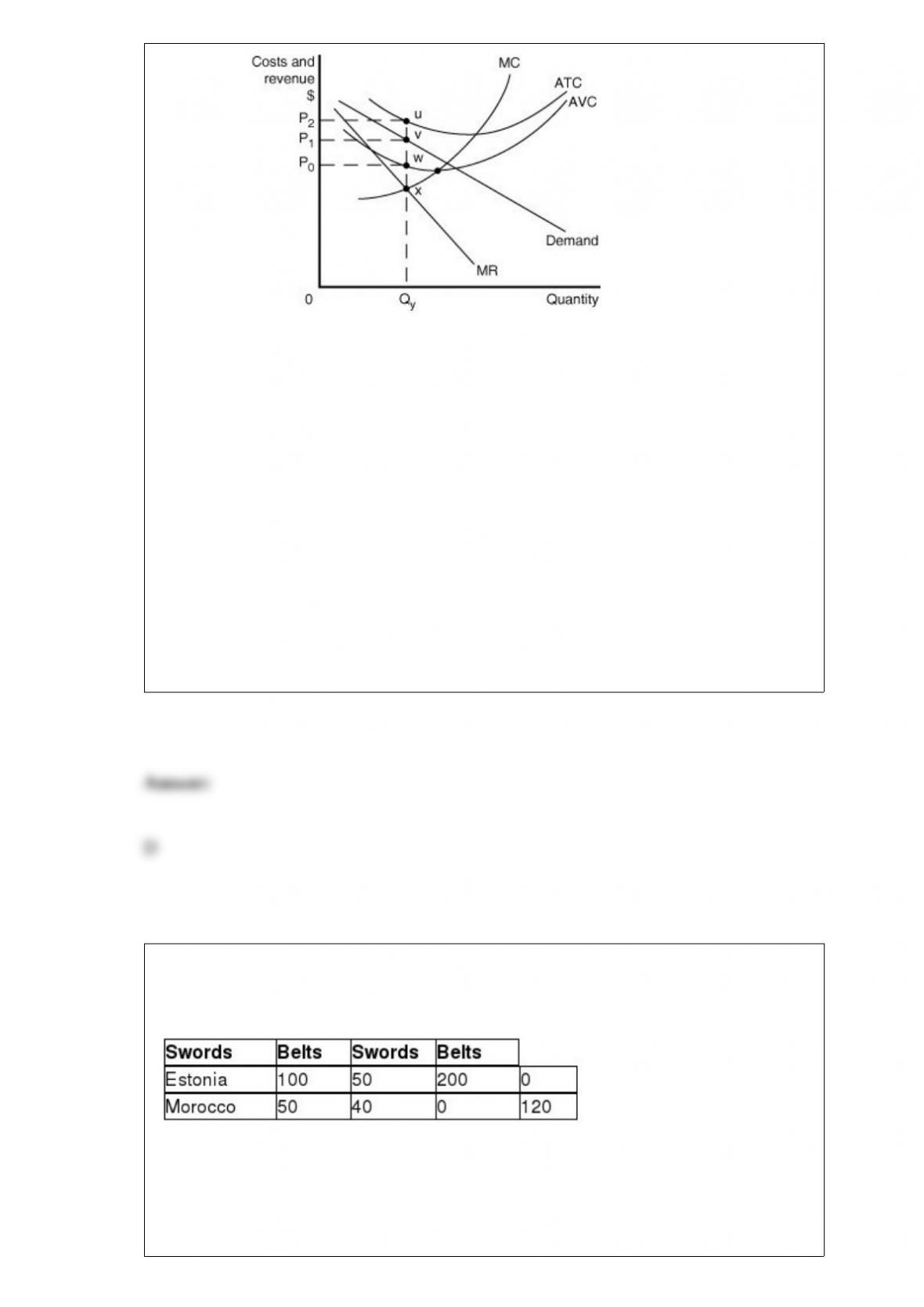
Figure 13-7 Figure 13-7 shows
short-run cost and demand curves for a monopolistically competitive firm in the
footwear market. Which of the following statements describes the best course of action
for the firm depicted in the diagram?
A) The firm should exit the industry because its price is less than its average total cost.
B) The firm should minimize its losses by producing Qy units and charging a price of
P0.
C) The firm should minimize its losses by producing Qy units and charging a price of
P2.
D) The firm should minimize its losses by producing Qy units and charging a price of
P1.
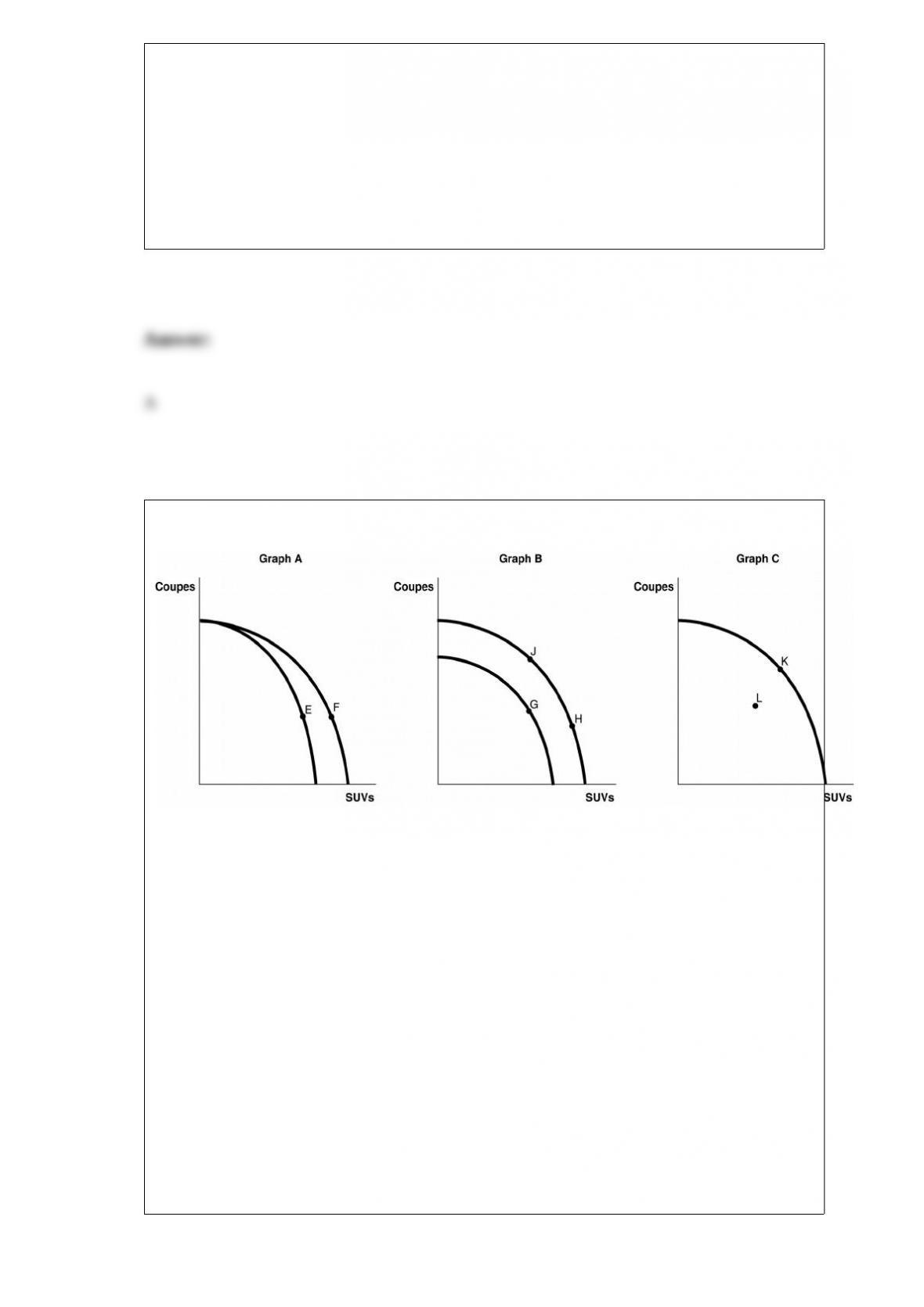
Table 9-12 Production and
Consumption Production
Without Trade With Trade
Estonia and Morocco can produce both swords and belts. Table 9-12 shows the
production and consumption quantities without trade, and the production numbers with
trade.
Which country has a comparative advantage in producing swords?
A) Estonia
B) Morocco
C) both countries
D) neither country
Figure 2-11
Mercedes Benz produces a full line of luxury automobiles, including coupes, sedans,
and SUVs, at a variety of manufacturing plants across the globe. Assume Mercedes
Benz produces both coupes and SUVs at its Tuscaloosa, Alabama factory. Figure 2-11
shows changes to its production possibilities frontier in response to new developments
and Different strategic production decisions at this factory.
Suppose worker productivity increases so that the total number of vehicles produced
increases as the company adds more machinery, workers and changes the layout of the
factory. This is best represented by the
A) movement from E to F in Graph A.
B) movement from G to H in Graph B.
C) movement from K to L in Graph C.
D) movement from J to H in Graph B.

The federal corporate income tax is
A) regressive.
B) proportional.
C) progressive.
D) unfair.
Which of the following would explain why economic profit might be less than
accounting profit?
A) A firm’s net income is less than its accounting profit.
B) A firm has only explicit costs.
C) A firm’s net income is greater than its accounting profit.
D) A firm has implicit costs as well as explicit costs.
Explain why you would rather be a borrower during a period of unexpected rising
inflation, and a lender during a period of unexpected declining inflation.
What are the key factors that determine the profitability of a firm in a monopolistically
competitive market?
What is a centrally planned economy?
How does a decrease in the tax rate on income earned on saving affect saving,
investment, the interest rate, and economic growth?
How does a public good differ from a quasi-public good? In your answer give an
example of each type of good.

Explain how mandatory seat belt laws may reduce the negative externalities of risky
behavior.