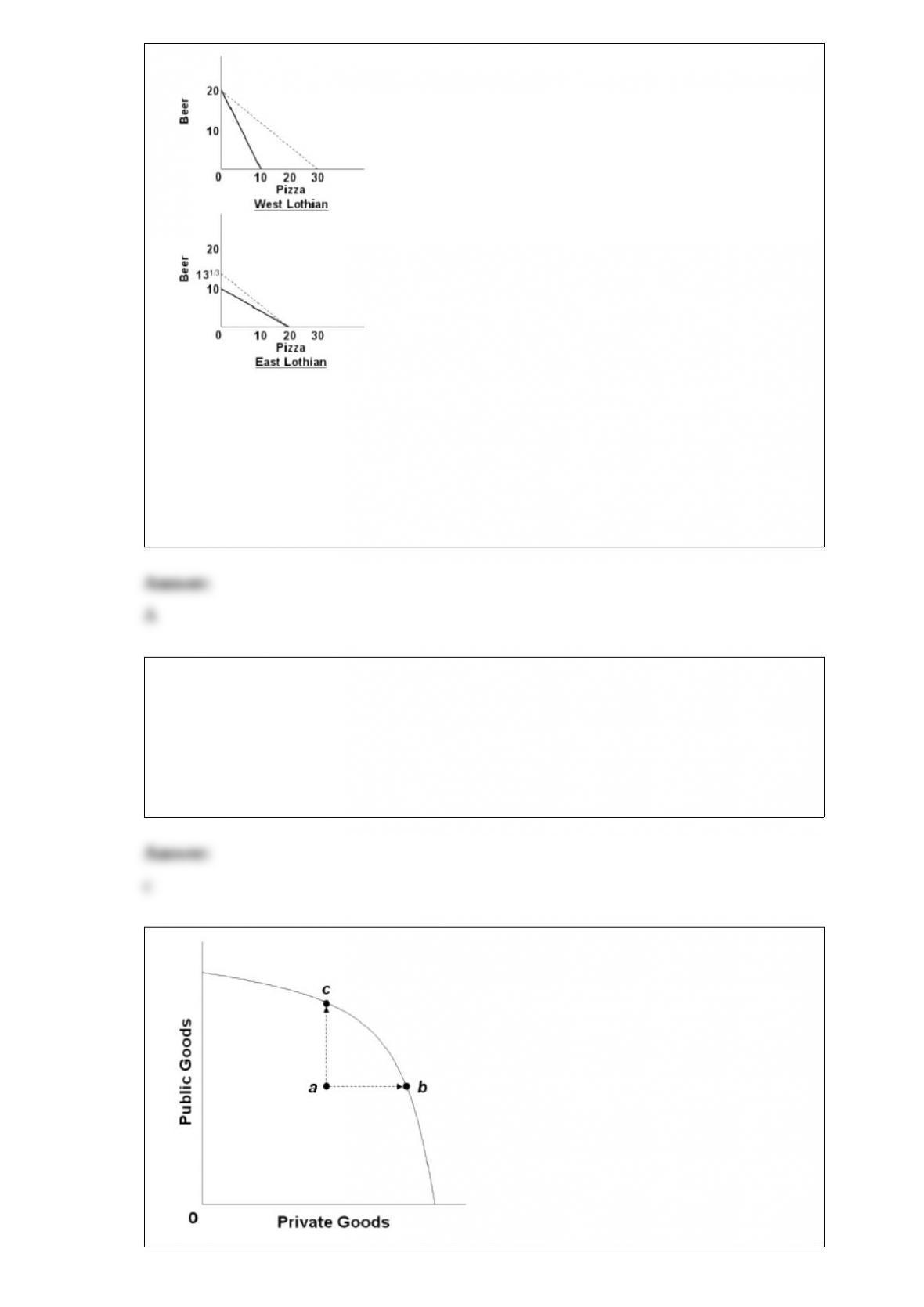
1)
Refer to the above diagrams. The solid lines are production possibilities curves; the
dashed lines are trading possibilities curves. The data suggest that:
A.West Lothian should specialize in, and export, beer.
B.both countries will be better off if they do not engage in specialization and trade
involving these two products.
C.West Lothian should specialize in, and export, pizza.
D.East Lothian should specialize in, and export, beer.
2) worker migration will cause wage rates to equalize across two countries if all of the
following conditions are met except:
a.migration is motivated strictly by wage differentials.
b.neither nation restricts or interferes with migration.
c.both countries use the same amount of capital and have the same level of technology.
d.migration has no cost.
3)

refer to the above diagram. the movement from point a to point c suggests that more:
a.private goods are being produced by employing currently idle resources.
b.public goods are being produced by employing currently idle resources.
c.public goods are being produced at the expense of fewer private goods.
d.private goods are being produced at the expense of fewer public goods.
4) Which of the following is a true statement?
A.Surpluses in the Federal budget between 1998 and 2001 gave way to a budget deficit
in 2002.
B.Surpluses in the Federal budget between 1992 and 1997 gave way to budget deficits
between 1998 and 2002.
C.The swing from budget surpluses in the late 1990s to budget deficits in the early
2000s resulted exclusively because of a downturn in the economy.
D.The swing from budget surpluses in the late 1990s to budget deficits in the early
2000s resulted exclusively from deep tax cuts by the Bush administration.
5) All else equal, when the Federal Reserve Banks engage in an expansionary monetary
policy, the interest rates received on government bonds usually:
A.fall.
B.rise.
C.remain constant.
D.move in the same direction as the bonds’ price.
6) Relatively rapid U.S. growth between 1999 and 2000, and from 2003 to 2007,
contributed to large U.S. trade deficits by:
A.increasing U.S. national income, which decreased U.S. exports.
B.reducing real interest rates in the United States.
C.increasing U.S. tax revenues and reducing the Federal budget deficit.
D.increasing U.S. national income, which increased U.S. imports.
7) A nation’s capital and financial account:
A.contains inpayment items, but not outpayment items.
B.includes service exports and service imports.
C.includes both inpayments and outpayments.
D.includes net investment income and net transfers.
8) which of the following persons is most likely to be insured for health care?
a.a minimum-wage teenager working for a fast-food restaurant.
b.a skilled worker employed by a large multinational corporation.
c.an unemployed retail clerk.
d.a part-time groundskeeper for a small manufacturing plant.
9) As it relates to R&D, a firm’s expected-rate-of-return-curve, r:
A.slopes downward because the firm arrays, highest to lowest, the rates of returns on
R&D activities.
B.slopes upward because of the law of diminishing returns.
C.is a horizontal line.
D.depends on whether it borrows from the bank or used retained earnings in financing
R&D.
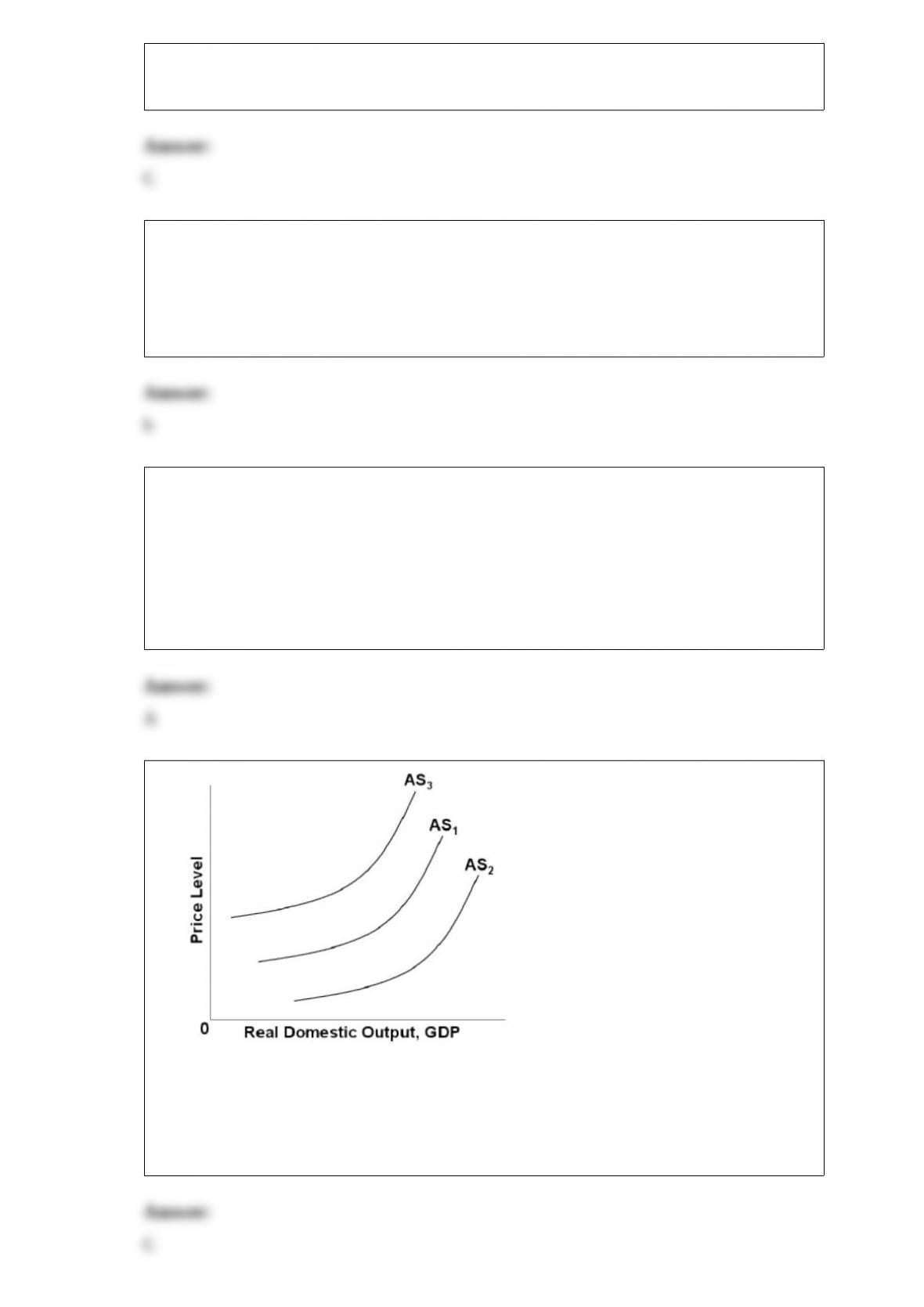
10)
In the above diagram, a shift from AS1 to AS2might be caused by a(n):
A.stricter government regulations.
B.increase in the prices of imported resources.
C.decrease in the prices of domestic resources.
D.increase in business taxes.

11) (consider this) the rapid rise in the number of women in the paid u.s. workforce
over the past several decades has:
a.shifted the u.s. production possibilities curve inward (to the left).
b.moved the u.s. economy from a point inside its production possibilities curve to a
point on the curve.
c.reduced income inequality in the united states.
d.shifted the u.s. production possibilities curve outward (to the right) and expanded real
gdp.
12) “Near-monies” are included in:
A.both M1 and M2.
B.M2 only.
C.M1 only.
D.neither M1 nor M2.
13) The following information about a banking system: new currency deposited in the
system = $40 billion; legal reserve ratio = 0.20; excess reserves prior to the currency
deposit = $0.
Refer to the above information. The $40 billion deposit of currency into checking
accounts will initially create:
A.$8 billion of new checkable deposits.
B.$10 billion of new checkable deposits.
C.$40 billion of new checkable deposits.
D.$160 billion of new checkable deposits.
14) total u.s. health care spending in 2006 was approximately:
a.$44.8 billion.
b.$862 billion.
c.$2.1 trillion.
d.$4.3 trillion.
15) an hypothesis is:
a.a fundamental truth that all economists accept.

b.a tentative, untested statement of possible cause and effect.
c.the same as a normative statement.
d.also known as a principle or law.
16) (Last Word) The rapid spread of ATMs has:
A.resulted from changes in banking laws.
B.increased the demand for bank tellers.
C.reduced the demand for bank tellers.
D.increased the hourly wage paid to bank tellers.
17) if average total cost is declining, then:
a.marginal cost must be greater than average total cost.
b.the average fixed cost curve must lie above the average variable cost curve.
c.marginal cost must be less than average total cost.
d.total cost must also be declining.
18) A rightward shift of the AD curve in the very steep upper part of the upsloping AS
curve will:
A.increase real output by more than the price level.
B.increase the price level by more than real output.
C.reduce real output by more than the price level.
D.reduce the price level by more than real output.

19)
Assumptions: (1) the labor force is comprised of 9 million men and 9 million women
workers; (2) the economy has 3 occupations, X, Y, and Z, each having identical demand
curves for labor; (3) men and women workers are homogeneous with respect to their
labor-market capabilities; (4) women are discriminated against by being excluded from
occupations X and Y and are confined to Z; and (5) aside from discrimination, the
economy is competitive.
Refer to the above diagram and list of assumptions. Under these circumstances 9
million women will be employed in occupation Z:
A.5 million men in X, and 4 million men in Y.
B.3 million men in XD, and 6 million men in Y.
C.6 million men in X, and 3 million men in Y.
D.and 4.5 million men each in occupations X and Y.
20) Which of the following is most likely to be an example of monopsony?
A.the market for fast-food workers in a large summer resort town.
B.the market for card dealers in Las Vegas.
C.the market for major league baseball umpires.
D.the market for retail sales clerks in a major city.