
Suppose that the federal budget is balanced when GDP is at potential GDP. If
equilibrium GDP falls below potential,
A) this will result in a current budget deficit.
B) the cyclically adjusted budget will be balanced.
C) government transfer payments will be rising and tax receipts will be falling.
D) All of the above are correct.
In April, market analysts predict that the price of titanium will fall in May. What
happens in the titanium market in April, holding everything else constant?
A) The supply curve shifts to the right.
B) The supply curve shifts to the left.
C) The quantity demanded and the quantity supplied of titanium increase.
D) The demand curve shifts to the right.
An increase in the purchasing power of money would not, on average, result in an
increase in the purchasing power of people’s income because a ________ price level
would likely mean ________ wages and salaries.
A) rising; falling
B) rising; rising

C) falling; falling
D) falling; rising
Which of the following is motivated by an efficiency concern?
A) In December 2006, the Bush administration restarted a short-term housing assistance
program for victims of Hurricane Katrina.
B) Each year, the University of Notre Dame conducts a lottery to parcel out the 30,000
seats available to contributors, former athletes and parents in the 80,000-seat stadium.
C) The United Network for Organ Sharing advocates a system of rationing scarce
kidneys that would favor young patients over old in an effort to wring more life out of
donated organs.
D) The federal government’s housing choice voucher program assists very low-income
families, the elderly, and the disabled to afford decent, safe, and sanitary housing in the
private market.
Oligopolies exist and do not attract new rivals because
A) of competition.
B) of barriers to entry.
C) the firms keep profits and prices so low that no rivals are attracted.
D) there can be no product differentiation.
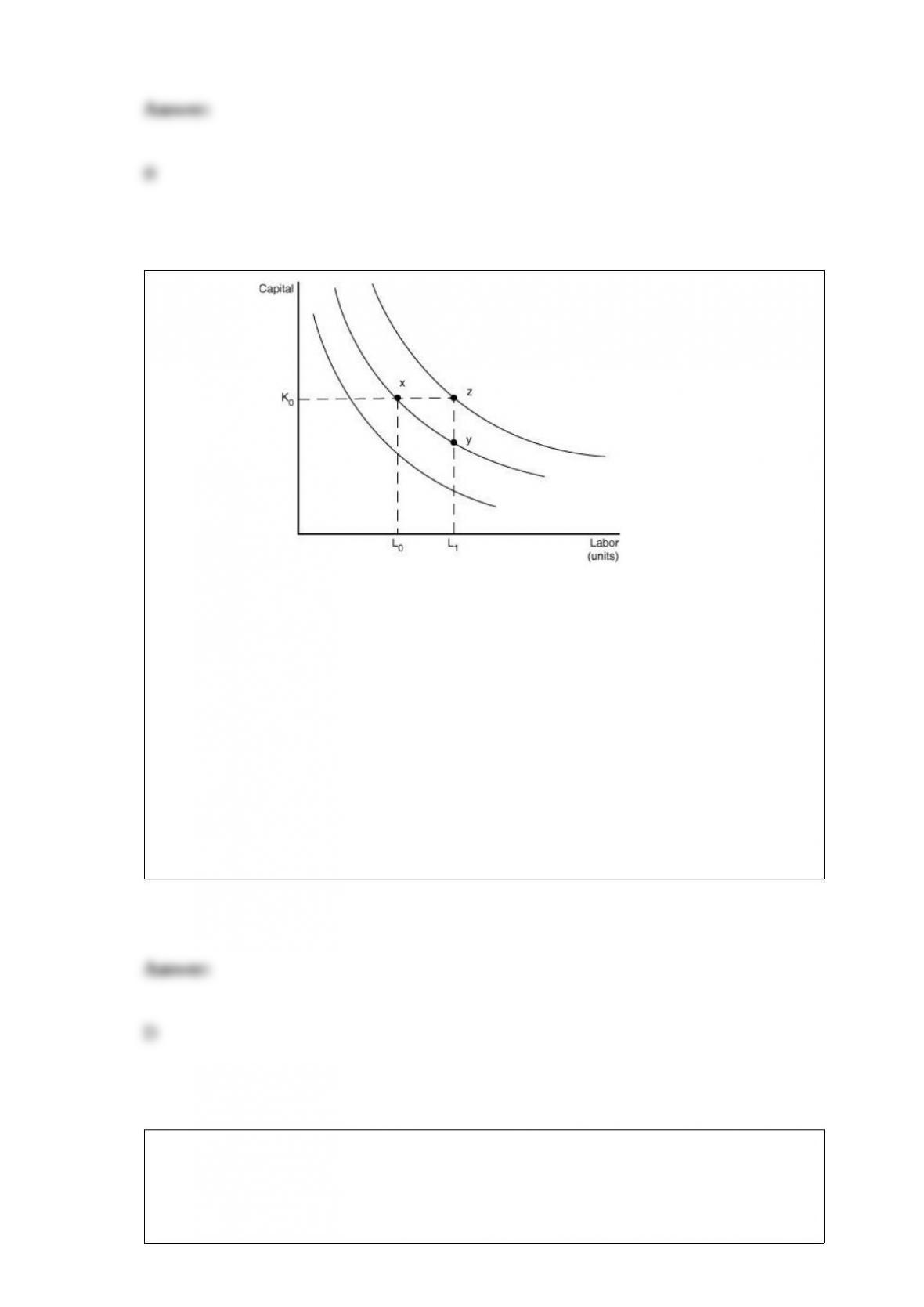
Figure 11-16
The figure above illustrates a series of isoquants. Which of the following statements is
true?
A) Points x, z, and y all represent the same output.
B) Points z and y represent the same output; this output is produced with more capital at
z than at y.
C) Point x and y represent the same output, but the cost of production at y is greater than
the cost of production at x.
D) Point z represents a greater output than point x or point y.
An increase in the real interest rate will
A) cause consumers to spend more and save less.

B) most likely lower consumers’ purchases of durable goods.
C) most likely lower the reward to savings.
D) most likely lower the cost of borrowing.
Only one of the following statements is correct. The statements compare perfectly
competitive (PC) markets and monopolistically competitive (MC) markets. Which
statement is correct?
A) Productive efficiency is achieved in both PC and MC markets. Allocative efficiency
is achieved only in MC markets.
B) Allocative efficiency is achieved in both PC and MC markets. Productive efficiency
is achieved only in PC markets.
C) Productive efficiency and allocative efficiency are both achieved in PC markets.
Neither is achieved in MC markets.
D) Allocative efficiency is achieved only in PC markets. Productive efficiency is
achieved only in MC markets.
A proportional tax is a tax for which people with lower incomes
A) pay a higher percentage of their incomes in tax than do people with higher incomes.
B) pay a lower percentage of their incomes in tax than do people with higher incomes.
C) pay the same percentage of their incomes in tax as do people with higher incomes.

D) pay the same amount of taxes as people with higher incomes pay.
A monopolistically competitive firm maximizes profit where
A) price = marginal revenue.
B) price > marginal cost.
C) marginal revenue > average revenue.
D) total revenue > marginal cost.
The federal funds rate
A) is determined administratively by the Fed.
B) is determined by the supply of and demand for bank reserves.
C) is determined directly by household demand for funds.
D) is determined directly by firm demand for funds.

The cross-price elasticity between Gillette razors and a related good is -3.4. What
happens to the demand for the related good if the price of Gillette razors falls by 10
percent?
A) The quantity demanded of the related good rises by 3.4 percent.
B) The quantity demanded of the related good falls by 34 percent.
C) The quantity demanded of the related good rises by 34 percent.
D) The quantity demanded of the related good falls by 3.4 percent.
Which of the following could explain why there is an increase in potential GDP but the
equilibrium level of GDP does not rise?
A) SRAS shifted to the right by more than LRAS.
B) AD shifted to the right by more than SRAS.
C) AD shifted to the right by less than SRAS.
D) SRAS and AD do not shift.

Figure 18-1
The appreciation of the dollar is represented as a movement from
A) B to A.
B) D to C.
C) C to B.
D) C to A.
Value added equals the market price of the firm’s product minus
A) wages and salaries.
B) the price of intermediate goods.
C) the price of all factors of production.
D) depreciation on plant and equipment.

Article Summary. According to the Department of Agriculture, net farm income
will grow to a record high of $120.6 billion in 2013, up from the previous high
mark in 2011 and after adjusting for inflation, its second highest level since 1973.
Net cash income, however, is expected to fall by 10 percent due to unsold
inventories. Exports of chickens and milk are expected to rise by 3 percent and 17
percent, respectively.
Source: Ros Krasny, “Farm income poised for record 2013: USDA,” Reuters,
August 27, 2013.
All else equal, the increase in demand for chicken and milk exports will ________ the
market prices for these exports and ________ economic profit in these markets.
A) increase; decrease
B) decrease; increase
C) increase; increase
D) decrease; decrease
Table 4-1
The table above lists the highest prices three consumers, Tom, Dick and Harriet, are
willing to pay for a short-sleeved polo shirt. If the price of the shirts falls from $28 to
$20,
A) consumer surplus increases from $14 to $35.
B) Tom will buy two shirts; Dick and Harriet will each buy one shirt.
C) consumer surplus will increase from $70 to $95.

D) Harriet will receive more consumer surplus than Tom or Dick.
In October, market analysts predict that the price of platinum will fall in November.
What happens in the platinum market in October, holding everything else constant?
A) The supply curve shifts to the right.
B) The supply curve shifts to the left.
C) The quantity demanded and the quantity supplied of platinum increase.
D) The demand curve shifts to the right.