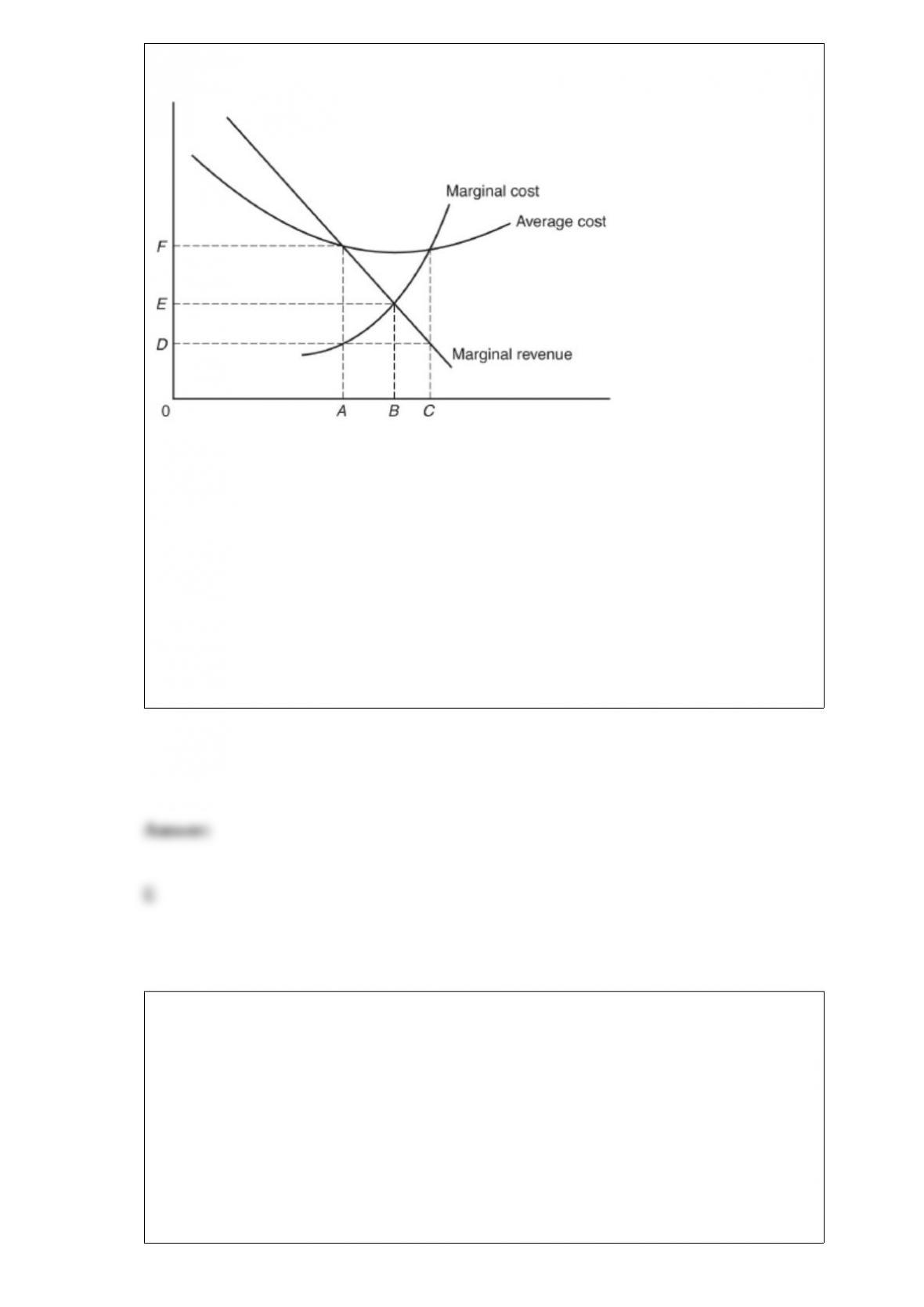
The following questions are based on the following diagram of a monopolist:
For this monopolist, the profit-maximizing price is
a. 0.
b. 0D.
c. 0E.
d. 0F.
e. above 0F.
The Taft-Hartley Act
a. established the eight-hour workday and additional pay for overtime work.
b. was intended to redress the balance between labor and employers.
c. makes it an unfair labor practice for employers to refuse to bargain collectively with
unions.
d. outlaws lockouts, the checkoff, and yellow dog contracts.

e. protects union members from abuse by union leaders.
Which of the following protects union members from abuse by union leaders?
a. Norris-La Guardia Act
b. Lewis Act
c. Taft-Hartley Act
d. Landrum-Griffin Act
e. Wagner Act
By the Social Security Administration’s definition, the number of poor people in the
United States in 2011 was around ________ million.
a. 2
b. 14
c. 46
d. 58
e. 75

Wage differentials that persist in labor markets because of the inability of individuals to
gain the training necessary to enter highly paid occupations are an example of
a. noncompeting groups.
b. a derived demand.
c. perfectly competitive homogeneous labor markets.
d. a bilateral involvement.
e. a marginal attachment.
The first major piece of pro-labor legislation in the 1930s that made it more difficult for
courts to issue injunctions against striking or picketing was the ________ Act.
a. Wagner
b. Taft-Hartley
c. Norris-La Guardia
d. Landrum-Griffin
e. Magna Carta

In a free market, producers’ desires to maximize profit
a. inevitably lead to rising market prices.
b. are inconsistent with incentives to introduce new technology.
c. guarantee that firms never take losses.
d. cause firms to use the most efficient techniques.
e. mean that government must control prices to prevent producers from overcharging
consumers.
In his first year in office, President Clinton’s fiscal policy proposals led to
a. a middle-class tax cut.
b. an upper-income tax increase.
c. significant increases in social welfare spending programs.
d. higher taxes on imported goods to promote increased employment in the United
States.
e. a balanced federal budget for the first time in 25 years.
Which of the following presents an optimal combination of inputs?
a. marginal product of labor/marginal product of capital = price of labor/price of capital
b. marginal product of labor/price of capital = marginal product of capital/price of labor
c. marginal product of capital/price of labor = price of labor/marginal product of labor
d. marginal product of capital/marginal product of labor = price of labor/price of capital
e. marginal product of capital = marginal product of labor
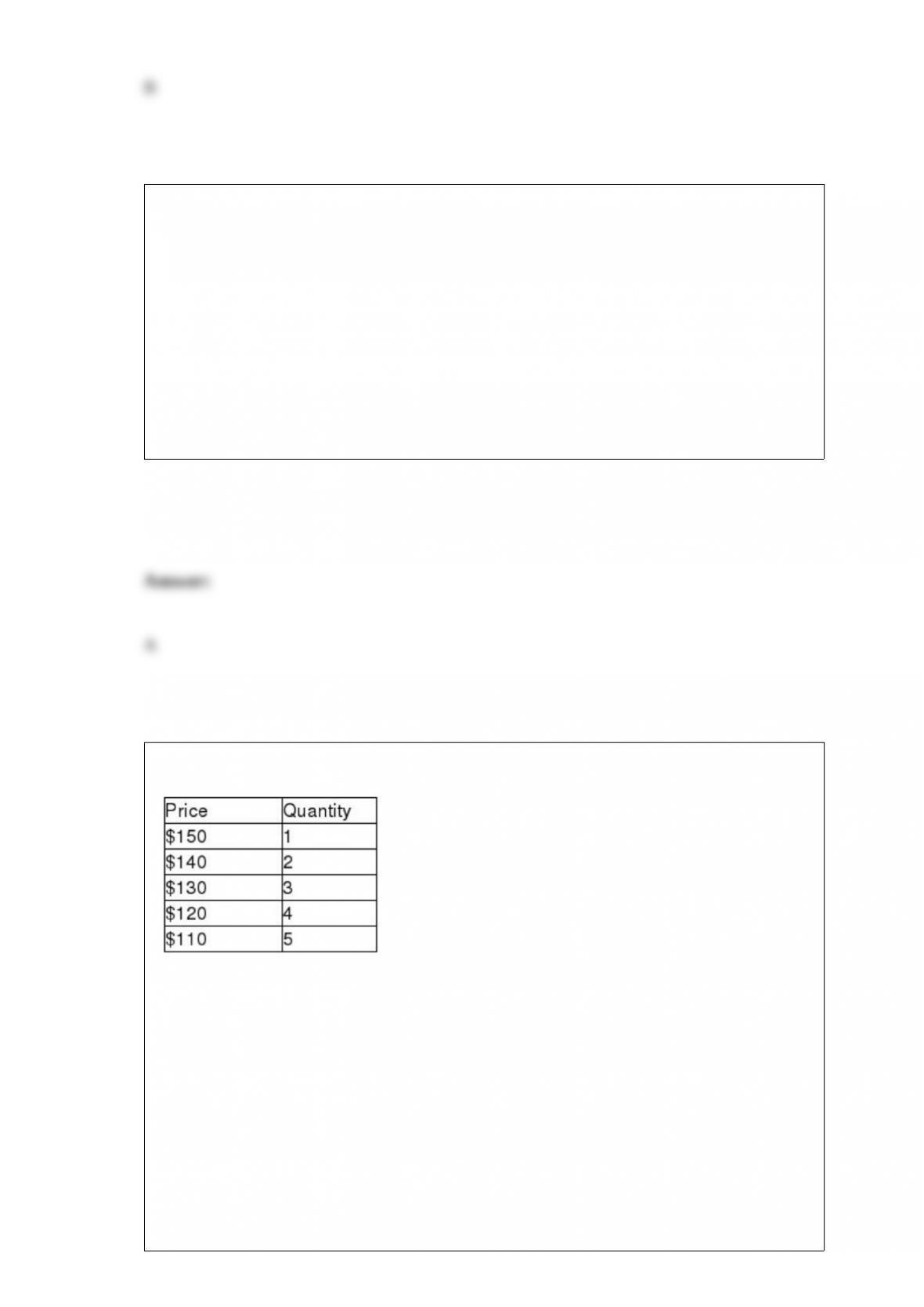
The following questions are based on the following demand schedule for a monopolist:
The marginal revenue associated with the sale of the third unit is
a. $390.
b. $130.
c. $110.
d. $10.
e. $3.

Alternative policies regarding the federal budget include the
a. annually and cyclically balanced budget policies and budgets that promote a socially
optimal and attainable combination of inflation and unemployment.
b. seldom, rarely, and never balanced budget policies.
c. actual, proposed, and cyclically adjusted budget policies.
d. executive, congressional, and treasury budget policies.
e. monthly, quarterly, and annually balanced budget policies.
A sales or excise tax
a. shifts the supply curve upward by the amount of the tax.
b. is rarely paid by the consumer if demand is insensitive to price.
c. is another name for a supply-side tax.
d. increases the quantity sold in the market.
e. has a very high collection cost relative to its yield.

The time period during which firms can raise output by using their fixed capacity more
intensively is called the
a. market period.
b. short run.
c. long run.
d. infinite run.
e. flexible run.
If interest rates on consumer loans rise, the
a. consumption function will shift downward.
b. saving function will shift downward.
c. consumption and saving functions will not change, but the amounts consumed and
saved will decline.
d. marginal propensity to consume will rise.
e. marginal propensity to save will rise.
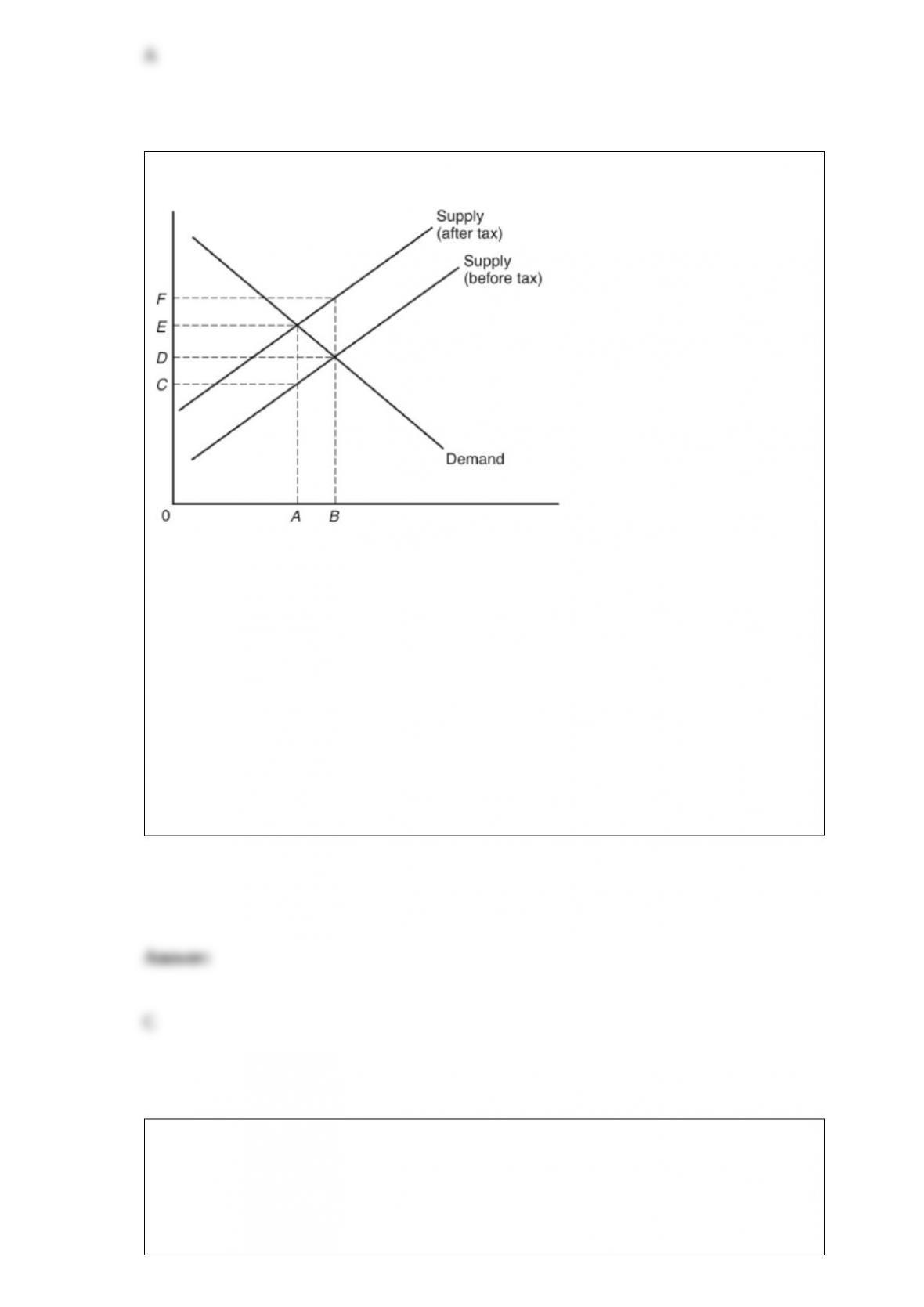
The following questions are based on the following diagram:
Assume an excise tax is imposed on the sale of a good described by the diagram. The
excise tax is best illustrated by
a. AB.
b. CD.
c. DF.
d. 0F.
e. 0E.
Which of the following conditions imposes the largest disincentive to speculate in
precious metals and collectibles?
a. runaway inflation

b. negative real interest rates
c. price stability
d. significant increases in the general price level
e. a breakdown in the monetary system
When marginal revenue exceeds marginal cost, a monopolist should
a. expand output.
b. discontinue production.
c. raise price.
d. reduce demand.
e. encourage new firms to compete with it.
The following questions are based on the following table:
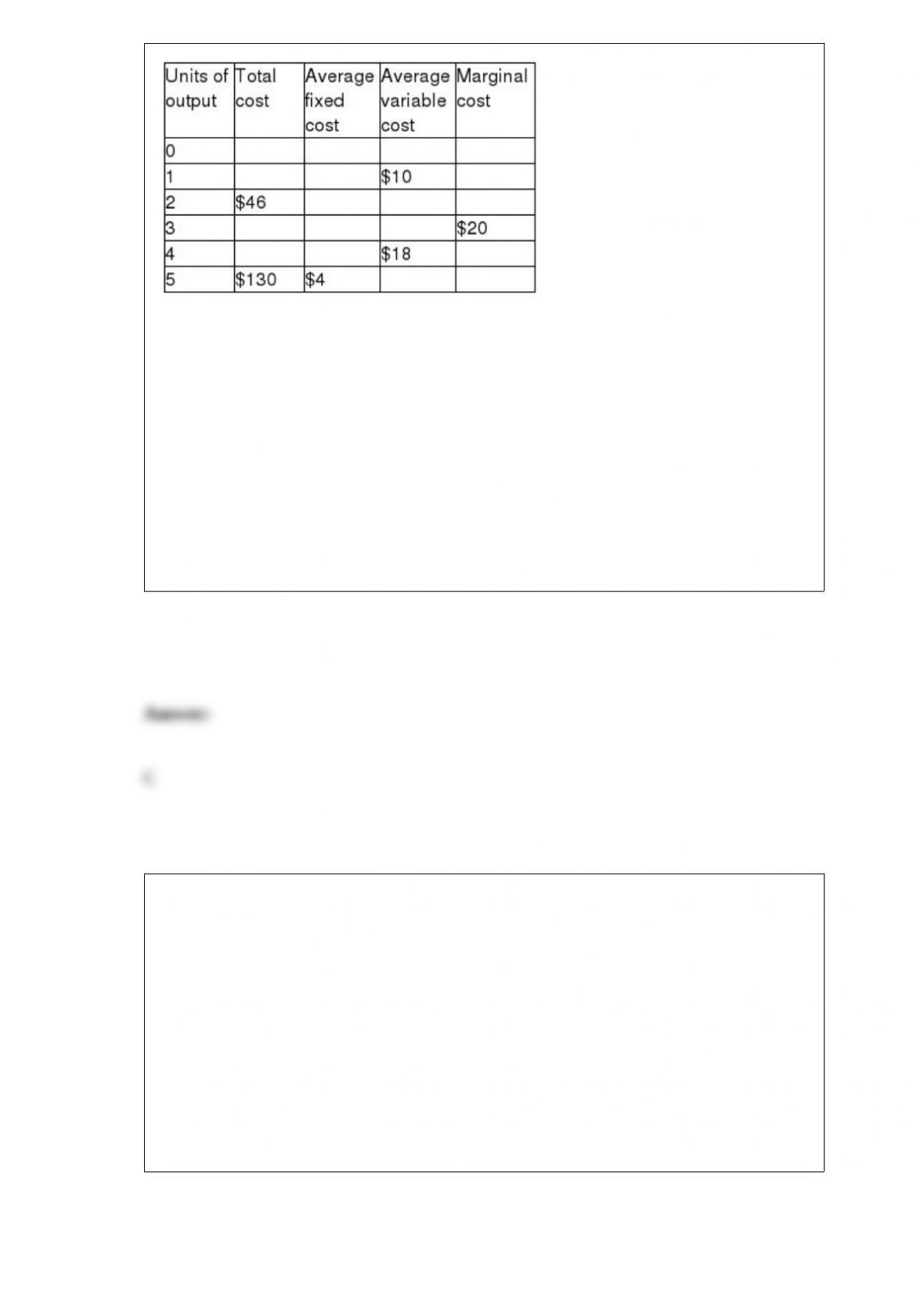
The total fixed cost is
a. $4.
b. $5.
c. $20.
d. $26.
e. $126.
Inflation
a. means demand is falling and supply is rising.
b. increases the value of the money supply.
c. rarely affects the distribution of income or wealth.
d. is generally highest when there is plenty of excess capacity and unemployed
resources.
e. is a general upward movement in the average level of prices.

If the actual federal budget shows a deficit but the structural budget deficit is falling,
most economists would attribute the deficit in the actual budget to
a. unemployment.
b. unchecked government spending.
c. rising consumer demand.
d. incomplete data.
e. inflation.
Economic stabilization activity, which is the responsibility of the executive and
legislative branches of the U.S. government, is called ________, while that presided
over by the U.S. central bank is called ________.
a. deficit financing; functional finance
b. supply-side economics; liquidity preference
c. incomes policy; commercial policy
d. fiscal policy; monetary policy
e. positive economics; normative economics

For a society operating at full employment, an increase in the amount of publicly
provided goods
a. can be achieved without the sacrifice of privately provided goods.
b. means a reduction in the scope of government services.
c. means that the rate of unemployment falls.
d. means that society must reduce its consumption of privately provided goods.
e. means that the production possibilities curve has shifted to the left.
If the morning paper reports that Americans, for the sixth month in a row, tend to spend
more money and save less, these events would be depicted in an income expenditures
model as
a. causing the 45-degree line to slope upward.
b. a downward shift in the supply function.
c. an upward shift in the consumption function.
d. an upward shift in the investment function.
e. a right to left movement along the consumption function.

The monopolist can set a price well above the competitive supply and demand level by
a. advertising to expand the market.
b. pushing the supply curve as far to the right as it will go.
c. restricting output.
d. using technology to speed production.
e. setting price equal to average cost.
The next question is based on this table.
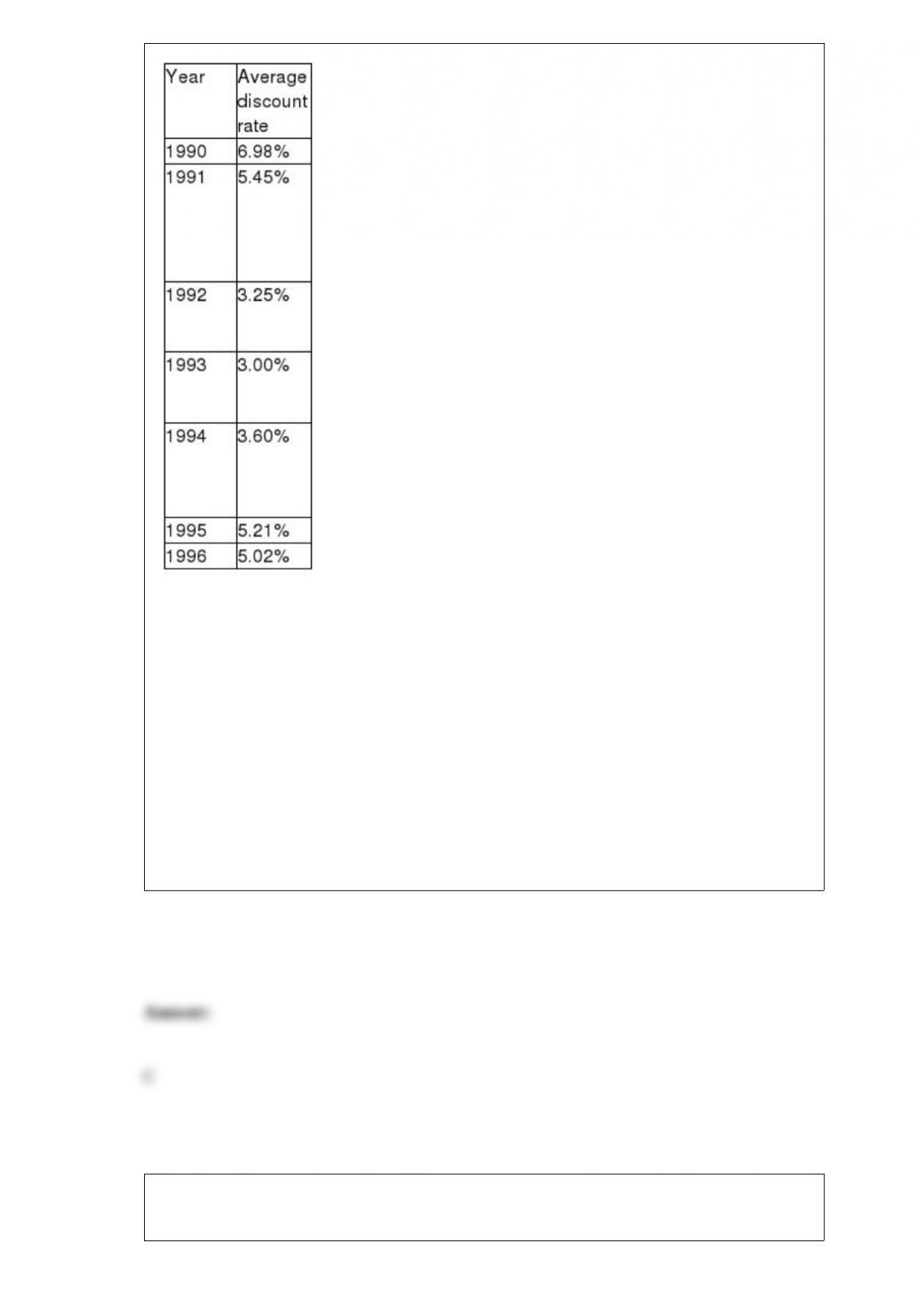
The information in the table suggests that the Fed was pursuing a more restrictive
monetary policy during the period from
a. 1990 to 1996.
b. 1990 to 1993.
c. 1993 to 1995.
d. 1995 to 1996.
e. January to December 1993.
A leftward shift in the aggregate supply curve produces

a. demand-side inflation.
b. increases in real output.
c. supply-side inflation.
d. a higher standard of living.
e. a horizontal Phillips curve.
The best example of the influences of supply-side economists on economic policy is
seen in the
a. Federal Reserve Act of 1913.
b. Employment Act of 1946.
c. tax increase of 1968.
d. wage and price controls of 1971.
e. tax cut of 1981.
An increase in the structural deficit most likely reflects the fact that fiscal policy is
a. having little or no impact on the economy.

b. effectively reducing the size of the national debt.
c. becoming more expansionary.
d. creating a substantial gap between potential and full-employment GDP.
e. causing the price level to fall.
In the long run, perfectly competitive industries experiencing decreases in demand
a. gain firms.
b. lose resources.
c. require price controls.
d. become monopolies.
e. remain unaffected.
One way to define luxuries (as opposed to necessities) is to say that luxuries are those
goods
a. purchased by consumers with high incomes.
b. with high prices.
c. with high income elasticities of demand.
d. that are perfectly price inelastic.
e. for which substitutes are not readily available.
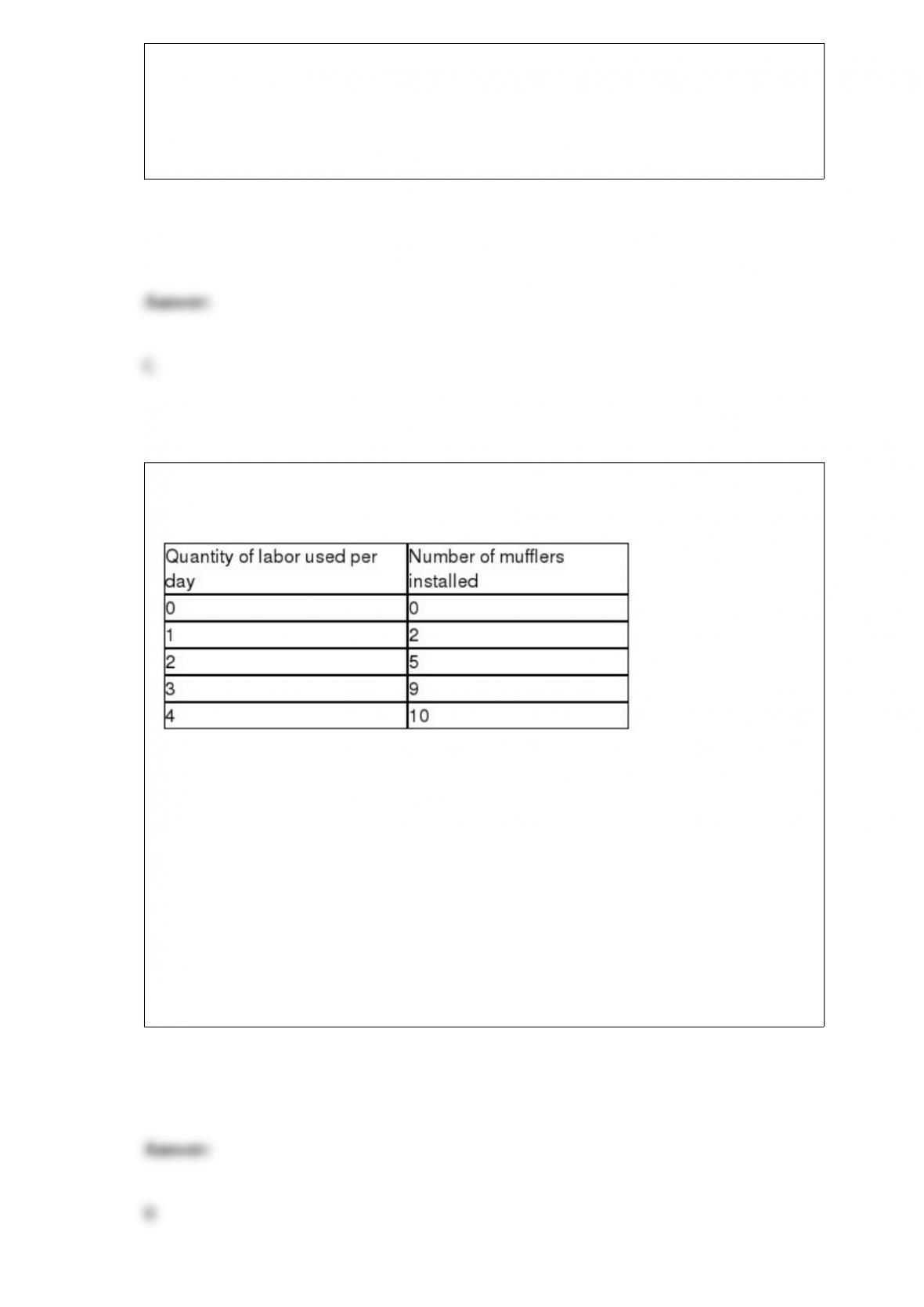
The following questions are based on the following information for an auto repair shop
specializing in muffler installation.
The average product of the third worker is
a. 1.
b. 3.
c. 4.
d. 9.
e. 27.
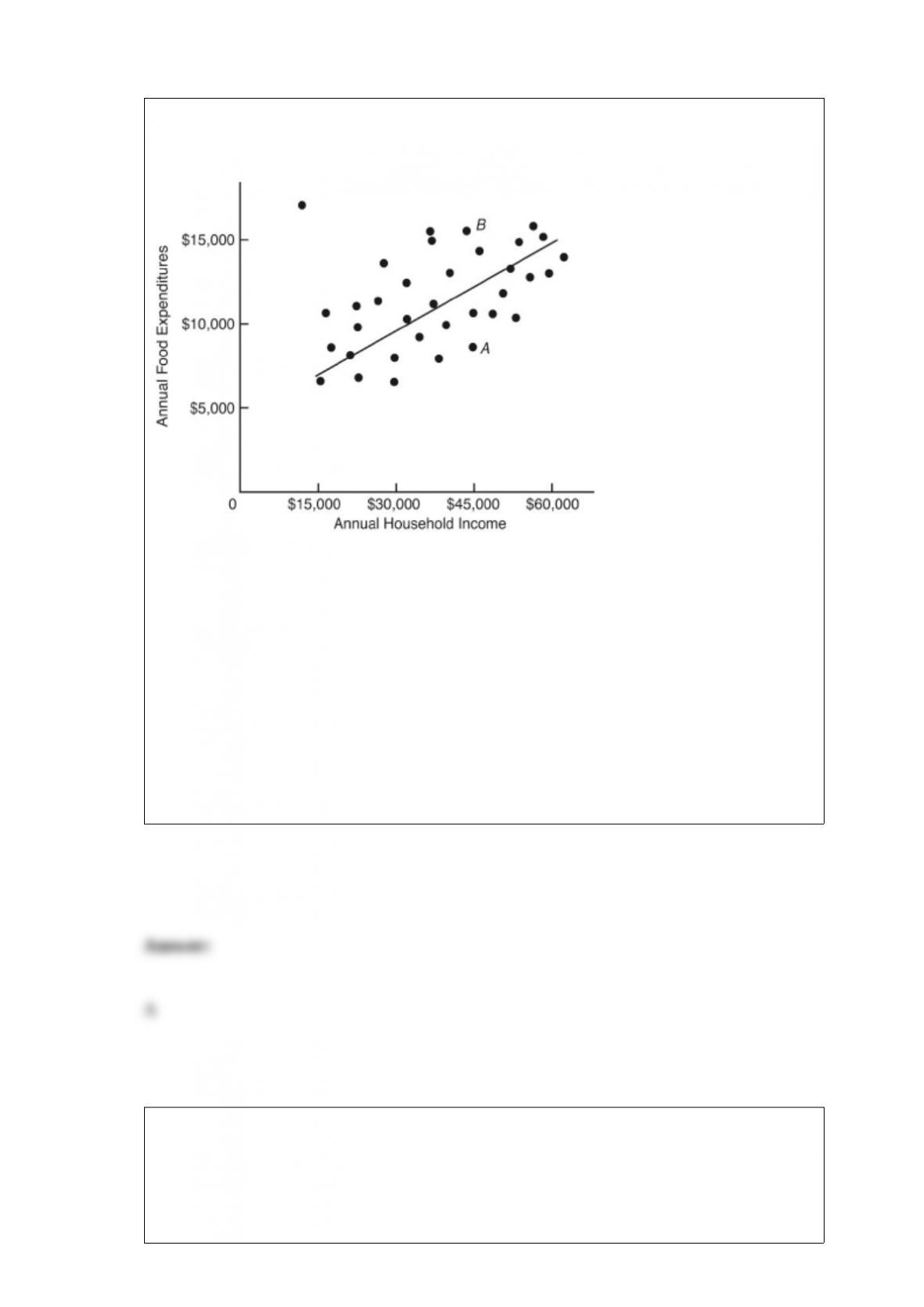
The following questions are based on the following diagram illustrating the results of a
study of food expenditures and income for a group of families:
From the graph it can be
seen that, on average, a lower-income family spends
a. a higher percentage of its income on food than a higher-income family.
b. a lower percentage of its income on food than a higher-income family.
c. the same percentage of its income on food as a higher-income family.
d. a different percentage of its income on food than any other family with the same
income.
e. too much of its income on food.
The average income of farm families in the United States is ________ the average
family income in the nation as a whole.
a. less than
b. approximately equal to
c. slightly more than
d. well above
e. more than triple