
1) When a firm is making a profit-maximizing production decision, which of the
following principles of economics is likely to be most important to the firm’s decision?
a.The cost of something is what you give up to get it.
b.A country’s standard of living depends on its ability to produce goods and services.
c.Prices rise when the government prints too much money.
d.Governments can sometimes improve market outcomes.
2) Holding all other forces constant, if decreasing the price of a good leads to an
increase in total revenue, then the demand for the good must be
a.unit elastic.
b.inelastic.
c.elastic.
d.None of the above is correct because a price decrease never leads to an increase in
total revenue.
3) The graph of the production function plots total cost versus quantity of output.
a.True
b.False
4) One assumption that distinguishes short-run cost analysis from long-run cost analysis
for a profit-maximizing firm is that in the short run,
a.output is not variable.
b.the number of workers used to produce the firm’s product is fixed.
c.the size of the factory is fixed.
d.there are no fixed costs.
5) Scenario 16-7
Consider the problem facing two firms, YumYum and Bertollini, in the frozen food
market. Each firm has just come up with an idea for a new “frozen meal for two”which
it would sell for $9. Assume that the marginal cost for each new product is a constant
$2, and the only fixed cost is for advertising. Each company knows that if it spends $12
million on advertising it will get 1.5 million consumers to try its new product. YumYum
has done market research which suggests that its product does not have any ‘staying”
power in the market. Even though it could get 1.5 million consumers to buy the product
once, it is unlikely that they will continue to buy the product in the future. Bertollini’s
market research suggests that its product is very good, and consumers who try the
product will continue to be consumers over the ensuing year. On the basis of its market
research, Bertollini estimates that its initial 1.5 million customers will buy one unit of
the product each month in the coming year, for a total of 18 million units.
On the basis of a theory that people buy a product because it is advertised, the content
of advertisements for Bertollini’s product
a.must show a consumer taste-test to be successful.
b.must include celebrity endorsements to be successful.
c.is irrelevant to the success of the advertisement.
d.Both a and b would be equally successful.
6) Production is efficient if the economy is producing at a point
a.on the production possibilities frontier.
b.outside the production possibilities frontier.
c.on or inside the production possibilities frontier.
d.inside the production possibilities frontier.
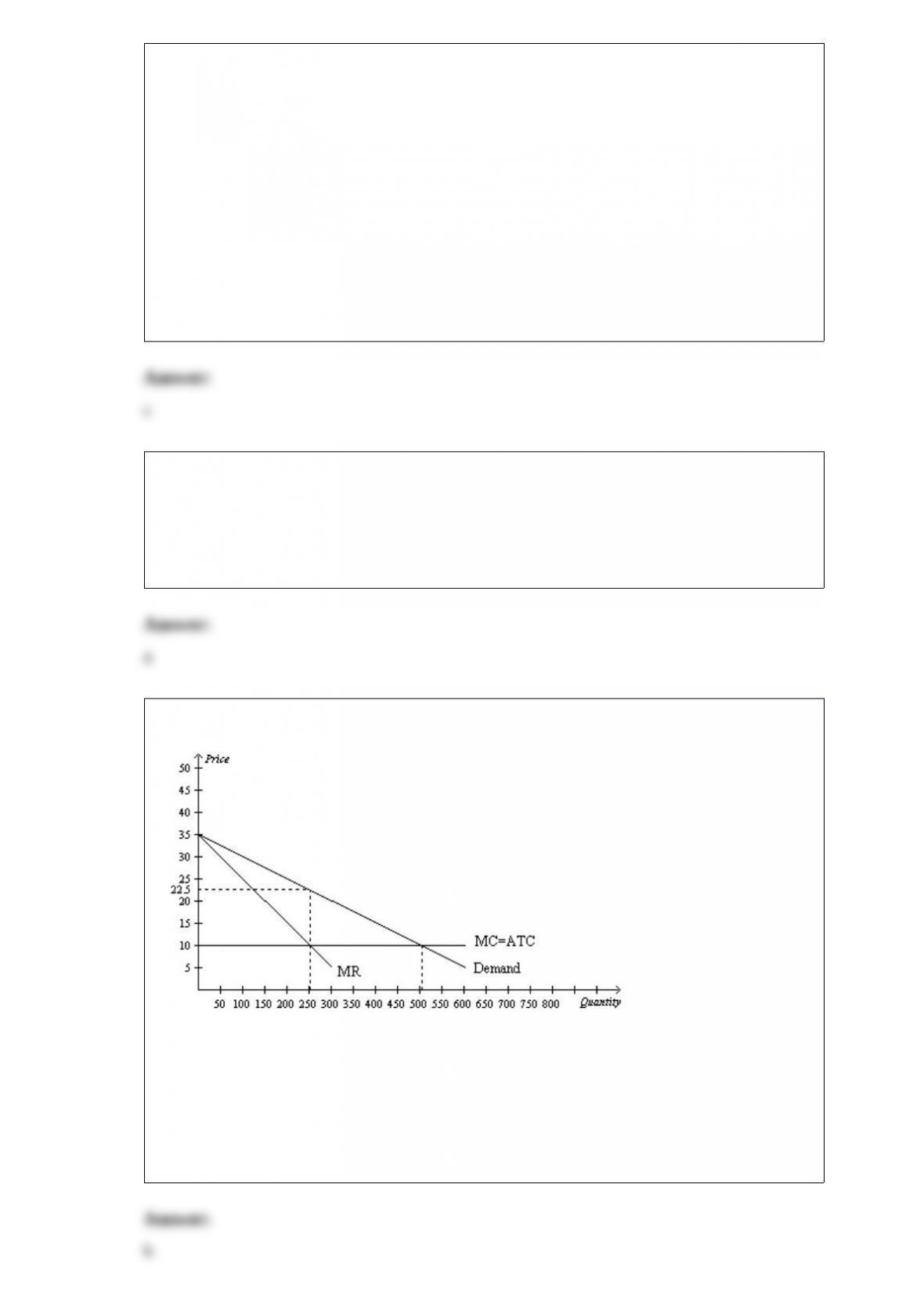
7) Figure 15-19
If the monopoly firm is not allowed to price discriminate, then consumer surplus
amounts to
a.$0.
b. $1,562.50.
c. $3,125.
d. $6,250.

8) Education yields positive externalities. For example, a more educated population
a.may increase the pace of technological advances, leading to higher productivity and
wages for everyone.
b.leads to more informed voters, resulting in better government for everyone.
c.tends to result in lower crime rates.
d.All of the above are correct.
9) Economists who are primarily responsible for advising Congress on economic
matters work in which agency?
a.the Federal Reserve
b.the Congressional Budget Office
c.the Department of the Treasury
d.the Department of Commerce
10) Each firm in a monopolistically competitive industry faces a downward-sloping
demand curve because
a.there are many other sellers in the market.
b.there are very few other sellers in the market.
c.the firm’s product is different from those offered by other firms in the market.
d.the firm faces the threat of entry into the market by new firms.
11) Some colleges charge all students the same fee for access to campus computing
services. Suppose that students differ by how many hours of campus computing
services they use. For example, some students print all their papers and assignment in
the campus computer labs, while others use their own printers in their apartments. The
computing services fee is most like a(n)
a.excise tax that conforms to the benefits principle.
b.excise tax that violates the benefits principle.
c.lump-sum tax that conforms to the benefits principle.
d.lump-sum tax that violates the benefits principle.

12) Some business practices that appear to reduce competition, such as resale price
maintenance, may have legitimate economic purposes.
a.True
b.False
13) Which of the following is not a characteristic of the Earned Income Tax Credit
(EITC)?
a.It does not discourage recipients from working.
b.It is less distortionary than other anti-poverty programs.
c.It helps the disabled who cannot work.
d.It applies only to the working poor.
14) An income tax in which the average tax rate is the same for all taxpayers would be
considered a
a.progressive tax.
b.regressive tax.
c.distortion-free tax.
d.proportional tax.
15) In the circular-flow diagram, which of the following items flows from firms to
households through the markets for the factors of production?
a.goods and services
b.land, labor, and capital
c.dollars spent on goods and services
d.wages, rent, and profit
16) Discrimination occurs when the marketplace offers different opportunities to similar
individuals who differ only by
a.age.
b.years of experience.
c.years of education.
d.All of the above are forms of discrimination.
17) Which of the following would not shift a market labor supply curve to the right?
a.a decrease in the wage paid to workers in a competing market
b.labor-augmenting technology
c.a change in worker tastes so that workers want to retire later
d.an increase in immigration
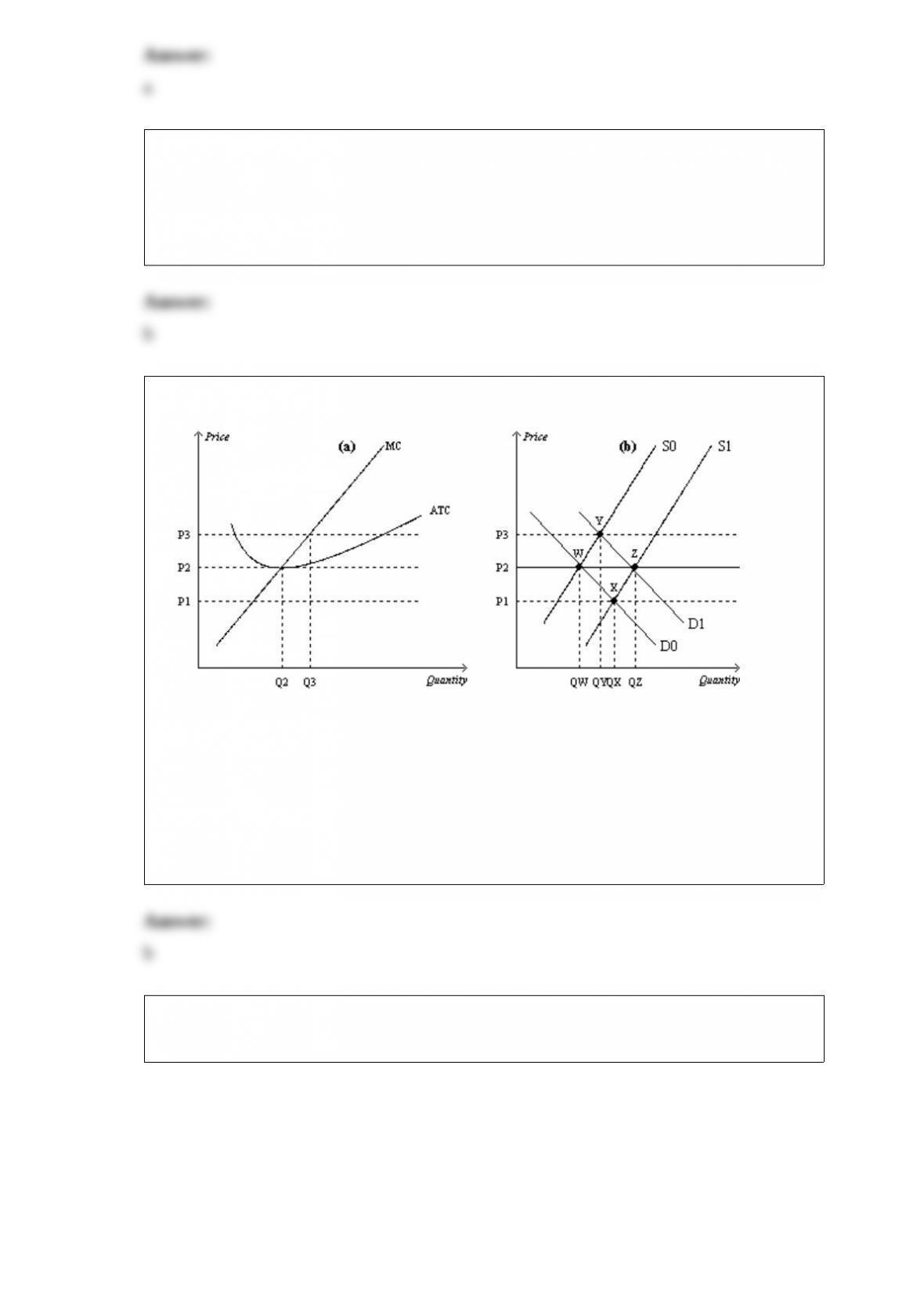
18) Figure 14-14
Assume that the market starts in equilibrium at point W in panel (b). An increase in
demand from D0 to D1 will result in
a.a new market equilibrium at point X.
b.an eventual increase in the number of firms in the market and a new long-run
equilibrium at point Z.
c.rising prices and falling profits for existing firms in the market.
d.falling prices and falling profits for existing firms in the market.
19) Figure 8-6
The vertical distance between points A and B represents a tax in the market.
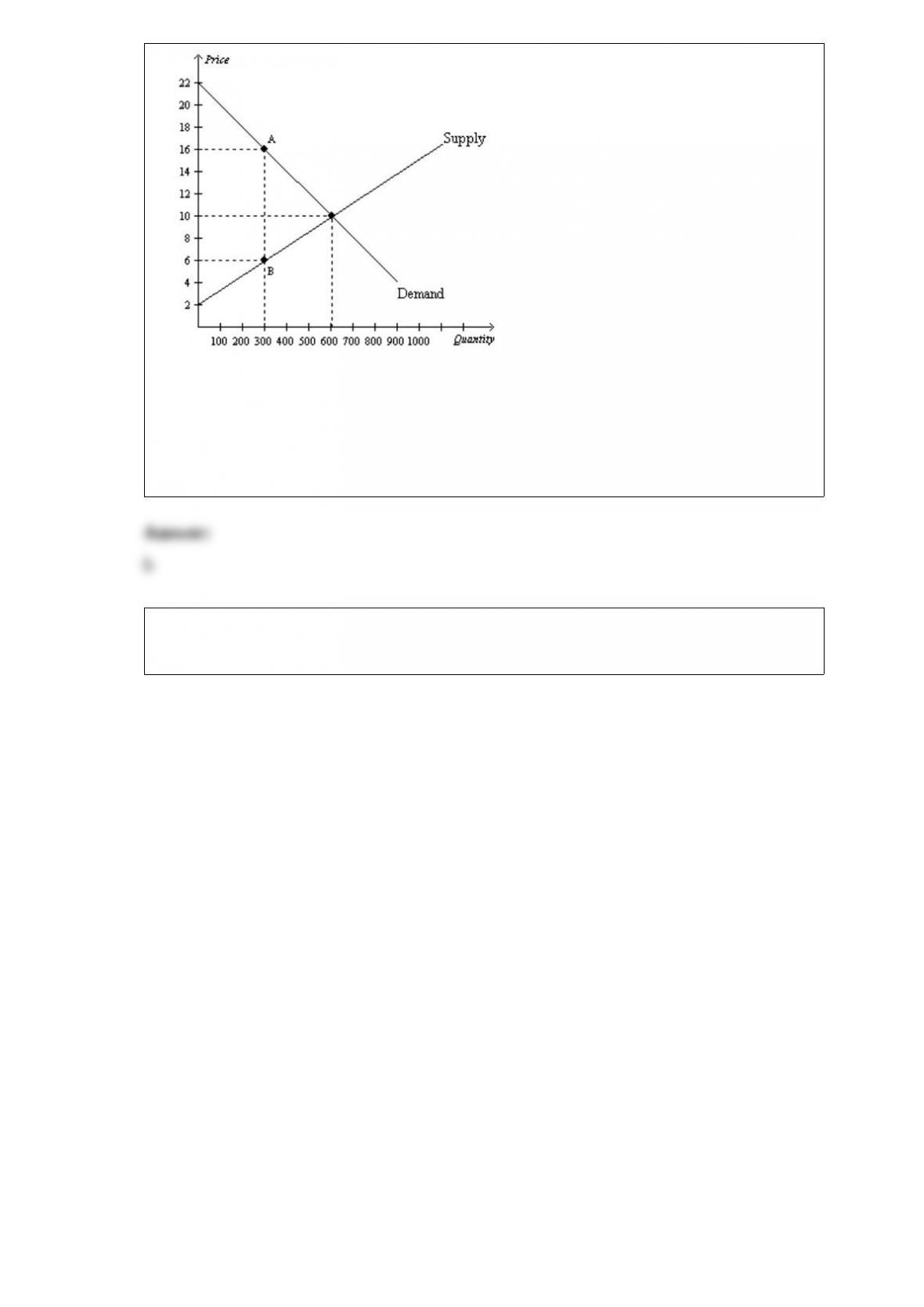
When the tax is imposed in this market, the price sellers effectively receive is
a. $4.
b.$6.
c.$10.
d.$16.
20) Perry’s Production Possibilities FrontierJordan’s Production Possibilities
Frontier