The law of one price holds exactly only if
A) antitrust laws are being enforced.
B) buyers have complete information.
C) transactions costs are zero.
D) it is impossible for buyers to resell the good.
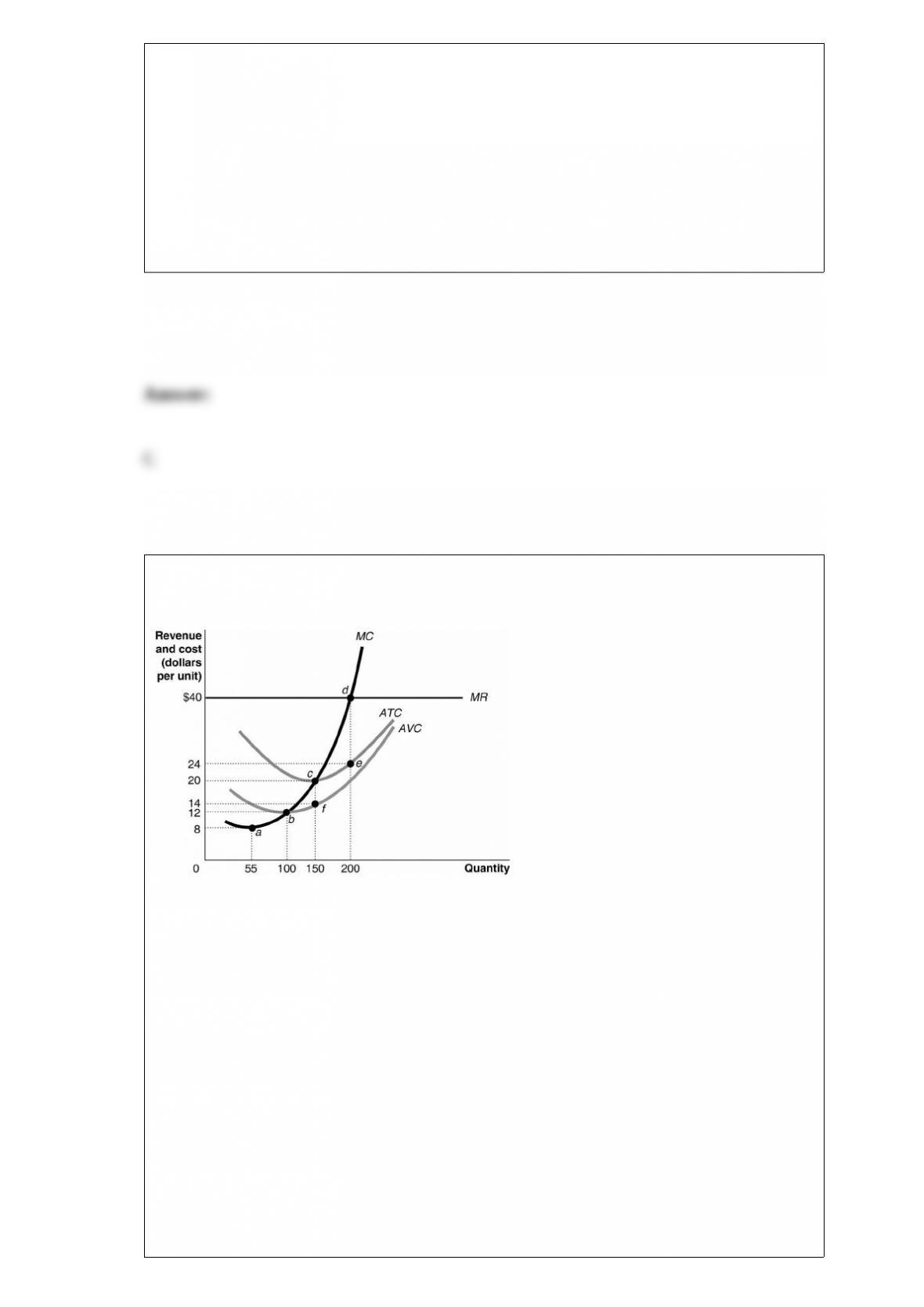
Figure 12-18
Use the figure above to answer the following questions.
a. How can you determine that the figure represents a graph of a perfectly competitive
firm? Be specific; indicate which curve gives you the information and how you use this
information to arrive at your conclusion.
b. What is the market price?
c. What is the profit-maximizing output?
d. What is total revenue at the profit-maximizing output?
e. What is the total cost at the profit-maximizing output?
f. What is the profit or loss at the profit-maximizing output?
g. What is the firm’s total fixed cost?
h. What is the total variable cost?
i. Identify the firm’s short-run supply curve.
j. Is the industry in a long-run equilibrium?
k. If it is not in long-run equilibrium, what will happen in this industry to restore
long-run equilibrium?
l. In long-run equilibrium, what is the firm’s profit maximizing quantity?
A key part of Microsoft’s business strategy in the video game console market has been
A) to wait until competitors introduce new technology in their products before
incorporating the technology in its products.
B) to concentrate on selling its products through large discount retailers like Wal-Mart.
C) the innovation of new products which initially have little to no competition.
D) to dominate the market by offering low-end products and beating its competitors’
prices.
A Nash equilibrium is
A) reached when an oligopoly’s market demand and supply intersect.
B) reached when each player chooses the best strategy for himself and for the group.
C) reached when each player chooses the best strategy for himself, given the other
strategies chosen by the other players in the group.
D) an equilibrium comprising non-dominant strategies only.
For each of the following pairs of products state which are complements, which are
substitutes, and which are unrelated.
a. Digital camera and memory stick
b. 7Up and Mountain Dew
c. Swimsuits and flip-flops
d. Tylenol and cat food
e. Photocopier and paper
Which of the following could be evidence of a market failure?
A) Resources in an economy are not fully utilized.
B) The market price of a product is above the average cost of production.
C) There are only a handful of firms competing against each other in an industry.
D) Market prices do not reflect true production costs.
Assume that both the demand curve and the supply curve for MP3 players shift to the
right but the demand curve shifts more than the supply curve. As a result
A) both the equilibrium price and quantity of MP3 players will increase.
B) the equilibrium price of MP3 players will increase; the equilibrium quantity may
increase or decrease.
C) the equilibrium price of MP3 players may increase or decrease; the equilibrium
quantity will increase.
D) the equilibrium price of MP3 players will decrease; the equilibrium quantity may
increase or decrease.
Which of the following is a reason why a firm would not engage in price
discrimination?
A) Price discrimination is illegal in some western states and the owners of firms in
these states face civil or criminal prosecution if they engage in price discrimination.
B) Some firms are not able to segment the market for the products they sell.
C) Some firms do not want to violate the law of one price.
D) The transactions costs associated with selling the product exceed the price of the
product.
Which type of business is the most difficult to set up?
A) sole proprietorship
B) partnership
C) corporation
D) There is no difference in the difficulty of establishment.
Figure 3-5
Refer to Figure 3-5. At a price of $5, the quantity sold
A) is 2 units.

B) is 4 units.
C) is 6 units.
D) cannot be determined.
Assume that you observe the long-run average cost curve of ACME Bookstores, a
national chain. Starting from the point on the curve where output is zero and moving to
the right which of the following lists the behavior of long-run average costs in the
correct sequence (that is, which will be observed first, second, etc.)?
A) minimum efficient scale; economies of scale; constant returns to scale; diseconomies
of scale
B) economies of scale; constant returns to scale; diseconomies of scale; minimum
efficient scale
C) constant returns to scale; economies of scale; minimum efficient scale; diseconomies
of scale
D) economies of scale; minimum efficient scale; constant returns to scale; diseconomies
of scale
Which of the following is an advantage of starting a new business as a proprietorship?
A) The owner has limited personal liability.

B) A proprietorship has few government rules and regulations to comply with.
C) Business profits are not taxed.
D) A proprietorship can easily attain additional funding.
All of the following are critical functions of the government in facilitating the operation
of a market economy except
A) protecting private property.
B) enforcing property rights.
C) ensuring an equal distribution of income to all citizens.
D) enforcing contracts.
Which of the following pricing strategies allows a firm to earn economic profit?
A) price discrimination
B) charging a price equal to marginal cost
C) charging a price equal to the average total cost of production
D) charging a price equal to the average variable cost of production
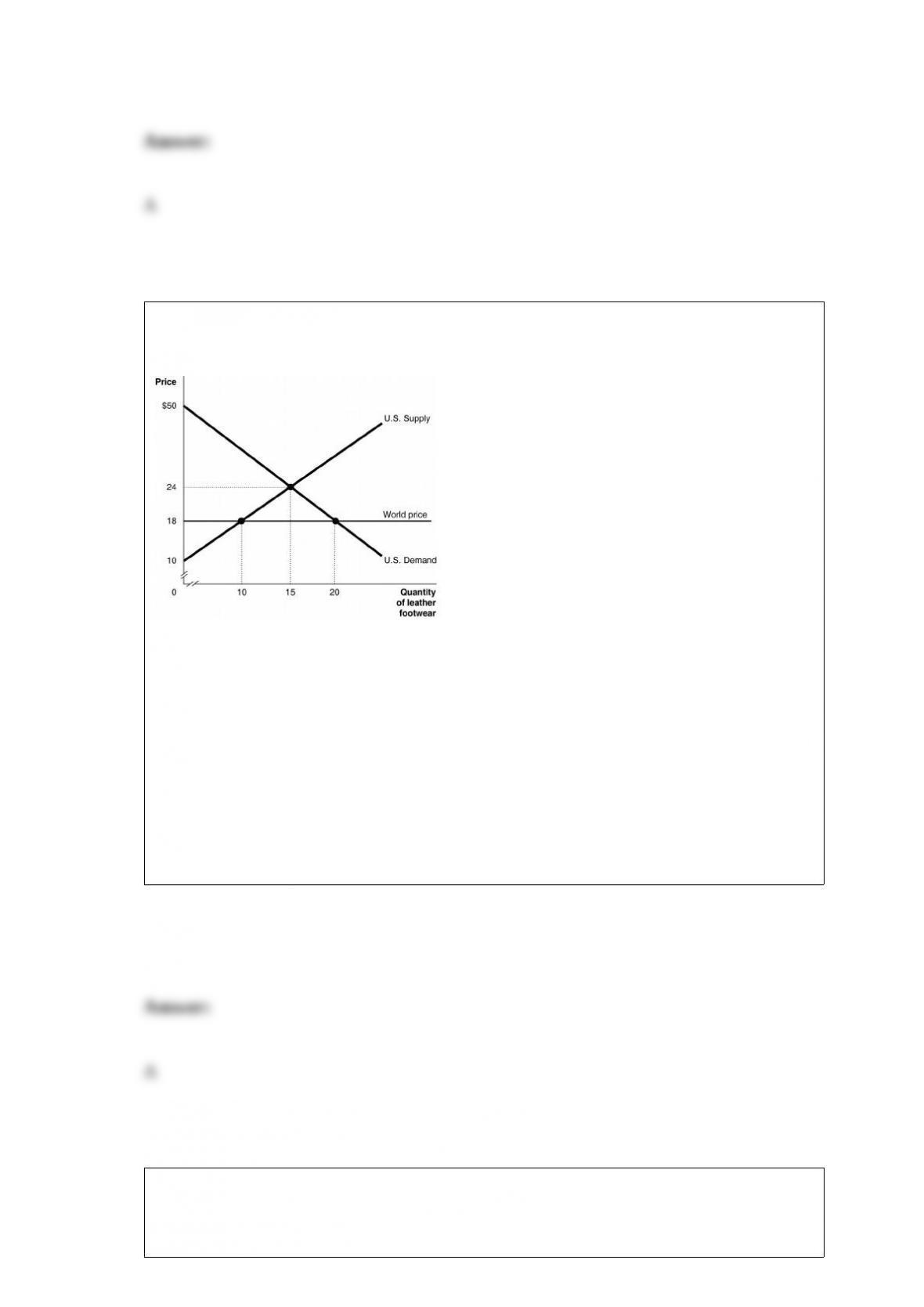
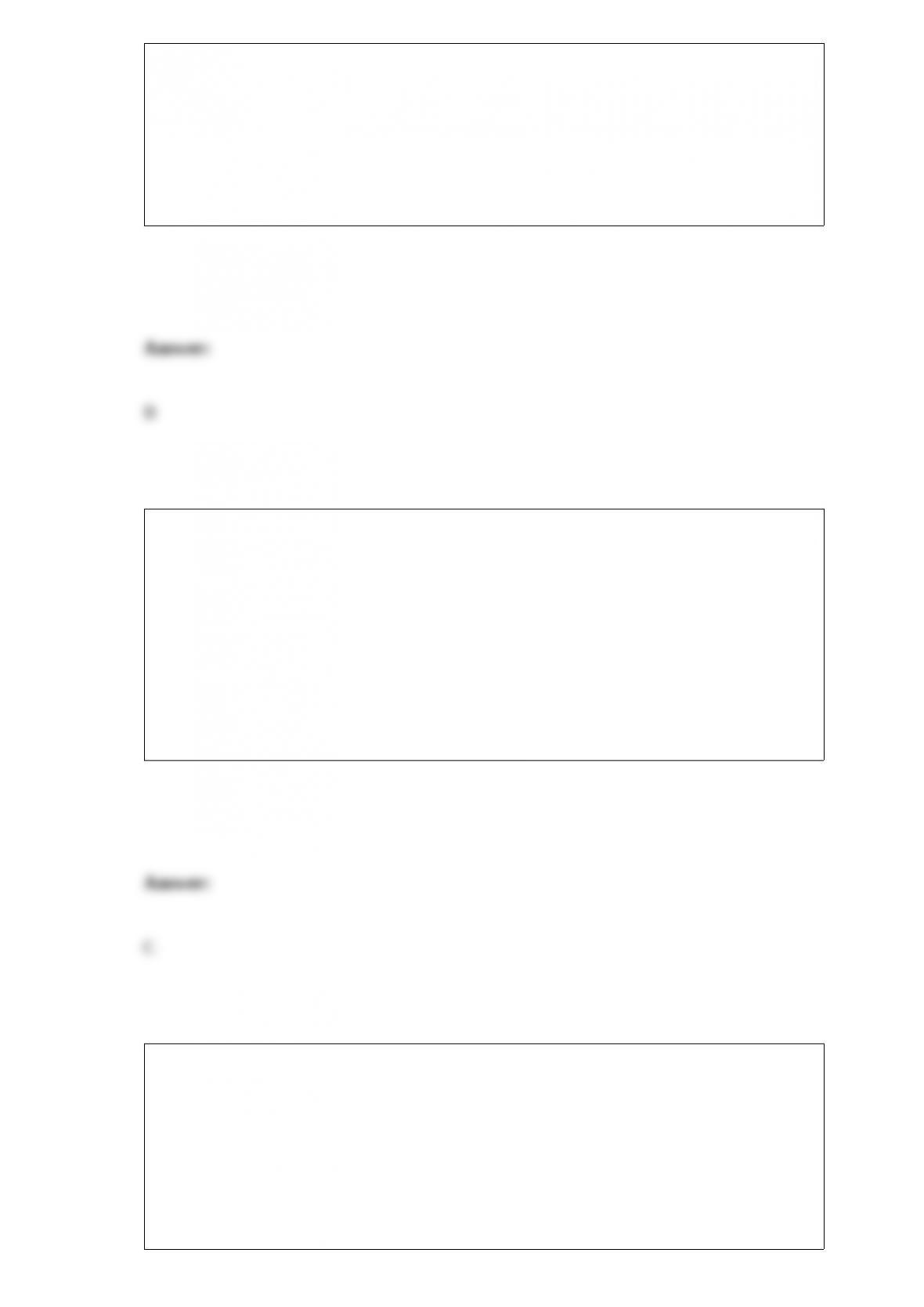
Figure 9-1
Figure 9-1 shows the U.S. demand and supply for leather footwear.
Refer to Figure 9-1. Under autarky, the consumer surplus is
A) $195.
B) $260.
C) $300.
D) $555.
Many people assume that if child workers in developing countries weren’t working in
factories, they would be in school. In fact, children in developing countries
A) split their time evenly between work and school.
B) usually have few good alternatives to work.
C) are only allowed to work if they have attended school up to age 15.
D) who work are relatively rare, as most do attend school full time.
Of the following high-income countries, which has the lowest number of MRI units per
1 million population?
A) Canada
B) Japan
C) the United Kingdom
D) the United States
Utility is
A) easily measured in units called utils.
B) subjective and difficult to measure.
C) the consumption of a quasi-public good like electricity or natural gas.

D) the production of a quasi-public good like electricity or natural gas.
Which of the following statements about perfect price discrimination is false?
A) There is no consumer surplus if a firm engages in perfect price discrimination.
B) Perfect price discrimination occurs when the seller charges the highest price each
consumer would be willing to pay for the product.
C) A condition for perfect price discrimination is that it must be costlier to service some
customers than others.
D) For the price-discriminating firm, its marginal revenue curve coincides with its
demand curve.
Consider the following pairs of items:
a. shampoo and conditioner
b. iPhones and earbuds
c. a laptop computer and a desktop computer
d. beef and pork
e. air-travel and weed killer
Which of the pairs listed will have a positive cross-price elasticity?
A) a and b only
B) c and d only
C) e only
D) a, b, and c only
A negative externality exists if
A) there are price controls in a market.
B) there are quantity controls in a market.
C) the marginal social cost of producing a good or service exceeds the private cost.
D) the marginal private cost of producing a good or service exceeds the social cost.
Table 13-3
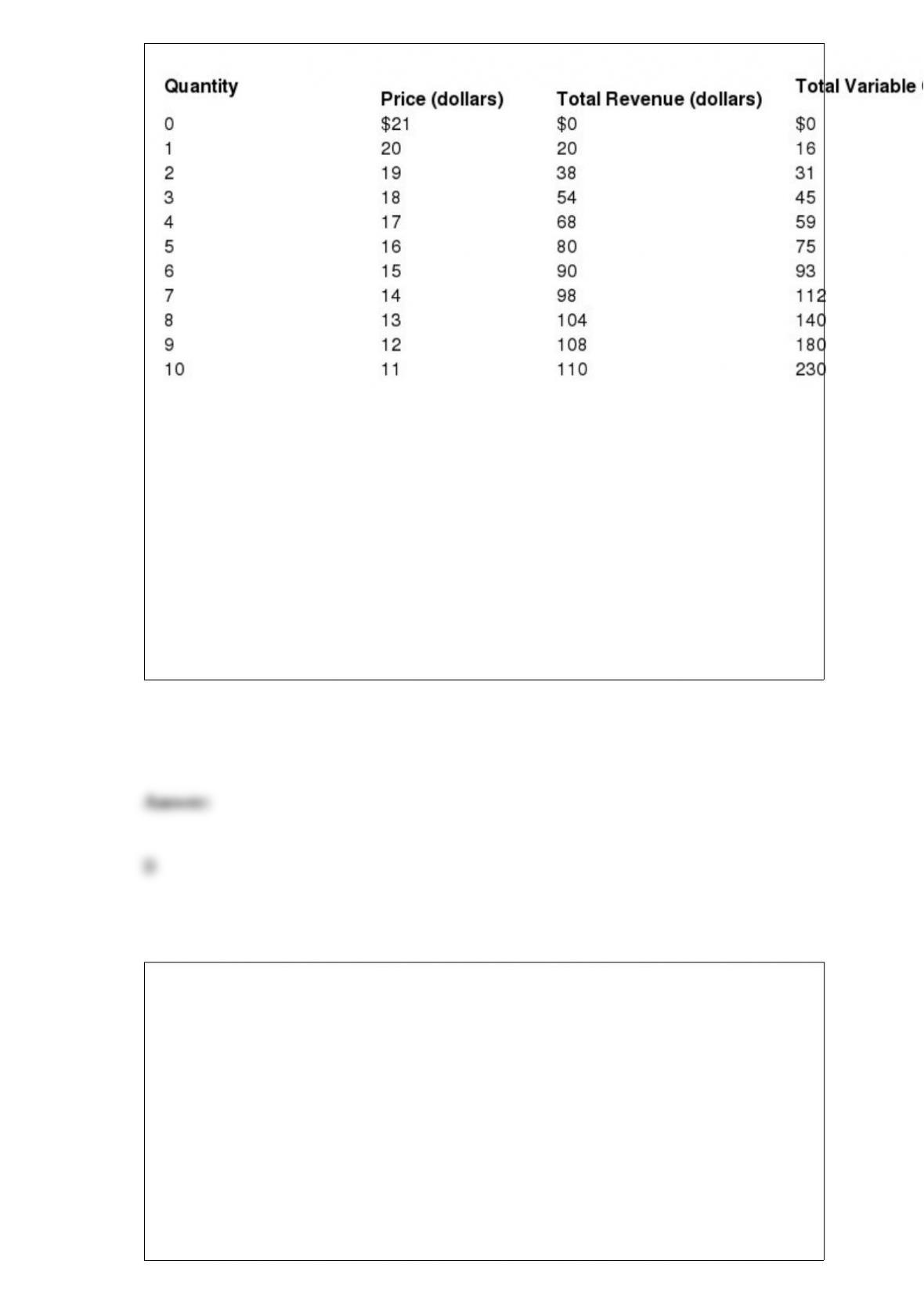
Table 13-3 shows the demand and cost schedules for a monopolistically competitive
firm.
Refer to Table 13-3. What is the amount of the firm’s loss at its optimal output level?
A) $0
B) $41
C) $45
D) $50
Tesla Motors manufacturers its cars at a plant in Fremont, California. At this plant,
Tesla is able to take advantage of the high level of technical training possessed by its
American workers, but it also sacrifices the ability to pay lower wages had it chosen to
open its plant in a low-wage country such as Mexico, India, or China. In deciding to
open the Fremont plant, Tesla
A) faced no trade-offs because employing more technically-skilled workers increased
efficiency.
B) faced a trade-off between higher cost and lower precision.
C) adopted a negative technological change because it chose high-skilled workers over
low-paid workers.
D) eroded some of its competitiveness in the luxury electric car market because of its
increased cost of production.
Figure 13-4
Figure 13-4 shows short-run cost and demand curves for a monopolistically competitive
firm in the market for designer watches.
Refer to Figure 13-4.What is the area that represents the loss made by the firm?
A) the area P0adP3
B) the area P1bcP2
C) the area P0acP2
D) the area P2cdP3

If productive efficiency characterizes a market
A) the marginal cost of production is minimized.
B) firms produce the goods that consumers desire most.
C) the output is being produced at the lowest possible cost.
D) firms use the best technology available to produce the good.
A curve that shows all the combinations of two inputs, such as labor and capital, that
will produce the same level of output is called
A) an isoquant.
B) an isocost line
C) a budget line.
D) an optimal input combination curve.
A.C. Pigou argued that the government can deal with a positive externality in
consumption by giving consumers a subsidy equal to the value of the externality.
A key difficulty facing insurance companies is that people know more about their health
than do insurance companies, and that those people who are seriously ill are the most
likely to want to obtain health insurance. What is this phenomenon called?
A) moral hazard
B) economic irrationality
C) asymmetric information
D) adverse selection
The De Beers Company blocked competition
A) in the diamond market by controlling the output of most of the world’s diamond
mines.
B) by controlling the supply of most of the world’s high-quality bauxite, the mineral
used to produce aluminum.
C) in the market for fresh and frozen cranberries because it controls about 80 percent of
the cranberry crop.
D) because it has lower costs of producing than other department stores due to
economies of scale.
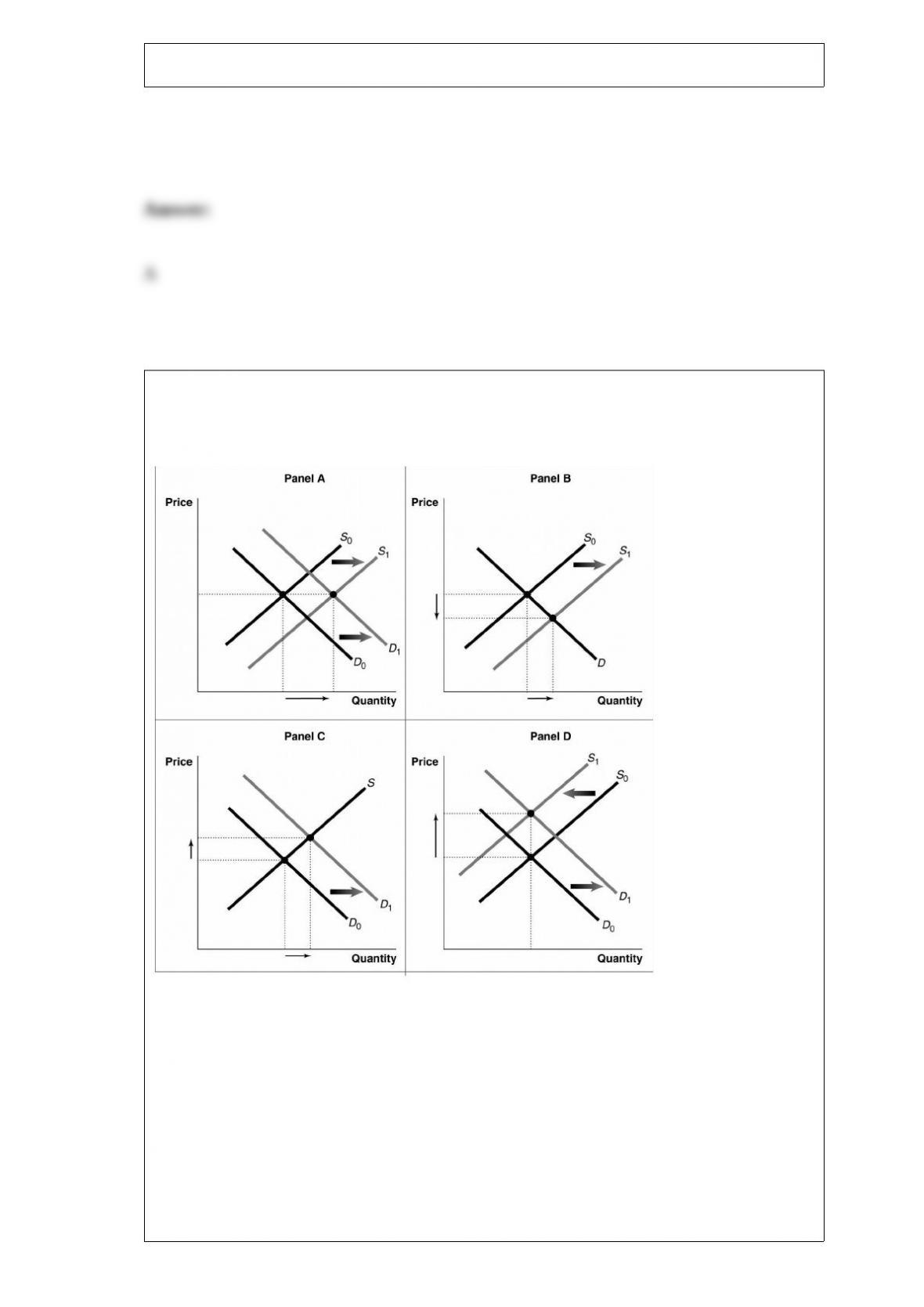
Figure 12-15
Refer to Figure 12-15. Assume that the medical screening industry is perfectly
competitive and that some firms are making short-run losses. Suppose the medical
screening industry runs an effective advertising campaign which convinces a large
number of people that yearly CT scans are critical for good health. Which of the
diagrams in the figure best describes what happens in the industry?
A) Panel A
B) Panel B
C) Panel C
D) Panel D
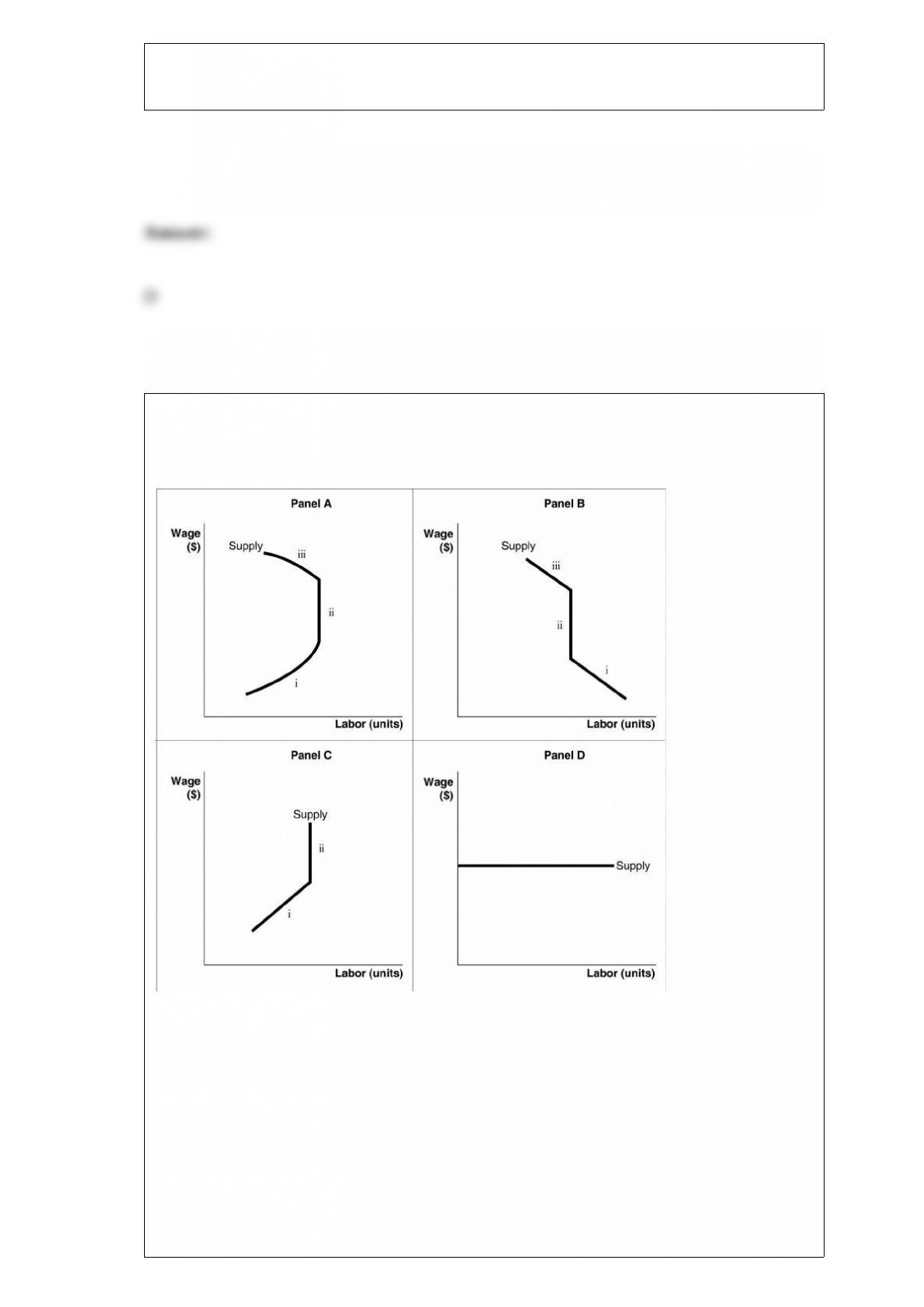
Figure 17-3
Refer to Figure 17-3. Which of the following statements is true?
A) Panel B correctly describes a situation in which the income effect dominates the
substitution effect at low wages (segment i) and again at very high wages (segment iii).
B) Panel B incorrectly describes a situation in which the income effect dominates the
substitution effect at low wages (segment i) and a situation in which the substitution
effect dominates the income effect at very high wages (segment iii).
C) Panel B incorrectly describes a situation in which the income effect dominates the
substitution effect at low wages (segment i).
D) Panel B incorrectly describes a situation in which the income effect dominates the
substitution effect at very high wages (segment iii)
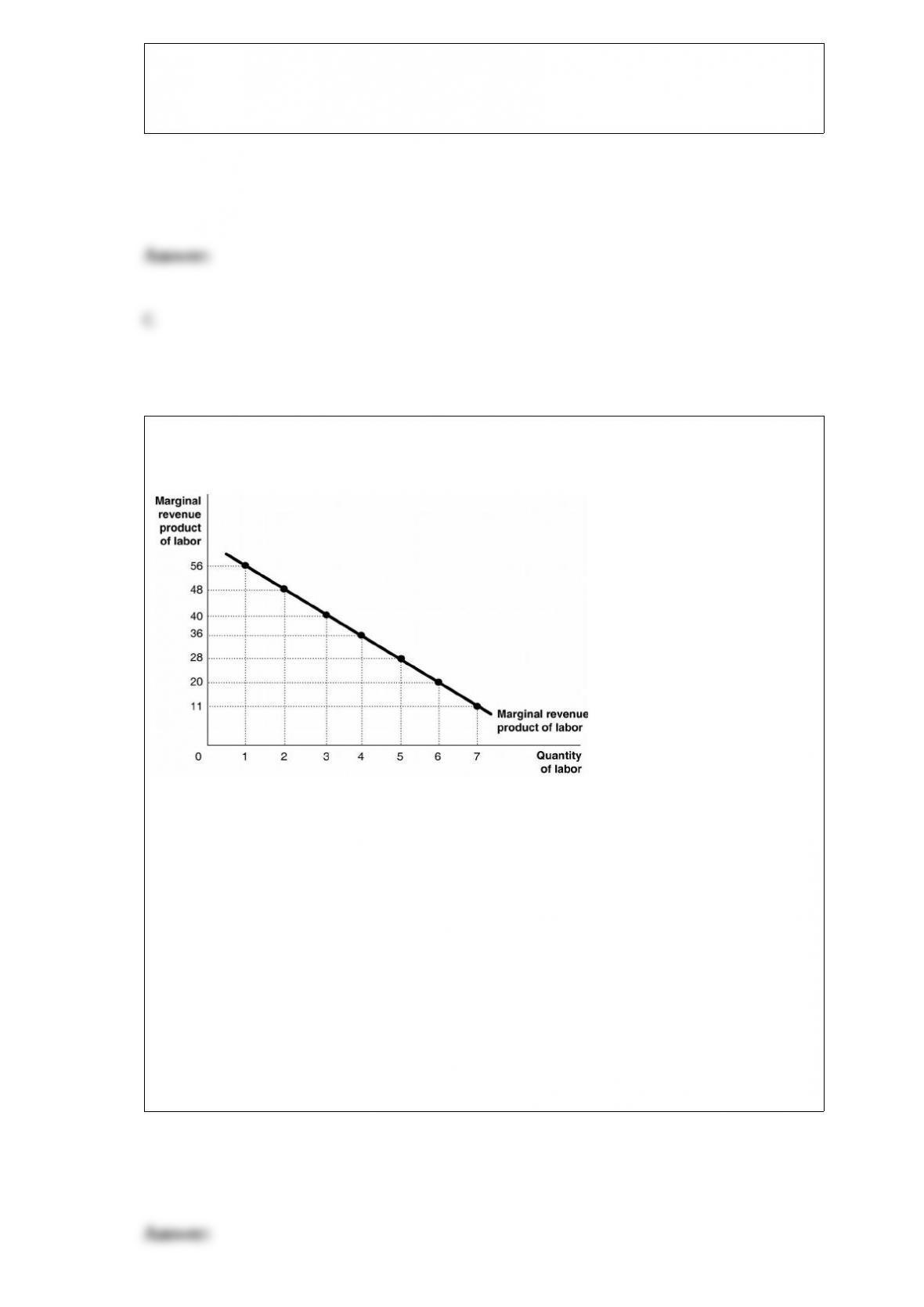
Figure 17-1
Figure 17-1 shows the marginal revenue product for Dale’s Hand-Sewn Doilies, a
producer of linen doilies.
Refer to Figure 17-1. Suppose the market price of doilies rises to $3. What happens to
the curve given in the diagram?
A) Nothing, because labor’s productivity has not changed.
B) There will be a movement along the curve.
C) The curve shifts to the right.
D) We cannot answer the question without knowing if Dale would want to hire more
workers.
The Wong family consumes 3 pounds of fish and 5 pounds of chicken per month. The
price of fish is $8 per pound and chicken is $4 per pound.
a. What is the amount of income allocated to fish and chicken consumption?
b. What is the price ratio (the price of fish relative to the price of chicken)?
c. Explain the meaning of the price ratio you computed.
d. If the Wongs maximize utility, what is the ratio of the marginal utility of fish to the
marginal utility of chicken?
e. If the price of chicken rises, will the Wong family consume more chicken, less
chicken or the same amount of chicken? Explain your answer using the rule of equal
marginal utility per dollar.
Table 10-1
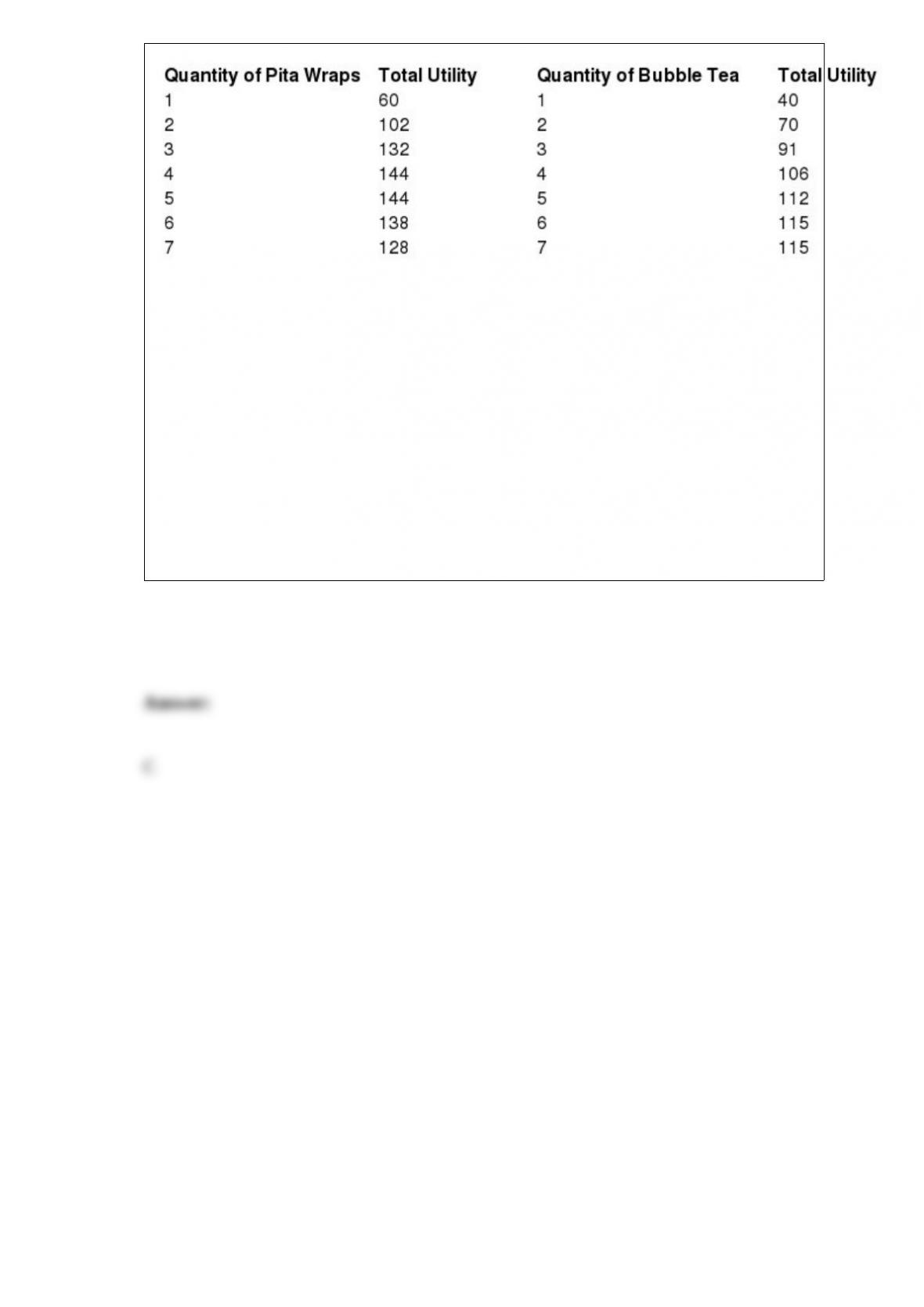
Keegan has $30 to spend on Pita Wraps and Bubble Tea. The price of a Pita Wrap is $6
and the price of a glass of Bubble Tea is $3. Table 10-1 shows his total utility from
different quantities of the two items.
Refer to Table 10-1. If Keegan can drink all the bubble tea he wants for free, how many
glasses will he consume?
A) 4 glasses
B) 5 glasses
C) 6 glasses
D) 7 glasses