
A market failure occurs when
a. shortages or surpluses of some good cannot be eliminated.
b. a private market cannot provide a good in socially efficient quantities.
c. consumers’ surplus falls to zero.
d. property is privately owned and people behave competitively.
Which of the following is not a reason to expect the slope of a consumer’s indifference
curve for current and future consumption to be greater than 1 with an endowment along
the 45° line?
a. People are naturally impatient.
b. One is never sure if he will be alive in the future.
c. A unit consumed today offers memories of consumption into the future.
d. A decline in interest rates.
What price does a monopoly charge when it perfectly implements a two-part tariff?
a. The simple monopoly price.
b. The competitive price.

c. A price higher than that charged by a simple monopoly.
d. A price between the monopoly and competitive prices.
Elasticity measures are preferred by economists to measures of slope when analyzing
changes in the quantity of a good consumers purchase because
a. they are harder to calculate.
b. the measure of slope is dependent upon the units of measurement, elasticity is not.
c. the measure of slope does not have any units of measurement, elasticity does.
d. elasticity measures depend upon the type of currency, slope does not.
Which of the following is an example of regulating quality standards?
a. Advertising bans.
b. Blue laws.
c. The minimum wage.
d. Professional licensing requirements.

Consider the ordinary and compensated demand curves for a normal good. If the price
of the good falls, then
a. the ordinary demand curve will show the larger increase in quantity demanded.
b. the compensated demand curve will show the larger increase in quantity demanded.
c. the increase in quantity demanded will be the same for the ordinary and compensated
demand curves.
d. we cannot predict whether ordinary or compensated demand will show the larger
response in quantity demanded.
Goods X and Y
For the following questions, assume that good X is on the horizontal axis and good Y is
on the vertical axis in the consumer-choice diagram. PX denotes the price of good X, PY
is the price of good Y, and I is the consumer’s income. Unless otherwise stated, the
consumer’s preferences are assumed to satisfy the standard assumptions.
Suppose the consumer is spending all of his income buying some of both goods. If the
marginal value of X is greater than the relative price of X, how can the consumer
improve his level of satisfaction?
a. By purchasing more of both goods.
b. By purchasing more of good X and less of good Y.
c. By purchasing more of good Y and less of good X.

d. The consumer cannot improve his level of satisfaction because he is at the optimum.
Goods X and Y
For the following questions, assume that good X is on the horizontal axis and good Y is
on the vertical axis in the consumer-choice diagram. PX denotes the price of good X, PY
is the price of good Y, and I is the consumer’s income. Unless otherwise stated, the
consumer’s preferences are assumed to satisfy the standard assumptions.
. Which of the following can cause a parallel, outward shift in the budget line?
a. A rise in the consumer’s income.
b. A rise in the marginal value of X in terms of Y.
c. A fall in the price of good X.
d. A fall in the price of good Y.
Mexico and Japan
The following questions refer to the following table which shows the abilities of
Mexico and Japan to produce food and cloth. Food and cloth are the only two
commodities in the world and their production requires only labor. The amounts of
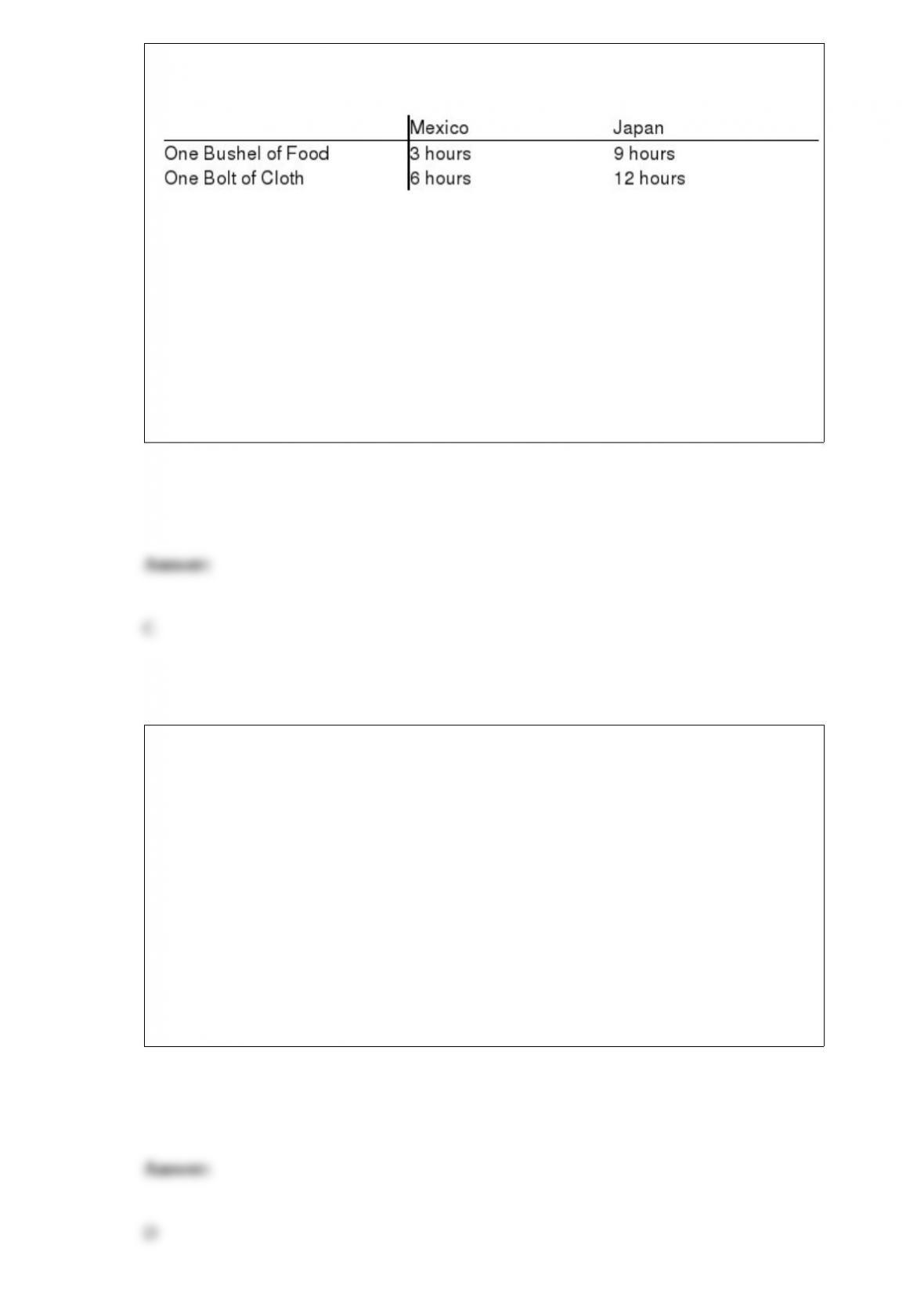
labor required to produce one unit of each of these commodities in the two countries are
shown in the table below.
What is the cost of producing cloth in Japan?
a. 1/2 bushel of food per bolt of cloth.
b. 3/4 bushel of food per bolt of cloth.
c. 4/3 bushels of food per bolt of cloth.
d. 3 bushels of food per bolt of cloth.
Monopoly Problem. Consider a monopoly with constant marginal costs of $20.
Consumers in the market for this monopoly’s product have demand of Q = 100 – 2P.
equation for this monopolist’s marginal revenue is
a. MR = 100 – 2P
b. MR = 100 – 4P
c. MR = 50 – 0.5Q
d. MR = 50 – Q

If the government conducts a survey asking it citizens how much they value having
potholes filled in, we can expect
a. an accurate evaluation of the work.
b. citizens to understate the value of the work.
c. citizens to exaggerate the value of the work.
d. most citizens to refuse to answer.
When inflation causes the absolute prices of all commodities to rise, what happens to
the relative prices of those commodities?
a. The relative prices also rise.
b. When absolute prices rise, the corresponding relative prices fall.
c. The relative prices are unaffected by changes in absolute prices.
d. No prediction can be made about changes in relative prices.
What is the marginal cost of producing a sixth unit of output?
a. $29.

b. $92.
c. $100.
d. Cannot be determined with the information available.
Frequently, a public good can be adequately provided by private action when its
benefits are
a. concentrated among a small number of people.
b. equally valued by everyone.
c. widespread.
d. greater than its costs.
Mexico and Japan
The following questions refer to the following table which shows the abilities of
Mexico and Japan to produce food and cloth. Food and cloth are the only two
commodities in the world and their production requires only labor. The amounts of
labor required to produce one unit of each of these commodities in the two countries are
shown in the table below.
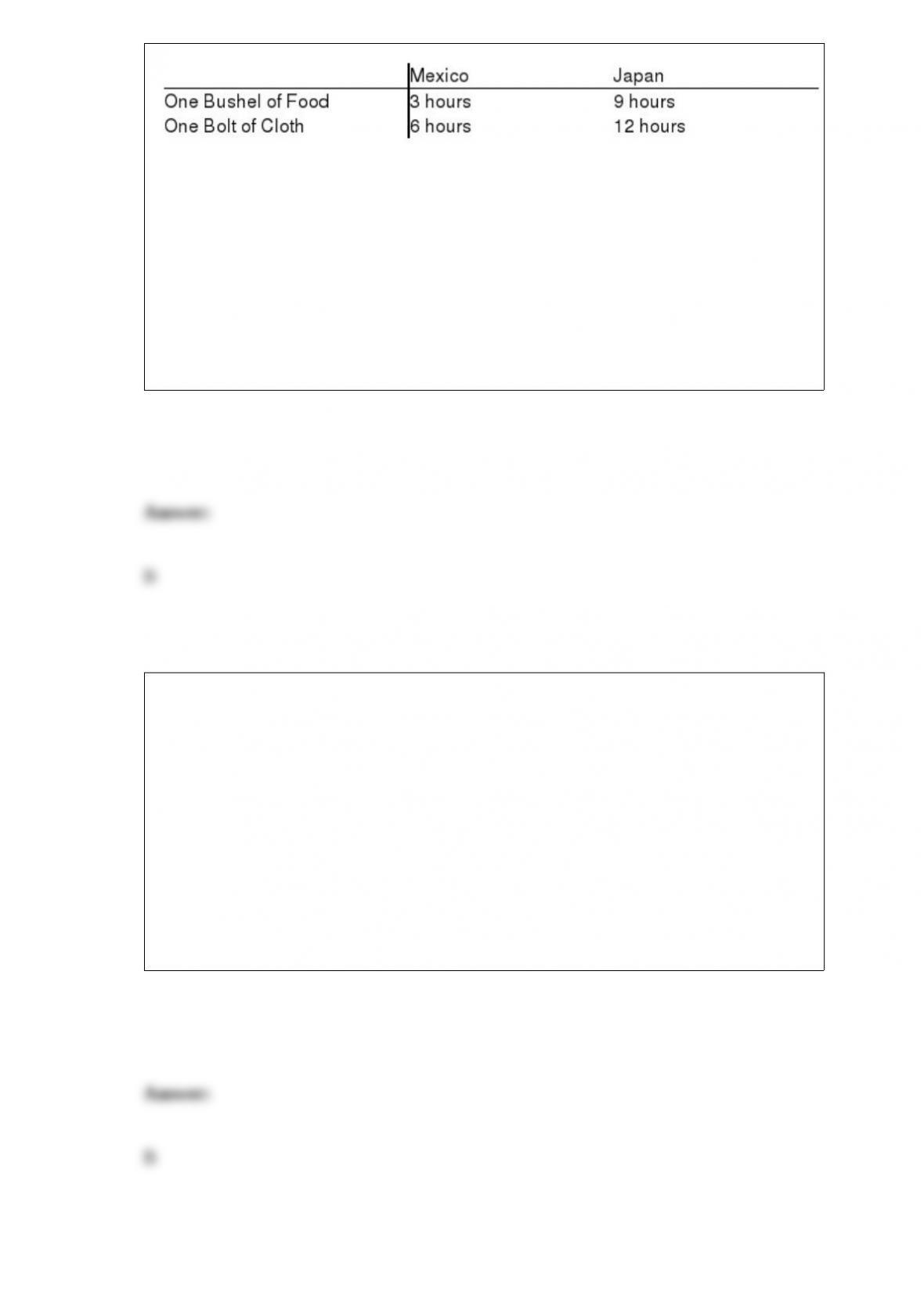
What is the cost of producing 1 bushel of food in Mexico?
a. 3 hours of labor.
b. 1/2 bolt of cloth.
c. 1/3 bushel of imported Japanese food.
d. 1/4 bolt of imported Japanese cloth.
Bonzo’s success in the Easter Basket business has attracted more characters into the
Easter Basket industry. If Easter Basket making is a constant cost industry, Bonzo
a. and the new entrants can all expect to be enjoying his current level of profits.
b. can expect his profits to be driven down to zero as new competitors push the price
down.
c. can expect to have to shutdown his operation in the face of new competition.
d. will have to increase his price to make up for the loss of any sales to new
competitors.

Using h to represent price elasticity of demand, a simple monopolist will find that its
marginal revenue at any point along its demand curve is equal to price at that point
multiplied by
a. (1 – 1/½h½)
b. 1/½h½
c. ½h½
d. ½h½*MC
A dominant strategy is one which
a. is best for a player no matter what strategy the other player chooses.
b. is optimal given the other player’s strategy, but may not be optimal should the other
player switch strategies.
c. will lead to a Pareto-optimal outcome.
d. will be chosen by the first player in a sequential game.
Supply and Demand
The following questions refer to the accompanying graph, which shows the supply and
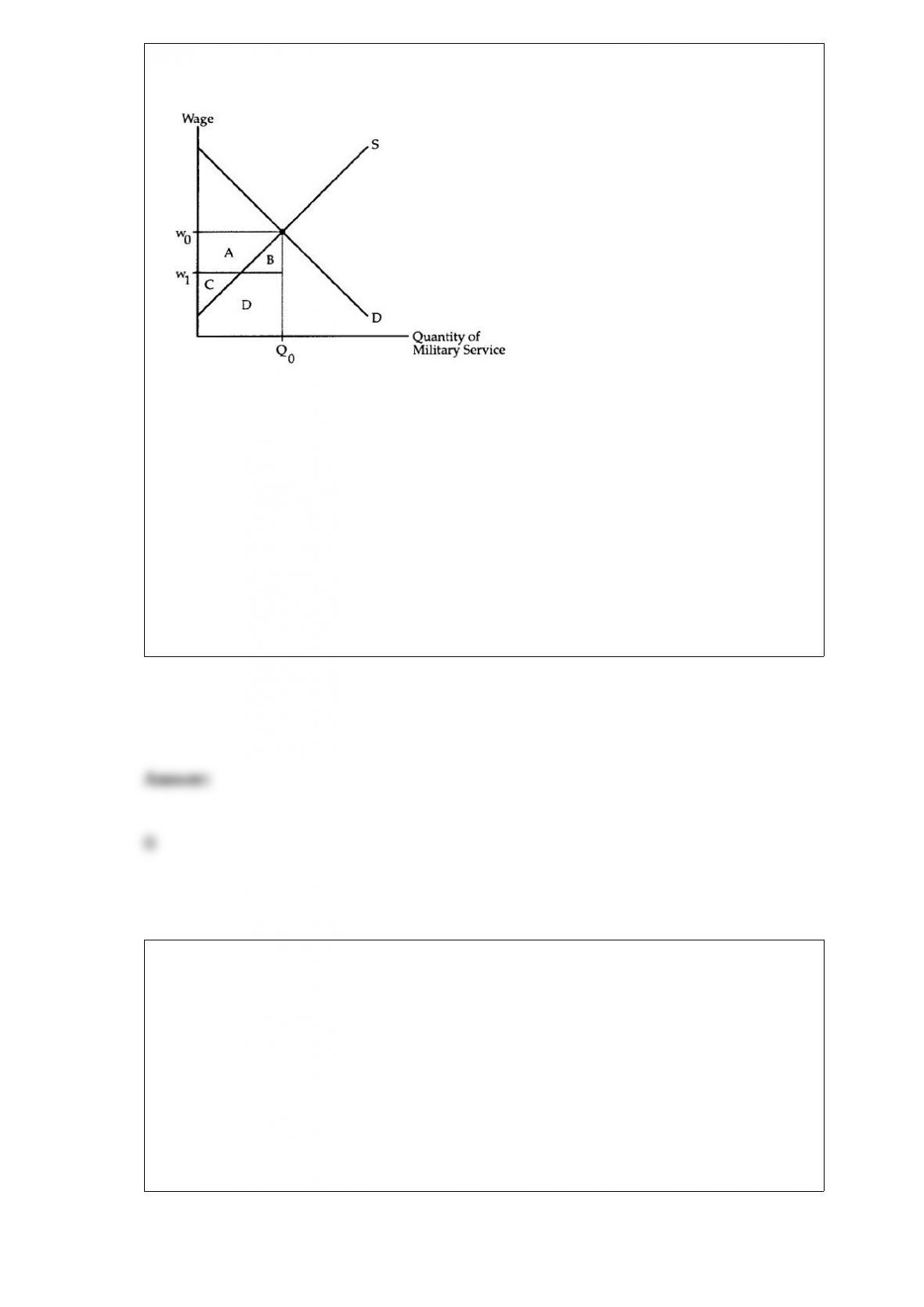
demand for military service.
Suppose the government relies on a volunteer army of size Q0 and pays soldiers the
wage w0. What does the area A + C represent?
a. The total wages paid by the government to the soldiers.
b. The rent earned by the soldiers.
c. The opportunity cost of the volunteers’ service.
d. The cost of the army to society.
The diagram used to show one player’s strategies across the top and the other player’s
strategies along the left, with the corresponding outcomes in the appropriate boxes is a
a. game matrix.
b. flow chart.
c. mixed strategy.
d. an oligopoly problem.

The expansion of capital that can occur in the long-run but not, by definition, in the
short-run, means that the long-run supply is
a. perfectly horizontal while the short-run supply curve is upward sloping.
b. sloping downwards while the short-run supply curve is upward sloping.
c. less elastic than the short-run supply curve.
d. more elastic than the short-run supply curve.
Which of the following is a normative economic statement?
a. A tax on corporate taxes will increase unemployment.
b. A rise in the minimum wage will increase unemployment.
c. A tax on the wealthy is more fair than a tax on the poor.
d. A rise in price will reduce consumer surplus.

Intertemporal substitution dictates that
a. people will work less in periods of high productivity.
b. people will spend more in periods of high productivity.
c. people will work more in periods of high productivity.
d. people will spend less in periods of high productivity.
Which of the following activities would fall under the leisure category in labor-leisure
indifference curve analysis
In the indifference curve-budget line model of labor supply, the slope of the
indifference curves is used to measure
a. the wage rate.
b. labor’s marginal product.
c. the worker’s nonlabor income.

d. the marginal value of leisure.
A simple monopoly will maximize its profit by producing the quantity where
a. price and marginal cost are equal.
b. the demand curve crosses the average cost curve.
c. marginal cost reaches its minimum.
d. marginal revenue equals marginal cost.
When a factor of production is in fixed supply, the revenue it earns
a. consists entirely of rent.
b. is an efficiency wage.
c. is independent of how the resource is used.
d. consists entirely of deadweight loss.

Private markets tend to undersupply nonexcludable goods because of
a. individuals’ incentives to be untruthful.
b. overcrowding.
c. free riding.
d. dissipated rents.
A limited military draft is likely to be inefficient because
a. it transfers wealth from those who are drafted to those who benefit from the army’s
services.
b. the wage rate paid to army personnel is set by the government, not by the market.
c. more people will be drafted than would have joined a volunteer army.
d. there is no guarantee that young adults with the lowest opportunity costs will be
drafted.

A fair coin is flipped. If it lands heads the person receives $1.00. If it lands tails, the
person receives $11.00. If the person is willing to pay $6.00 to take this gamble, they
must be
a. risk-averse.
b. risk-neutral.
c. risk-preferring.
d. either risk-neutral or risk-preferring (not risk-averse).
All points on a risk-neutral individual’s indifference curve have the same expected
value.
A firm’s marginal revenue product of labor equals the marginal product of labor times
the cost per unit of the labor.

When the price of a good rises, the income effect always reduces the quantity
demanded of the good.
When a firm has chosen to shutdown it has exited the industry.
The slope of the budget line always equals the consumer’s marginal value.
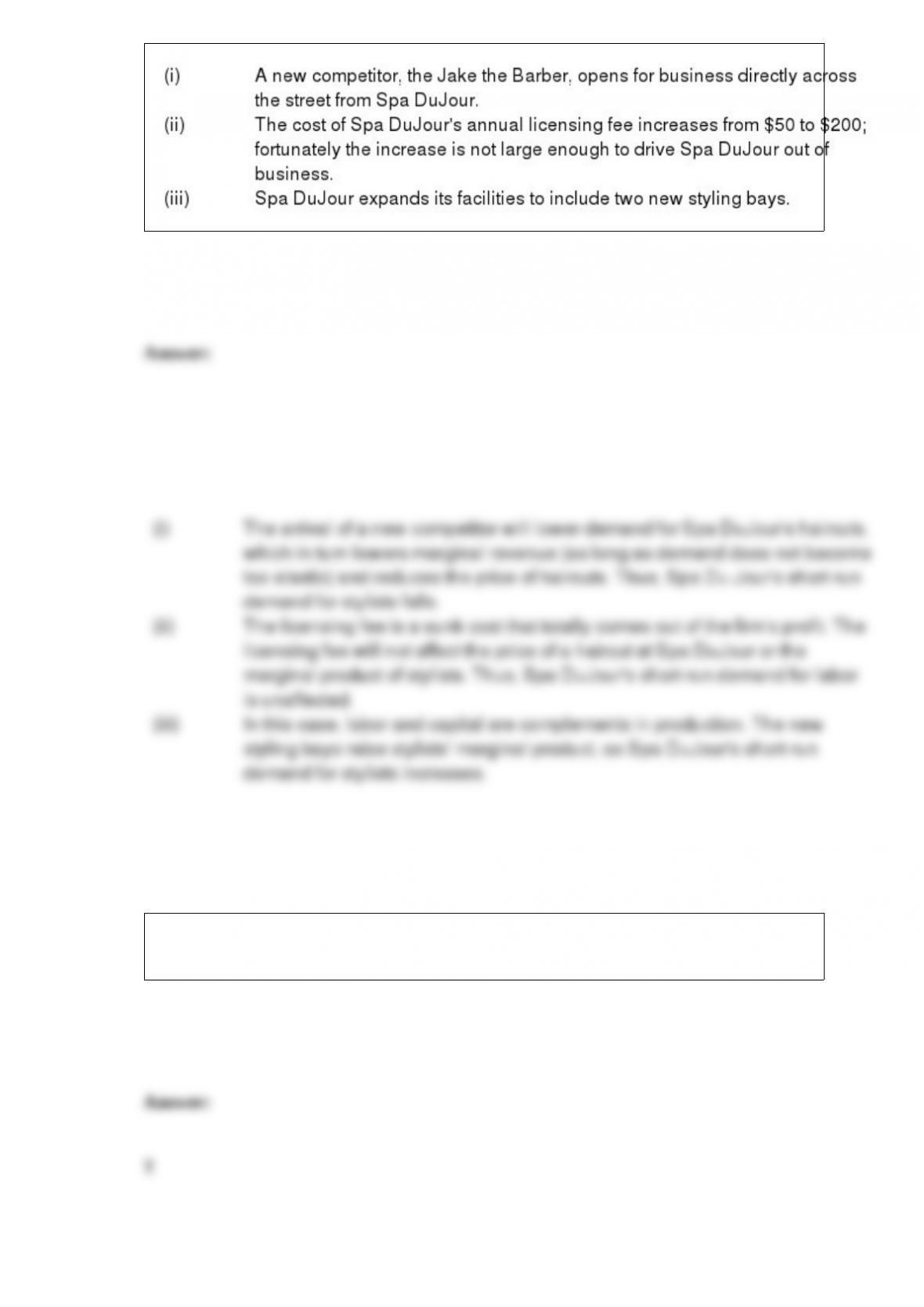
The Spa DuJour Salon faces a downward-sloping demand curve for haircuts and hires
stylists in a competitive labor market. How will each of the following affect the
short-run demand for stylists at Armadillo?
When the law of supply holds, an increase in the price of a product will cause producers
to increase the quantity they wish to sell.
For each of the following pairs of products, discuss which of the two would be expected
to be more price elastic and explain why.
i. water vs. diamonds
ii. insulin vs. cough syrup
iii. meat vs. filet mignon
iv. gasoline right after hurricane Katrina vs. gasoline over that entire summer
The marginal value of a good is the dollar value that the consumer receives, on average,
from each unit of the good purchased.

The price of a good accurately reflects the total value it creates for society.
A $5 per unit sales tax is bad for consumers because it implies that the total amount
(price plus tax) that they must pay increases by $5.
The substitution and income effects are in opposition when the price of an inferior good
changes.
An increase in the price of gasoline relative to telephones will cause inflation.

Higher costs, whether fixed or variable, will cause a leftward shift in the industry’s
short-run supply curve.
Adverse selection can cause insurance companies to limit the amount of insurance they
provide to people who are “poor risks.”
Define the term rent. Explain why confiscation of rents would cause more than a simple
transfer of income from resource owners to the government.