1) pure monopoly means:
a.any market in which the demand curve to the firm is downsloping.
b.a standardized product being produced by many firms.
c.a single firm producing a product for which there are no close substitutes.
d.a large number of firms producing a differentiated product.
2)
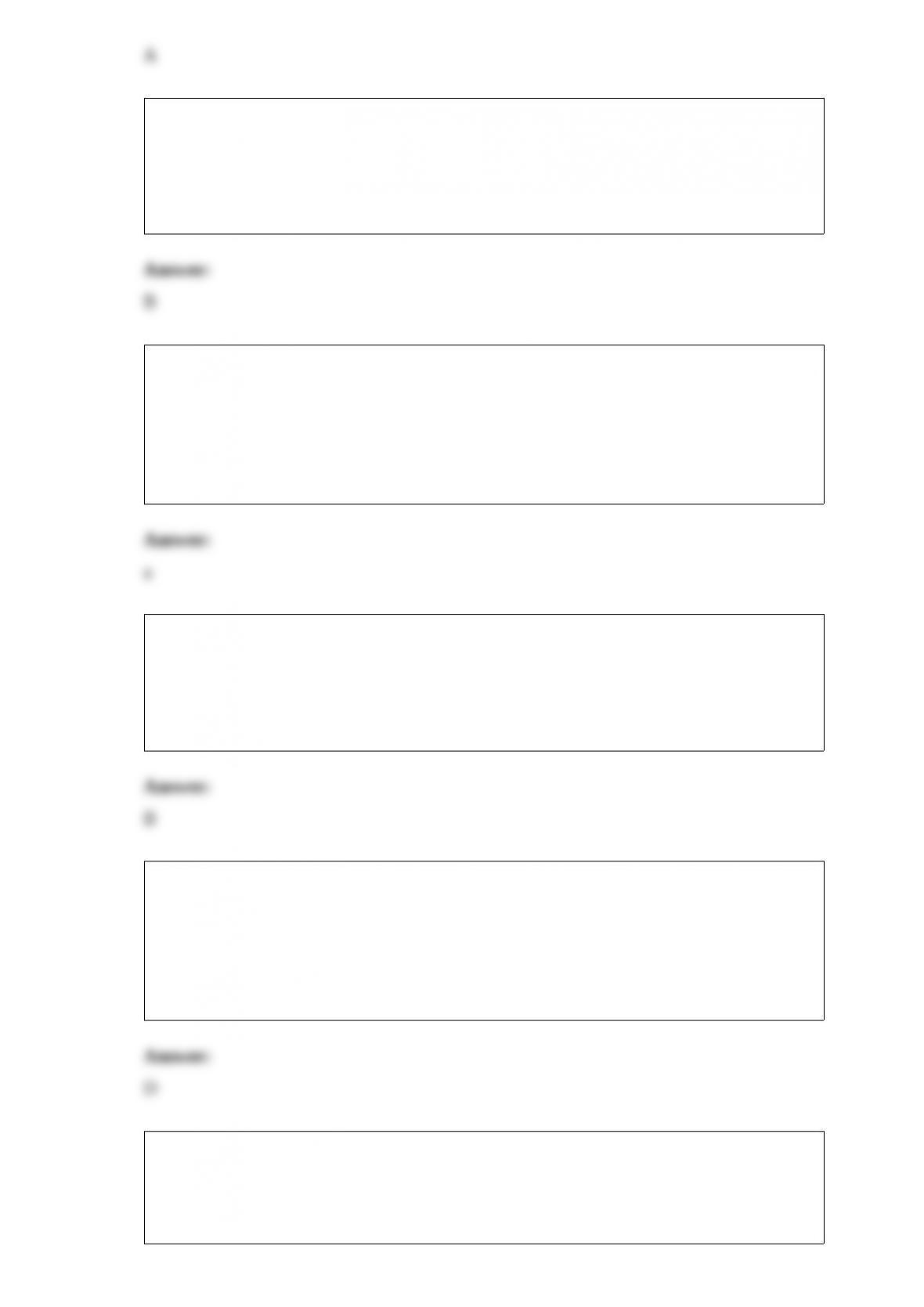
Refer to the above diagrams, in which AD1 and AS1 are the “before” curves and AD2
and AS2 are the “after” curves. Other things equal, a decline in investment spending
caused by the interest-rate effect of a price-level increase is depicted by the:
A.shift of the AD curve in panel (A).
B.shift of the AS curve in panel (B).
C.move from point a to point b in panel (B).
D.move from point a to point c in panel (C).
3) If the Fed were to set policy according to the Taylor rule, then if real GDP falls by 2
percent below potential GDP, the Fed should:
A.raise the Federal funds rate by 1 percentage point.
B.reduce the Federal funds rate by 1 percentage point.
C.raise the inflation rate by 1 percentage point.
D.change the Federal funds rate until inflation hits the target rate of 4 percent.
4) Other things equal, if wage rates increase by 20 percent, the greatest decline in
employment will occur when labor costs are a:
A.large proportion of total costs and product demand is elastic.
B.small proportion of total costs and product demand is elastic.
C.large proportion of total costs and product demand is inelastic.
D.small proportion of total costs and product demand is inelastic.
5) The current system of exchange rates can best be described as:
A.freely fluctuating exchange rates.
B.managed floating exchange rates.
C.rigidly fixed exchange rates.
D.an adjustable peg system.
6) suppose that the mr = mc condition cannot be completely met for a firm because
there is no level of output at which mr and mc are equal. in that case the firm should:
a.produce up to and including the last unit for which mr exceeds mc.
b.produce up to and including the last unit for which mc exceeds mr.
c.shut down.
d.continue to produce as long as mr is positive.
7) Plastic cards that contain computer chips that store account balances are known as:
A.credit cards.
B.smart cards.
C.debit cards.
D.E-cards.
8) Which one of the following is most likely to increase the Herfindahl index of a
particular industry?
A.a conglomerate merger
B.a vertical merger
C.a price fixing arrangement among all the industry firms
D.a horizontal merger
9) The demographic transition view alleges that:
A.the DVCs must first accept the use of birth control techniques to increase their
standards of living.
B.population growth will only decline if mortality rates exceed birth rates.
C.if incomes first rise, population growth will then decline.
D.population growth has no bearing on a nation’s per capita income.
10) In saying that the present system of floating exchange rates is managed we mean
that:
A.countries that allow their exchange rate to move freely will lose their borrowing
privileges with the IMF.
B.the value of any IMF member’s currency can only vary 2 percent from its par value.
C.IMF officials determine exchange rates on a day-to-day basis.
D.the central banks of various countries sometimes buy and sell foreign exchange to
alter undesirable trends in exchange rates.
11) The agricultural market for corn can be characterized as a purely competitive
industry. How might the following events affect the short-run cost curves and output for
a firm in the industry?
(a)A reduction in the cost of fertilizer that is sold to corn farmers.
(b)The Internal Revenue Service (IRS) changes tax laws which increase the amount of
depreciation that farmers can deduct for equipment.
(c)The market price of corn falls.
12) The idea of government failure includes all of the following except:
A.limited and bundled choices.
B.bureaucratic inefficiency.
C.pressure by special-interest groups.
D.extensive positive externalities from public and quasi-public goods.
13) What is the difference between the Federal Reserve Banks purchases of securities
from the commercial banking system and those from the public? Give an example.
14) Explain how monopolistically competitive producers try to improve on the
condition of just breaking even in the long run. Is this improvement a benefit for
consumers?
15) Explain in nontechnical terms why oligopolistic prices may tend to be inflexible.
16) What is the median-voter model and what are two implications from it?
17) In practice the antitrust laws deal more with oligopolies than with pure monopolies.

Is this true?