1)
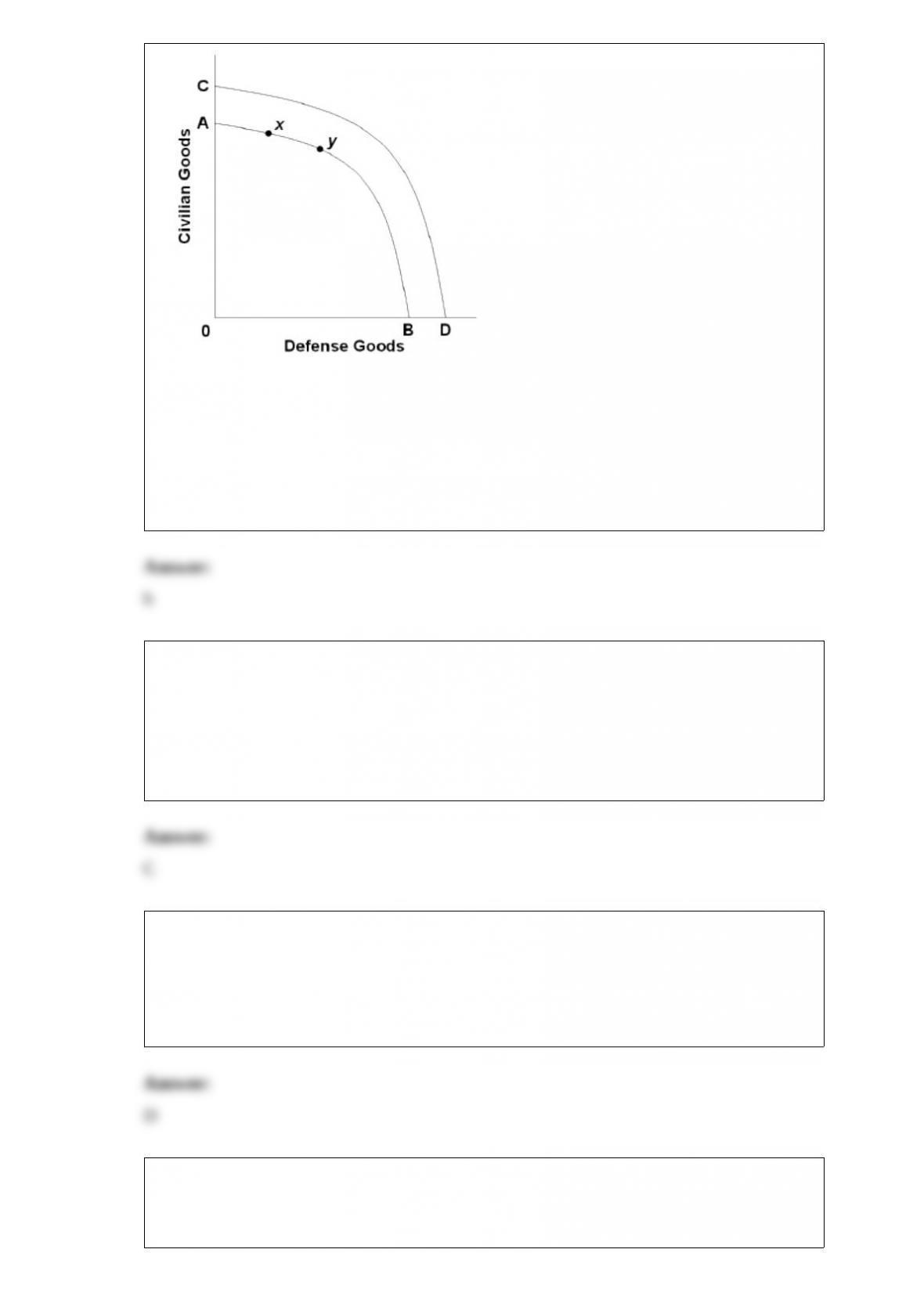
(consider this) refer to the above diagram. suppose that point y represents the optimal
combination of civilian goods and defense goods. we can conclude that at y the
marginal benefit of defense goods:
a.exceeds the marginal cost of defense goods.
b.equals the marginal cost of defense goods.
c.is zero.
d.is negative.
2) Which of the following is the basic economic policy function of the Federal Reserve
Banks?
A.holding the deposits or reserves of commercial banks
B.acting as fiscal agents for the Federal government
C.controlling the supply of money
D.the collection or clearing of checks among commercial banks
3) The equilibrium price level and level of real output occur where:
A.real output is at its highest possible level.
B.export equal imports.
C.the price level is at its lowest level.
D.the aggregate demand and supply curves intersect.
4) A firm is hiring the profit-maximizing amount of an input when:
A.AVC = MC.
B.MP = MRC.
C.MRC = MR.
D.MRP = MRC.
5) Use the following data to calculate: (a) the size of the labor force and (b) the official
unemployment rate.
Total population 1500; population under age 16 and institutionalized, 360; not in labor
force, 450; unemployed, 69; workers with part-time jobs who are looking for full-time
jobs, 30.
6) At the equilibrium level of GDP:
A.MV = nominal GDP.
B.MV = real GDP.
C.M = nominal GDP.
D.V = 1/MPS.
7) suppose you go to a doctor but your health insurance plan reimburses you for only 80
percent of the bill. this is an example of:
a.a copayment.
b.a deductible.
c.monopsony power.
d.a deferred benefit plan.
8) The following domestic supply and demand schedules for a product. Suppose that the
world price of the product is $1.
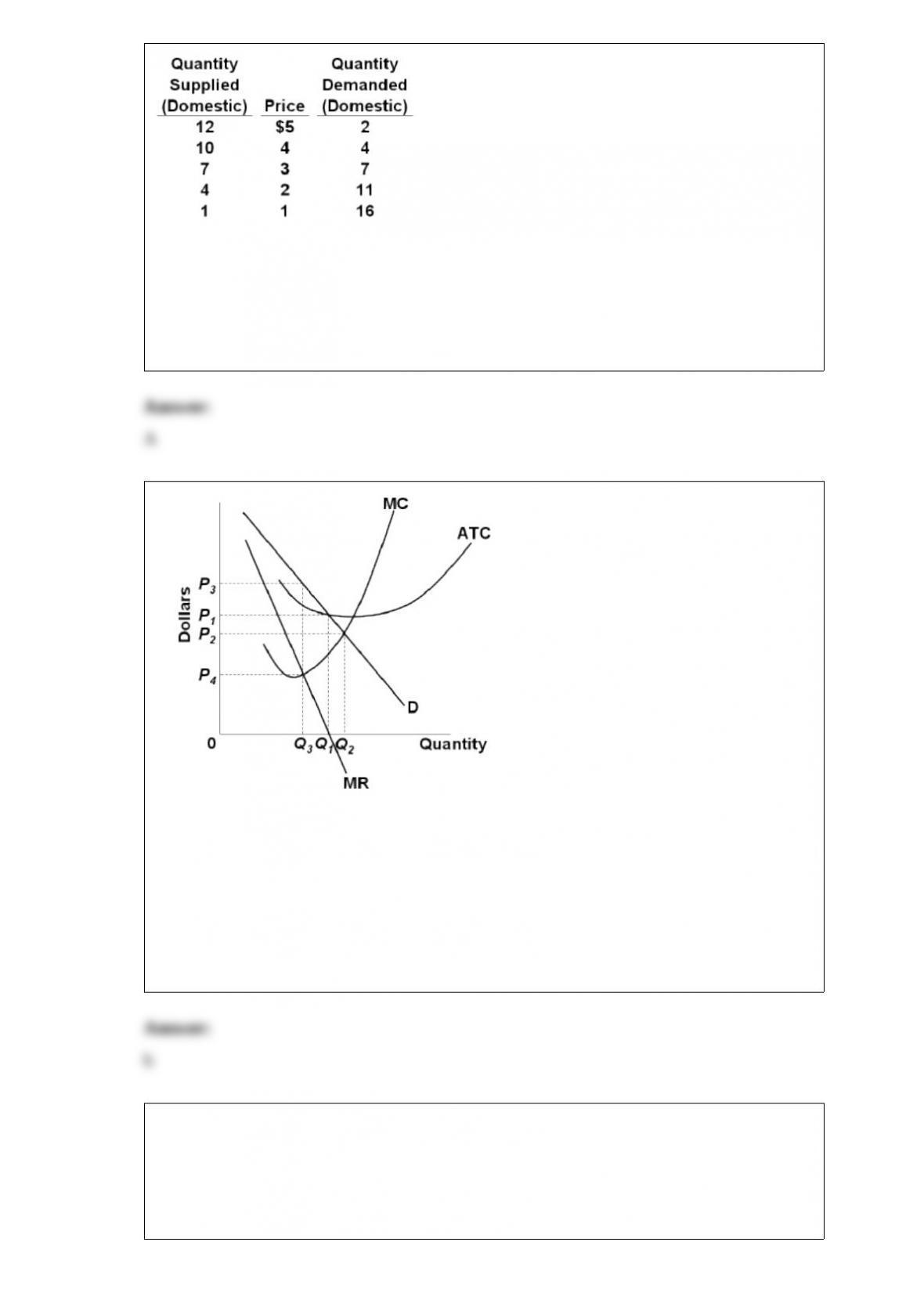
Refer to the above data. With free trade, that is, assuming no tariff, the outputs
produced by domestic and foreign producers respectively would be:
A.1 unit and 15 units.
B.4 units and 7 units.
C.7 units and 0 units.
D.4 units and 6 units.
9)
refer to the above diagram for a pure monopolist. if a regulatory commission sets price
to achieve the most efficient allocation of resources, it will have to:
a.tax the monopolist p3p1 per unit to prevent the monopolist from realizing an
economic profit.
b.subsidize the monopolist or the monopolist will go bankrupt in the long run.
c.subsidize the monopolist p1p4 per unit to allow the monopolist to break even.
d.tax the monopolist p1p2 per unit to prevent the monopolist from realizing an
economic profit.
10) an industry is best defined as a group of firms that:
a.compete for labor.
b.produce identical or similar products.
c.use identical production techniques.
d.are located in the same city or geographic area.
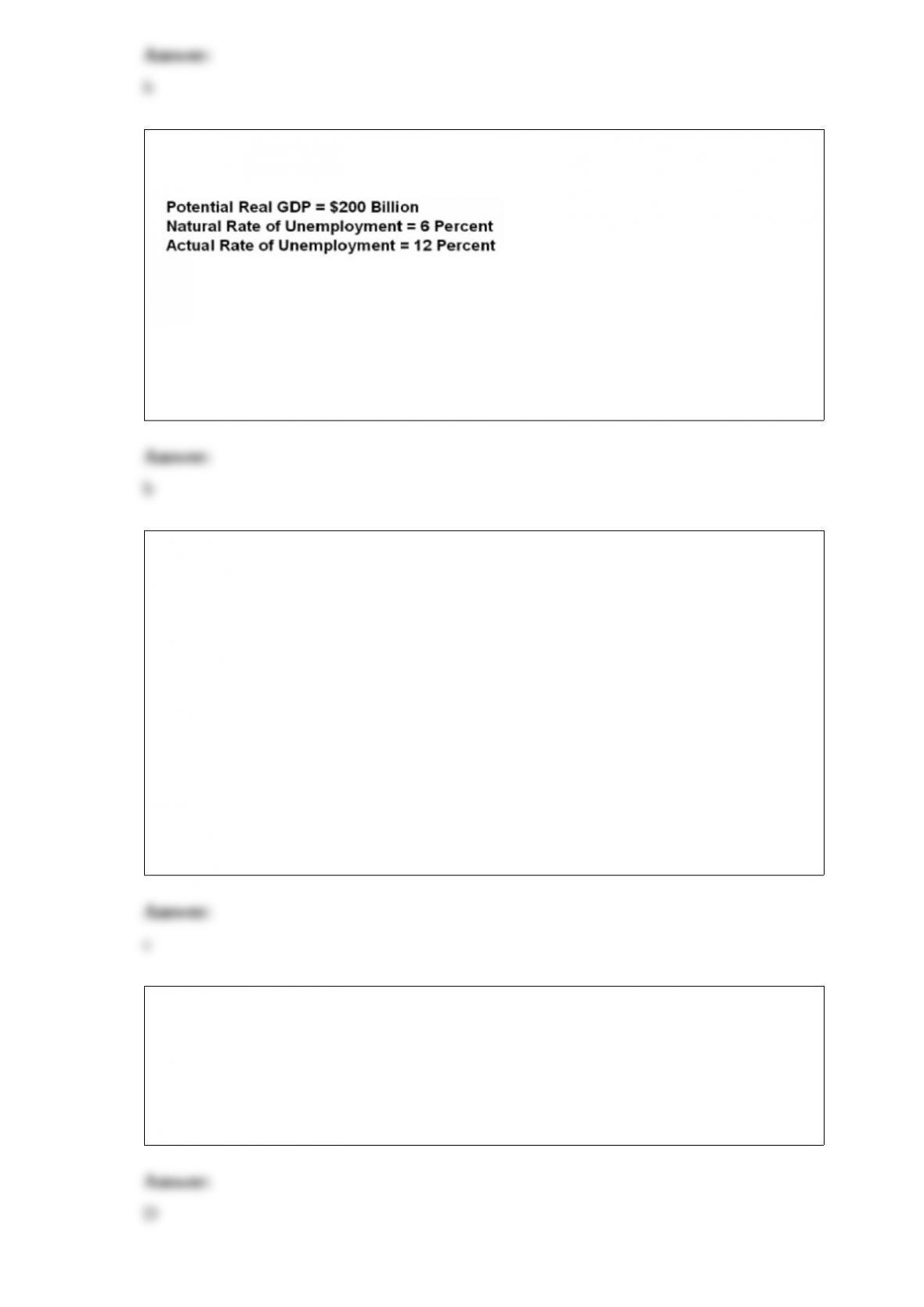
11) answer the next question(s) on the basis of the following information for a specific
year in a hypothetical economy for which okun’s law is applicable:
refer to the above data. the size of the negative gdp gap as a percent of potential gdp for
the above economy is:
a.9 percent.
b.12 percent.
c.15 percent.
d.18 percent.
12) assume that if the interest rate that businesses must pay to borrow funds were 20
percent, it would be unprofitable for businesses to invest in new machinery and
equipment so that investment would be zero. but if the interest rate were 16 percent,
businesses will find it profitable to invest $10 billion. if the interest rate were 12
percent, $20 billion would be invested. assume that total investment continues to
increase by $10 billion for each successive 4 percentage point decline in the interest
rate.
refer to the above information. which of the following is an accurate verbal statement of
the described relationship?
a.there is no regular or dependable relationship between business investment and the
interest rate.
b.the amount of business investment is unaffected by changes in the interest rate.
c.investment spending by businesses varies inversely with the interest rate.
d.investment spending by businesses varies directly with the interest rate.
13) Most monetarists would say that:
A.the MV = PQ equation provides a better understanding of the macroeconomy than
does the Ca + Ig + Xn + G = GDP equation.
B.most changes in the price level are explainable by changes in the money supply.
C.the velocity of money is quite stable.
D.all of these are true.
14) (Last Word) Relative to previous decades, the U.S. economy is less affected by
changes in the price of oil partly because:
A.the composition of GDP has changed from larger, heavier items such as earth movers
and steel products toward smaller, lighter items such as software and microchips.
B.The United States is now more reliant on domestic oil and less reliant on imported
oil.
C.The United States has vastly expanded its hydroelectric capacity (dams and
reservoirs).
D.The ratio of passenger cars to passenger trucks has increased.
15) What economic events and policies led to the emergence of the U.S. economy from
the stagflation of the late 1970s and early 1980s? Depict the effect of these events using
the extended ADAS model.
16) Whenever there is change in spending real GDP will change by a multiple of the
initial change in spending. Explain this multiplier effect.
17) Define the consumption and saving schedules.
18) How do banks partly reconcile the goals of profits and liquidity?
19) What are negative externalities and positive externalities? How do they affect
supply and demand curves?
20) How could you use the Coase theorem to predict what would happen when smoke
from a factory created dirty air and slightly acid rain for all the residents in the area in a
one-mile radius of the plant?
21) What are four criticisms of the single tax on land?
22) What are tying contracts? How are tying contracts treated by antitrust enforcers?
23) What are the four principal tools of monetary policy? Explain how they can be
used.