
Local or state offices of the Department of Justice usually set prices for natural
monopolies in their jurisdictions.
If demand is inelastic, the absolute value of the price elasticity coefficient is greater
than one.
The income effect of a price change refers to the change in the quantity demanded of a
good that results from a change in the price of a complementary product.
The additional output a firm produces by hiring one more worker is called the marginal
product of labor.

One reason why McDonald’s charges a single price for its products is that it is difficult
and costly for the company to determine each individual consumer’s willingness to pay.
Examining the conditions that could lead to a recession in an economy is an example of
a macroeconomics topic.
Labor demand is considered a derived demand because producers do not demand labor
for itself but only because labor is used to produce output that consumers desire.

Firms in perfect competition produce the productively efficient output level in the short
run and in the long run.
In monopolistic competition, if a firm produces a highly desirable product relative to its
competitors, the firm will be able to raise its price without losing any customers.
If the market price is at equilibrium, the producer surplus is minimized.
It is possible to have a comparative advantage in producing a good or service without
having an absolute advantage.

Holding all other factors constant, income earned from capital is more unequally
distributed than income earned from labor.
An entry barrier exists when firms in an industry charge the lowest price possible for
their products.
A product is considered to be excludable if it is jointly owned by all members of a
community.

Perfectly competitive industries tend to produce low-priced, low-technology products.
In a free market there are significant restrictions on how a good or service can be
produced or sold.
You purchase a share of Facebook stock from a friend who purchased the stock 1 year
ago. Your purchase of the stock represents a transaction in the primary financial market.
An important reason why diseconomies of scale arise is because firms may have to hire
lower-skilled workers as firms expand.

When diminishing marginal utility sets in, total utility must be negative.
When voluntary exchange takes place, neither party gains from the exchange.
The most important factor contributing to wage differences in the labor market is
differences in the level of education and training among workers.

In the circular flow model, households demand resources such as labor services in the
factor market.
“A decrease in the price of tablet computers will decrease the demand for desktop
computers.” This statement is an example of a normative economic statement.
A tariff is a numerical limit on the quantity of a good that can be imported.
An increase in the number of firms in a market will cause the quantity of a good
supplied to increase.

If the population increases and input prices decrease, the equilibrium quantity of a
product will definitely increase.
Most food products have low income and price elasticities of demand.
The payment received by suppliers of entrepreneurial skills is called interest.

A normal good is a good for which the demand increases as income decreases, holding
everything else constant.
A monopolistically competitive firm can convince buyers that its product has value by
differentiating its product to suit consumers’ preferences.
The process a firm uses to turn inputs into outputs of goods and services is called
technology.
For a given supply curve, the deadweight loss from the imposition of a tax is smaller if
demand is more elastic.

An optimal two-part tariff pricing schedule maximizes consumer surplus.
As the number of firms in a market decreases, the supply curve will shift to the left and
the equilibrium price will rise.
The only type of business that faces unlimited liability is a sole proprietorship.

The slope of an isoquant is equal to the ratio of the price of the input on the horizontal
axis divided by the price of the input on the vertical axis, multiplied by -1.
If the marginal benefit of reducing emissions of some air pollutant is less than the
marginal cost
A) further reductions will make society better off.
B) further reduction will make society worse off.
C) pollution taxes should be imposed on producers to pay for further reductions.
D) economic efficiency will be increased if further reductions are made.
If economies of scale are relatively important in an industry, the typical firm’s
A) marginal cost curve will decline continuously until it reaches minimum efficient
scale.
B) long-run average cost curve will begin rising before it reaches minimum efficient
scale.
C) long-run average cost curve will reach a minimum at a level of output that leaves
room for a large number of firms to enter the industry.
D) long-run average cost curve will reach a minimum at a level of output that is a
relatively large fraction of total industry sales.

The attainable production points on a production possibilities curve are
A) the horizontal and vertical intercepts.
B) the points along the production possibilities frontier.
C) the points outside the area enclosed by the production possibilities frontier.
D) the points along and inside the production possibility frontier.
Patents, tariffs, and quotas are all examples of
A) government-imposed barriers.
B) economic regulations that increase efficiency.
C) entry barriers that improve a country’s standard of living.
D) entry barriers that protect consumers.
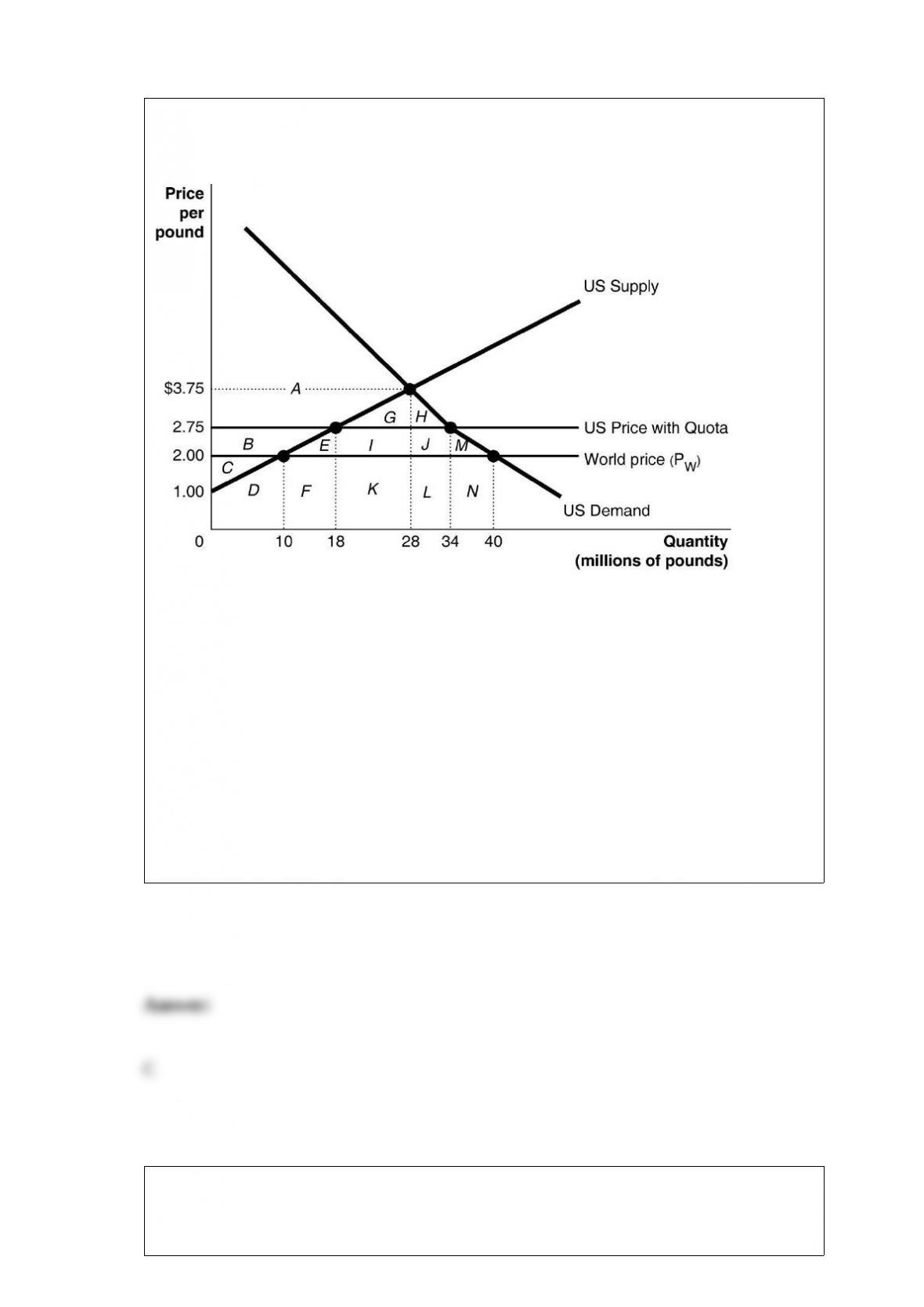
Figure 9-3
Since 1953 the United States has imposed a quota to limit the imports of peanuts.
Figure 9-3 illustrates the impact of the quota.
Refer to Figure 9-3. If there was no quota, how many pounds of peanuts would be
imported?
A) 16 million
B) 24 million
C) 30 million
D) 40 million
If you received negative marginal utility from consuming the 4th slice of pizza, then
your total utility from 4 slices of pizza must be less than your total utility from 3 slices
of pizza.

If the price of muffins, a normal good you enjoy, rises
A) the income and substitution effects offset each other but the price effect leads you to
buy fewer muffins.
B) both the income and substitution effects lead you to buy fewer muffins.
C) the substitution effect which causes you to decrease your muffin consumption
outweighs the income effect which causes you to increase your muffin consumption,
resulting in fewer muffins purchased.
D) the income effect which causes you to decrease your muffin consumption outweighs
the substitution effect which causes you to increase your muffin consumption, resulting
in fewer muffins purchased.
The expenses you encounter when you buy in one market and sell in a distant market
are known as
A) production costs.
B) fixed costs.
C) transactions costs.
D) sunk costs.
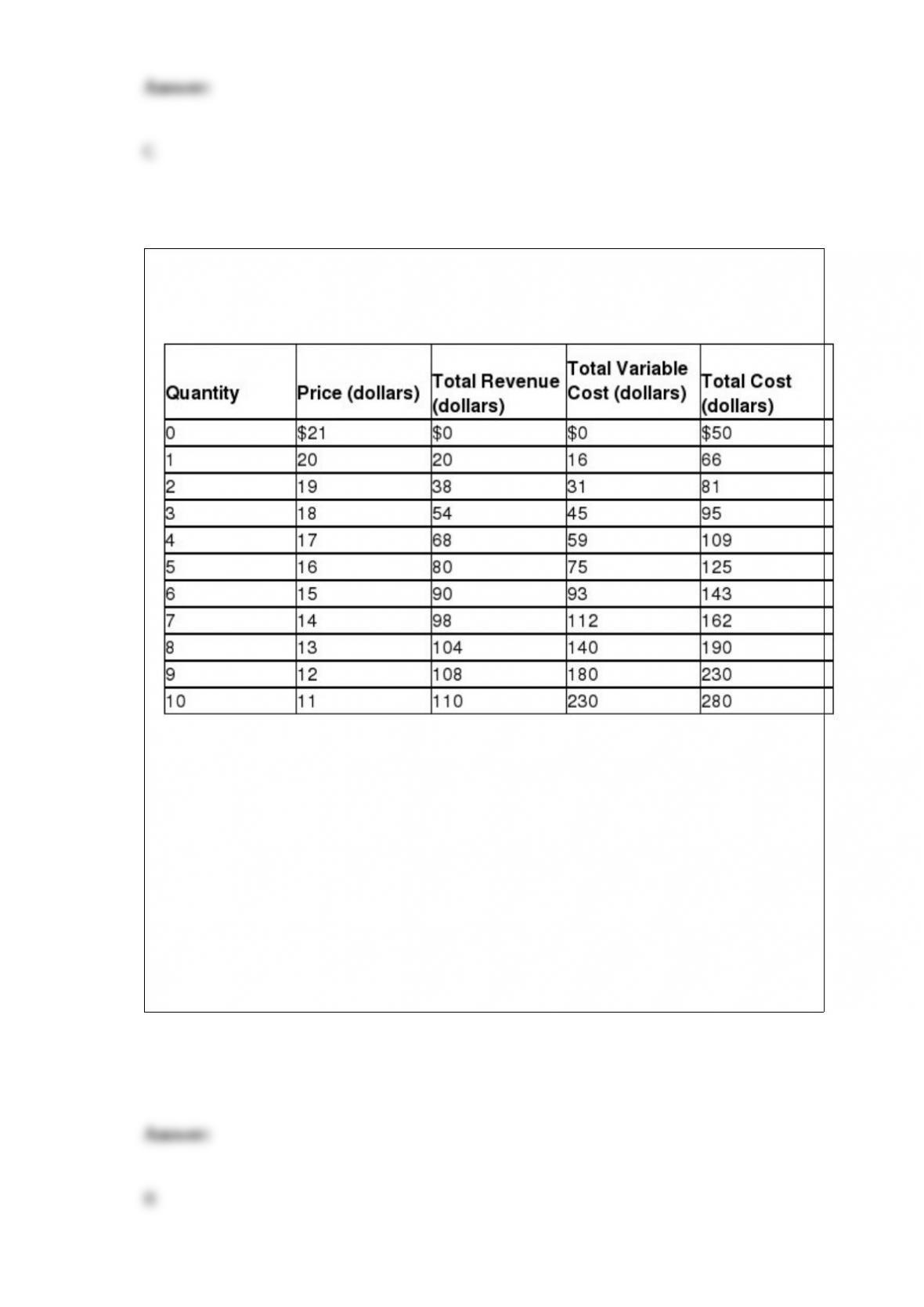
Table 13-3
Table 13-3 shows the demand and cost schedules for a monopolistically competitive
firm.
Refer to Table 13-3. What is the amount of the firm’s loss at its optimal output level?
A) $0
B) $41
C) $45
D) $50
Which of the following describes how a positive externality affects a competitive
market?
A) The externality causes a difference between the private benefit from consumption
and the social benefit.
B) The externality causes a difference between the private benefit from production and
the social cost of production.
C) The externality causes quantity demanded to exceed quantity supplied.
D) The externality causes a difference between the social cost of production and the
social cost of consumption.
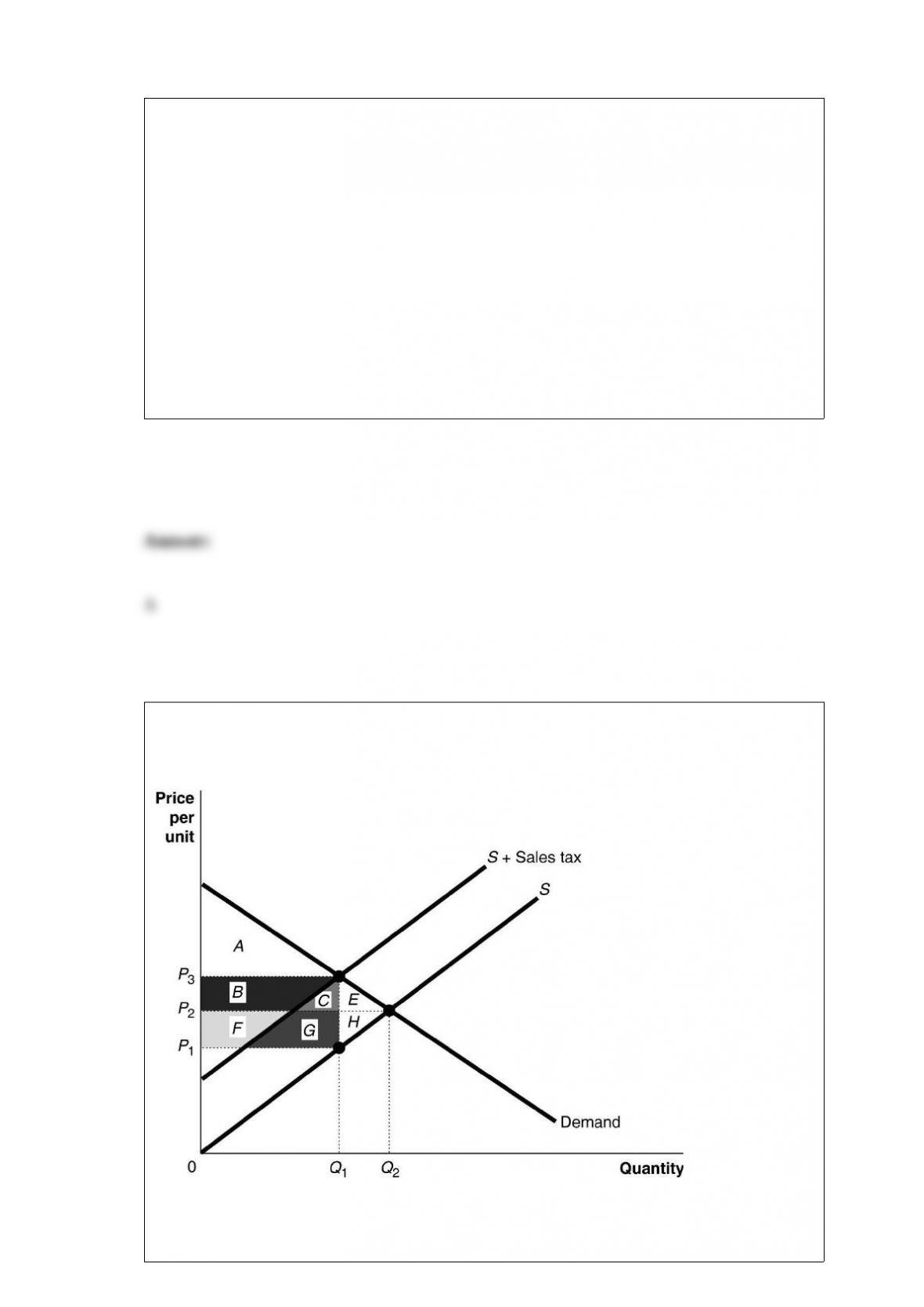
Figure 18-1
Refer to Figure 18-1. Of the tax revenue collected by the government, the portion
borne by producers is represented by the area
A) B + C.
B) F + G.
C) E + H.
D) B + C + F + G.
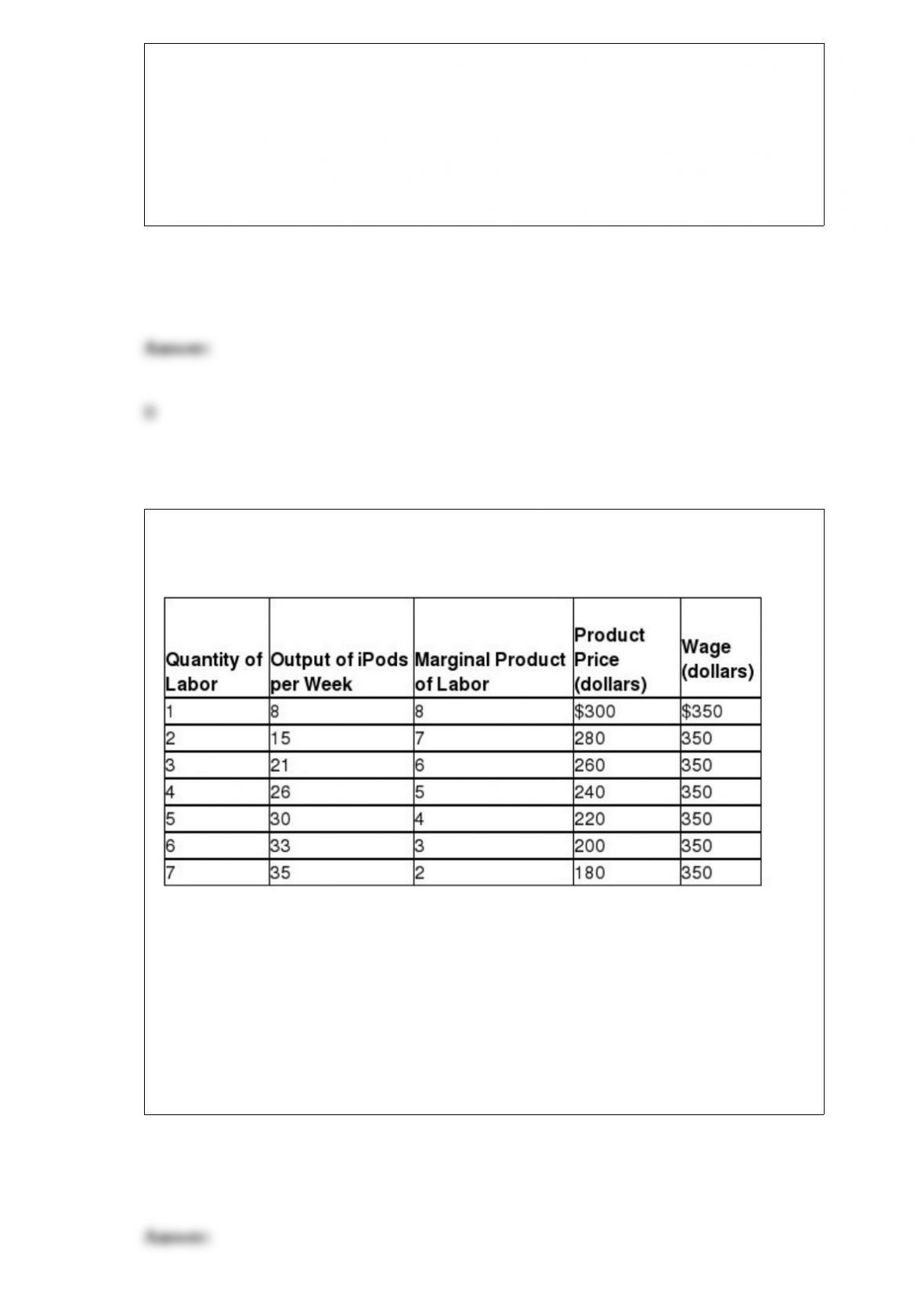
Table 17-2
Refer to Table 17-2. The firm represented in the diagram
A) has market power in the factor market.
B) has market power in the output market.
C) has market power in both the factor and product market.
D) has no market power in the factor or product market.

If the price of hairspray is represented by equation P = 10 – 2 QD, then the
corresponding quantity of hairspray demanded is represented by the equation
A) QD = 5P – 2.
B) QD = 0.5P + 2.
C) QD = 50 -5P.
D) QD = -10 + 0.2P.
When you buy previously-issued shares of Twitter stock, this transaction takes place in
the
A) primary market.
B) bond market.
C) secondary market.
D) bear market.
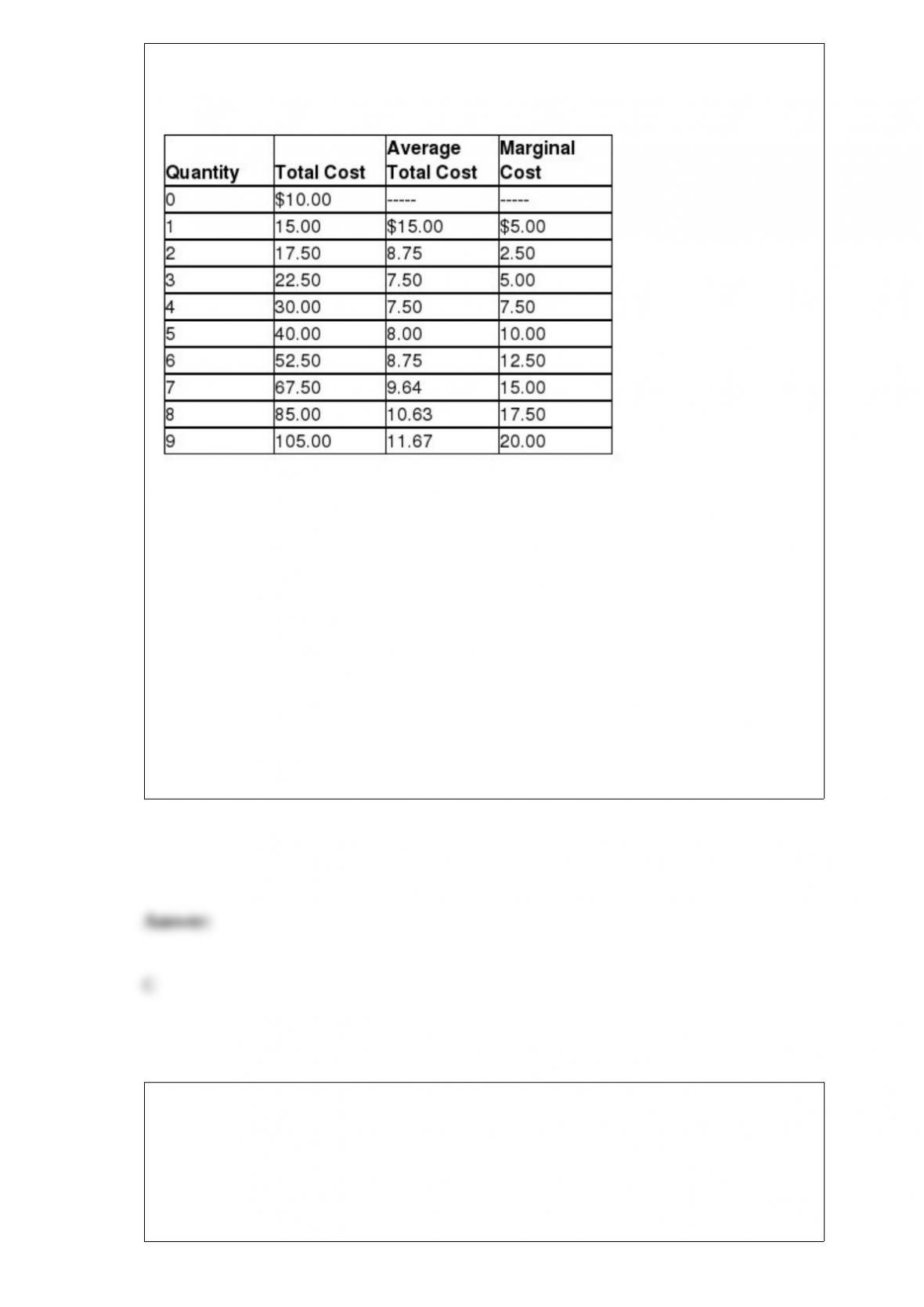
Table 12-3
Arnie sells basketballs in a perfectly competitive market. Table 12-3 summarizes
Arnie’s output per day (Q), total cost (TC), average total cost (ATC) and marginal cost
(MC).
Refer to Table 12-3. What price (P) will Arnie charge and how much profit will he earn
if the market price of basketballs is $12.50?
A) Price and profit cannot be determined from the information given.
B) P = $12.50; profit = $52.50
C) P = $12.50; profit = $22.50
D) P = $20; profit = $75.00.
In recent years unemployment rates in several European countries have been higher
than unemployment rates in the United States. Many economists believe that European
unemployment rates have been higher because
A) of the different methods used to measure unemployment. If similar methods were
used, unemployment rates in Europe and the United States would be about the same.

B) European firms hire many seasonal workers from other countries, and this tends to
inflate unemployment rates in their countries.
C) unemployment benefits are more generous in Europe than in the United States.
D) the size of the military is much larger in the United States and all military personnel
are classified as employed.
Economists estimated that the price elasticity of beer is -0.30 and the income elasticity
of beer is 0.09. This means that
A) an increase in the price of beer will increase the quantity demanded of beer and beer
is a normal good.
B) an increase in the price of beer will lead to an increase in revenue for beer sellers
and beer is a normal good.
C) a decrease in the price of beer will lead to an increase in revenue for beer sellers and
beer is an inferior good.
D) an increase in the price of beer will lead to a decrease in the quantity demanded of
beer and beer is a luxury.
A firm should hire more workers to increase its profits if
A) the marginal product of labor is greater than the wage the firm will pay these

workers.
B) the wage rate is less than the marginal revenue product of labor.
C) there is enough capital and other resources for the workers to use.
D) the demand for labor is elastic.
Donnie’s Donuts incurs $450,000 per year in explicit costs and $200,000 in implicit
costs. The bakery earns $800,000 in revenues and has $2 million in net worth. Based on
this information, what is the accounting profit for Donnie’s Donuts?
A) $150,000
B) $350,000
C) $600,000
D) $1.2 million
Figure 3-7
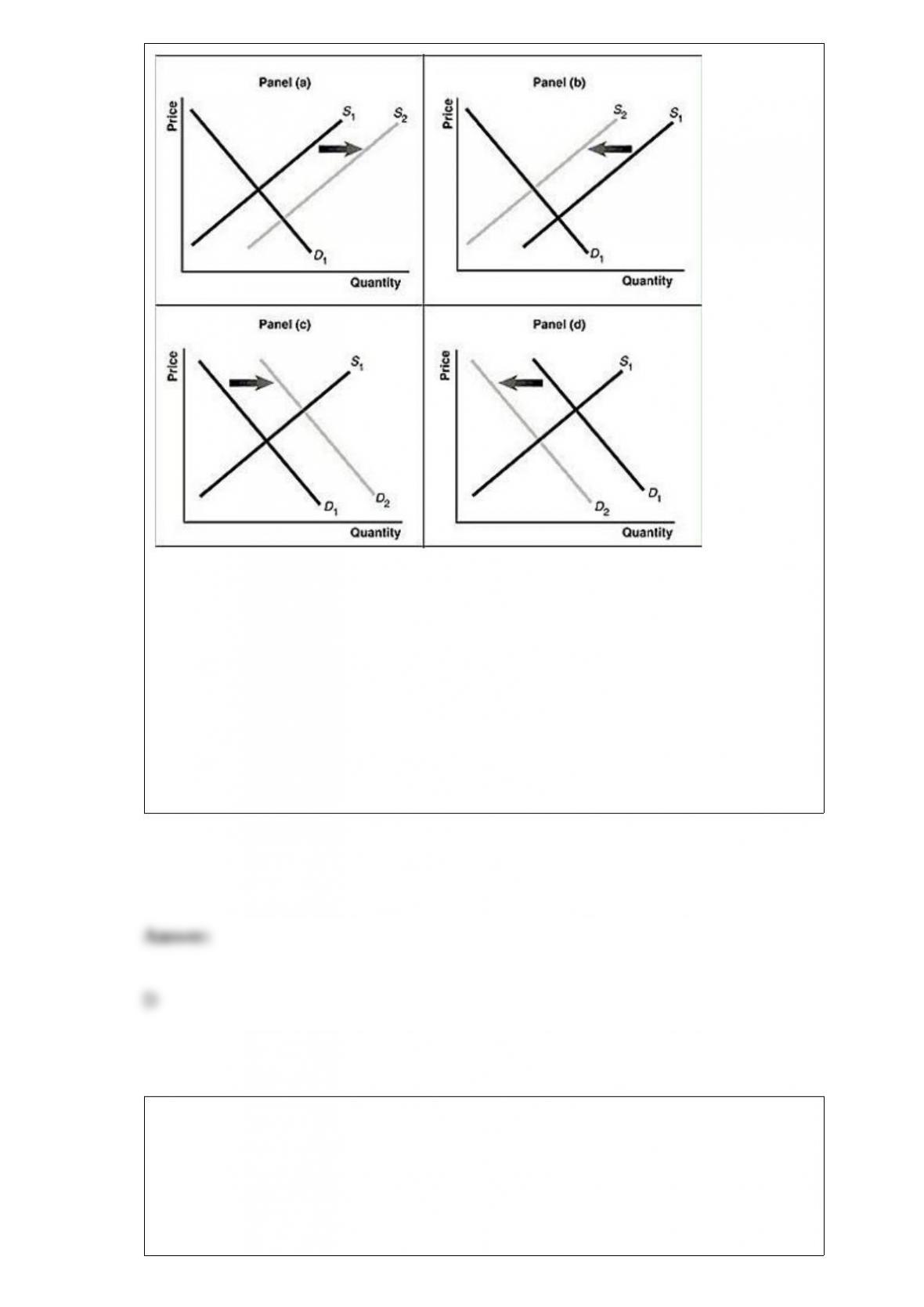
Refer to Figure 3-7. Assume that the graphs in this figure represent the demand and
supply curves for potatoes and that steak and potatoes are complements. What panel
describes what happens in this market when the price of steak rises?
A) Panel (a)
B) Panel (b)
C) Panel (c)
D) Panel (d)
All of the following are examples of spending on goods and services in the circular
flow model except
A) Giovani buys a new cell phone to replace the one he flushed down the toilet.
B) Amir buys a new humidor for his cigar shop.

C) Isabella buys the sushi plate for lunch at the Turning Japanese Sushi Bar.
D) Vijay buys a new minivan for his family’s cross-country vacation.
Which of the following is an implicit cost of production?
A) interest paid on a loan to a bank
B) wages paid to labor plus the cost of carrying benefits for workers
C) the utility bill paid to water, electricity, and natural gas companies
D) rent that could have been earned on a building owned and used by the firm
Firms pay famous individuals to endorse their products because
A) apparently demand is affected not just by the number of people who use a product
but also by the type of person that uses the product.
B) the firms are irrational and are wasting advertising expenditures.
C) famous people obviously know what are the best goods and services.
D) famous people only consume high-quality products.
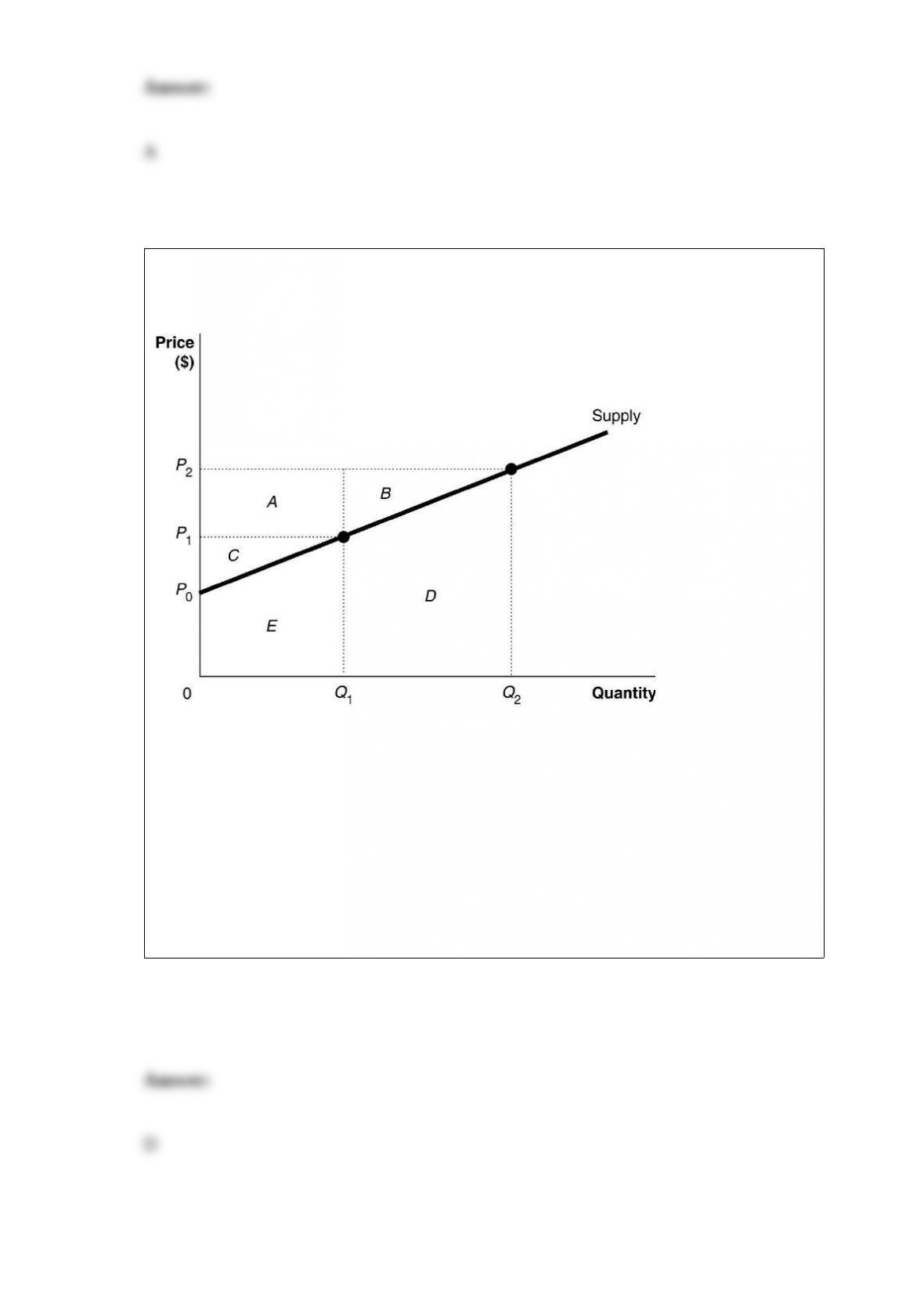
Figure 4-2
Refer to Figure 4-2. What area represents the increase in producer surplus when the
market price rises from P1to P2?
A) B + D
B) A + C + E
C) C + E
D) A + B

Table 14-3
Suppose OPEC has only two producers, Saudi Arabia and Nigeria. Saudi Arabia has far
more oil reserves and is the lower-cost producer compared to Nigeria. The payoff
matrix in Table 14-3 shows the profits earned per day by each country. “Low output”
corresponds to producing the OPEC assigned quota and “high output” corresponds to
producing the maximum capacity beyond the assigned quota.
Refer to Table 14-3. Is there a dominant strategy for Saudi Arabia and, if so, what is it?
A) Yes, the dominant strategy is to produce a high output.
B) Yes, the dominant strategy is to produce a low output.
C) No, there is no dominant strategy.
D) Yes, it has a dominant strategy depending on what Nigeria does.
Figure 13-11
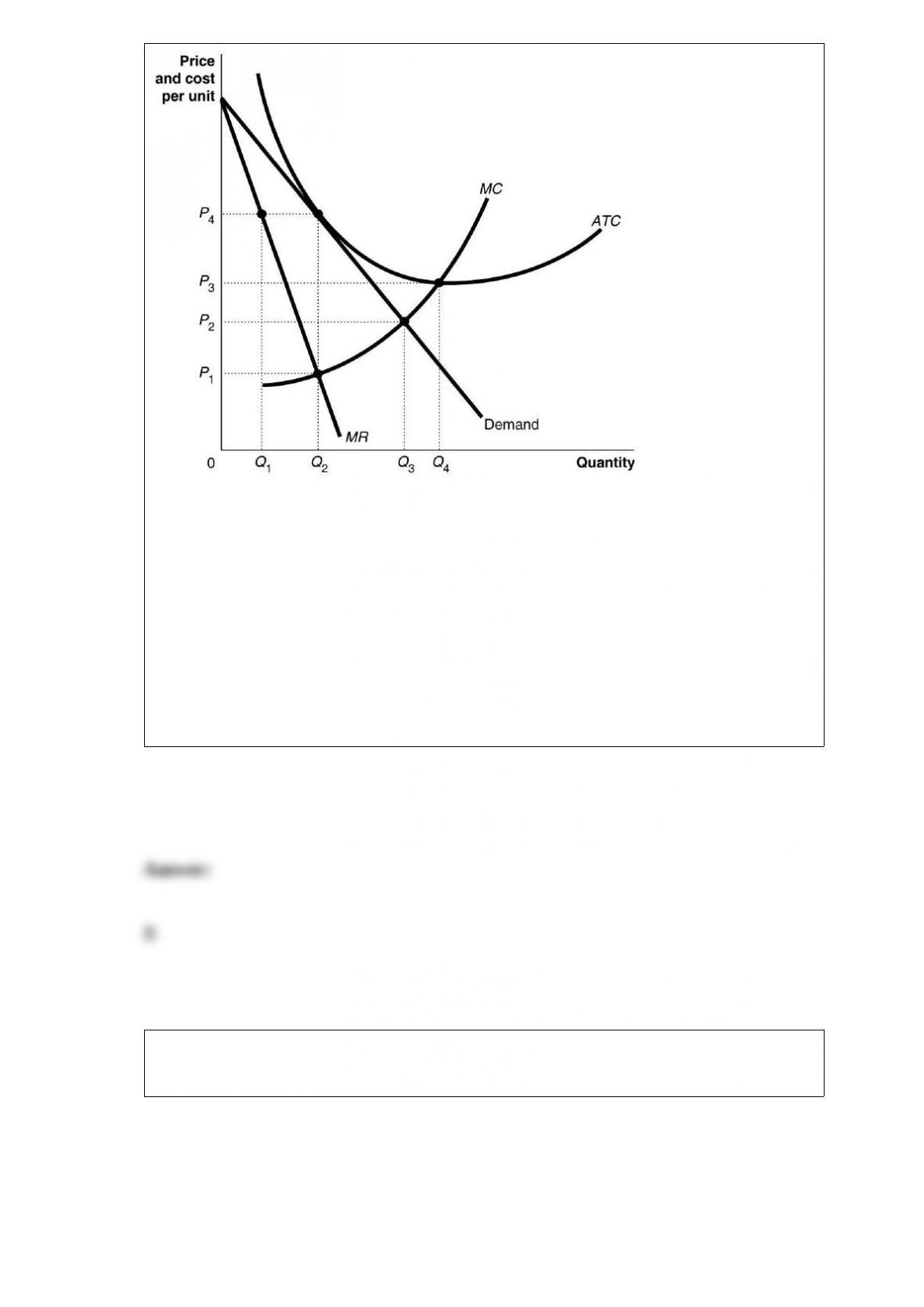
Refer to Figure 13-11. What is the monopolistic competitor’s profit maximizing
output?
A) Q1 units
B) Q2 units
C) Q3 units
D) Q4 units
Figure 13-6

Refer to Figure 13-6. Suppose Dell finds the relationship between the average total
cost of producing notebook computers and the quantity of notebook computers
produced is as shown by Figure 13-2. Dell will maximize profits if it produces
________ notebook computers per month.
A) 100,000
B) 200,000
C) 300,000
D) Not enough information is given to determine the profit-maximizing quantity.
Figure 12-4

Figure 12-4 shows the cost and demand curves for a profit-maximizing firm in a
perfectly competitive market.
Refer to Figure 12-4. If the market price is $30, should the firm represented in the
diagram continue to stay in business?
A) No, it should shut down because it is making a loss.
B) No, it should shut down because it cannot cover its variable cost.
C) Yes, because it is covering part of its fixed cost.
D) Yes, because it is making a profit.
Suppose the absolute value of the price elasticity of demand for meals at Fortune Buffet
House is ∞. What happens to sales revenue if the restaurant increases its price by 5
percent?
A) Sales revenue falls by less than 5 percent.
B) Sales revenue remains unchanged.
C) Sales revenue falls by 100 percent.
D) It cannot be determined without information on prices.

In a decision tree, the difference between a decision node and a terminal node is that
A) at a decision node all participants are free to make individual decisions but at a
terminal node they must agree on a collective decision.
B) at a decision node all participants make the same decision, while at a terminal node
different players may make different decisions.
C) at a decision node a decision must be made, while a terminal node shows the payoff.
D) at a decision node a decision must be made, while at a terminal node the final
decision must be made.
When a firm has been granted a trademark, which grants legal protection against other
firms using the name of the product that has been granted the trademark, the firm
A) still faces the possibility that the name will become widely used and no longer
associated with a specific company.
B) does not have to worry about legally enforcing the trademark; this is the
responsibility of the legal system.
C) still must apply for a copyright and a patent to ensure that no other firm will use the
product’s name.
D) must spend an annual amount on advertising the product each year; the amount it
must spend is negotiated by the firm and the government agency that grants the
trademark.

In the long run, a firm in a perfectly competitive industry will supply output only if its
total revenue covers its
A) explicit costs plus its implicit costs.
B) fixed costs.
C) implicit costs.
D) explicit costs.
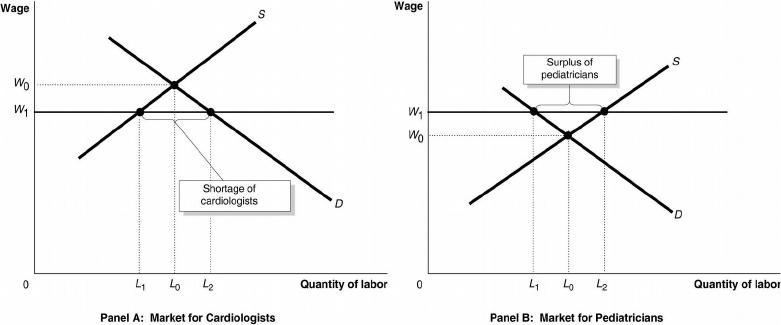
In the medical profession, pediatricians receive lower salaries than cardiologists.
Suppose the government passes comparable worth legislation that requires hospitals to
pay pediatricians the same salaries as cardiologists. Explain the effect of this legislation
and illustrate your answer with demand and supply graphs for the following two
scenarios:
a. hospitals respond by placing salaries at a level between the two existing salaries
b. hospitals respond by placing pediatricians’ salaries at the initial level of cardiologists.
The “tragedy of the commons” refers to the phenomenon where
A) individuals are free riders.
B) people overuse a common resource.
C) people do not internalize an externality.
D) there is rivalry in consumption.
What is meant by the term “internalizing an externality”? How does a Pigovian tax or

subsidy internalize an externality?
Assume the market price for lemon grass is $4.00 per pound, but most buyers are
willing to pay more than the market price. At the market price of $4.00, the quantity of
lemon grass demanded is 1,500 pounds per month, and quantity demanded does not
reach zero until the price reaches $30.00 per pound. Construct a graph showing this
data, calculate the total consumer surplus in the market for lemon grass, and show the
consumer surplus on the graph.

List three reasons why demand for a product will often increase if the product is
endorsed by a celebrity.
Scott is a manager at a pool cleaning business. He has hired 10 workers to clean pools
for him and is considering what type of payment scheme he should set up for his
workers. He can pay each of his workers $10 per hour to clean pools, or he can pay his
workers $20 for each pool a worker cleans. (It takes 2 hours, on average, for an
employee to clean a pool thoroughly.) If Scott wants to maximize the number of pools
his workers clean in one day, which payment scheme should he use? Explain.

A firm’s labor demand curve is also its marginal revenue product curve. For both the
perfectly competitive firm and the output price maker, the labor demand curve slopes
downwards. However, there is a difference in the reasons why the labor demand curve
slopes downwards. What is this difference?
Article Summary
Due to changing shopping habits and increased online sales, Macy’s announced it would
be closing 35 to 40 underperforming stores in early 2016. The stores represent about 5
percent of its total locations, and the company expects to lose about $300 million in
sales, or 1 percent of total sales, from the closures. Over the past five years, Macy’s has
closed 52 stores and opened 12 new locations, leaving the company 770 stores in 45
states.
Source: Ed Brackett and Alexander Coolidge, “Macy’s to close up to 40 stores,” USA
Today, September 9, 2015.
Refer to the Article Summary above. Use a graph to illustrate average total cost curves
for Macy’s before and after closing the 35 to 40 stores. Assume that after closing the

stores, Macy’s will be producing at minimum average total cost.
What is the difference between explicit collusion and implicit collusion?

Discuss the role of product differentiation and advertising in monopolistic competition.
Explain the similarities and differences between the long-run equilibrium for a perfectly
competitive firm and a monopolistically competitive firm. Illustrate your answer with a
graph demonstrating the long-run equilibrium for the two types of firms.

The simple trade model demonstrates that countries can expand consumption by
specializing in the production of goods and services in which they have a comparative
advantage. In reality we do not see complete specialization in production. State three
reasons why this is case.

What is the difference between zero accounting profit and zero economic profit?
What is the difference between price discrimination and other forms of discrimination?
What gives rise to a natural monopoly? How do consumers benefit from a natural
monopoly?

Explain how collusion makes firms better off. Given the incentives to collude, briefly
explain why every industry does not become a cartel.
“Buy low and sell high is advice given to people who want to make a profit by buying
and selling shares of stock. Arbitrage is defined as buying a product in one market at a
low price and reselling it in another market at a high price. Therefore, when stock
brokers buy and sell stocks to earn a profit they are engaging in arbitrage.” Evaluate this
statement; state whether it is true or false and explain your answer.

Economists have noted that businesses of a certain type tend to congregate
geographically, attracting workers with skills in those fields. This, in turn, lures more
firms seeking employees with those skills. Some examples include commercial
banking, software development, and the automobile industry. What mechanism is at
work here? Briefly explain how the mechanism works to the advantage of employers
and employees.