
1) Complete the accompanying table.
(a)What is the break-even level of income? How is it possible for households to dissave
at very low income levels?
(b)If the proportion of total income consumed decreases and the proportion saved
increases as income rises, explain how the MPC and MPS can be constant at various
levels of income.
2) efficiency gains from migration:
a.will tend to be greater when workers migrate from nations with high unemployment
to nations experiencing full employment.
b.imply that all workers, domestic and migrant, are financially better off as a result of
migration.
c.will tend to be greater in countries experiencing “brain drain.”
d.usually benefit one nation at the expense of another.
3) Assume in a private closed economy that the equilibrium level of income is $380 and
the MPS is 0.25. Now suppose government collects taxes of $50 and spends the entire
amount. As a result:
A.the equilibrium level of real income and the price level will both remain unchanged.
B.nominal wage rates will fall.
C.the equilibrium level of income will rise to $420.
D.the equilibrium level of income will rise to $430.
4) the following cost data for a purely competitive seller:

the above data are for:
a.the long run.
b.the short run.
c.both the short run and the long run.
d.the intermediate market period only.
5) the vertical distance between the horizontal axis and any point on a pure competitor’s
demand curve measures:
a.total revenue.
b.total cost.
c.product price, marginal revenue, and average revenue.
d.the quantity demanded.
6) the typical production possibilities curve is:
a.an upsloping line that is concave to the origin.
b.a downsloping line that is convex to the origin.
c.a downsloping line that is concave to the origin.
d.a straight upsloping line.
7) the production possibilities curve has:
a.a positive slope that increases as we move along it from left to right.
b.a negative slope that increases as we move along it from left to right.
c.a negative slope that decreases as we move along it from left to right.
d.a negative slope that is constant as we move along it from left to right.

8) which of the following is a labor resource?
a.a computer programmer
b.a computer
c.silicon (sand) used to make computer chips
d.a piece of software used by a firm
9) the law of increasing opportunity costs states that:
a.if society wants to produce more of a particular good, it must sacrifice larger and
larger amounts of other goods to do so.
b.the sum of the costs of producing a particular good cannot rise above the current
market price of that good.
c.if the sum of the costs of producing a particular good rises by a specified percent, the
price of that good must rise by a greater relative amount.
d.if the prices of all the resources used to produce goods increase, the cost of producing
any particular good will increase at the same rate.
10) Effective usury laws:
A.subsidize lenders.
B.penalize those who borrow at the below-market interest rate.
C.improve efficiency in investing.
D.keep some low-income people from obtaining credit and loans.
11) (Advanced analysis) Assume that the MPC is .8 in an economy that has an
aggregate supply curve with a slope of 1. Also, suppose that the price level is flexible
downward. A decrease in investment spending of $10 billion will shift the aggregate
demand curve leftward by:
A.$50 billion and decrease real GDP by $50 billion.
B.$50 billion and decrease real GDP by $25 billion.
C.$10 billion and decrease real GDP by $10 billion.
D.$10 billion and decrease real GDP by $25 billion.
12)
Refer to the above data. We can conclude from the information given that this firm is a:
A.pure monopolist.
B.discriminating monopolist.
C.monopolistic competitor.
D.pure competitor.
13) the elasticity of demand for a product is likely to be greater:
a.if the product is a necessity, rather than a luxury good.
b.the greater the amount of time over which buyers adjust to a price change.
c.the smaller the proportion of one’s income spent on the product.
d.the smaller the number of substitute products available.
14)
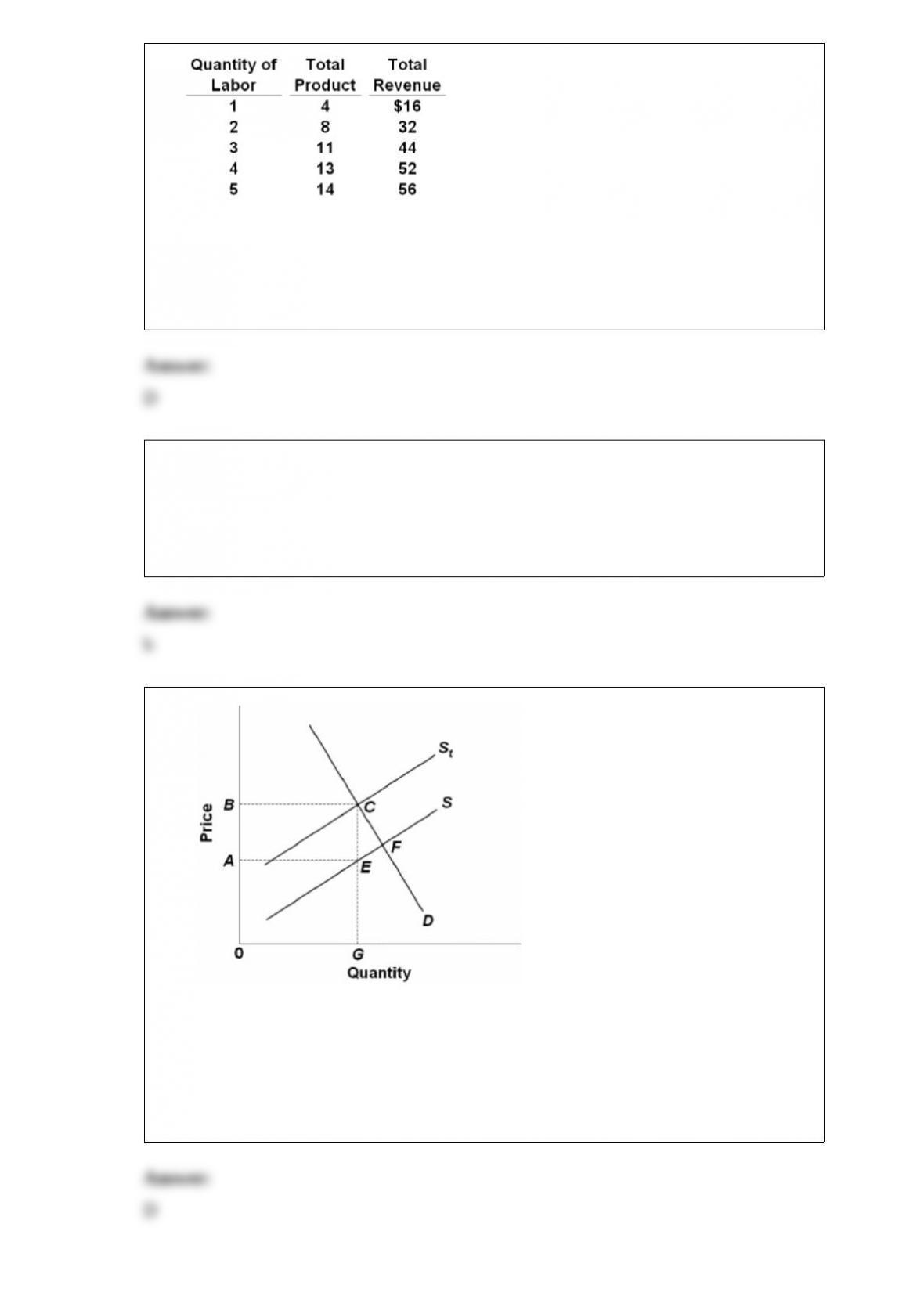
Refer to the above figure in which S is the before-tax supply curve and St is the supply
curve after an excise tax is imposed. The efficiency loss of this tax will be area:
A.ABCE.
B.ABCE + ECF.
C.0AEG.
D.ECF.

15) assuming migration is unimpeded and costless, which of the following statements is
most accurate about the effect of immigration on wages in both the origin and
destination nations?
a.wages will rise in the origin nation, fall in the destination nation, and overall wage
income must rise.
b.wages will rise in both nations, and overall wage income must rise.
c.wages will rise in the origin nation and fall in the destination nation, and the wage
changes must cancel each other, resulting in no net change in overall wage income.
d.wages will rise in the origin nation and fall in the destination nation, but the effect on
overall wage income depends on the elasticities of labor demand.
16) according to emerson: “want is a growing giant whom the coat of have was never
large enough to cover.” according to economists, “want” exceeds “have” because:
a.people are greedy.
b.productive resources are limited.
c.human beings are inherently insecure.
d.people are irrational.
17)
refer to the above tables. opportunity costs of producing military goods are:
a.increasing in duckistan but constant in herbania.
b.constant in both duckistan and herbania.
c.larger in duckistan than in herbania.
d.smaller in duckistan than herbania.
18) an increase in the price of product a will:
a.reduce the demand for resources used in the production of a.
b.increase the demand for complementary product c.
c.increase the demand for substitute product b.
d.reduce the demand for substitute product b.

19) According to the Taylor rule, if real GDP is 4 percent below potential GDP, the Fed
should:
A.lower the Federal funds rate by 2 percentage points.
B.lower the Federal funds rate by 4 percentage points.
C.lower the Federal funds rate by 8 percentage point.
D.do nothing, as the economy will correct itself.