1) Between 1990 and 2000, the United States significantly reduced its emissions of
greenhouse gases and effectively eliminated the climate-change problem.
2) A rightward and upward shift of the Phillips Curve is consistent with the occurrence
of stagflation.
3) the income effect explains an exception to the law of demand.
4) The principle that private negotiation can resolve potential externalities without
resort to government intervention is known as the Coase theorem.
5) a pure monopolist will maximize profits by producing at that output where price and
marginal cost are equal.
6) The Fed increases interest rates mainly by selling government securities.
7) during the past ten years the annual rate of inflation in the united states has averaged
less than 1 percent.
8) Six of the 50 states account for approximately half of all union members in the
United States.
9) the demand for health care is highly elastic with respect to both price and income.
10) assume a purely competitive firm is selling 200 units of output at $3 each. at this
output its total fixed cost is $100 and its total variable cost is $350. this firm:
a.is maximizing its profit.
b.is making a profit, but not necessarily the maximum profit.
c.is incurring losses.
d.should shut down in the short run.
11) the economizing problem is:
a.the need to make choices because economic wants exceed economic means.
b.how to distribute resources equally amongst all members of society.
c.that people’s means often exceed their wants.
d.that people do not know how to rationally allocate resources.
12) which of the following would not be appropriate if government were attempting to
restrain a dramatic rise in the general price level?
a.an increase in tax rates
b.a decrease in subsidies to businesses
c.an increase in transfer payments to households
d.a decrease in government spending
13) (1) The composite index of leading indicators turns downward for three consecutive
months, suggesting the possibility of a recession; (2) Economists reach agreement that
the economy is moving into a recession; (3) A tax cut is proposed in Congress; (4) The
tax cut is passed by Congress and signed by the President; (5) Consumption spending
begins to rise, aggregate demand increases, and the economy begins to recover.
Refer to the above information. The administrative lag of fiscal policy is reflected in
events:
A.1 and 2.
B.2 and 3.
C.3 and 4.
D.4 and 5.
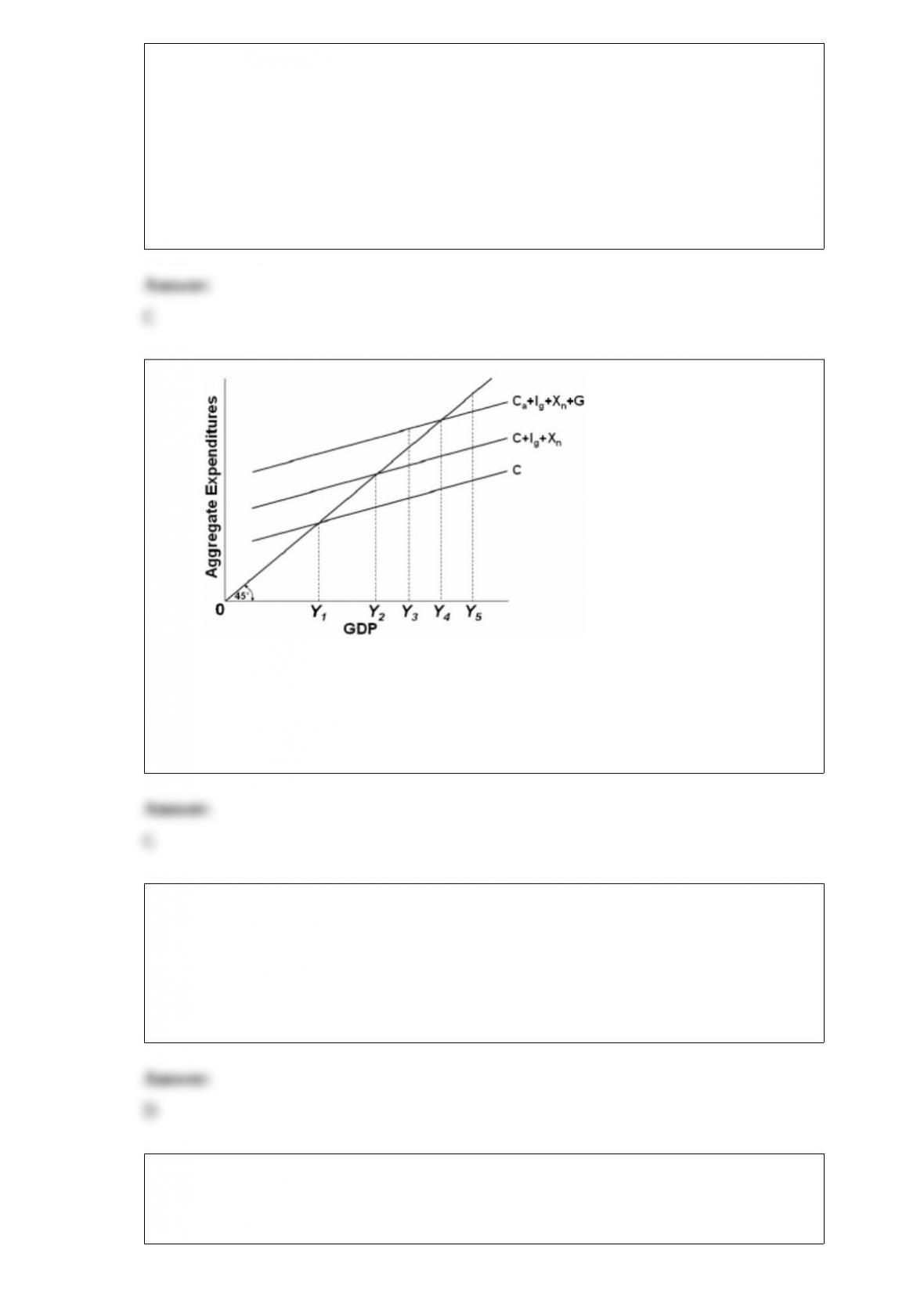
14)
Refer to the above diagram. If the full-employment GDP is Y5, government should:
A.incur neither a deficit nor a surplus.
B.cut taxes and government spending by equal amounts.
C.reduce taxes and increase government spending.
D.increase taxes and reduce government spending.
15) Which of the following occupations is among the ten projected most rapidly
declining U.S. occupations in terms of percentage increases?
A.medical assistants
B.veterinarians
C.college professors
D.telephone operators
16) Evaluate the effect of the following on the AD curve, AS curve, equilibrium price
level and equilibrium output.
(a)The U.S. imposes tariffs on foreign goods to promote domestic industry. In
retaliation, foreign countries impose tariffs on U.S. goods.
(b)Congress decides to decrease personal income taxes, and to compensate for the lost
revenue they decrease business subsidies.
(c)A technology boom improves technology across industries, improving their
productivity.
(d)U.S. oil companies discover new large oil reserves in the U.S. The international price
of oil falls.
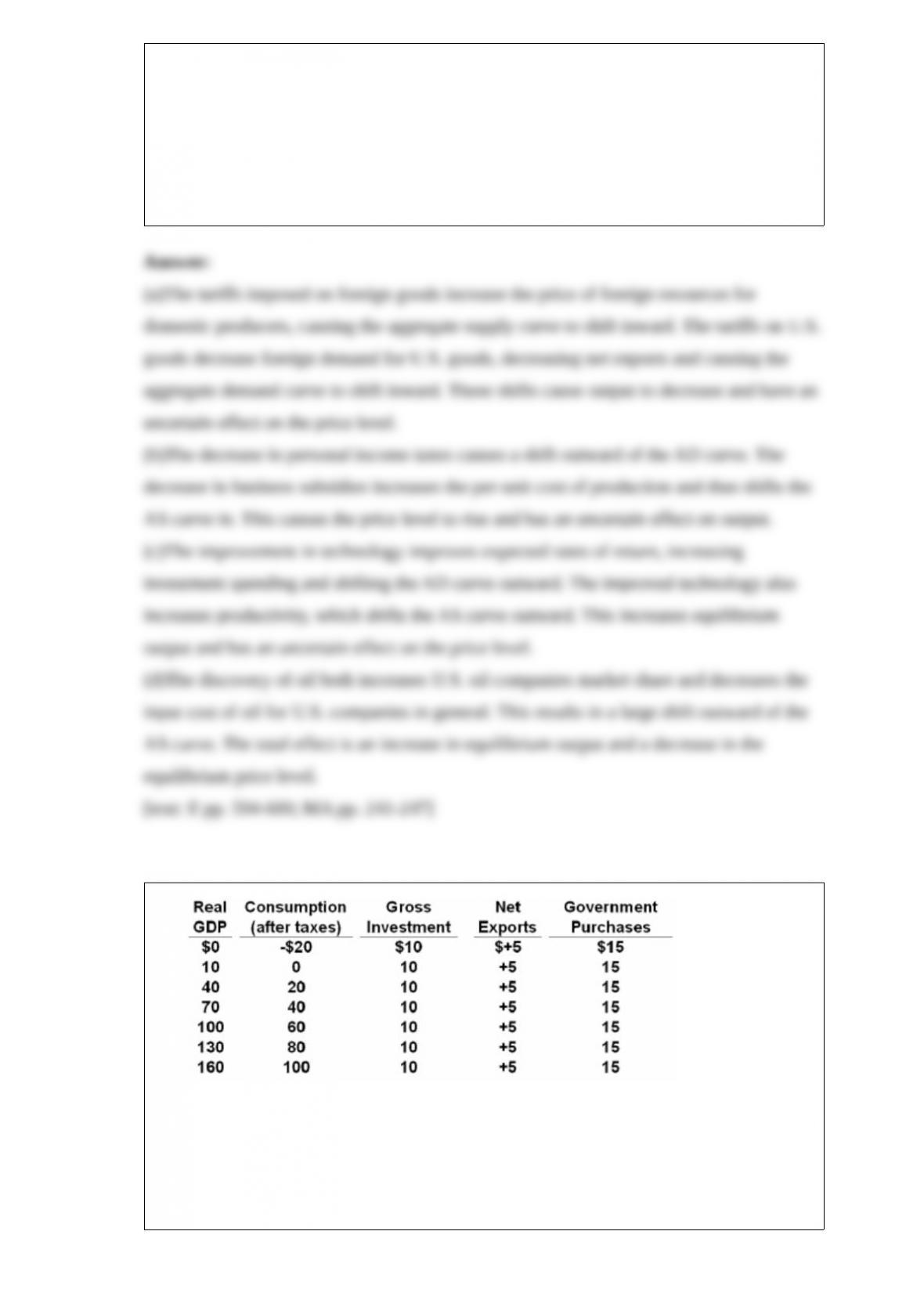
17)
Refer to the above table. Exports might be ____ and imports ____.
A.$10; $5
B.$10; $0
C.$0; $5
D.$5; 10
18) Other things equal, the resource demand curve of an imperfectly competitive seller
will:
A.lie below its marginal revenue product curve.
B.be subject to increasing marginal productivity.
C.be less elastic than that of a purely competitive seller.
D.be more elastic than that of a purely competitive seller.
19) The amount that a commercial bank can lend is determined by its:
A.required reserves.
B.excess reserves.
C.outstanding loans.
D.outstanding checkable deposits.
20) The world’s largest debtor nation in terms of debt owed to foreign citizens and
governments is:
A.Russia.
B.Argentina.
C.Japan.
D.The United States.
21) the health care market is characterized by:
a.extensive negative externalities.
b.significant positive externalities.
c.perfect knowledge by both buyers and sellers.
d.a perfectly inelastic demand.
22) Which of the following is not correct?
A.Other things equal, a monopsonist will pay a lower wage rate than will a firm hiring
labor competitively.
B.A monopsonistic employer will pay workers a wage rate equal to their MRP.
C.A purely competitive seller will pay workers a wage rate equal to their MRP.
D.An imperfectly competitive seller will employ additional workers as long as the MRP
of additional workers exceeds their MRC.
23) if the elasticity of demand for labor in the united states is unitary, immigration into
the united states can be expected to:
a.increase the average u.s. wage rate.
b.decrease the total amount of wage earnings that u.s. workers receive.
c.increase the total amount of wage earnings that u.s. workers receive.
d.leave the total amount of wage earnings that u.s. workers receive unchanged.
24) Suppose the economy’s multiplier is 2. Other things equal, a $25 billion decrease in
government expenditures on national defense will cause equilibrium GDP to:
A.decrease by $50 billion.
B.decrease by $150 billion.
C.remain unchanged since spending on military goods is unproductive and usually
wasteful.
D.decrease by $25 billion.
25) What led to the bank runs of the early 1930s?
26) Describe the three major units of the Federal Reserve System and their functions.
27) What determines the economic rent for land? Explain from a supply and demand
perspective.
28) How is a price index computed?
29) In what fundamental way do the spending-taxation decisions of government differ
from the consumption-saving plans of households? Why is this difference significant?
30) Explain cost-push inflation using aggregate demandaggregate supply analysis.
31) Monopolists are not technologically competitive. Explain.
32) How does economic rivalry take place in monopolistic competition? Describe the
different aspects of product differentiation and price competition.
33) Why are expectations important when discussing profits? What effects do these
profit expectations have on the economic system?
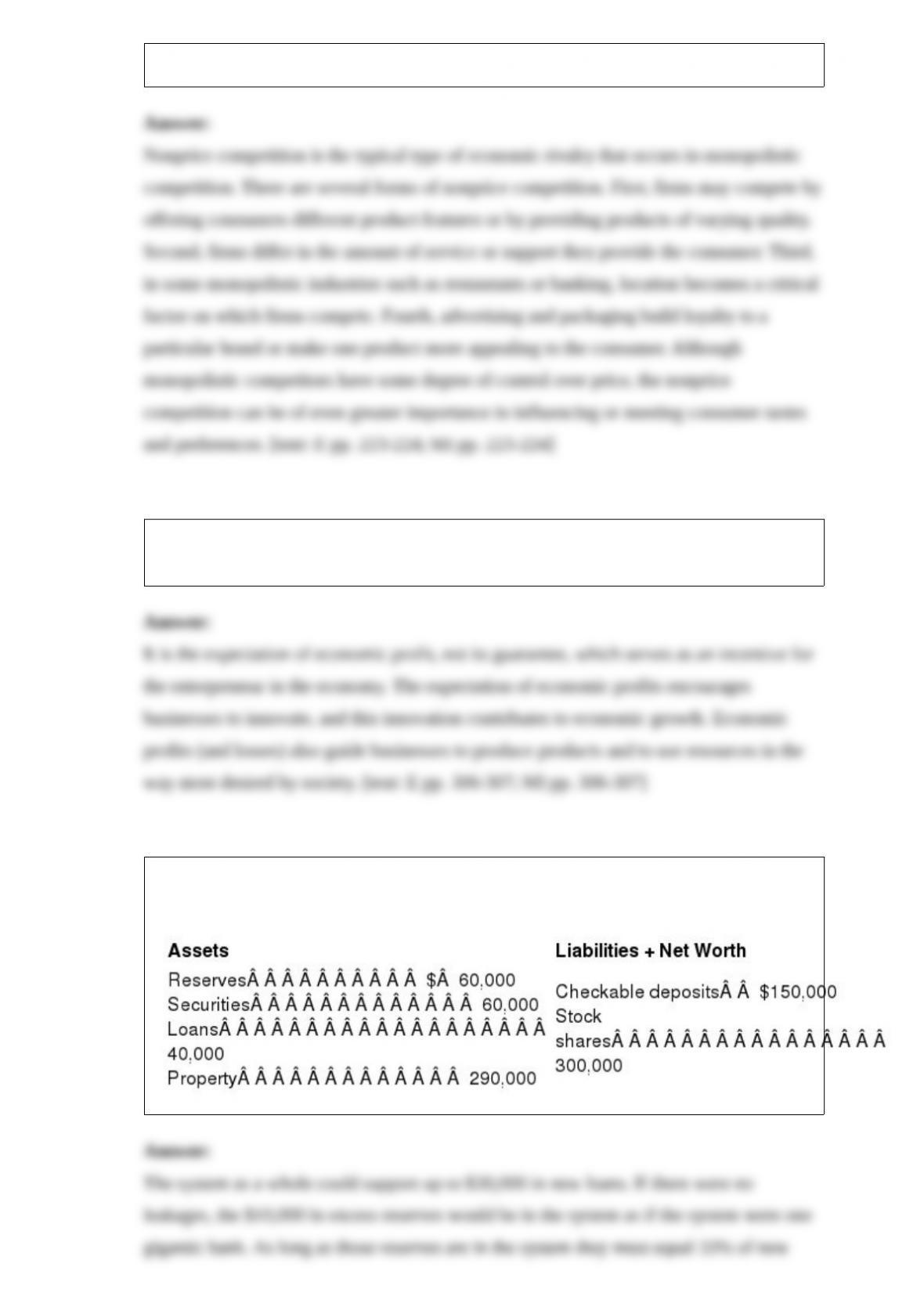
34) If the balance sheet below were for the entire banking system instead of just a
single bank, by how much could loans be expanded? Assume a reserve ratio of 33%.