
Fluctuating exchange rates can alter a multinational firm’s profits and losses. The U.S.
corporation, Motorola, produces cell phones and sells cell phones in Mexico. If the
dollar appreciates against the peso, then Motorola’s revenues from these operations
should ________ and its costs from these operations should ________.
A) rise; fall
B) rise; rise
C) fall; fall
D) fall; rise
A sole proprietorship is
A) the easiest type of business to set up.
B) the most Difficult type of business to set up.
C) the most expensive type of business to set up.
D) the least profitable type of business to set up.
Figure 17-5
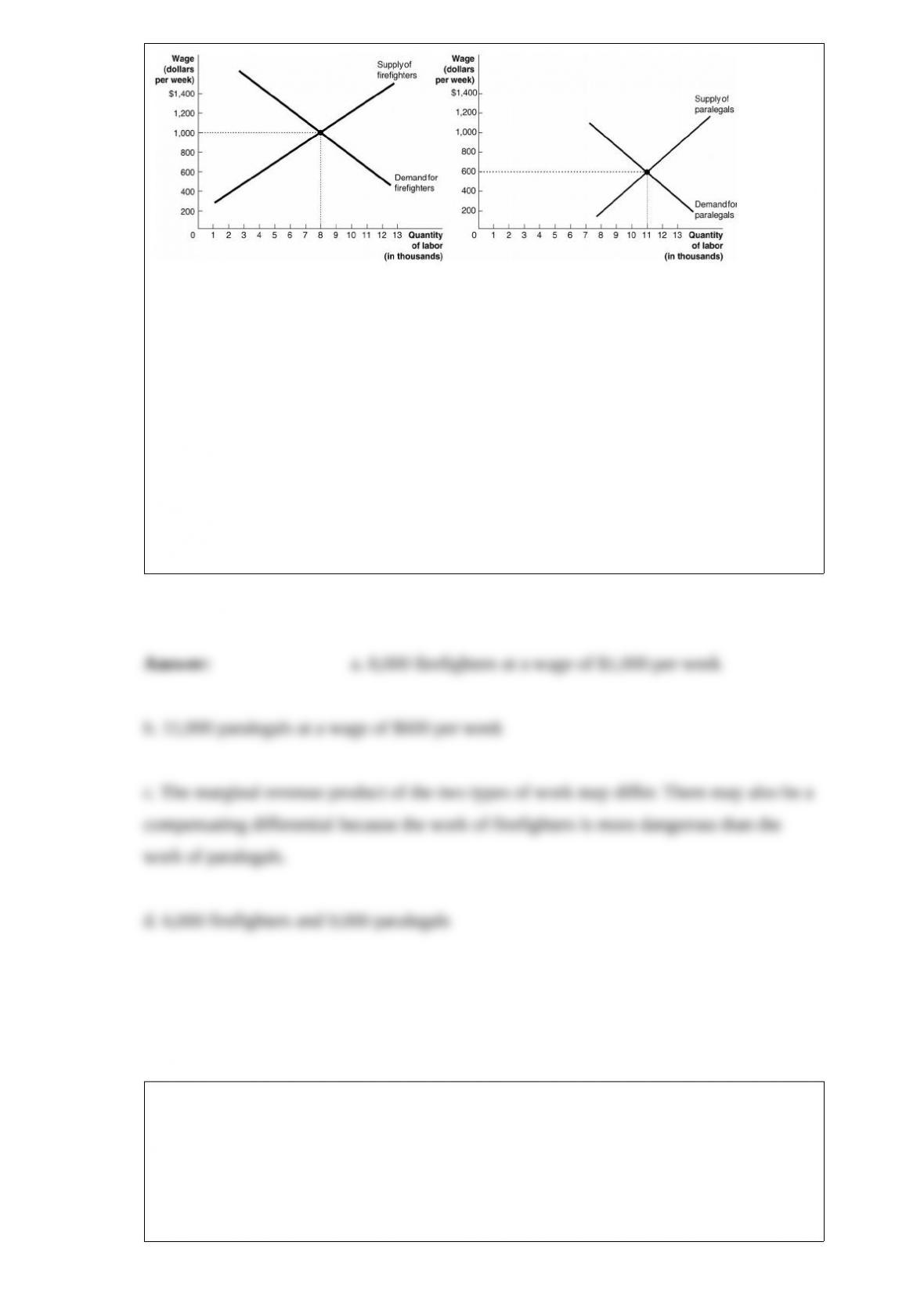
Answer the following questions.
a. What is the equilibrium quantity of firefighters hired, and what is the equilibrium
wage?
b. What is the equilibrium quantity of paralegals hired, and what is the equilibrium
wage?
c. Explain why firefighters might earn a higher weekly wage than paralegals.
d. Suppose that comparable worth legislation is passed, and the government requires
that firefighters and paralegals be paid the same wage, $800 per week. Now how many
firefighters will be hired and how many paralegals will be hired?
The most important determinant of the price elasticity of demand for a good is
A) the definition of the market for a good.
B) the availability of substitutes for the good.

C) the share of the good in the consumer’s budget.
D) whether the good is a necessity or a luxury.
Consider the following items:
a. the novel The DaVinci Code by Dan Brown
b. the “The Spirited Shipper,” an innovative wine shipping box
c. a Swiss chef’s award-winning recipe
d. an original fabric design, for example, the fabric used for “Coach” bags and luggage
Which of the items listed is an example of intellectual property?
A) a and b only
B) a, b, and c
C) a and d only
D) all of the items listed
What is different about buying stocks and buying bonds?
A) A stock can possibly pay dividends forever, but bonds have a fixed number of
payments.
B) Differences of opinion about a stock’s future may vary considerably but there is less
difference about a bond’s future.
C) The future growth of a stock is more uncertain than the payments of a bond.
D) All these are differences between stocks and bonds.
An individual seller in perfect competition will not sell at a price lower than the market
price because
A) demand for the product will exceed supply.
B) the seller would start a price war.
C) the seller can sell any quantity she wants at the prevailing market price.
D) demand is perfectly inelastic.
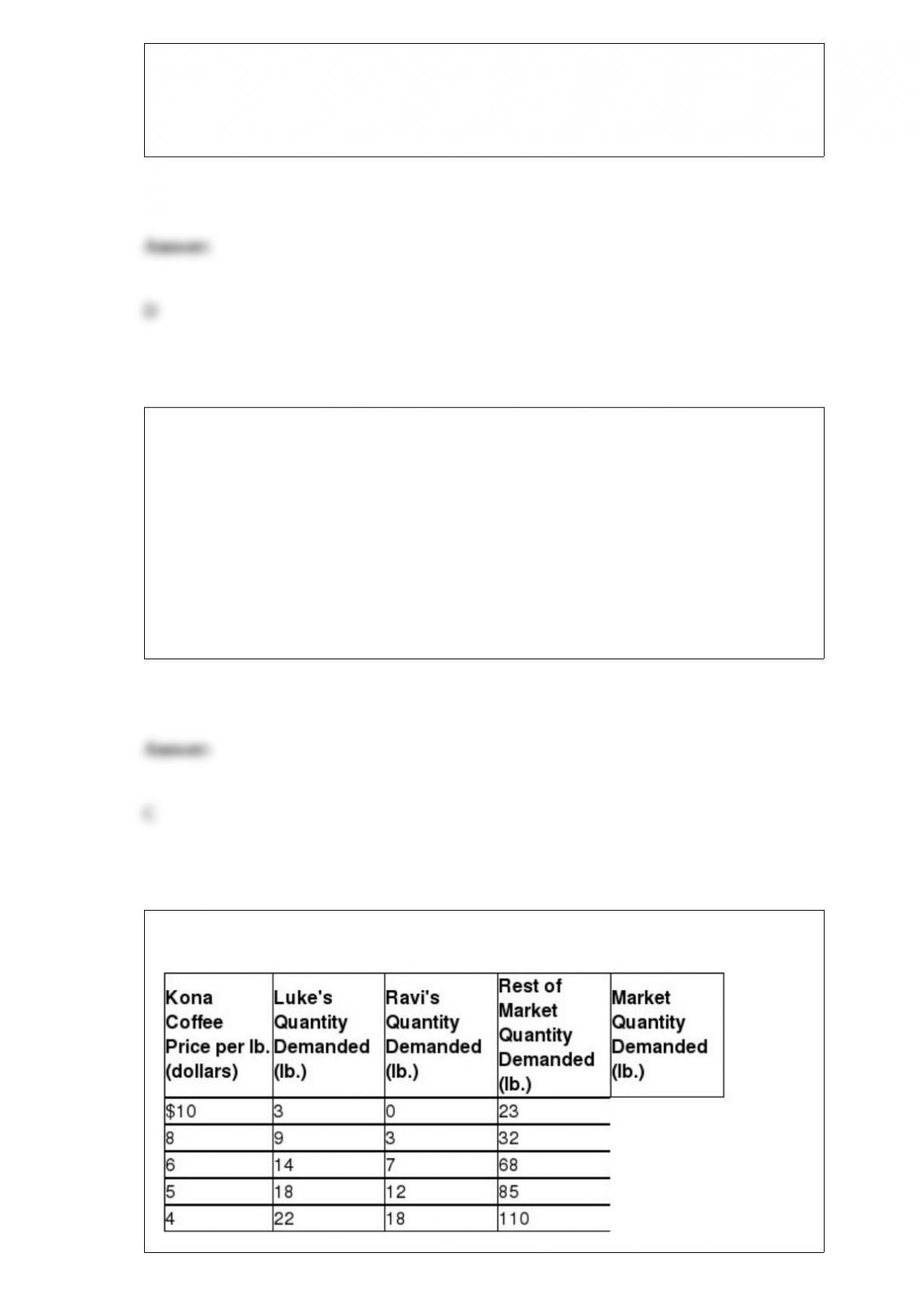
Table 3-1

The table above shows the demand schedules for Kona coffee of two individuals (Luke
and Ravi) and the rest of the market. If the price of Kona coffee falls from $6 to $4, the
market quantity demanded would
A) decrease by 89 lb.
B) increase by 26 lb.
C) increase by 61 lb.
D) increase by 110 lb.
Danielle Ocean pays for monthly pool maintenance for her home swimming pool. Last
week the owner of the pool service informed Danielle that he will have to raise his
monthly service fee because of increases in the price of pool chemicals. How is the
market for pool maintenance services affected by this?
A) There is an increase in the supply of pool maintenance services.
B) There is a decrease in the demand for pool maintenance services.
C) There is a decrease in the quantity of pool maintenance services supplied.
D) There is a decrease in the supply of pool maintenance services.
Individuals who have never been the best at doing anything
A) cannot have a comparative advantage in producing any product.

B) can still have a comparative advantage in producing some product.
C) perform all tasks at a higher opportunity cost than others.
D) must have an absolute advantage in at least ones task.
Suppose that in 2014, all prices in the economy double and that all wages and salaries
also double. In 2014 you
A) are worse off than you were in 2013 as you can no longer afford to buy as many
goods and services.
B) are better off than you were in 2013 as your salary is higher than it was in 2013 and
you can now buy more goods and services.
C) are no better off or worse off than you were in 2013 as the purchasing power of your
salary has remained the same.
D) cannot determine whether you are better off or worse off than you were in 2013,
because the purchasing power of your salary cannot be determined.
The principle of ________ is that the economic cost of using a factor of production is
the alternative use of that factor that is given up.
A) marginal cost
B) opportunity cost
C) normative economics

D) entrepreneurship
Consider two single-malt whiskey distillers, Laphroaig and Knockando. If they
advertise, they can both sell more whiskey and increase their revenue. However, the
cost of advertising more than offsets the increased revenue so that each distiller ends up
with a lower profit than if they do not advertise. On the other hand, if only one
advertises, that distiller increases its market share and also its profit.
a. Construct a payoff matrix using the following hypothetical information: If neither
distiller advertises: each earns a profit of $35 million per year. If both advertise: each
earns a profit of $20 million per year. If one advertises and the other does not: the
distiller who advertises earns a profit of $50 million and the distiller who does not
advertise earns a profit of $9 million.
b. If the two distillers agree to coordinate their strategies, what is the outcome?
Suppose the per-unit production cost of a book is $4.00 and the retail price is $32. If the

book publisher sells books to a bookstore at a 40 percent discount, what is the amount
of the publisher’s markup per book? Assume that bookstores sell books at the retail
price.
A) $12.80
B) $15.20
C) $19.20
D) $21.60
A key part of Microsoft’s business strategy in the video game console market has been
A) to wait until competitors introduce new technology in their products before
incorporating the technology in its products.
B) to concentrate on selling its products through large discount retailers like Wal-Mart.
C) the innovation of new products which initially have little to no competition.
D) to dominate the market by offering low-end products and beating its competitors’
prices.
Sunk costs
A) are costs associated with repairing something you already own.
B) are important for optimal decision making.

C) are costs that have already been paid and cannot be recaptured in any significant
way.
D) are costs that firms sink into marketing.
Which of the following is a necessary condition for successful price discrimination?
A) The seller must possess market power.
B) The buyer must possess market power.
C) Transaction costs must be zero.
D) Buyers must have identical inelastic demands.
Automatic stabilizers refer to
A) the money supply and interest rates that automatically increase or decrease along
with the business cycle.
B) government spending and taxes that automatically increase or decrease along with
the business cycle.
C) changes in the money supply and interest rates that are intended to achieve
macroeconomic policy objectives.
D) changes in federal taxes and purchases that are intended to achieve macroeconomic
policy objectives.

Article Summary
In an August 2013 speech from the Lincoln Memorial, President Obama was expected
to emphasize that increased economic equality is needed to improve racial equality.
Economic gaps based on race have endured for 50 years, with the differences in
unemployment rates between blacks and whites remaining virtually unchanged and the
gap in wealth actually increasing. “If you look at 50 years after the 1960s civil rights
movement, the most stubborn and persistent challenge when it comes to the nation’s
racial challenge remains in the areas of economics and wealth,” said Marc Morial,
president of the National Urban League. Source: Zachary A. Goldfarb, “For Obama, 50
years after historic march, economic equality the path to racial justice,” Washington
Post, August 17, 2013.
The article mentions increased economic equality is needed in terms of wealth, and for
some people this means a more equitable distribution of wealth. What is meant by a
more equitable distribution of wealth?
A) a more allocatively efficient distribution of wealth
B) a more productively efficient distribution of wealth
C) a more fair distribution of wealth
D) wealth distributed based on income levels