
1) to keep the yen’s exchange value from appreciating against the dollar, japan’s
exchange stabilization fund would buy yen for dollars on the foreign exchange market.
a.true
b.false
2) international trade benefits:
a.all workers
b.most workers
c.many workers
d.none of these is correct
3) according to the strategic-trade-policy hypothesis, a subsidy granted to domestic
exporters may lead to increased export profits which more than offset the cost of the
subsidy to domestic taxpayers.
a.true
b.false
4) gold constitutes the largest component of the world’s international reserves.
a.true
b.false
5) suppose a central bank prevents a depreciation of its currency by intervening in the
foreign exchange market and buying its currency with foreign currency. this causes the
a.domestic money supply to decrease and a decline in aggregate demand
b.domestic money supply to increase and a decline in aggregate demand
c.domestic money supply to decrease and a rise in aggregate demand
d.domestic money supply to increase and a fall in aggregate demand

6) for the united states, a consequence of its current account deficit is a growing foreign
ownership of the capital stock of the united states and a rising fraction of u.s. income
that must be diverted abroad in the form of interest and dividends to foreigners.
a.true
b.false
7) an effective buy american law results in deadweight welfare losses for the united
states in the form of the protective effect and consumption effect.
a.true
b.false
8) assume that ford motor company obtains all of its inputs in the united states and all
of its costs are denominated in dollars. an appreciation of the dollar’s exchange value:
a.enhances its international competitiveness
b.worsens its international competitiveness
c.does not affect its international competitiveness
d.none of the above
9) assume boeing inc. (of the united states) and airbus industrie (of europe) rival for
monopoly profits in the canadian aircraft market. suppose the two firms face identical
cost and demand conditions, as seen in figure 6.1.
figure 6.1. strategic trade policy: boeing versus airbus
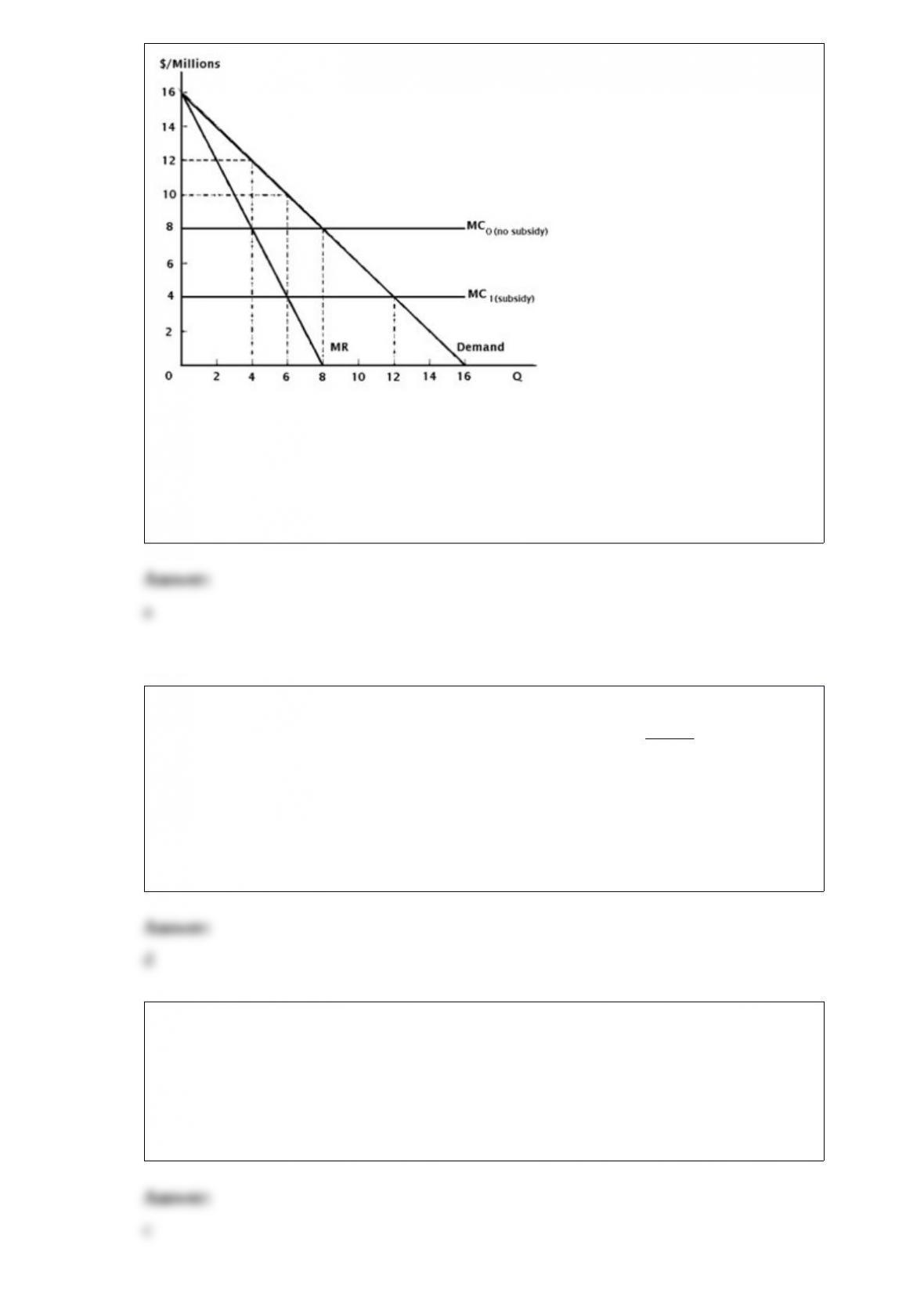
consider figure 6.1. for europe as a whole (airbus and european taxpayers), the subsidy
leads to a (an) increase/decrease in net revenues of $____.
a.increase of $12 million
b.increase of $16 million
c.decrease of $12 million
d.decrease of $16 million
10) by removing discriminatory government procurement laws within the european
union, member nations hoped to benefit from all of the following except:
a.eu governments could purchase from the cheapest foreign suppliers
b.increased competition occurs as domestic firms compete with foreign firms
previously shut out of the domestic market
c.industries are restructured which permits surviving firms to achieve economies of
scale
d.agricultural prices fall as more farmers are allowed to produce their commodities
11) during the 1970s, the european union, in its quest for monetary union, adopted what
came to be referred to as the “community snake.” this device was a:
a.adjustable pegged exchange rate system
b.dual exchange rate system
c.jointly floating exchange rate system
d.freely floating exchange rate system

12) for the united states, merchandise trade has generally constituted the largest portion
of its goods-and-services account.
a.true
b.false