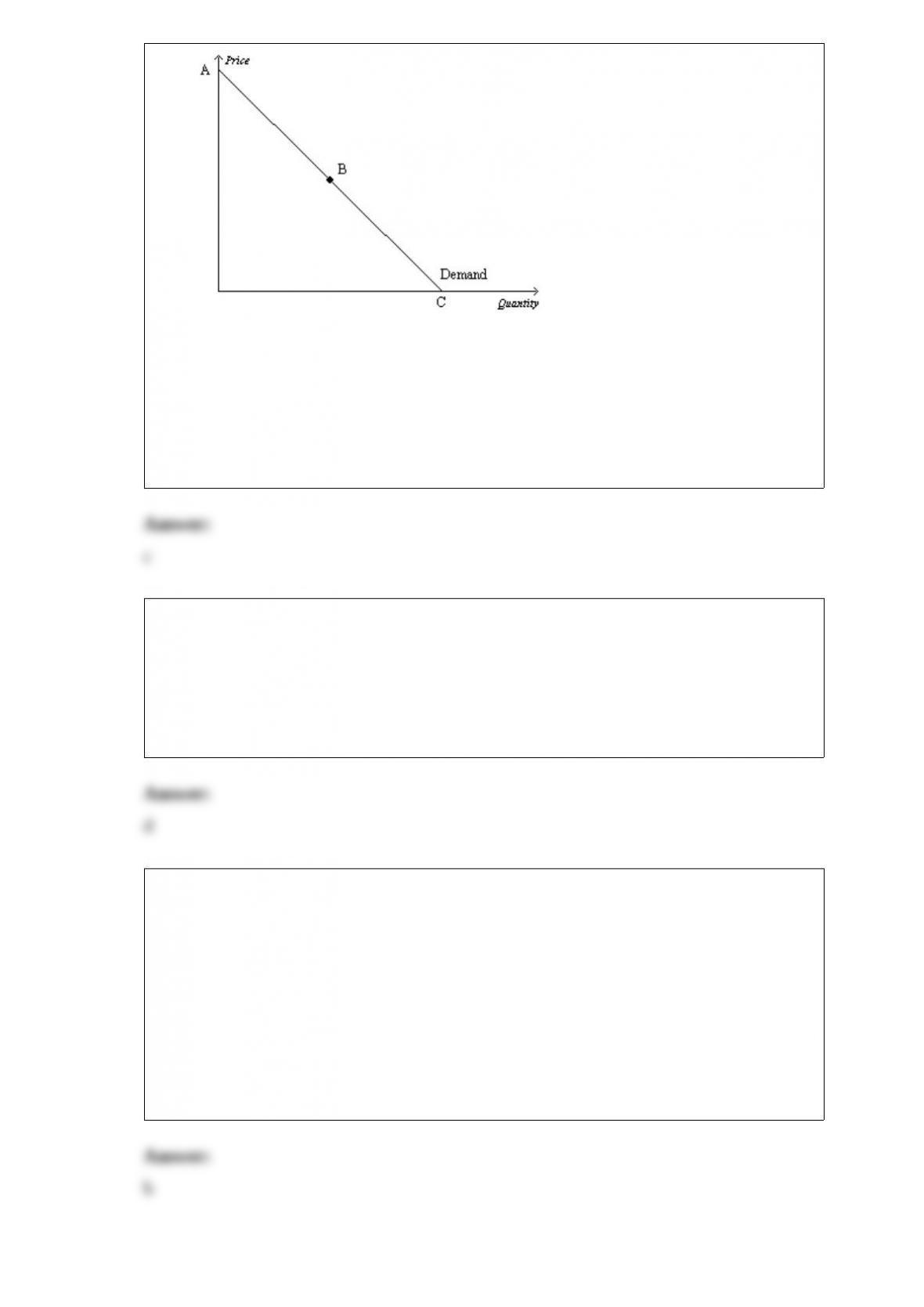
1)
If the price increases in the region of the demand curve between points A and B, we can
expect total revenue to
a.increase.
b.stay the same.
c.decrease.
d.first increase, then decrease until total revenue is maximized.
2) Corrective taxes that are imposed upon the producer of a nasty smell can be
successful in reducing that smell because the tax makes the producer
a.externalize the positive externality.
b.externalize the negative externality.
c.internalize the positive externality.
d.internalize the negative externality.
3) Scenario 20-5
Suppose the government implemented a negative income tax and used the following
formula to compute a family’s tax liability:
Taxes owed = (1/4 of income) – $10,000
Refer to Scenario 20-5. A family earning $110,000 before taxes would have how much
after-tax income?
a.$82,500
b.$92,500
c.$100,000
d.$127,500
4) Total surplus
a.can be used to measure a market’s efficiency.
b.is the sum of consumer and producer surplus.
c.is the value to buyers minus the cost to sellers.
d.All of the above are correct.
5) Refer to Figure 9-21. With free trade allowed, this country
a.exports 200 units of the good.
b.exports 400 units of the good.
c.imports 400 units of the good.
d.exports 800 units of the good.
6) Scenario 13-8
Wanda owns a lemonade stand. She produces lemonade using five inputs: water, sugar,
lemons, paper cups, and labor. Her costs per glass are as follows: $0.01 for water, $0.02
for sugar, $0.03 for lemons, $0.02 for cups, and $0.10 for the opportunity cost of her
labor. She can sell 300 glasses for $0.50 each.
What are Wanda’s total economic profits?
a.$150
b.$126
c.$96
d.$54
7) A natural monopolist’s ability to price its product is
a.constrained by the market demand curve.
b.constrained by market supply.
c.not affected by market demand.
d.enhanced by regulatory control of the government.
8) A competitive firm
a.and a monopolist are price takers.
b.and a monopolist are price makers.
c.is a price taker, whereas a monopolist is a price maker.
d.is a price maker, whereas a monopolist is a price taker.
9) The difference in wages paid to major-league baseball players and minor-league
baseball players is most likely due to
a.differences in chance.
b.differences in natural ability.
c.the fact that the players’ union is strong.
d.a compensating differential.
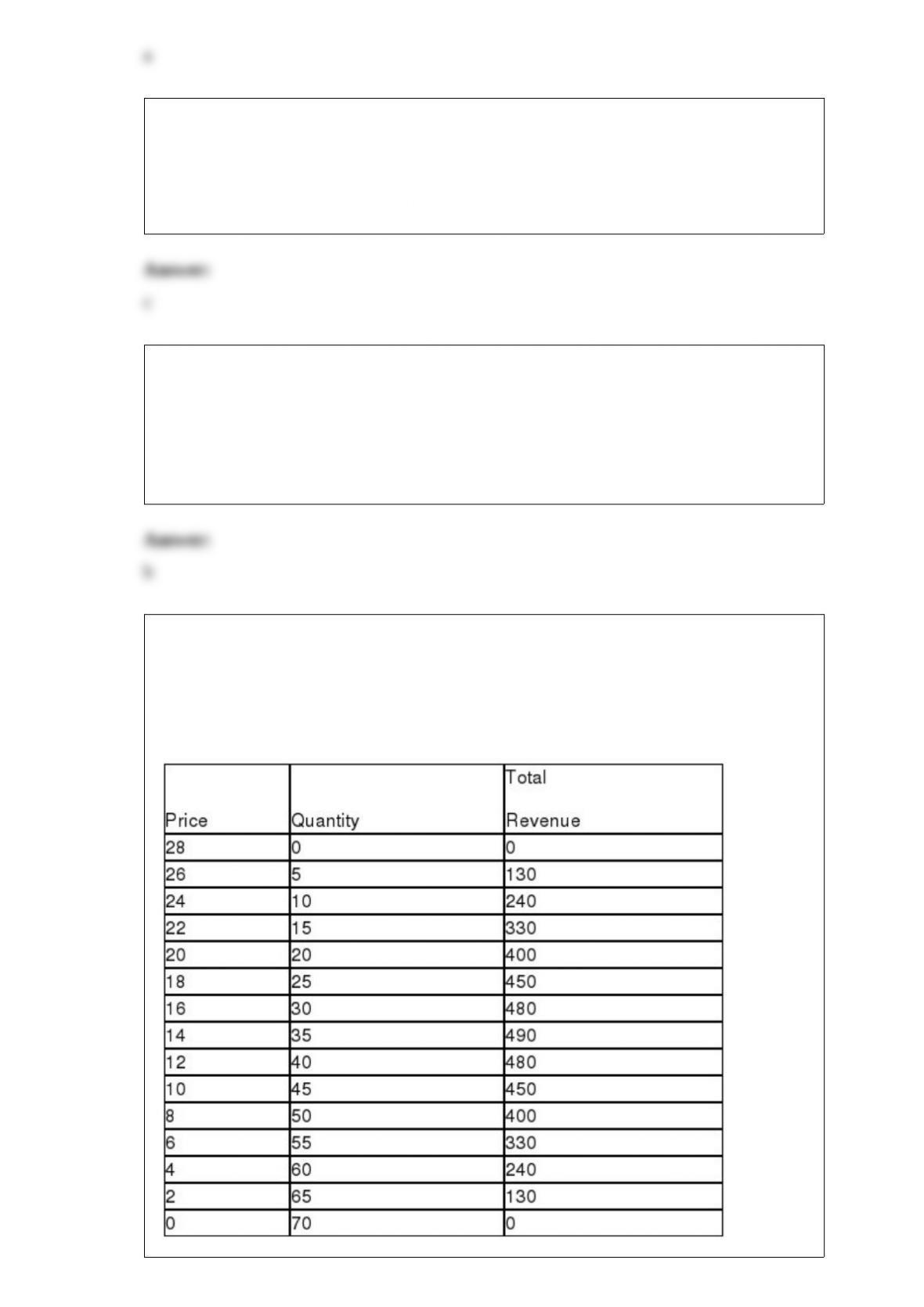
10) Table 17-11
Only two firms, ABC and XYZ, sell a particular product. The table below shows the
demand curve for their product. Each firm has the same constant marginal cost of $8
and zero fixed cost.

Refer to Table 17-11. If this market were perfectly competitive instead of oligopolistic,
what quantity would be produced?
a.25
b.35
c.50
d.70
11) The U.S. tax burden is
a.about the same as most European countries.
b.higher than most European countries.
c.lower than most European countries.
d.higher than all European countries.
12) Which of the following statements regarding a competitive market is not correct?
a.There are many buyers and many sellers in the market.
b.Because of firm location or product differences, some firms can charge a higher price
than other firms and still maintain their sales volume.
c.Price and average revenue are equal.
d.Price and marginal revenue are equal.
13) Which of the following equations is not valid?
a.Consumer surplus = Value to buyers – Amount paid by buyers
b.Producer surplus = Amount received by sellers – Cost to sellers
c.Total surplus = Value to buyers – Amount paid by buyers + Amount received by
sellers – Costs of sellers
d.Total surplus = Value to sellers – Cost to sellers