
Which of the following countries had the lowest GDP per capita in 2012?
A) France
B) Mexico
C) Democratic Republic of the Congo
D) Argentina
Jeremy is thinking of starting up a small business selling NASCAR memorabilia. He is
considering setting up his business as a corporation. What is one advantage to Jeremy
of setting up his business as a corporation?
A) By setting up the business as a corporation, Jeremy would not face double taxation.
B) By setting up the business as a corporation, Jeremy would have the ability to share
risk with shareholders.
C) By setting up the business as a corporation, Jeremy would have both ownership and
control over the business.
D) All of the above would be advantages of setting up his business as a corporation.
Suppose the Fed purchases Treasury Securities. Interest rates in the United States will
________ and the U.S. dollar will ________ against foreign currencies.
A) decrease; appreciate
B) decrease; depreciate
C) increase; depreciate
D) increase; appreciate
The main tool that the Federal Reserve uses to conduct monetary policy is
A) open market operations.
B) discount policy.
C) setting reserve requirements.
D) acting as the lender of last resort.
E) check clearing.
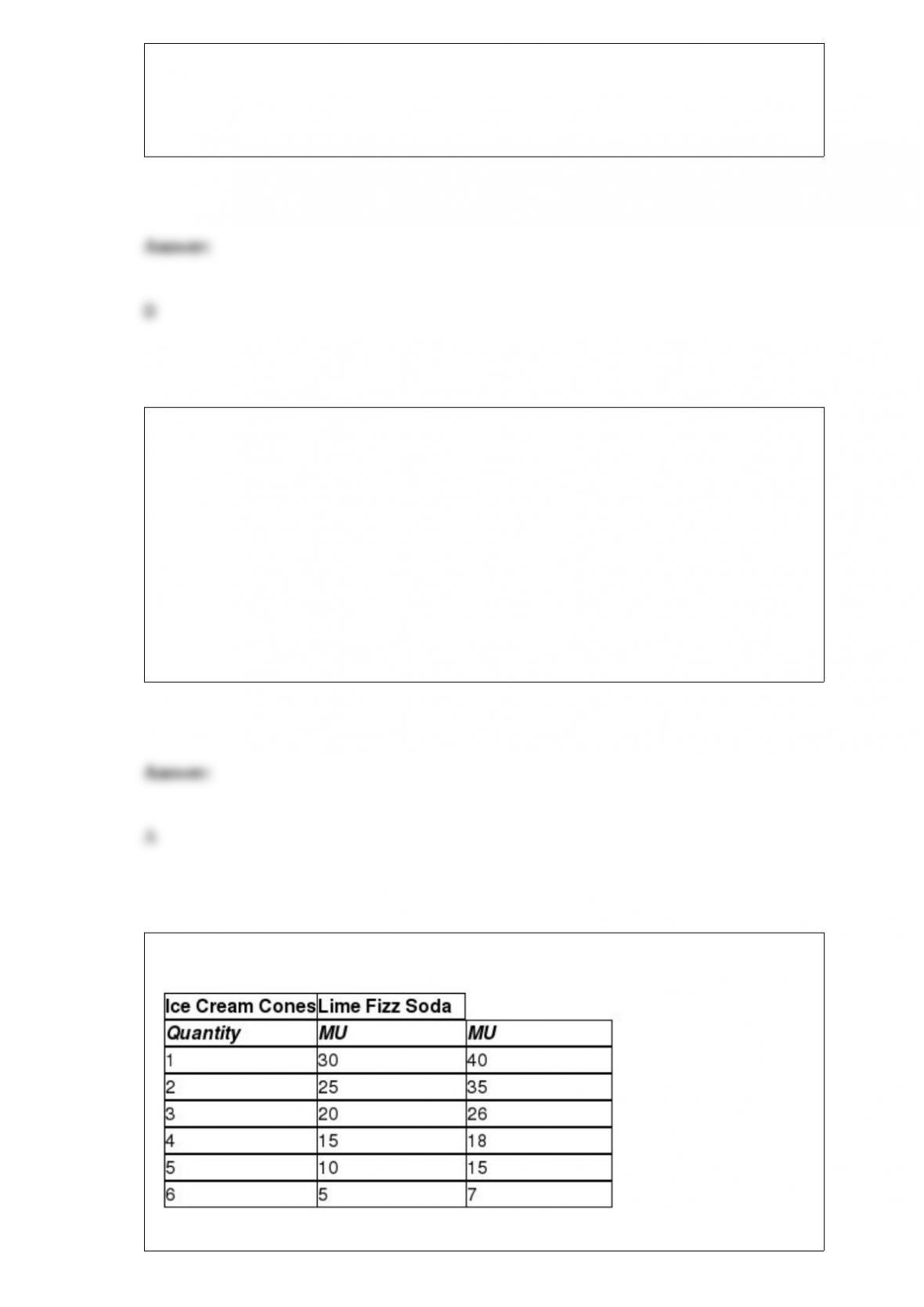
Table 10-3

The table above shows Lee’s marginal utility from consuming ice cream cones and cans
of Lime Fizz Soda. Select the phrase that completes the following statement. “We can
determine the number of ice cream cones and cans of Lime Fizz Soda Lee should
consume to maximize his utility
A) if we know what Lee’s income is.”
B) if we know what Lee’s income is and the price of an ice cream cone and the price of
a can Lime Fizz Soda.”
C) by adding up the marginal utilities for ice cream cones and Lime Fizz Soda.”
D) if we know the values of the marginal utility per dollar for ice cream cones and Lime
Fizz Soda.”
Economists usually assume that people act in a rational, self-interested way. In
explaining how consumers make choices this means that economists believe
A) consumers will always buy goods and services at the lowest possible prices.
B) consumers spend their incomes to order to accumulate the most goods and services.
C) consumers make choices that will leave them as satisfied as possible given their
incomes, tastes and the prices of goods and services available to them.
D) consumers will spend their incomes and time on activities that benefit themselves as
much as possible, without regard to the welfare of others.
Which of the following undermines a firm’s ability to engage in price discrimination?

A) the seller’s market power
B) the inability to prevent resale of the product from one market segment to another
C) buyers having different elasticities of demand for the product
D) the seller’s ability to segment the total market
Expansionary monetary policy to prevent real GDP from falling below potential real
GDP would cause the inflation rate to be relatively ________ and real GDP to be
relatively ________.
A) higher; higher
B) higher; lower
C) lower; higher
D) lower; lower
Refer to Table 9-3. Select the statement that accurately interprets the data in the table.
A) Bryce has an absolute advantage in making candles and soap.
B) Tina has an absolute advantage in making candles and soap.
C) Neither Bryce nor Tina has an absolute advantage in making candles.
D) Neither Bryce nor Tina has an absolute advantage in making soap.

Article Summary. Over the past two years, the Indian rupee has fallen 26 percent in
value against the U.S. dollar, reaching a record low of 61.80 rupees per dollar in
August 2013. The decline reflects increasing capital outflows and pessimism
regarding the government’s attempts to reverse this trend. The Indian government
was expected to announce potential measures to increase the inflow of capital,
including the possibility of raising debt abroad, raising money from Indians who
live abroad, easing restrictions on overseas borrowing, and raising interest rates.
Critics argue that current and well-entrenched policies deter capital inflow from
investors and corporations, and raising interest rates may reduce confidence in the
economy, which experienced a decade-low growth rate of 5 percent in 2013.
Source: Rafael Nam, “Rupee over 60: Why Indian currency weakness may be here
to stay,” Reuters, August 8, 2013.
All else equal, a depreciation of the Indian rupee relative to a currency such as the U.S.
dollar should ________ Indian exports and ________ imports to India.
A) increase; increase
B) increase; decrease
C) decrease; increase
D) decrease; decrease
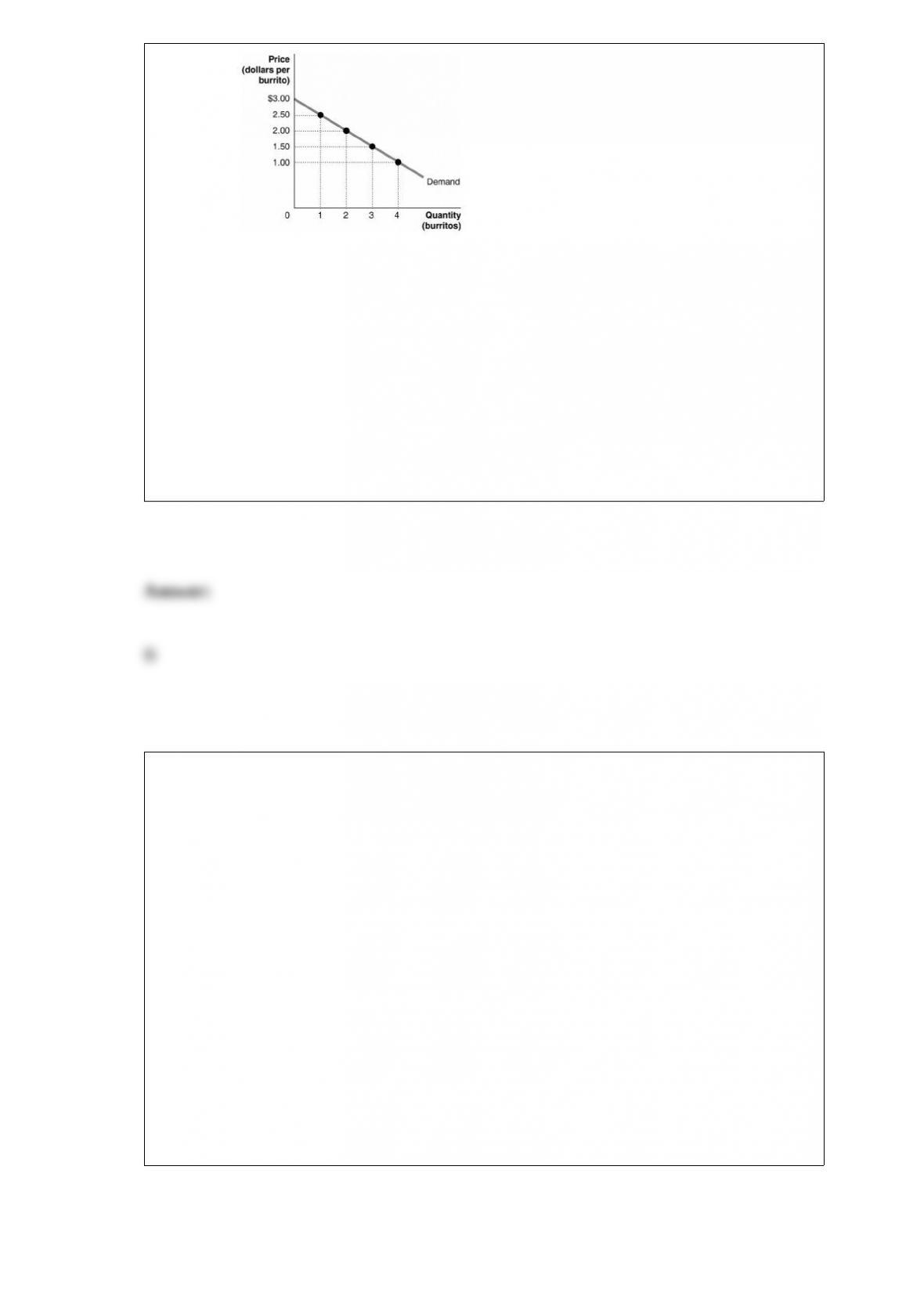
Figure 4-1 Figure 4-1 shows Arnold’s demand curve for
burritos.
If the market price is $1.50, what is Arnold’s consumer surplus?
A) $1.50
B) $2.25
C) $3.00
D) $4.75
Joss is a marketing consultant. Iris and Daphne are potential customers interested in
commissioning Joss to undertake a market survey and compile the findings in a report.
Iris is willing to pay $500 for the service while Daphne is willing to pay $800. Suppose
that the opportunity cost of Joss’s time is $1,200. Assume that Iris and Daphne do not
know each other. Which of the following statements is true?
A) Joss should charge each customer $600; that way he will earn his opportunity cost
and it will be fair to both Iris and Daphne.
B) Joss should charge Iris $500 and Daphne no more than $700; that way he earns his
opportunity cost and there is no loss in economic surplus.
C) Joss should charge Iris $500 and Daphne $800; that way economic surplus is
maximized.
D) Joss should charge Iris $500 but charging Daphne $800 is unfair because it allows
Joss to earn more than his opportunity cost.

Who receives the most of what is produced in a market economy?
A) lawmakers and other politically favored groups
B) those who are willing and able to buy them
C) everyone receives an equal amount
D) people who earn the highest incomes
Apple’s decision in 2002 to focus on developing a smartphone rather than a tablet
computer exemplifies the
A) refusal of firms to invest in more than one project where unlimited resources are
involved.
B) refusal of firms to invest in more than one project where limited resources are
involved.
C) trade-off that firms face due to unlimited resources.
D) trade-off that firms face due to limited resources.

Empirical evidence from 1960 to 2010 shows that convergence in economic growth is
occurring in which of the following cases?
A) Low-income industrial countries are catching up to high-income industrial countries.
B) Low-income developing countries are catching up to high-income industrial
countries.
C) Low-income industrial countries are catching up to high-income developing
countries.
D) All low-income countries are catching up to all high-income countries.
Since 1900, real GDP per capita has ________ and this measure ________ the actual
growth in standards of living in the United States over this time.
A) increased; understates
B) increased; overstates
C) decreased; understates
D) decreased; overstates
What is the primary Difference between a sole proprietorship and a partnership?
A) Proprietorships have unlimited liability, while partnerships have limited liability.
B) Partnerships can issue stocks and bonds, while proprietorships cannot.
C) Partnerships have more owners than do proprietorships.
D) There is no real Difference between the two types of firms.
Which of the following is not a component of aggregate expenditure?
A) consumption spending
B) planned investment spending
C) actual investment spending
D) government spending
A perfectly competitive firm faces a demand curve that is
A) horizontal.
B) vertical.
C) perpendicular to the quantity axis.
D) perfectly inelastic.

Suppose a developing country receives more machinery and capital equipment as
foreign entrepreneurs increase the amount of investment in the economy. As a result,
A) the long-run aggregate supply curve will shift to the right.
B) the long-run aggregate supply curve will shift to the left.
C) the economy will move up along the long-run aggregate supply curve.
D) the economy will move down along the long-run aggregate supply curve.