
Applying the least-cost rule to two factors, a firm will
a. maximize profits at the output at which MRP = MFC.
b. minimize costs when the MPP of factor A equals the MPP of factor B.
c. minimize costs when the MRP of factor A equals the MRP of factor B.
d. minimize costs when the MPP of factor A divided by the price of A equals the MPP
of factor B divided by the price of B.
A tariff is a
a. tax imposed on domestic producers of export goods.
b. legal limit on the amount of a good that can be imported.
c. tax imposed on imported goods.
d. legal limit on the amount of a good that can be produced by foreign owners of a firm
located in a host country.
“The theory’s predictions are consistent with what I believe, so now I have good reason
to believe what the theory says.”This statement is likely to have been made by a person
who believes that
a. theories should be tested by gathering and analyzing data.

b. theories are descriptive of reality.
c. theories should be falsifiable or refutable.
d. b and c
e. none of the above
The term “derived demand” refers to the idea that a change in the
a. demand for one good, say, tennis racquets, will affect the demand for related goods,
say, tennis balls.
b. demand for a good is affected by the supply of that good.
c. demand for a good will affect the demand for the factors used to produce that good.
d. supply of a factor will affect the demand for that factor.
With respect to a PPF for goods X and Y, productive efficiency implies that in order to
producemore of goodX there will be a reduction in production of good Y.
a. True
b. False
Which of the following statements is true?
a. Oil is classified as part of the resource category land.
b. A person working for a company is classifiedas part of the resource category capital.
c. A machine in a factory is classified as part of the resource category land.
d. A person with the particular talent for organizing the resources of land, labor, and
capital to produce goods, seek new business opportunities, and develop new ways of
doing things is classified as part of the resource category labor.
e. a and d
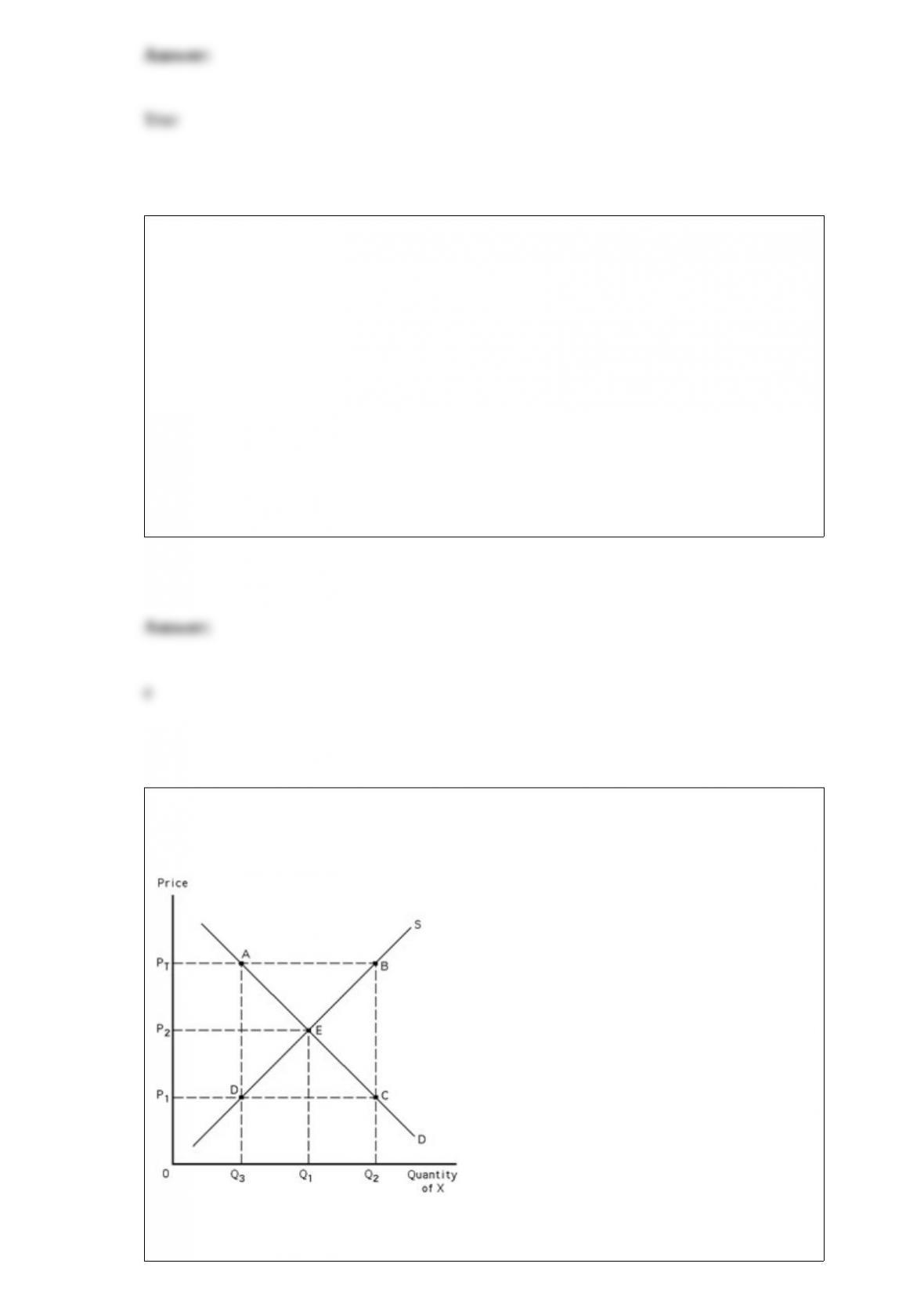
Refer to Exhibit 39-1. Given the target price of PT, the deficiency payment per unit is
Exhibit 39-1
a. PT – P2.
b. PT + P1.
c. PT – P2.
d. PT – P1.
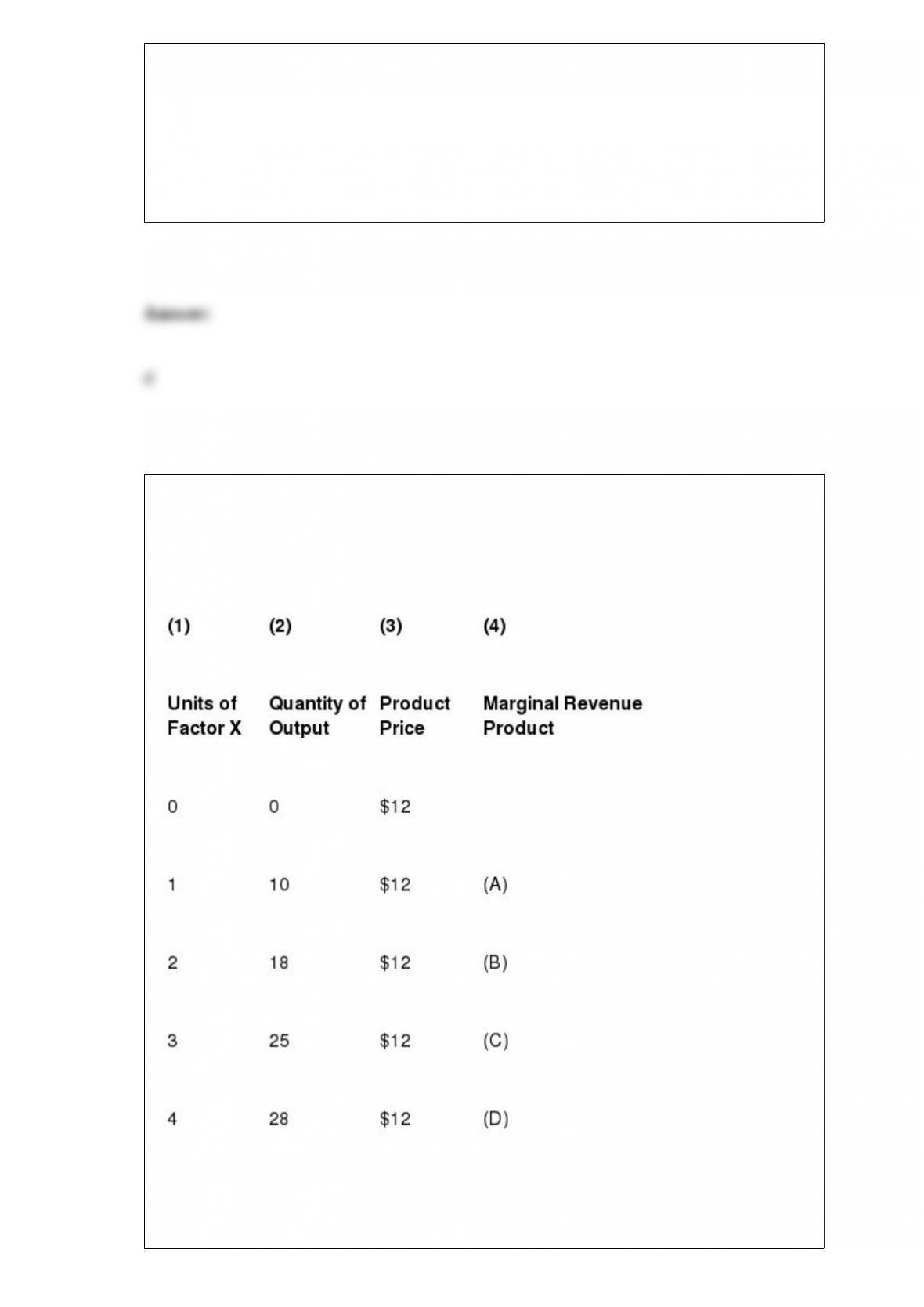
Refer to Exhibit 27-1. What dollar value goes in blank (C)?
Exhibit 27-1
a. $300
b. $12

c. $30
d. $84
When a new word processing software program is released, companies that might use it
must consider not only the cost of buying it, but the costs of retraining all their
employees to use it, and of training their support staff to install and operate it. These
additional costs beyond the purchase price are known as __________ costs.
a. implicit
b. innovation
c. switching
d. transformation
Refer to Situation 4-1. Before the oil embargo, the price ceiling on gasoline had no
noticeable effect on the market. What is the most likely explanation for this?
Situation 4-1
During the winter of 1973-74, a general system of wage and price controls (including a
price ceiling on gasoline) was in force in the United States. At the beginning of 1974,
some oil-producing countries imposed an oil embargo (a legal prohibition on
commerce) on the West. In the spring of 1974, price controls were abolished.
a. The equilibrium price of gasoline was probably below the price ceiling.

b. The demand curve for gasoline in the 1970s was vertical.
c. The supply curve for gasoline in the 1970s was vertical.
d. The equilibrium price of gasoline was probably above the price ceiling.
On a supply-and-demand diagram, quantity demanded equals quantity supplied
a. only at the single equilibrium price.
b. at every price at or above the equilibrium price.
c. at every price at or below the equilibrium price.
d. at every price.
A firm can use a given plant more intensively and it can change the size of a plant.
When it uses a given plant more intensively, it is holding one factor __________ and
therefore the time period of production is most likely the __________.
a. fixed; short run
b. fixed; long run
c. more important than another; long run
d. more important than another; short run

Which of the following statements is true?
a. In a world of efficiently used scarce resources, more of one good necessarily means
less of some other good.
b. The law of increasing opportunity costs assumes that all people have the same ability
to produce goods.
c. Efficiency implies that it is impossible to get more of one good without getting less
of another.
d. Even if a country has unemployed resources, it can still be operating on its
production possibilities frontier (PPF).
e. a and c
If scarcity didn’t exist, neither would
a. rationing devices.
b. competition.
c. labor.
d. capital.
e. a and b
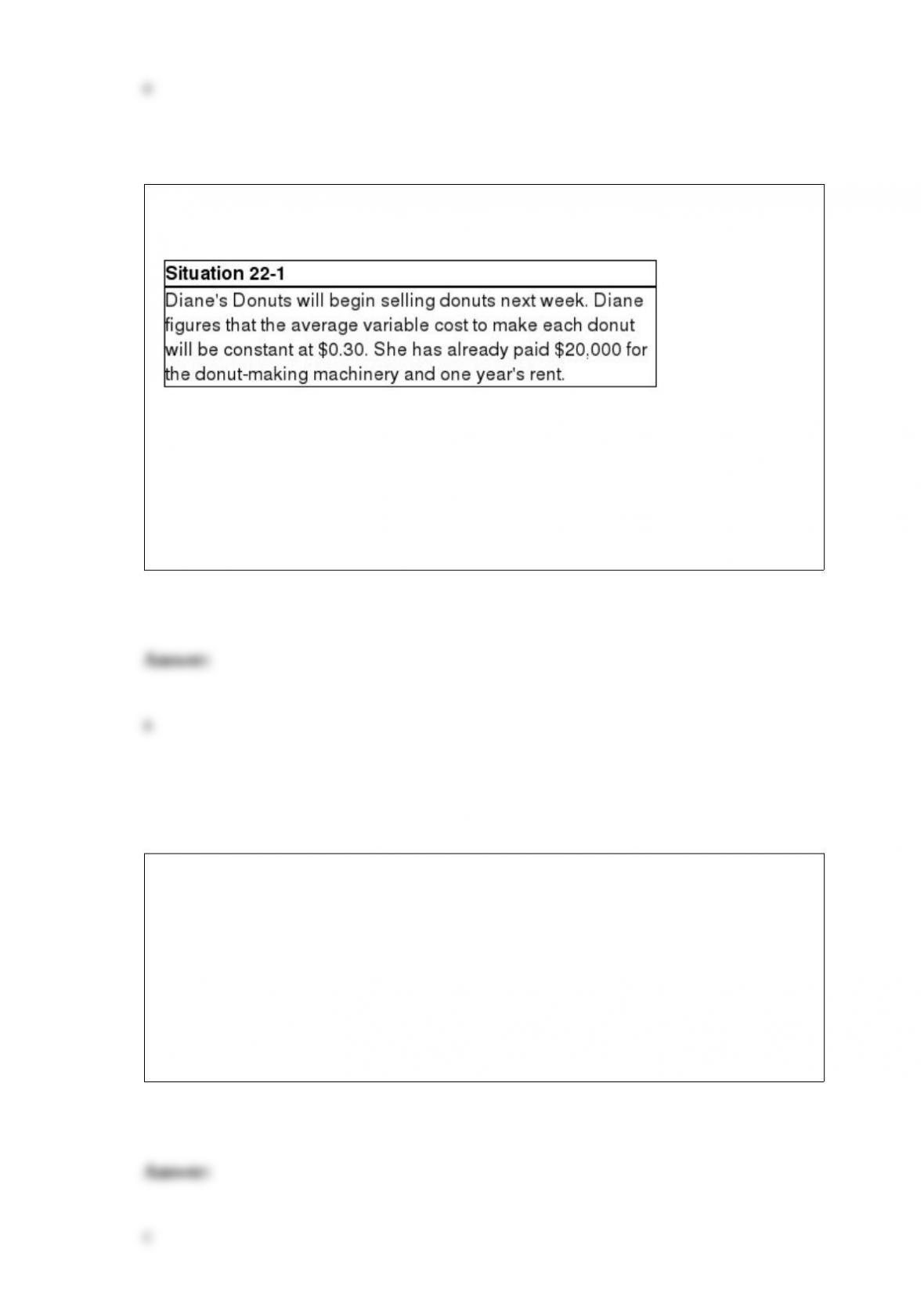
Refer to Situation 22-1. What will Diane’s total variable costs be if she sells 36,500
donuts in one year?
a. $10,950
b. $18,450
c. $22,080
d. $12,500
Which of the following increases the quantity supplied of agricultural goods?
a. acreage allotments
b. assigning market quotas
c. agricultural price supports
d. a, b, and c