
1) In 2002, the United States announced its “Global Climate Change” initiative to
reduce greenhouse gases per dollar of GDP by 18 percent by 2012.
2) International trade based on the principle of comparative advantage creates a more
efficient allocation of world economic resources.
3) income elasticity measures the effect of a change in income on the purchases of some
good or service.
4) Technological advance includes new and improved products, new and improved
production techniques, and new and improved distribution methods.
5) In the last half of the 1990s monetary policy was highly effective in the United States
but highly ineffective in Japan.
6) Advocates of the minimum wage argue that its effects should be analyzed within the
context of a dynamic and imperfectly competitive labor market.
7) The rate of unionization is substantially higher for protective service workers than
for sales workers.

8) other things equal, younger workers are more likely to migrate than older workers.
9) when the price of a product falls, the income effect induces the consumer to purchase
more of it while the substitution effect prompts her to buy less.
10) in 2006, some 45 million americans did not have health insurance.
11) when the dollar price of yen rises, the dollar appreciates in value relative to the yen.
12) removing all illegal immigrants would expand domestic-born employment by an
amount equal to the number of illegal immigrants removed.
13) A lump-sum tax causes the after-tax consumption schedule to be flatter than the
before-tax consumption schedule.
14) Government transfer programs result in a U.S. Lorenz Curve that is closer to the
diagonal line than would be the case without the programs.
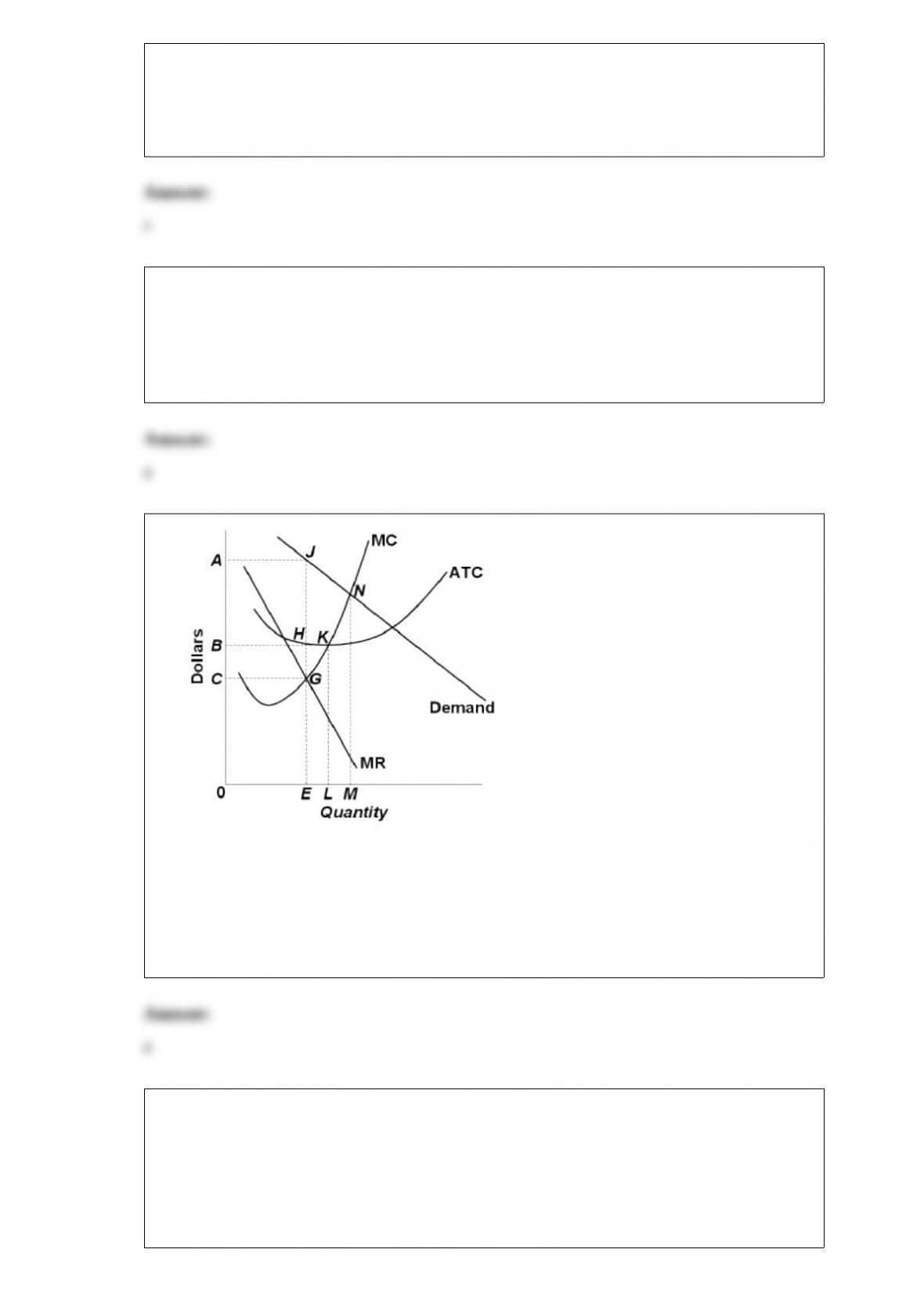
15) confronted with the same unit cost data, a monopolistic producer will charge:
a.the same price and produce the same output as a competitive firm.
b.a higher price and produce a larger output than a competitive firm.
c.a higher price and produce a smaller output than a competitive firm.
d.a lower price and produce a smaller output than a competitive firm.
16) the location of the product supply curve depends on:
a.production technology.
b.the number of buyers in the market.
c.the tastes of buyers.
d.the location of the demand curve.
17)
refer to the above diagram. at the profit-maximizing level of output, the firm will
realize:
a.an economic profit of abhj
b.an economic profit of acgj
c.a loss of gh per unit
d.a loss of jh per unit
18) economic historians date the start of the industrial revolution around the year 1776,
when james watt:
a.built the first factory for mass production.
b.invented the steam locomotive.
c.successfully lobbied british parliament for the enactment of patent legislation to
protect new inventions.
d.invented and built a more powerful and efficient steam engine.
19) the marginal benefit curve is:
a.upsloping because of increasing marginal opportunity costs.
b.upsloping because successive units of a specific product yield less and less extra
benefit.
c.downsloping because of increasing marginal opportunity costs.
d.downsloping because successive units of a specific product yield less and less extra
benefit.
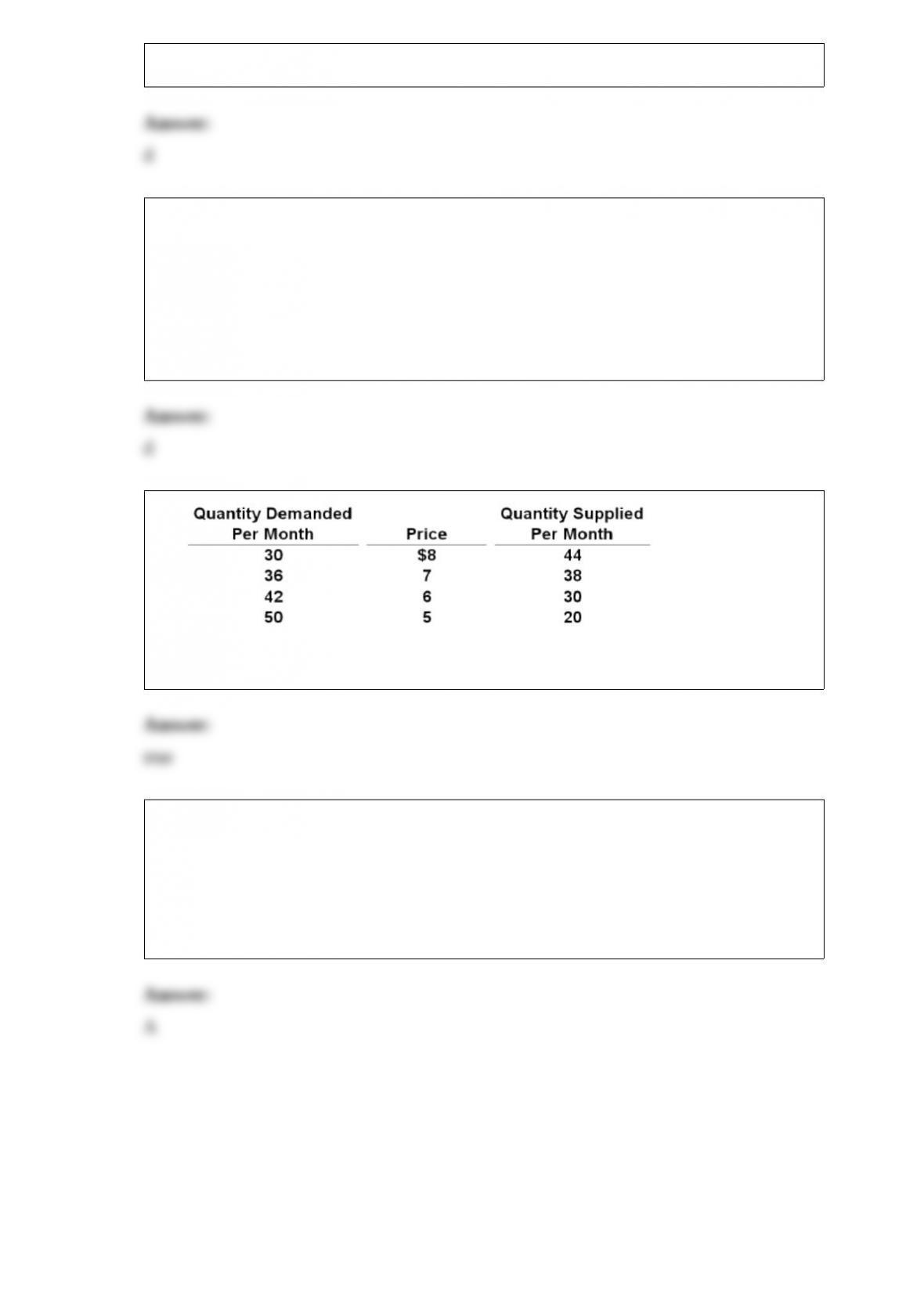
20)
refer to the above data. the equilibrium price of this product is somewhere between $6
and $7.
21) If the current price level was such that the aggregate quantity demanded exceeded
the aggregate quantity supplied, we would expect:
A.inflation to occur.
B.the aggregate demand curve to shift rightward.
C.the aggregate demand curve to shift leftward.
D. the aggregate supply curve to shift leftward.
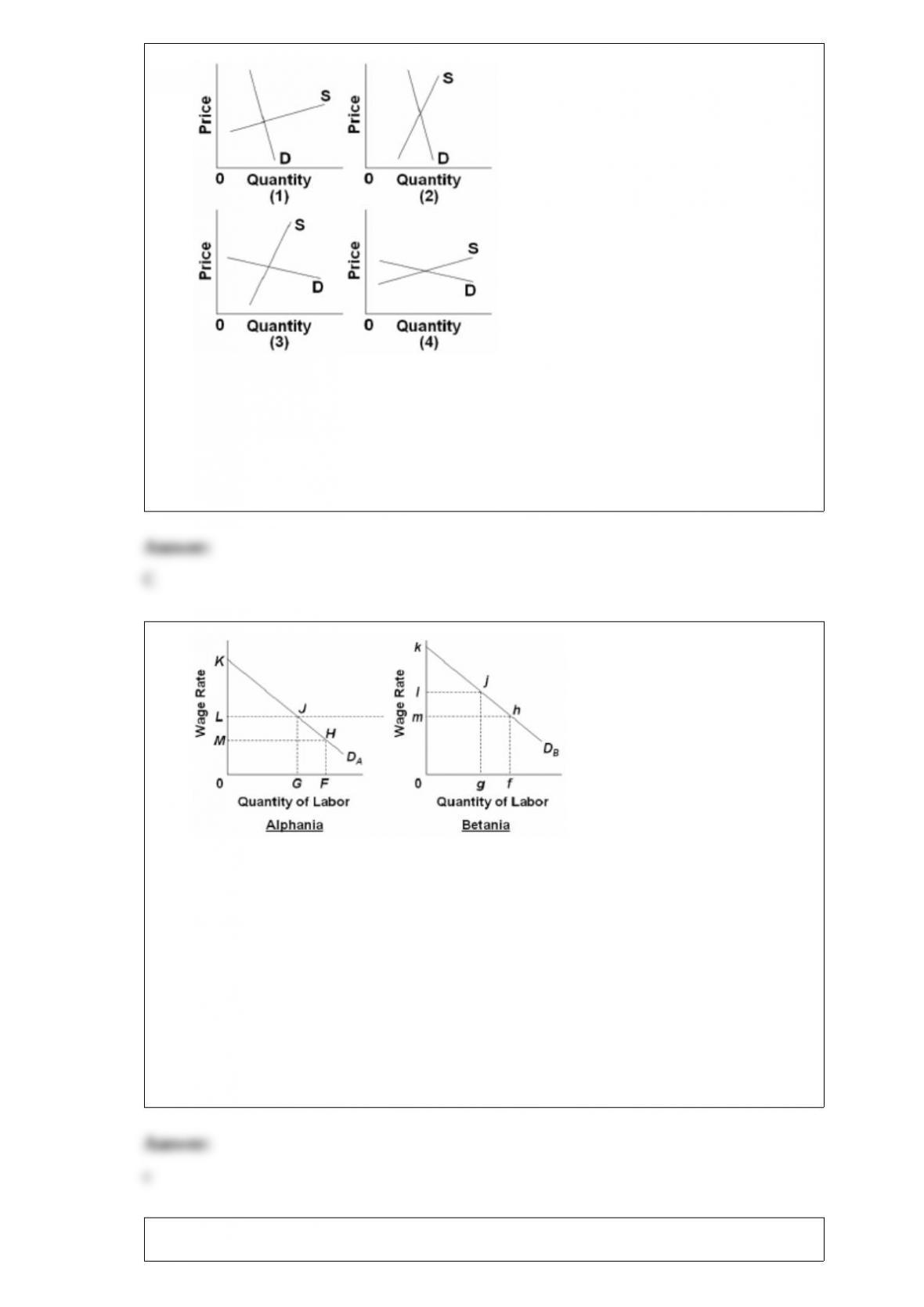
22)
In which of the above market situations will the largest portion of an excise tax of a
specified amount per unit of output be borne by buyers?
A.4
B.3
C.1
D.2
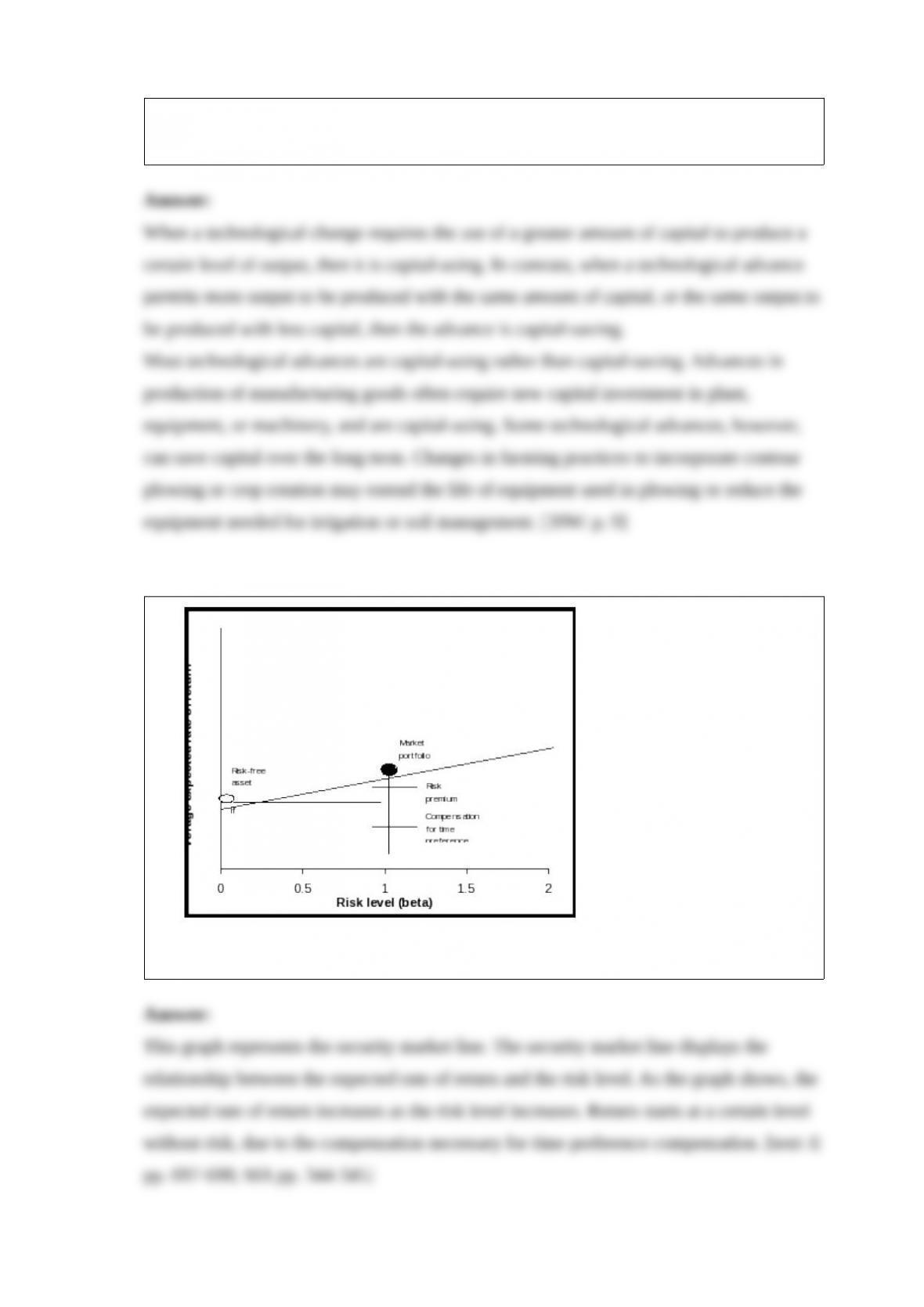
23)
assumptions: (1) the demand for labor in alphania and betania are as shown by da and
db, respectively; (2) alphania’s native labor force is f and that of betania is g; (3) wage l
in alphania is equal to wage m in betania; and (4) full employment exists in both
countries.
refer to the above diagram and assumptions. if unemployment, rather than full
employment, had initially existed in alphania:
a.then betania’s loss of output would have been greater.
b.then betania’s gain of output would have been less.
c.its loss of output would have been less.
d.its loss of output would have been greater.
24) (last word) the immigration acts of 1921 and 1924:

a.set annual quotas that favored immigrants from western and northern europe.
b.encouraged greater immigration from asia.
c.encouraged greater immigration from south and central america.
d.effectively blocked all immigration until 1965.
25) Which of the following amended the Clayton Act’s prohibition against mergers that
substantially lessen competition?
A.Celler-Kefauver Act of 1950
B.Wheeler-Lea Act of 1938
C.Clayton Act of 1914
D.Sherman Act of 1890
26) Describe three major features of the Taylor rule.
27) What is the term auction facility and how does it affect the excess reserves and the
monetary multiplier of the banking system?

28) What role can government play in fostering economic growth in developing
countries?
29) Why is the money demand curve downward sloping?
30) What is the goal of monetary policy?

31) Why is it important to account for the net foreign factor income when calculating
domestic income instead of national income?
32) Migration to the United States will occur as long as wages are higher in the United
States than in the other country. Evaluate.
33) Evaluate the statement that unexpected declines in demand, with inflexible prices,
generate a rise in unemployment and a fall in output.
34) What is the difference between capital-using and capital-saving technological
advances? Give examples.
35) Explain the relationship
displayed on the graph. Mark the following points of interest: if, a risk-free asset, a
market portfolio, the compensation for time preference and the risk premium.