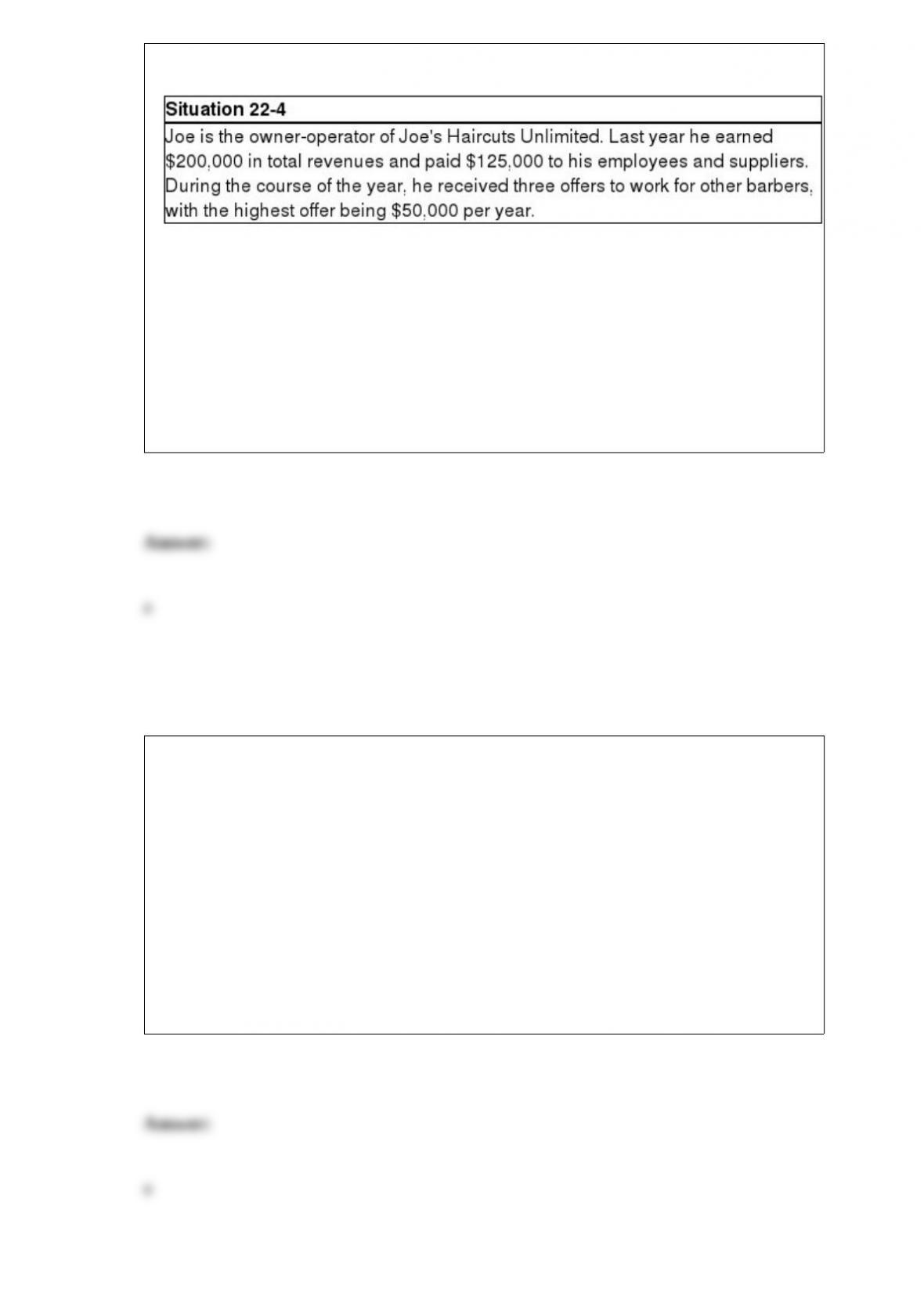
Refer to Situation 22-4.What are Joe’s explicit costs?
a. $125,000
b. $175,000
c. $35,000
d. $200,000
e. $50,000
Which of the following is an illustration of the law of increasing opportunity costs?
a. As more cars are produced, the opportunity cost of each additional car is greater than
for the preceding unit.
b. As more cars are produced, the opportunity cost of each additional car is less than for
the preceding unit.
c. As more cars are produced, the opportunity cost of each additional car is the same as
for the preceding unit.
d. People pay lower prices for cars the higher the costs of producing cars.

The simple majority decision rule may generate results that are
a. efficient, because the projects undertaken are the ones desired by more than 50
percent of the people.
b. efficient, because projects are undertaken only if total benefits exceed total costs.
c. efficient, because the intensity of individuals’ preferences are considered.
d. inefficient when the total benefits of projects undertaken are less than the total costs.
e. inefficient when the intensity of individuals’ preferences are considered.
As Jamal’s income rises, his demand for pizza does not change. It follows that, for
Jamal, pizza is a(n)
a. normal good.
b. inferior good.
c. neutral good.
d. substitute good.
e. complementary good.
Which of the following is false?
a. Special interest legislation is necessarily bad legislation in the sense that it does not
(because it cannot) ever benefit the general public.

b. A special interest group is a subset of the general population that holds usually
intense preferences for or against a particular government service, activity, or policy.
c. Congressional districts can be thought of as special interest groups for certain
purposes.
d. Special interest groups are likely to argue for their specific policies or programs by
claiming they serve the best interests of the general public.
To an economist, an increase in demand means the same thing as an increase in quantity
demanded.
a. True
b. False
A price floor set above the equilibrium price will
a. clear the market for the good.
b. result in a shortage of the good.
c. result in a surplus of the good.
d. force some firms in this industry to go out of business.

If the firm is producing a quantity of output for which MC > MR, then the firm should
increase production to increase its profits.
a. True
b. False
Grade inflation in colleges may possibly be a result of college professors being in a
prisoner’s dilemma setting.
a. True
b. False
Unions often encourage the buying public to “look for the union label” primarily
because
a. they feel that only U.S. and/or union-made goods are of high quality.
b. they feel that it is un-American to buy goods from foreign producers.
c. doing so may increase demand for the product they produce, which in turn may
increase the wage rate paid to union employees.
d. they realize that Americans are too busy to take time to gather all the important
information about a product and these labels are a way of informing the buying public
that union-made goods are well made.
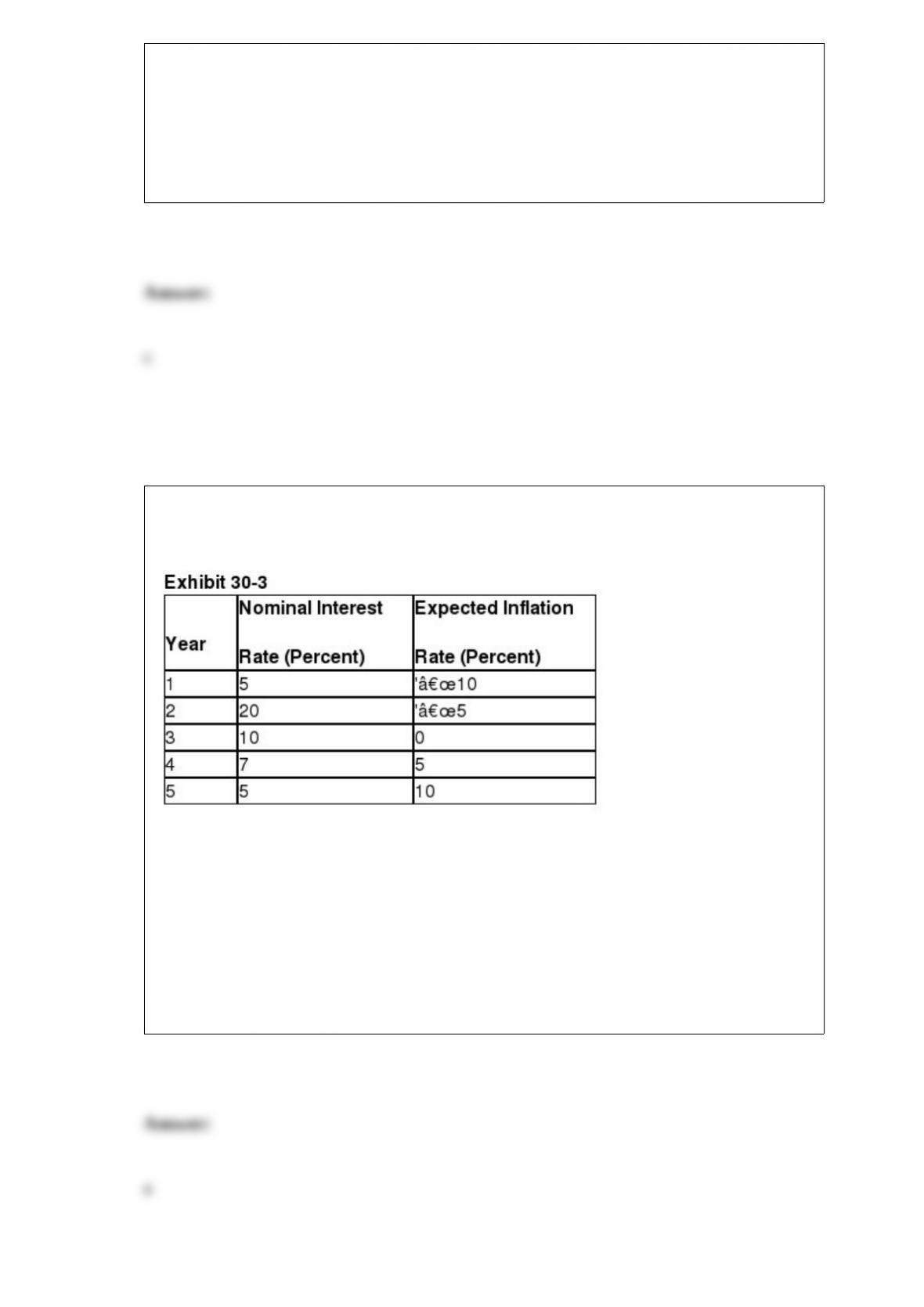
Refer to Exhibit 30-3. The real interest rate in year 2 is
a. 25 percent.
b. 5 percent.
c. 15 percent.
d. -25 percent.
e. -15 percent.

The equilibrium interest rate is determined
a. by the demand for loanable funds.
b. by the supply of loanable funds.
c. by the demand for and supply of loanable funds.
d. independently of the demand for and supply of loanable funds.
Refer to Situation 33-1.If the prospective criminal sets the following values:
Situation 33-1Suppose that the equation that represents the expected benefits of
burglary for a given prospective criminal is as follows:
EB = Ps x Loot
The criminal’s cost equation is as follows:
EC = [Pp x (I + F)] +AC
Where:
EB is the expected benefits of burglary
Ps is the probability of successfully burglarizing a house
Loot is the dollar take from the burglary
EC is the expected costs of burglary
Pp is the probability of imprisonment
I is the income the criminal gives up if caught and imprisoned
F is the dollar value the criminal puts on freedom
AC is the anguish cost of committing a burglary Ps = 65 percent
Loot = $20,000
Pp = 20 percent
I = $30,000
F = $15,000
AC = $5,000
The prospective criminal’s expected benefit from committing the burglary is
______________ and his expected cost of committing the burglary is
_______________.Economic theory tells us that under these circumstances, the
prospective criminal ______________ commit the burglary. a. $13,000; $14,000; will
b. $13,000; $14,000; will not
c. $6,667; $50,000; will not
d. $57,500; $50,000; will
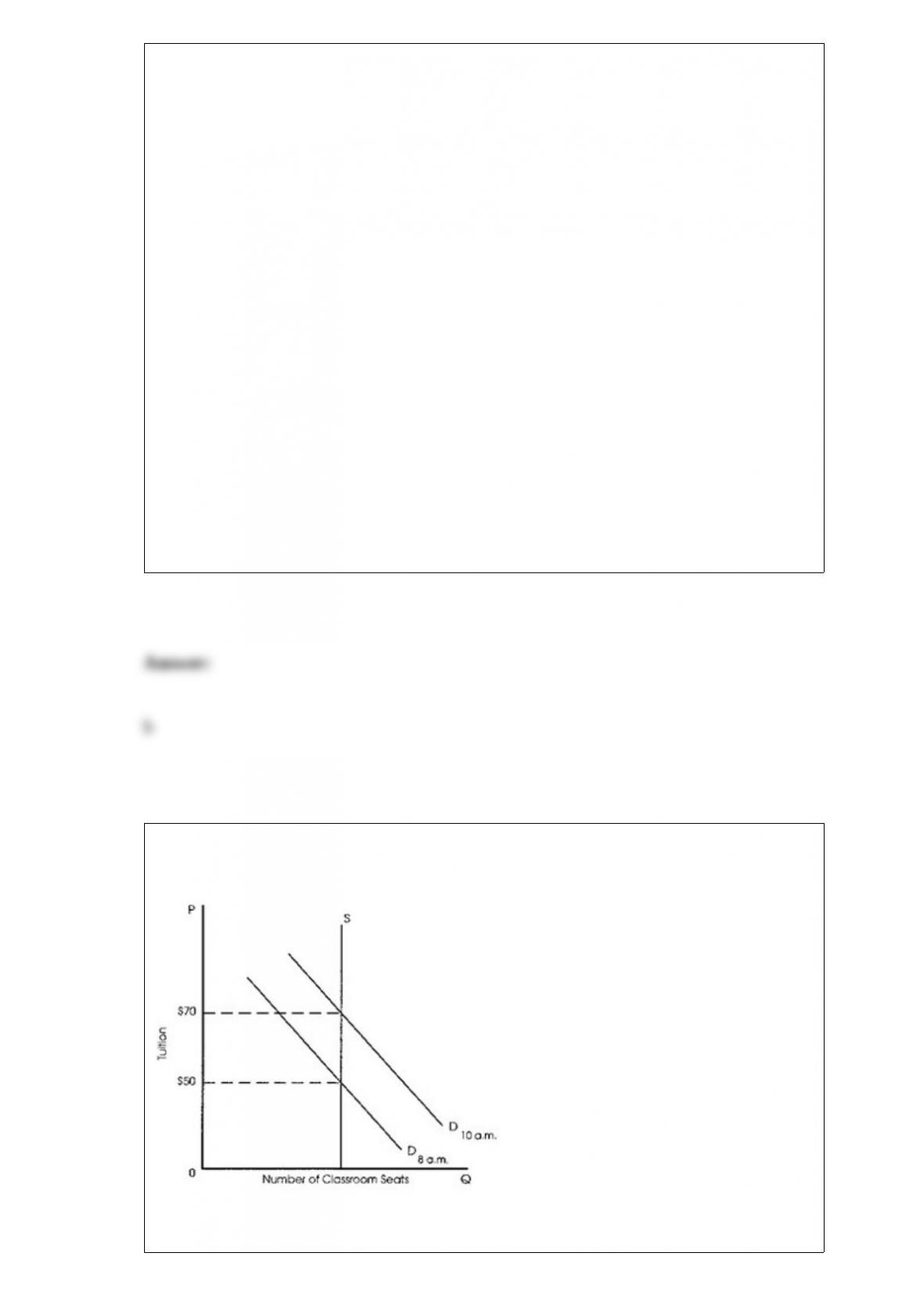
Refer to Exhibit 5-2. If the tuition is set at $60 there will be
Exhibit 5-2
a. a shortage at 10 a.m. and a surplus at 8
a.m.

b. a surplus at 10 a.m. and a shortage at 8 a.m.
c. equilibrium at both 10 a.m. and 8 a.m. because the price is half-way between their
individual equilibria.
d. none of the above
Indifference curves are generally downward sloping and concave to the origin.
a. True
b. False
Assuming the demand for their products is inelastic, farmers (as a group) have an
incentive to
a. increase the supply of what they sell.
b. agree among themselves to decrease the supply of what they sell.
c. spend at least 10 percent of their budgets to advertise their products.
d. b and c
e. a and c

Special interest group Q receives a 1/10,000th slice of the economic pie.Its net benefit
from either an economic growth policy or a transfer policy is $50,000.In order for
group Q to be indifferent between the two policies, the economic growth policy would
have to make the size of the economic pie (Real GDP) grow
by_________________.This type of analysis is used to show that special interest
groups tend press government for ______________ instead of ________________.
a. $50,000,000; economic growth; transfers
b. $500,000; transfers; economic growth
c. $500,000,000; transfers; economic growth
d. $5,000,000; transfers; economic growth
e. none of the above
To reduce pollution, economists generally prefer a corrective tax to a
command-and-control policy because the same goals can be achieved but in an efficient
manner with a corrective tax.
a. True
b. False

A negative externality exists when
a. marginal social costs are less than marginal private costs.
b. marginal social costs are greater than marginal private costs.
c. marginal social benefits are less than marginal private benefits.
d. marginal social benefits are greater than marginal private benefits.
e. b and c