
1) ITQs generate the most efficient use of resources when everyone keeps and fills their
own quotas.
2) U.S. exports increase and U.S. imports decrease the supplies of foreign monies
owned by U.S. banks.
3) consumer sovereignty means that legislation now protects the rights of consumers to
dispose of their incomes as they see fit.
4) Actual investment consists of planned investment plus unplanned changes in
inventories (plus or minus.)
5) Other things equal, the less competitive the market in which a firm sells its product,
the less elastic will be its resource demand curve.
6) TANF stands for Temporary Assistance for Needy Families.
7) If the economy were encountering a severe recession, proper monetary and fiscal
policies would call for:
A.selling government securities, raising the reserve ratio, lowering the discount rate,
increasing reserves available through the term auction facility, and a budgetary surplus.
B.buying government securities, reducing the reserve ratio, reducing the discount rate,
increasing reserves available through the term auction facility, and a budgetary deficit.

C.buying government securities, raising the reserve ratio, raising the discount rate,
reducing reserves available through the term auction facility, and a budgetary surplus.
D.buying government securities, reducing the reserve ratio, raising the discount rate,
reducing reserves available through the term auction facility, and a budgetary deficit.
8) a purely monopolistic industry:
a.has no entry barriers.
b.has a downward sloping demand curve.
c.produces a product or service for which there are many close substitutes.
d.earns only a normal profit in the long run.
9) the post hoc fallacy and the correlation problem both relate to:
a.the calculation of marginal costs and marginal benefits of any economic activity.
b.the issue of determining causation.
c.the frequent inability of households and businesses to behave rationally.
d.the tradeoff problem associated with competing goals.
10) which of the following is an example of monetary policy?
a.raising taxes to reduce inflation.
b.increasing government spending to reduce unemployment and stimulate production.
c.lowering interest rates to encourage spending and promote full employment.
d.cutting food stamps and other transfer payment programs during periods of rapid
growth and high inflation.
11) if nominal gdp rises:
a.real gdp may either rise or fall.
b.we can be certain that the price level has risen.
c.real gdp must fall.
d.real gdp must also rise.

12) The corporate decision on type and level of R&D activity is difficult because:
A.the interest-rate cost of funds is difficult to estimate.
B.much of corporate R&D is based on the pursuit of science, not on the profit motive.
C.expected returns lie in the future and are highly uncertain.
D.total returns and marginal returns greatly diverge.
13) The following information for a hypothetical economy. All values are in nominal
terms.
M = $100
V = 2
Ca = $160
Xn = $10
G = $10
Refer to the above information. In equilibrium, Ig is:
A.$20.
B.$10.
C.$5.
D.$50.
14) If a firm is hiring variable resources D and F in imperfectly competitive input
markets, it will maximize profits by employing D and F in such quantifies that:
A.MRPD/MRCD = MRPF/MRCF = 1.
B.MRPD/MRCD = MRPF/MRCF.
C.MRPD/PD = MRPF/PF = 1.
D.MRPD/PD = MRPF/PF.
15) Open-market operations refer to:
A.purchases of stocks in the New York Stock Exchange.
B.the purchase or sale of government securities by the Fed.
C.central bank lending to commercial banks.
D.the specifying of loan maximums on stock purchases.
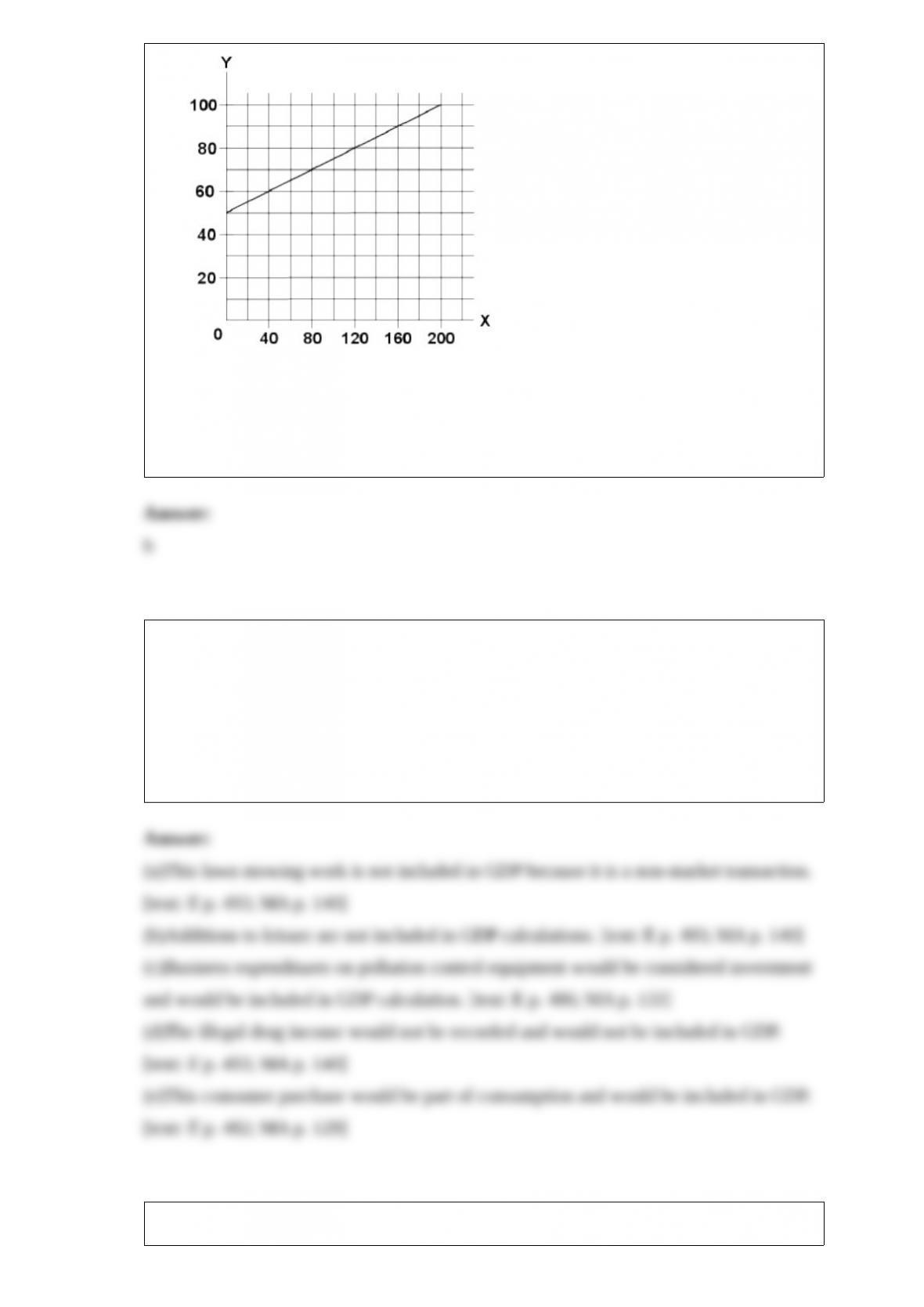
16)
refer to the above diagram. the variables x and y are:
a.inversely related.
b.directly related.
c.unrelated.
d.negatively related.
17) Which of the following are included and which are excluded in calculating this
years GDP? Explain in each instance.
(a)A homeowner who mows her own lawn
(b)A decline in the average hours worked per week
(c)Business expenditures on pollution control equipment
(d)Income from illegal drug activities
(e)The person who purchases a health care product
18) In the United States, the rate of unionization is:

A.higher for sales workers than for transportation workers.
B.lower for managers than for teachers.
C.lower for production workers than for sales workers.
D.higher for social workers than for protective service workers.
19) a consumer’s demand curve for a product is downsloping because:
a.total utility falls below marginal utility as more of a product is consumed.
b.marginal utility diminishes as more of a product is consumed.
c.time becomes less valuable as more of a product is consumed.
20) Other things equal, an increase in an economy’s exports will:
A.lower the marginal propensity to import.
B.have no effect on domestic GDP because imports will change by an offsetting
amount.
C.decrease its domestic aggregate expenditures and therefore decrease its equilibrium
GDP.
D.increase its domestic aggregate expenditures and therefore increase its equilibrium
GDP.
21) suppose that julia receives a $20 gift card for the local coffee shop, where she only
buys lattes and muffins. if the price of a latte is $4 and the price of a muffin is $2, then
we can conclude that julia:
a.should only buy muffins.
b.should only buy lattes.
c.can buy 5 lattes or 10 muffins if she chooses to buy only one of the two goods.
d.can buy 5 lattes and 10 muffins with her $20 gift card.
22) the value of u.s. imports is:
a.added to exports when calculating gdp because imports reflect spending by americans.
b.subtracted from exports when calculating gdp because imports do not constitute
spending by americans.
c.subtracted from exports when calculating gdp because imports do not constitute
production in the united states.
d.added when calculating gdp because imports do not constitute production in the
united states.
23) Other things equal, if wage rates increase by 20 percent, the greatest decline in
employment will occur when labor costs are a:
A.large proportion of total costs and product demand is elastic.
B.small proportion of total costs and product demand is elastic.
C.large proportion of total costs and product demand is inelastic.
D.small proportion of total costs and product demand is inelastic.
24) Define the relationship between the average expected rate of return, if, and the risk
premium.
25) Explain the three major factors that can cause a shift in aggregate supply. That is,
explain the three major determinants of supply.
26) Describe how changes in the Feds major policy tool leads to expansionary and
restrictive monetary policies.
27) How will the market demand curve for a public good differ from the market
demand curve for a private good?
28) Does the recent productivity acceleration experienced in the U.S. mean that the
business cycle is dead?
29) Given all the complications that can result with fiscal policy, is fiscal policy still
considered an effective policy tool for stabilizing business cycle fluctuations?