
We start with a 3 percent real interest rate in the United States and in Japan. Next, the
real interest rate in Japan falls to 2 percent, and the U.S. real interest remains constant.
As a result,
a. the yen will depreciate and the dollar will appreciate.
b. both the yen and the dollar will depreciate.
c. the yen will appreciate and the dollar will depreciate.
d. both the yen and the dollar will appreciate.
If the equilibrium exchange rate between U.S. dollars and Japanese yen is $0.007 = 1
yen, but currently the exchange rate is $0.009 = 1 yen, then with flexible exchange rates
the dollar price of a yen will __________, and the yen will __________.
a. increase; appreciate
b. decrease; appreciate
c. increase; depreciate
d. decrease; depreciate
Suppose the current exchange rate between the U.S. dollar and the Mexican peso is
$0.10 = 1 peso. Furthermore, suppose the price level in the United States rises 15
percent at a time when the Mexican price level is stable. According to the purchasing
power parity theory, what will be the new equilibrium exchange rate?
a. $0.085 = 1 peso
b. $0.13 = 1 peso
c. $0.15 = 1 peso
d. $0.115 = 1 peso
e. none of the above
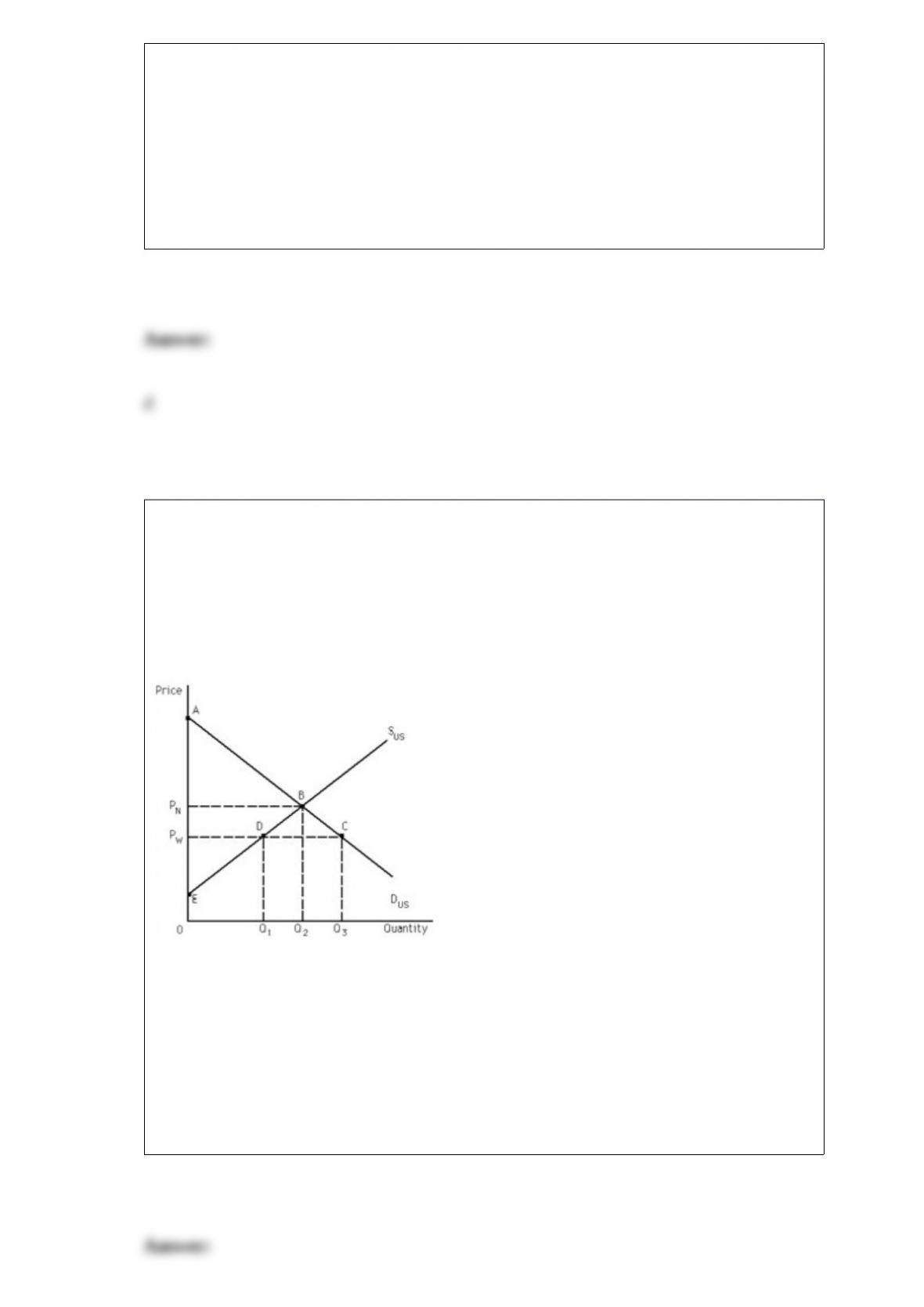
Refer to Exhibit 34-2. The U.S. demand and supply for a good are shown. Under a
policy of free trade, the world price is PW. If there is a policy change such that imports
are prohibited, the price becomes PN. U.S. producers are better off if imports are
__________; specifically, their producers’ surplus changes by area __________.
Exhibit 34-2
a. permitted; PWDE
b. permitted; PN BDPW
c. prohibited; BDC
d. prohibited; PNBDPW

Suppose the economy goes from a point on its production possibilities frontier (PPF) to
a point below that PPF. Assuming that the PPF has not shifted, this could be due to
a. a gain of resources.
b. a loss of resources.
c. technological improvement in the production of both goods.
d. an increase in unemployment of some resources.
In most societies, dollar price acts as the main rationing device. If dollar price weren’t
the main rationing device, would there still be a need for some rationing device to take
its place?
a. No, because with dollar price there would be no scarcity, although shortages would
still exist.
b. Yes, because there is a need for a rationing device as long as scarcity exists.
c. Yes, because there is a need for a rationing device as long as the world’s population is
so large.
d. No, because dollar price creates scarcity and without money price scarcity wouldn’t
exist.
e. none of the above
The supply of labor in labor market X is a function of (or depends upon)
a. wage rates in other labor markets.
b. the marginal physical product of workers in any labor market.
c. the price of the product that is produced by workers in labor market X.
d. a and c
All economists agree that to justify that market failure has occurred, it is sufficient to
have the market choose an inferior product over a superior product.
a. True
b. False
Labor supply is a reflection of the number of persons who can actually do a job.

a. True
b. False
Public choice refers to
a. the decisions and decision-making processes that individuals go through to solve
public problems.
b. political decisions made in the interest of the public at large.
c. the application of economic principles and tools to public-sector decision making.
d. the process that individuals undergo to decide what goods and services they will
purchase and consume.
e. the process that individuals undergo to decide whether or not they will pursue a
career government service.
The demand curve facing a firm in monopolistic competition is downward sloping,
because the firm
a. sells a differentiated product.
b. is the entire industry by itself.
c. is small relative to the market.

d. b and c
e. none of the above
The demand curve facing a monopolist is always
a. the same as the industry demand curve.
b. perfectly inelastic.
c. perfectly elastic.
d. unit elastic.
“In two hours the polls will close. I know I should probably vote, but it is raining, and
besides, there is a basketball game on TV tonight, so I’ll just stay in.” This person is
exhibiting
a. median voter preferences.
b. rational ignorance.
c. decision making based on cost-benefit considerations.
d. logrolling.
Which of the following statements is false?
a. Congress has granted the U.S. Postal Service the exclusive franchise to deliver
first-class mail.
b. A natural monopoly exists where economies of scale are so pronounced in an
industry that only one firm can survive.
c. In the United States patents are granted for a period of 10 years.
d. A public franchise is a right granted to a firm by government that permits the firm to
provide a particular good or service and excludes all others from doing the same.
Refer to Exhibit 38-2.If the closing price of Dasher’s stock on the previous day was
$17.50, what value goes in blank (A)?
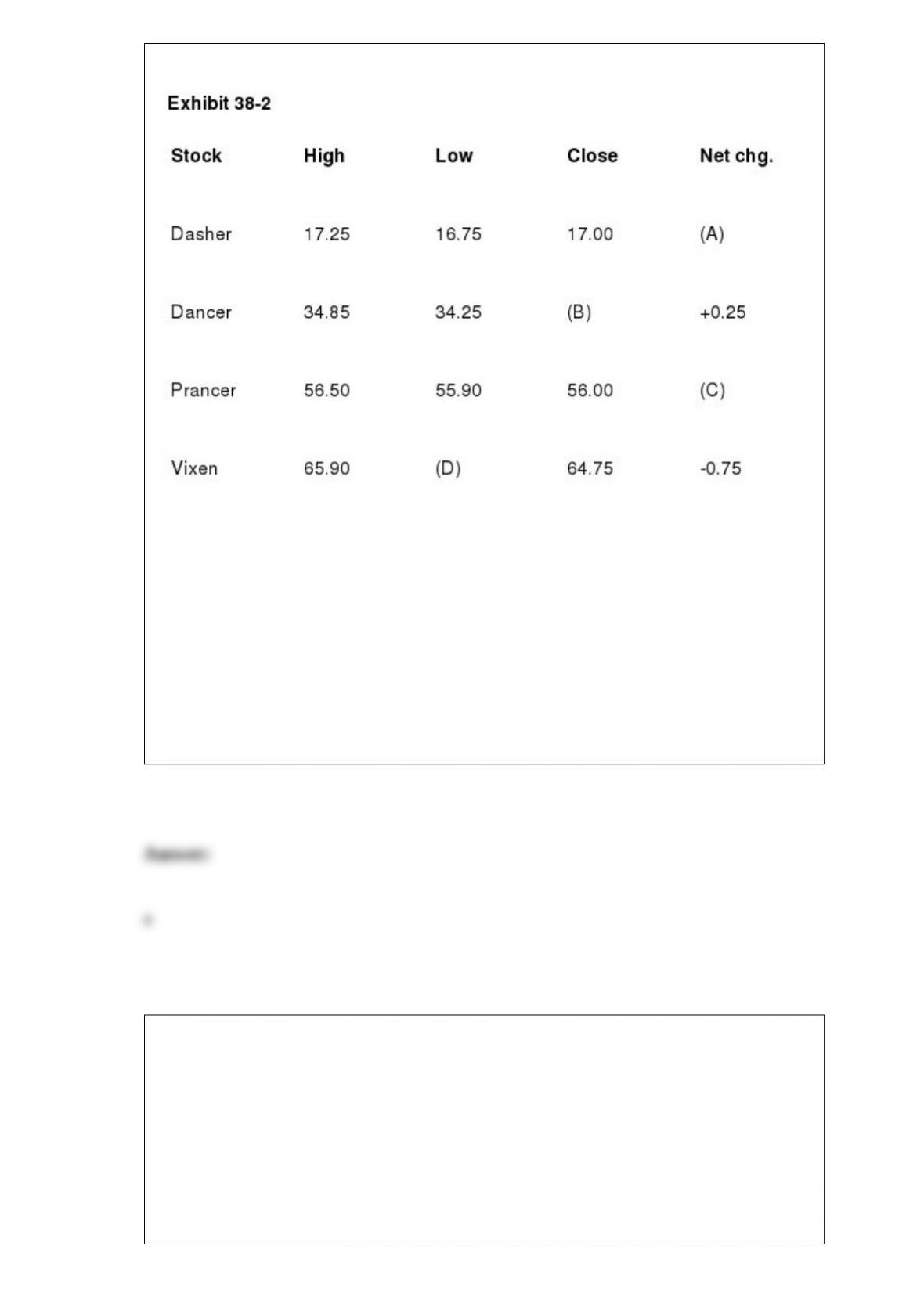
a. -0.50
b. +0.50
c. -0.25
d. -0.75
e. There is not enough information given to answer this question.
The space on the freeway is fixed at any instant of time. A supply curve that shows this
is
a. perfectly horizontal.
b. upward sloping.
c. downward sloping.

d. perfectly vertical.