1) the income and substitution effects account for:
a.the upward sloping supply curve.
b.the downward sloping demand curve.
c.movements along a given supply curve.
d.the “other things equal” assumption.
2) A farmer who has fixed amounts of land and capital finds that total product is 24 for
the first worker hired; 32 when two workers are hired; 37 when three are hired; and 40
when four are hired. The farmer’s product sells for $3 per unit and the wage rate is $13
per worker.
Refer to the above information. How many workers should the farmer hire?
A.1
B.2
C.3
D.4
3)
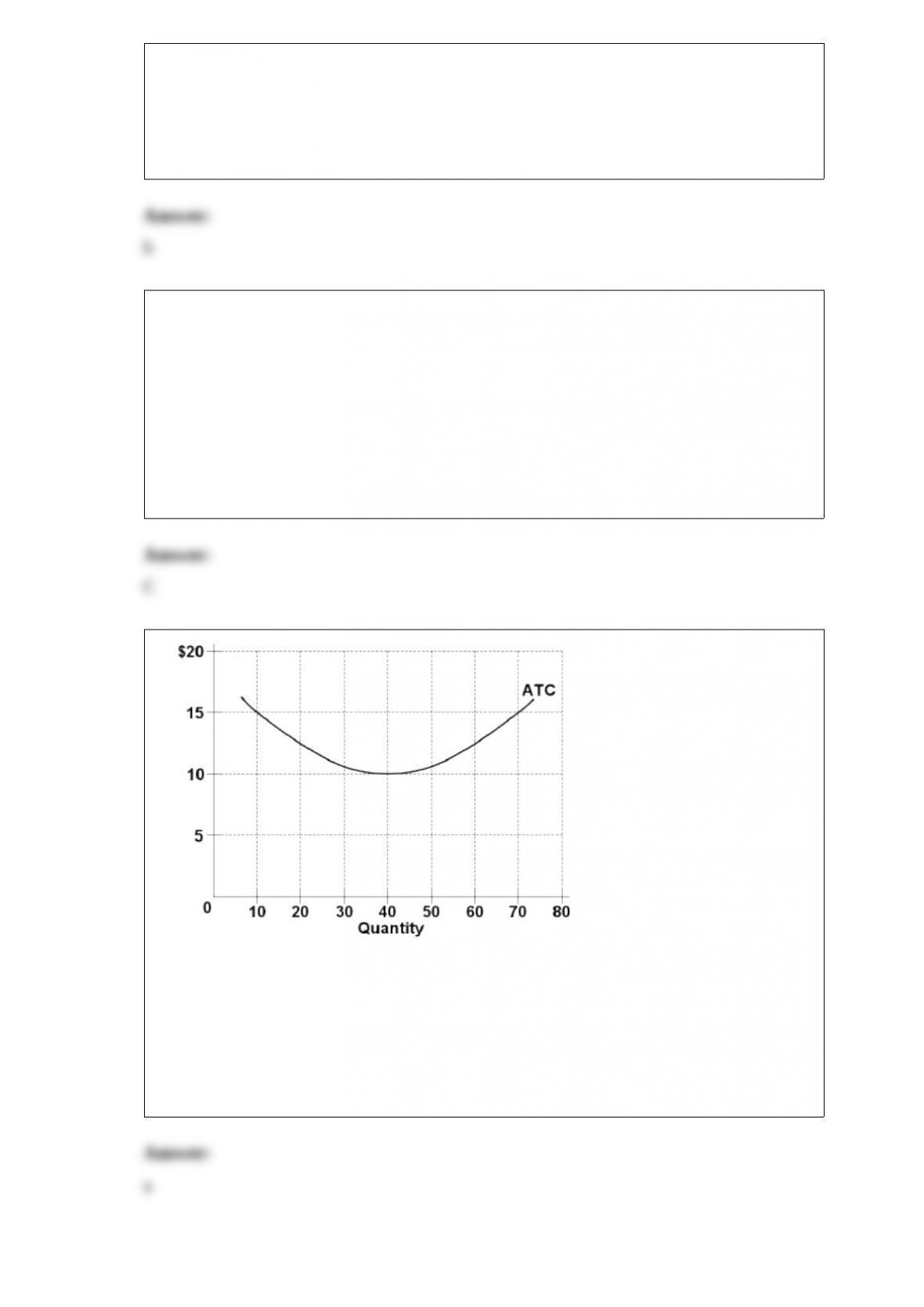
refer to the above diagram showing the average total cost curve for a purely competitive
firm. suppose that total variable cost is $300 at 40 units of output. at that level of
output, average fixed cost:
a.is $2.50.
b.is $4.
c.is $100.
d.cannot be determined from the information provided.
4) if a nondiscriminating pure monopolist decides to sell one more unit of output, the
marginal revenue associated with that unit will be:
a.equal to its price.
b.the price at which that unit is sold less the price reductions which apply to all other
units of output.
c.the price at which that unit is sold plus the price increases which apply to all other
units of output.
d.indeterminate unless marginal cost data are known.
5)
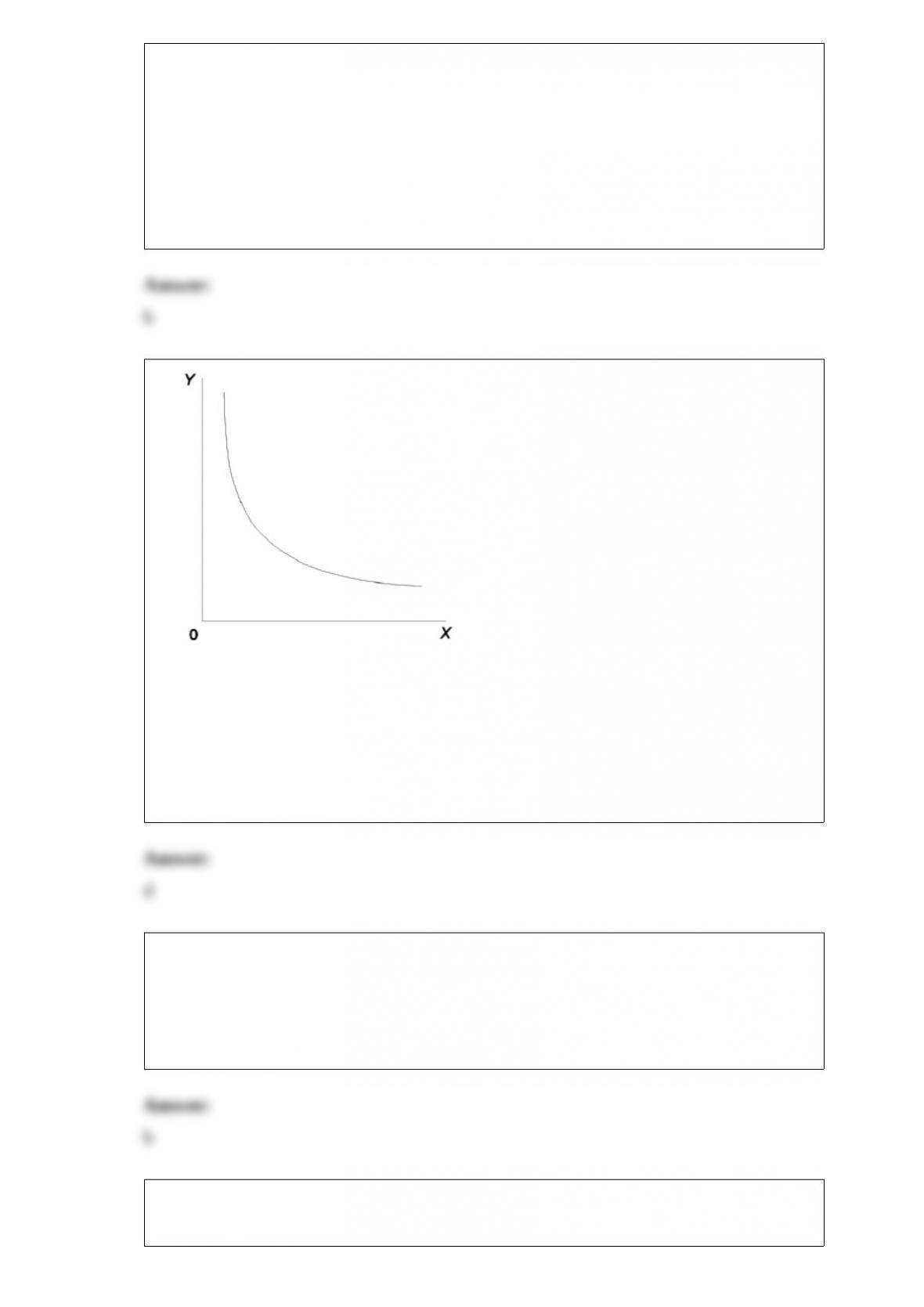
the indifference curve in the above diagram yields juan 100 units of utility. if juan’s
money income were to increase by 20 percent, the indifference curve would:
a.shift leftward.
b.shift rightward.
c.become steeper.
d.not be affected.
6) the supply of known monet paintings is:
a.perfectly elastic.
b.perfectly inelastic.
c.relatively elastic.
d.relatively inelastic.
7) Which of the following will likely accompany an expansionary money policy?
A.a higher prime interest rate
B.a lower Federal funds rate
C.a higher discount rate
D.higher income tax rates
8) The increased-domestic-employment argument for tariff protection holds that:
A.domestic inflation is a desirable policy goal because it stimulates exports.
B.domestic deflation is a desirable policy goal because it stimulates imports.
C.an increase in tariffs will reduce net exports and stimulate domestic employment.
D.an increase in tariffs will increase net exports and stimulate domestic employment.
9) an external cost or external benefit is also known as a(n):
a.marginal benefit.
b.principal-agent problem.
c.transfer payment.
d.spillover.
10) a nation’s gross domestic product (gdp):
a.is the dollar value of all final output produced within the borders of the nation.
b.is the dollar value of all final output produced by its citizens, regardless of where they
are living.
c.can be found by summing c + in + s + xn.
d.is always some amount less than its c + ig+ g + xn.
11) Property rights for fish from the open ocean:
A.do not exist.
B.are established by the United Nations.
C.exist once the fish are sold at market.
D.exist once the fish are caught.
12) (consider this) the economic perspective used in customer decision making at
fast-food restaurants is reflected in:
a.customers selecting the shortest line.
b.decisions for which marginal costs exceed marginal benefits.
c.all customer lines tending to be of different length.
d.irrational purchasing of high-fat-content food.
13) with a downsloping demand curve and an upsloping supply curve for a product, an
increase in consumer income will:
a.increase equilibrium price and quantity if the product is a normal good.
b.decrease equilibrium price and quantity if the product is a normal good.
c.have no effect on equilibrium price and quantity.
d.reduce the quantity demanded, but not shift the demand curve.
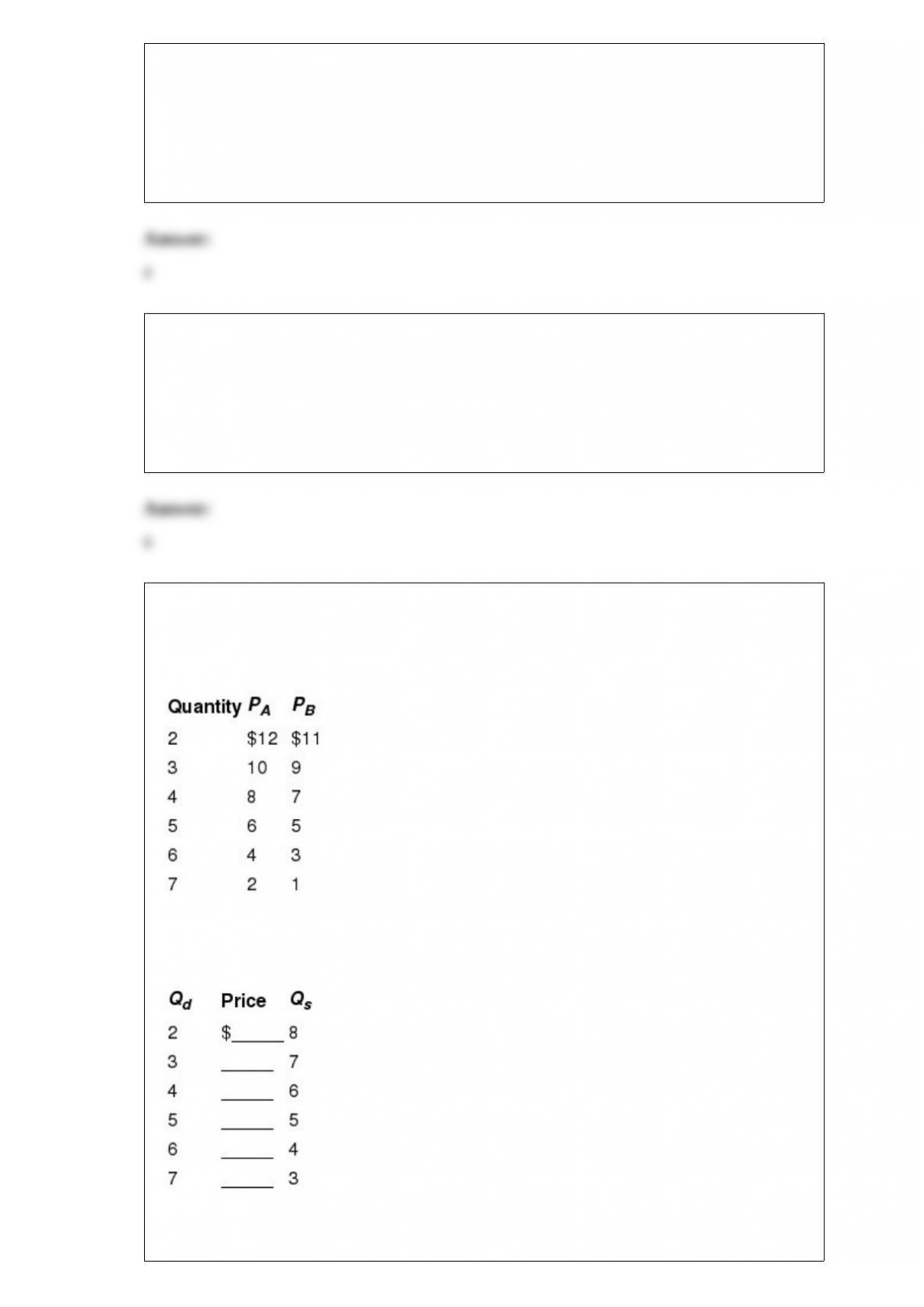
14) Data on two individuals preferences for a public good are reflected in the table
below. PA and PB represent the prices individuals A and B, the only two people in the
society, are willing to pay for the last unit of a public good, rather than do without.
(a)Complete the table below showing the collective willingness to pay for the public
good in this society.
(b)Given the supply schedule for this public good as shown by the Qs column, what is
the optimal quantity of this public good and what is the optimal price?
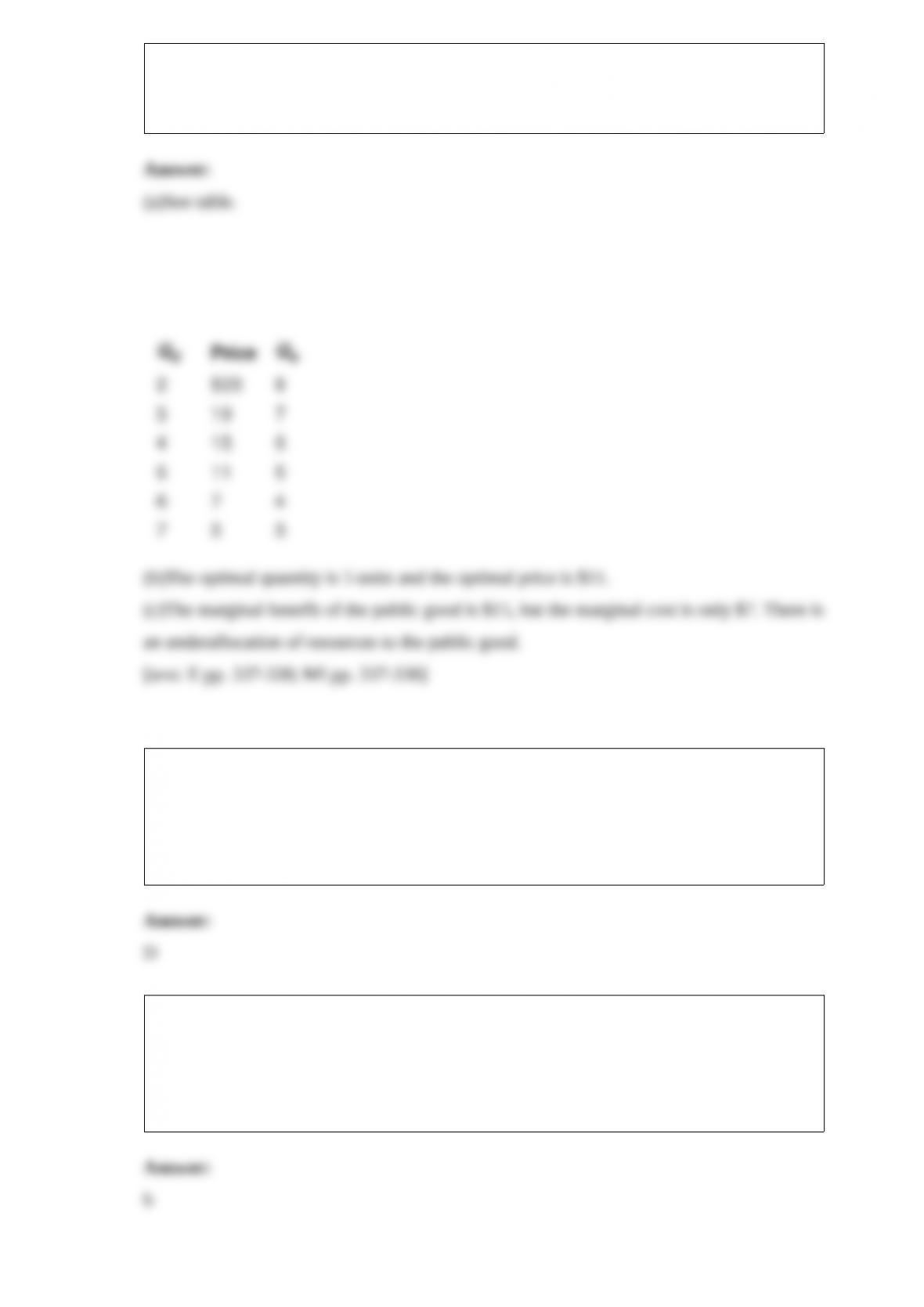
(c)What is the perceived marginal benefit and perceived marginal cost when 4 units of
the public good are supplied? What does this indicate about the allocation of resources
to this public good?
15) The asset most commonly traded is:
A.land.
B.buildings.
C.corporate stock.
D.money.
16) the problem of asymmetric information is that:
a.neither health care buyers nor providers are well-informed.
b.health care providers are well-informed, but buyers are not.
c.the outcomes of many complex medical procedures cannot be predicted.
d.insurance companies are well-informed but policy purchasers are not.
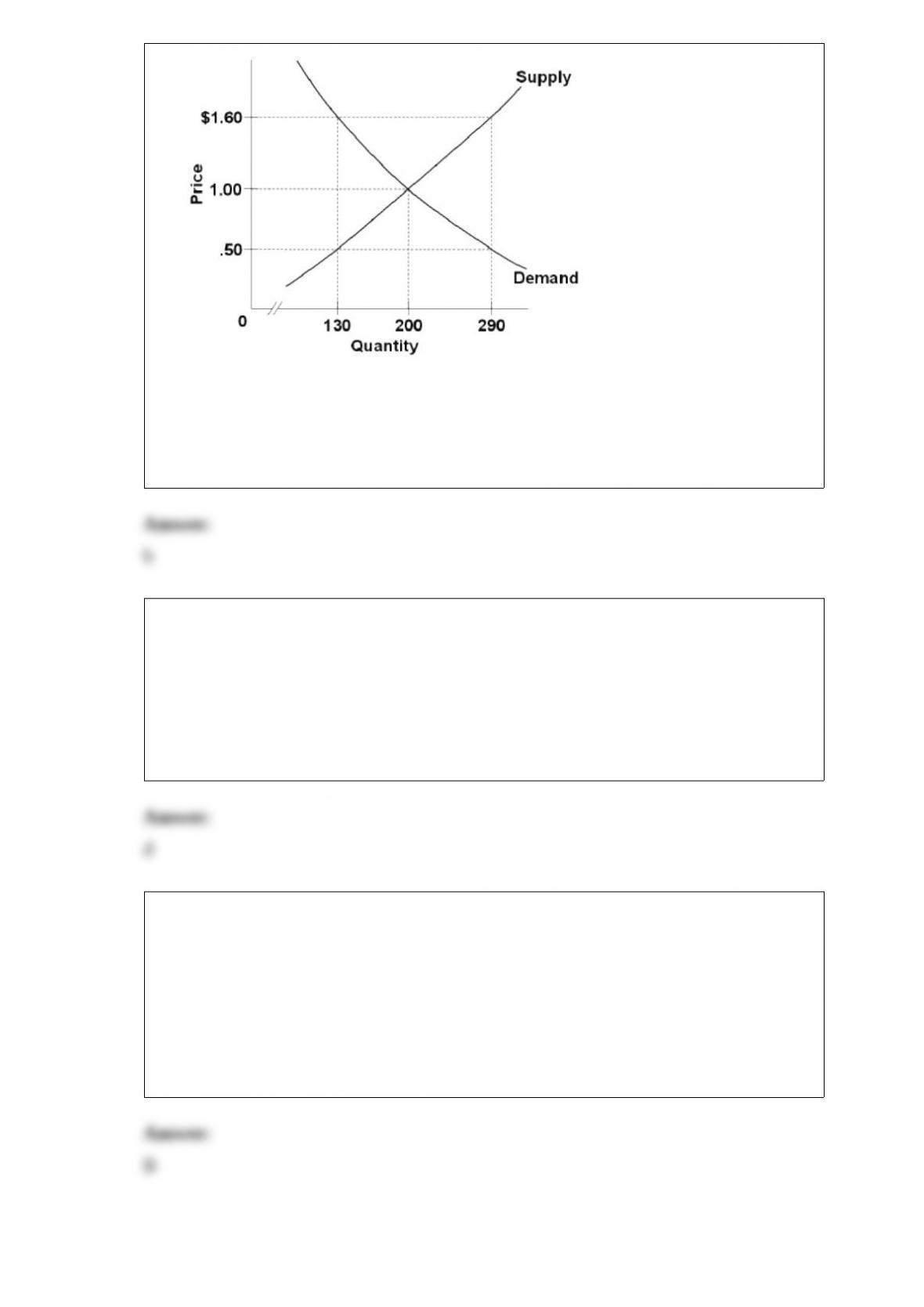
17)
refer to the above diagram. a surplus of 160 units would be encountered if price was:
a.$1.10, that is, $1.60 minus $.50.
b.$1.60.
c.$1.00.
d.$.50.
18) in contrast to american firms, japanese firms frequently make lifetime employment
commitments to their workers and agree not to lay them off when product demand is
weak. other things being equal, we would expect japanese firms to:
a.face more elastic product demand curves than american firms.
b.have relatively greater variable costs than american firms.
c.discontinue production at higher product prices than would american firms.
d.continue to produce in the short run at lower prices than would american firms.
19) According to some supporters of the minimum wage, it has very small or even
nonexistent negative employment effects because:
A.the demand for minimum wage labor is highly elastic.
B.it reduces turnover among minimum wage workers, prompts employers to use them
more efficiently, and thus raises their average productivity.
C.it encourages teenagers to stay in school.
D.employers substitute lower fringe benefits for higher pay, keeping their compensation
costs the same.